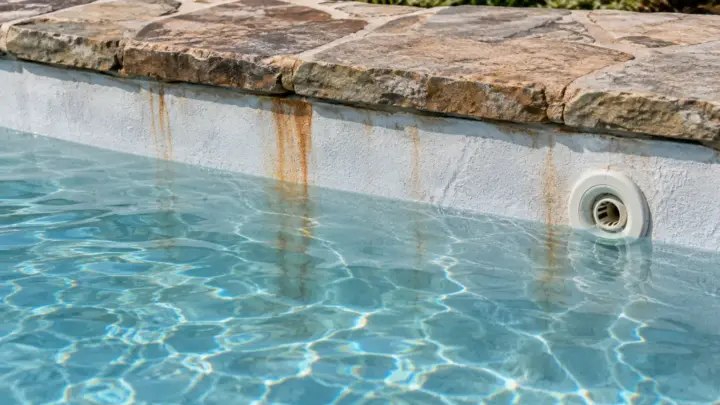
A saturation index of 0 is balanced; above 0 potentially scale forming, below 0 potentially aggressive. That is how PHTA’s water balance bulletin reads the scale. “Aggressive” here means the water tends to attack the calcium in plaster and other cement-based surfaces.
How wide the acceptable band is depends on who sets it. APSP (now part of PHTA) uses -0.3 to +0.5. New York’s pool code puts the optimum at 0, with tolerance limits of plus or minus 0.5. Utah’s pool rule requires -0.3 to +0.3. None of these rules covers home pools, so pick one and stick with it. The APSP band is the one the pool industry usually refers to.
One limit before the maths: PHTA says these indexes are not a guide to sanitizing or swimmer safety. A balanced index tells you nothing about whether your free chlorine is high enough. It predicts how calcium carbonate behaves and nothing else.
What the index tells you
The Langelier Saturation Index (LSI, often shortened to SI) predicts whether your water will deposit calcium carbonate on your surfaces or dissolve it from them.
- Below 0: potentially aggressive. PHTA says “the lower the number, the stronger the tendency” to etch cementitious surfaces. New York’s code says such water “may be corrosive”.
- Around 0: balanced. Scale shouldn’t form, and calcium carbonate shouldn’t dissolve from the surfaces.
- Above 0: potentially scale forming. The higher the number, the stronger the tendency.
PHTA adds that a slightly positive value may be preferred over a negative one, because a thin layer of scale gives some protection. New York’s code goes further and requires the index to stay “slightly on the positive side” within its tolerance limits.
The formula and its four inputs
PoolSpaKit uses the formula and factor tables from New York’s pool code (10 NYCRR 6-1.30). PHTA describes the same equation as the pool industry’s standard:
SI = pH + TF + CF + AF – 12.1
- pH goes in as measured.
- TF is the temperature factor, based on water temperature in °F.
- CF is the calcium factor, based on calcium hardness in ppm. PHTA lists using “total hardness in place of calcium hardness” as a common error. If your kit only reports total hardness, you need a separate calcium hardness test.
- AF is the alkalinity factor, based on carbonate alkalinity in ppm (see the CYA section below).
- 12.1 is a constant that assumes about 500 ppm total dissolved solids (TDS).
How to work it out
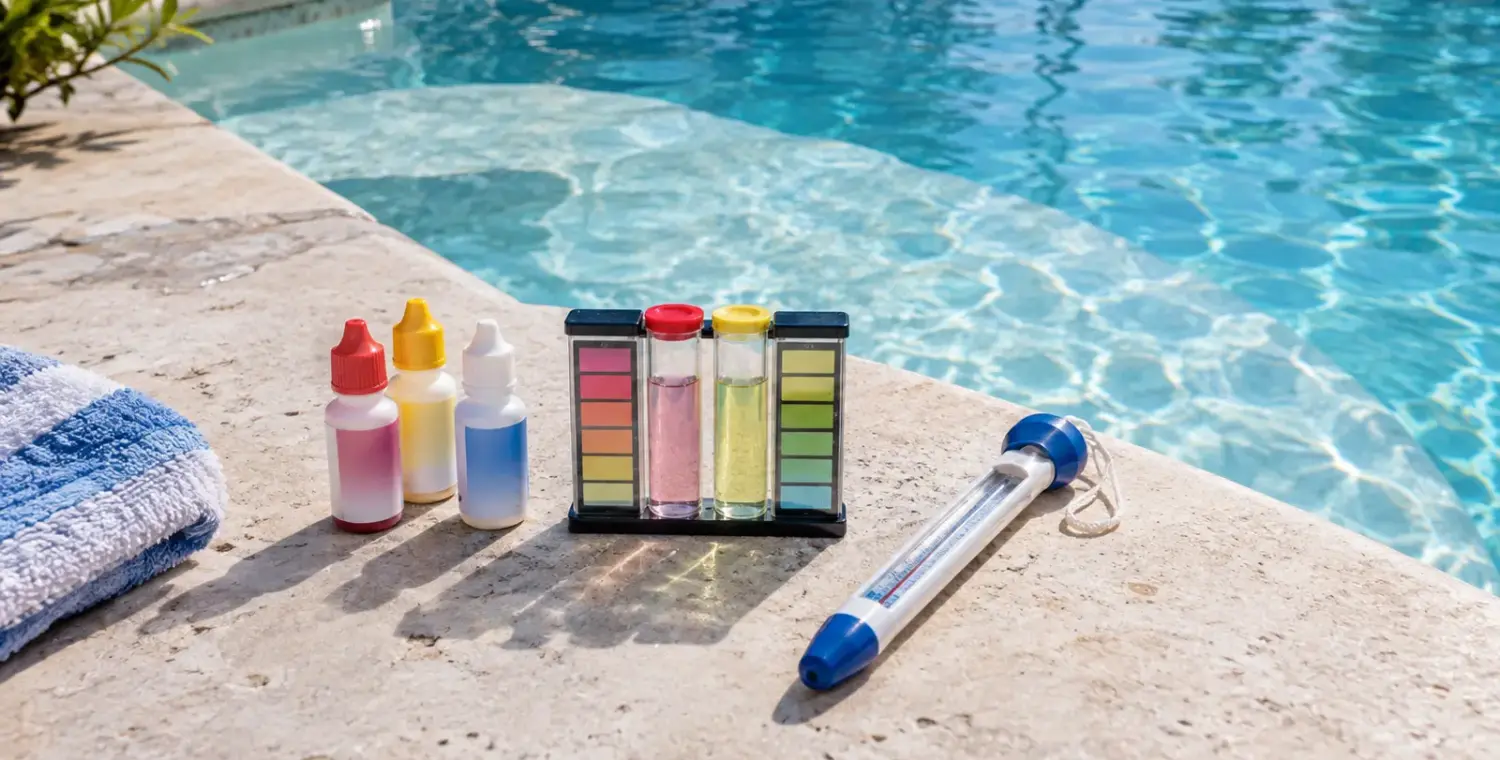
- Test pH, total alkalinity, calcium hardness and cyanuric acid (CYA), and take the water temperature. PHTA notes that you need accurate tests to get an accurate index.
- If there is any CYA in the pool, convert total alkalinity to carbonate alkalinity.
- Look up TF, CF and AF in the table below. If a reading falls between two rows, take the value proportionally between them (straight-line interpolation). New York’s own example does this and uses a temperature factor of 0.52.
- Add pH + TF + CF + AF, then subtract 12.1.
| Water temp (°F) | TF | Calcium hardness (ppm) | CF | Alkalinity (ppm) | AF |
|---|---|---|---|---|---|
| 32 | 0.0 | 5 | 0.3 | 5 | 0.7 |
| 37 | 0.1 | 25 | 1.0 | 25 | 1.4 |
| 46 | 0.2 | 50 | 1.3 | 50 | 1.7 |
| 53 | 0.3 | 75 | 1.5 | 75 | 1.9 |
| 60 | 0.4 | 100 | 1.6 | 100 | 2.0 |
| 66 | 0.5 | 150 | 1.8 | 150 | 2.2 |
| 76 | 0.6 | 200 | 1.9 | 200 | 2.3 |
| 84 | 0.7 | 300 | 2.1 | 300 | 2.5 |
| 94 | 0.8 | 400 | 2.2 | 400 | 2.6 |
| 105 | 0.9 | 800 | 2.5 | 800 | 2.9 |
| 128 | 1.0 | 1000 | 2.6 | 1000 | 3.0 |
Factors are from 10 NYCRR 6-1.30. The table labels the last column “total alkalinity”, but PHTA says to enter carbonate alkalinity there.
How CYA changes the alkalinity input
Your test kit’s total alkalinity reading includes cyanurate from stabilizer. PHTA says cyanurate “will contribute to the total alkalinity concentration” and that carbonate alkalinity “should always be used when calculating LSI.” PHTA’s correction is:
Carbonate alkalinity = measured TA – (CYA x correction factor)
The factor depends on pH. PHTA’s table gives 0.31 at pH 7.4 and only covers pH 7.0 to 8.0. Outside that pH range the correction isn’t defined.
Worked example
Take a plaster pool at 84 °F with pH 7.4, calcium hardness 200 ppm, total alkalinity 100 ppm and CYA 50 ppm.
- Carbonate alkalinity: 100 – (50 x 0.31) = 84.5 ppm
- TF at 84 °F = 0.7. CF at 200 ppm = 1.9. AF at 84.5 ppm sits between the 75 and 100 rows, so it comes to about 1.94.
- SI = 7.4 + 0.7 + 1.9 + 1.94 – 12.1 = about -0.16
That is slightly on the aggressive side of zero. It falls inside the APSP, New York and Utah bands, but it doesn’t meet New York’s note about staying “slightly on the positive side”.
Two variations show how much the inputs matter:
- Skip the CYA correction and enter 100 ppm directly, so AF becomes 2.0. Uncorrected alkalinity: SI = 7.4 + 0.7 + 1.9 + 2.0 – 12.1 = -0.10. The water looks better balanced than it really is.
- Cool the water down, and TF drops to 0.4. Same water at 60 °F: SI = about -0.46. That is outside the APSP and Utah bands and only just inside New York’s. PHTA gives a similar warning: water with ideal individual readings can drop below -0.3 when the temperature falls below 60 degrees.
Which reading moves the index fastest
The table makes this easy to see. pH goes into the formula as it is, so a 0.1 change in pH moves the index by 0.1. Calcium and alkalinity enter on a logarithmic scale. Doubling calcium from 100 to 200 ppm only moves CF from 1.6 to 1.9, and alkalinity behaves the same way. Temperature matters more than people expect: warming from 60 °F to 84 °F adds 0.3. So when your index is off, look at pH and water temperature first. Calcium and alkalinity are slow levers.
This article doesn’t give doses. To raise a low reading, see how much baking soda raises alkalinity and how much calcium chloride raises calcium hardness.
Why chasing the index alone misleads
PHTA lists what the index can’t do:
- It doesn’t necessarily predict corrosion of steel and other metals. Heaters and metal fittings can still corrode when the index looks fine.
- It doesn’t predict how much scale will form or how much surface will etch.
- It’s a snapshot of the water when you took the sample. It doesn’t reliably tell you anything about last month or next week.
- Sequestering agents can hold back scaling even when the index is high.
So keep each reading within its own recommended range, and use the index as a cross-check.
When your number needs adjusting: salt and high-TDS pools
The 12.1 constant assumes about 500 ppm TDS. PHTA says treating it as fixed is a known error, especially in salt pools, where TDS is far higher than that. With the plain formula, a salt pool’s index comes out higher than its true value. Utah’s rule deals with this by replacing 12.1 with a TDS factor that rises as dissolved solids increase. If you run a salt system, treat your result as an upper estimate.
Public pools have their own rules. CDC’s Model Aquatic Health Code requires public aquatic venues to check the saturation index monthly, and New York and Utah set their own bands for the pools they regulate.
Next step
Run a full test that includes calcium hardness and CYA, then work out your index using carbonate alkalinity. If it comes out negative, check pH and water temperature before you add anything. If you use strips, make sure you read them correctly, because a small reading error feeds straight into the index.
Sources
- Pool & Hot Tub Alliance (PHTA): Technical Bulletin: Water Balance Indexes
- New York State Department of Health: 10 NYCRR Section 6-1.30 Saturation index for swimming pools
- Utah Department of Health (Utah Admin. Code, via Cornell LII): R392-302-25 Disinfection and Quality of Water
- Pool & Hot Tub Alliance (PHTA): Fact Sheet: Alkalinity
- CDC: 2024 Model Aquatic Health Code, Code Language, 5th Edition
Research checked 2026-10-27.