Cyanuric acid, usually called CYA or pool stabilizer, helps protect chlorine from sunlight in outdoor pools. It also changes how chlorine performs. That makes it a useful treatment ingredient in the right setting and a potential problem when its concentration no longer suits the pool’s operating requirements.
Before adding stabilizer or planning water replacement, confirm the CYA reading, identify the sanitizer products in use and check the exact equipment instructions. There is no single CYA target or chlorine dose that safely applies to every residential pool.
What cyanuric acid does
Sunlight can break down chlorine in an outdoor pool. CYA interacts with chlorine in a way that reduces that loss, helping the pool retain a residual. The trade-off is that stabilizer also affects disinfection effectiveness; retaining chlorine is not the same as keeping every aspect of its performance unchanged.
The 2026 NSW Health water-quality guidelines explain both effects. Their operating rules apply to NSW public venues, rather than every home pool worldwide, but the distinction between sunlight protection and disinfection is useful when interpreting residential results.
Standalone cyanuric acid does not contain chlorine. It cannot replace sanitizer or turn an unsatisfactory chlorine reading into satisfactory water by itself. Continue testing sanitizer and pH even after the stabilizer result is where the applicable instructions require it.
How CYA gets into the pool
Standalone stabilizer or conditioner
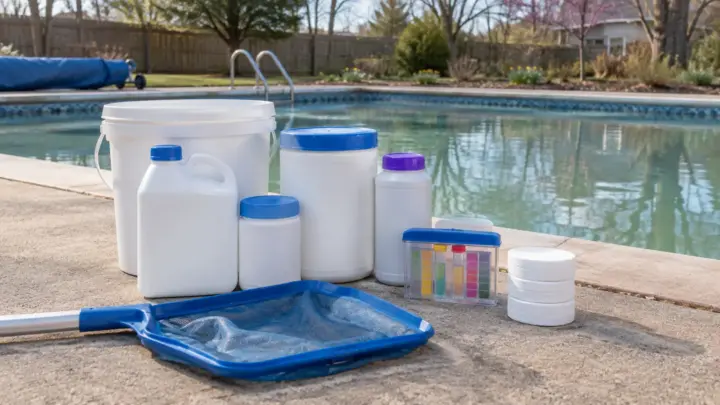
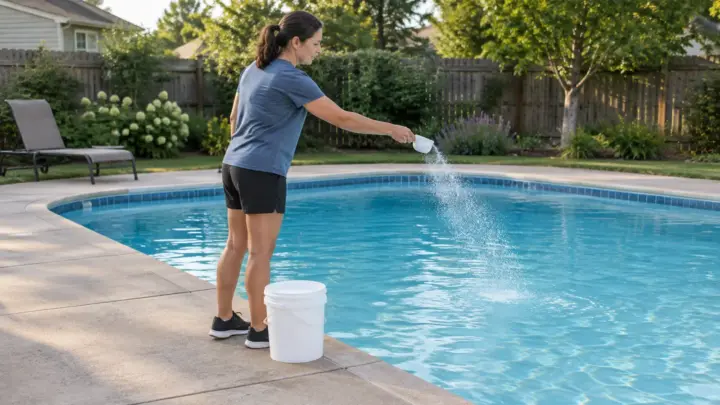
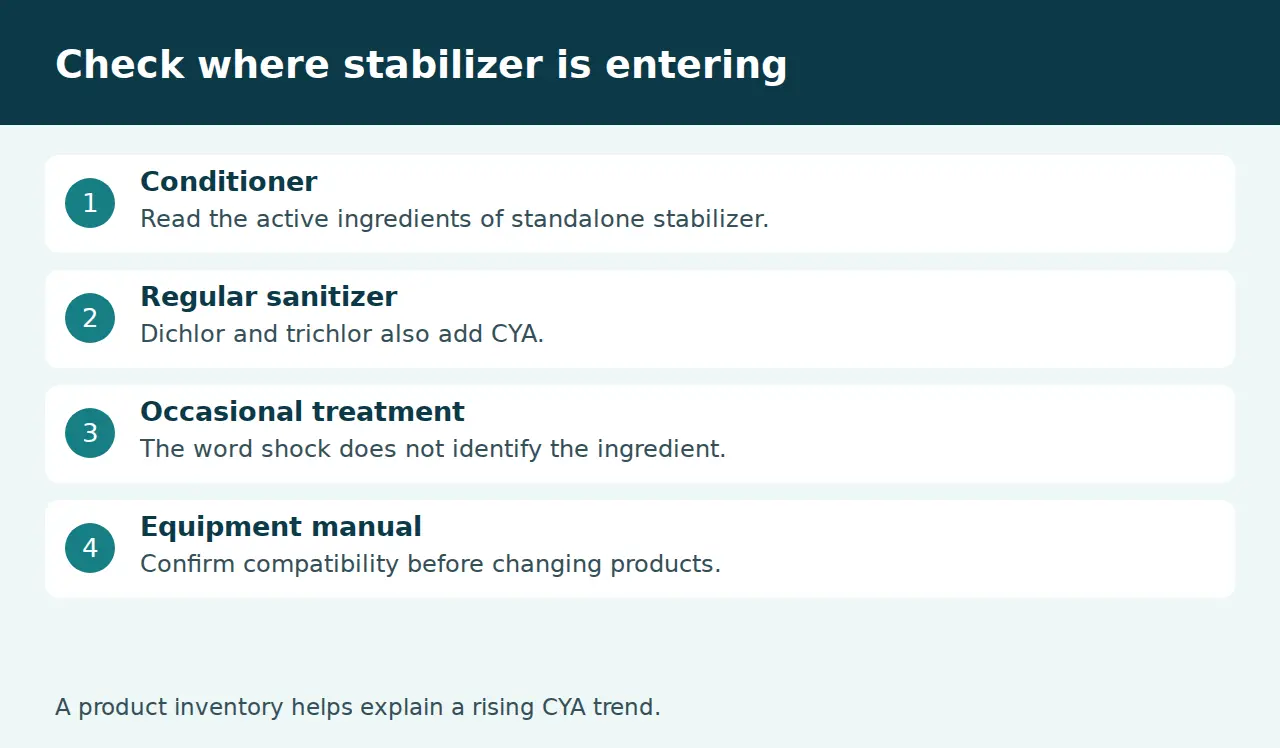
Products sold as pool stabilizer or conditioner may add cyanuric acid separately. Check the ingredients and label rather than relying on the front-of-pack name. Record the product, its concentration where stated, the amount actually added and the date.
When starting up or refilling a pool, do not assume the previous CYA reading still applies. Use a current test and the equipment’s instructions. Equally, do not add another dose just because an immediate follow-up test appears unchanged; follow the product’s dissolution, circulation and retesting directions.
Stabilized chlorine products
Dichlor and trichlor are stabilized chlorine products that also add CYA. An owner can therefore build up stabilizer without ever buying a separate conditioner. Taylor’s CYA monitoring guide identifies repeated use of these products as an important source of accumulation.
Sodium hypochlorite and calcium hypochlorite do not add CYA as those active ingredients. That does not make them interchangeable with the current treatment system: each has its own instructions, balance effects and compatibility requirements. Check the complete label, including any additional ingredients.
Use an input inventory rather than a vague description such as “tablets and shock.” Write down the active ingredient of each regular sanitizer and occasional treatment. “Shock” describes a purpose or marketing category; it does not identify whether a product adds stabilizer.
Why the chlorine target depends on context
CDC’s US home-pool guidance recommends at least 1 ppm chlorine without CYA and at least 2 ppm when CYA or CYA-containing chlorine is used, with pH between 7.0 and 7.8. These are scoped minimum recommendations, not a complete algae-treatment plan or proof that any CYA concentration is acceptable.
The applicable sanitizer label, local requirements and equipment manual may require a different operating plan. Do not select the lowest number from several sources while ignoring their conditions. A rule for an unstabilized pool, a public facility and a particular salt chlorinator can describe different situations.
For owners in the UK, Canada and Australia, check guidance and approved product labels for the local market. For commercial or public venues, use the applicable operating regulations and qualified oversight. This article does not supply a universal free-chlorine-to-CYA ratio or substitute for those requirements.
If free chlorine repeatedly falls below the required level, use our low chlorine in a pool guide to investigate demand, testing and delivery as well as stabilizer. CYA is one part of that diagnosis, not an explanation for every low residual.
Outdoor pools, salt systems, indoor pools and hot tubs
An outdoor saltwater pool still uses chlorine. Its stabilizer requirements need to be checked against the exact salt-system manual, not against a remembered recommendation for another model. Do not assume a salt generator eliminates the need to test CYA where the manual calls for it.
Equipment compatibility also matters. For example, the current Pentair IntelliChlor Plus and LT manual prohibits using dichlor or trichlor with that device and gives its own CYA guidance. That is a specific manufacturer instruction, not an invitation to copy one product’s chemistry limits into every salt pool.
Do not transfer an outdoor-pool stabilizer routine to a hot tub. CDC recommends against CYA and CYA-containing chlorine products in hot tubs. Indoor pools require their own treatment plan; the cited Pentair manual also instructs owners not to use CYA indoors.
CYA does not provide the same UV stabilization for bromine. If you have a bromine-treated system, adding pool stabilizer is not an equivalent way to protect its sanitizer. Confirm the complete treatment method before making a change.
Confirm the test, especially near its limits
Use the correct CYA method for your kit, with a representative sample and the specified reagent, mixing and reading procedure. Our pool water testing guide covers the wider sampling routine and why consistent methods matter.
A common turbidimetric method develops cloudiness in a treated sample, then uses a disappearing black dot to interpret the result. The cloudiness is part of the test reaction; it is not a diagnosis that the pool itself is cloudy. Follow the kit’s viewing instructions instead of improvising lighting, volumes or endpoints.
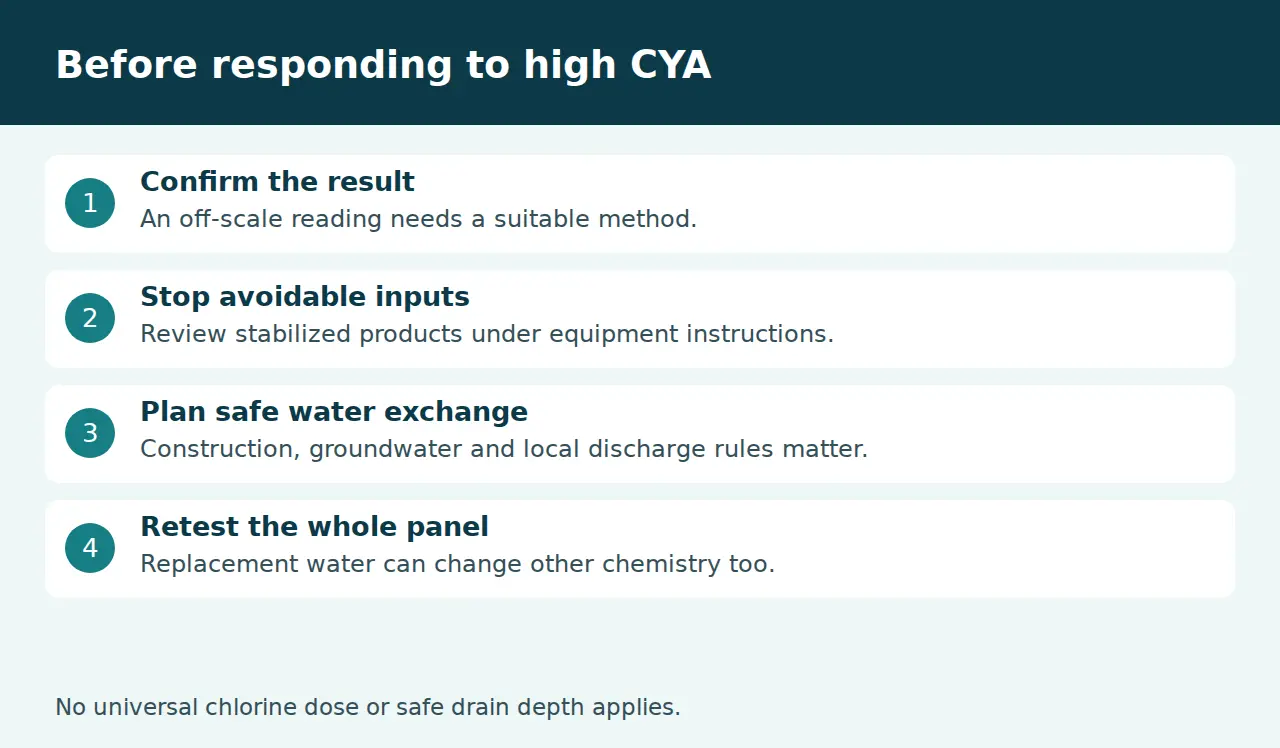
An off-scale result is a measurement limit, not an exact value beyond the printed scale. Taylor’s discussion of test dilutions provides a specific procedure for its affected CYA methods. Use the procedure for your actual kit, or obtain a suitable confirmatory test, before calculating a treatment plan.
Do not borrow a CYA dilution method for a pH test. Different tests work differently. If two CYA results disagree materially, compare sampling, method and range before treating the larger or smaller number as automatically correct. Retain the original results and note any dilution or laboratory method used.
If CYA appears too low
First establish whether stabilizer is appropriate for this pool and whether the result is genuinely below the applicable requirement. Review recent refilling, product history and the test’s measuring range. A reading below its lowest useful scale does not necessarily establish an exact zero.
Where the instructions call for a CYA addition, calculate it from reliable pool volume, confirmed chemistry and the exact product label. Follow its application method, circulation, waiting and re-entry directions. This guide does not give a universal amount or tell you to place a product in a skimmer, sock or other location regardless of its label.
Continue managing sanitizer during the adjustment. If chlorine cannot be maintained or water is unsuitable for swimming, keep the pool closed. Do not treat newly added stabilizer as immediate evidence that the disinfection problem has been solved.
If CYA appears too high
Confirm the value before a substantial intervention. Then identify further CYA inputs, including regular dichlor or trichlor and occasional stabilized treatments. Continuing those inputs while trying to reduce the concentration can undermine the plan.
Over-stabilization is a performance and operating-context concern. The shorthand “chlorine lock” can suggest an all-or-nothing event, which is not a useful basis for treatment. Look at the measured CYA, sanitizer, pH and applicable limits, then choose a qualified plan.
Replacing some water with lower-CYA water can reduce the concentration. That is a chemistry principle, not a safe draining instruction for every pool. The replacement supply and the method of exchanging water both need assessment. Keep ongoing sanitizer requirements in view during the process. Our guide to how much water to drain to lower cyanuric acid shows the replacement-fraction arithmetic.
Water replacement requires a separate safety decision
Do not empty a pool or choose a drain depth from an online percentage alone. Pentair’s guidance on pool drainage risks warns about groundwater pressure and damage to fiberglass or in-ground vinyl-lined pools when emptied.
Consult the builder or qualified service professional about construction, liner or finish, groundwater and the permitted operating water level. Check local water-use and discharge requirements before planning replacement. Refilling can also change pH, alkalinity and hardness, so the full water panel needs attention afterward.
Do not change chemical products inside a feeder without following its compatibility and changeover instructions. A switch in sanitizer supply is a separate equipment and chemical-safety decision. Health Canada’s pool chemical guidance reinforces following labels and equipment manuals and never mixing different chemicals.
Prevent a recurring stabilizer problem
Keep a CYA trend alongside the sanitizer-product inventory and water replacement record. If the result rises, compare it with stabilized product use before adding still more conditioner. If it falls unexpectedly, confirm the test and review water losses and replacement rather than assuming a fixed seasonal pattern.
CYA can also affect the alkalinity value used in a saturation-index calculation. Follow that method’s adjustment instructions and keep measured total alkalinity separate from the corrected input. A favorable balance calculation cannot certify adequate disinfection.
Common questions
Will more stabilizer fix green pool water?
Do not treat water color with CYA alone. Use our green pool water troubleshooting guide to distinguish possible causes and establish a test-led treatment order.
Should I add CYA whenever chlorine disappears?
No. Check whether the pool needs stabilizer and whether the result is reliable. Demand, delivery and test interference can also explain a low chlorine reading.
What if there has been a diarrhoeal incident?
Close the pool and follow the appropriate contamination-response guidance with qualified help. CYA affects those procedures. Routine stabilizer adjustment or ordinary shock advice is not a substitute for a specific incident-response plan.
Research checked October 1, 2026. We only claim hands-on testing when we’ve actually tested the product ourselves. Featured image is an original illustration.
Sources and references
- CDC: Home pool and hot tub treatment and testing
- Health Canada: Swimming pool and spa cleaning
- NSW Health: Guidelines for Managing Water Quality in Public Swimming Pools and Spa Pools
- NSW Health: Stabiliser use in outdoor swimming pools
- Taylor Technologies: Why monitoring CYA in a pool is important
- Taylor Technologies: How and when to use dilutions in pool and spa testing
- Pentair: IntelliChlor Plus and LT Installation and Maintenance Guide
- Pentair: Assessing your pool after a power outage