Cloudy pool water is a symptom, not a diagnosis. Low sanitizer, developing algae, suspended debris, mineral imbalance and filtration problems can produce similar-looking haze. The right fix starts with measurements and an equipment check, not an automatic dose of shock.
Stop swimming while the cause and water condition are uncertain. If you cannot clearly see the pool bottom, treat that as a visibility problem requiring correction before use. The American Red Cross advises choosing pool water clear enough to see the bottom; appearance alone still does not establish disinfection.
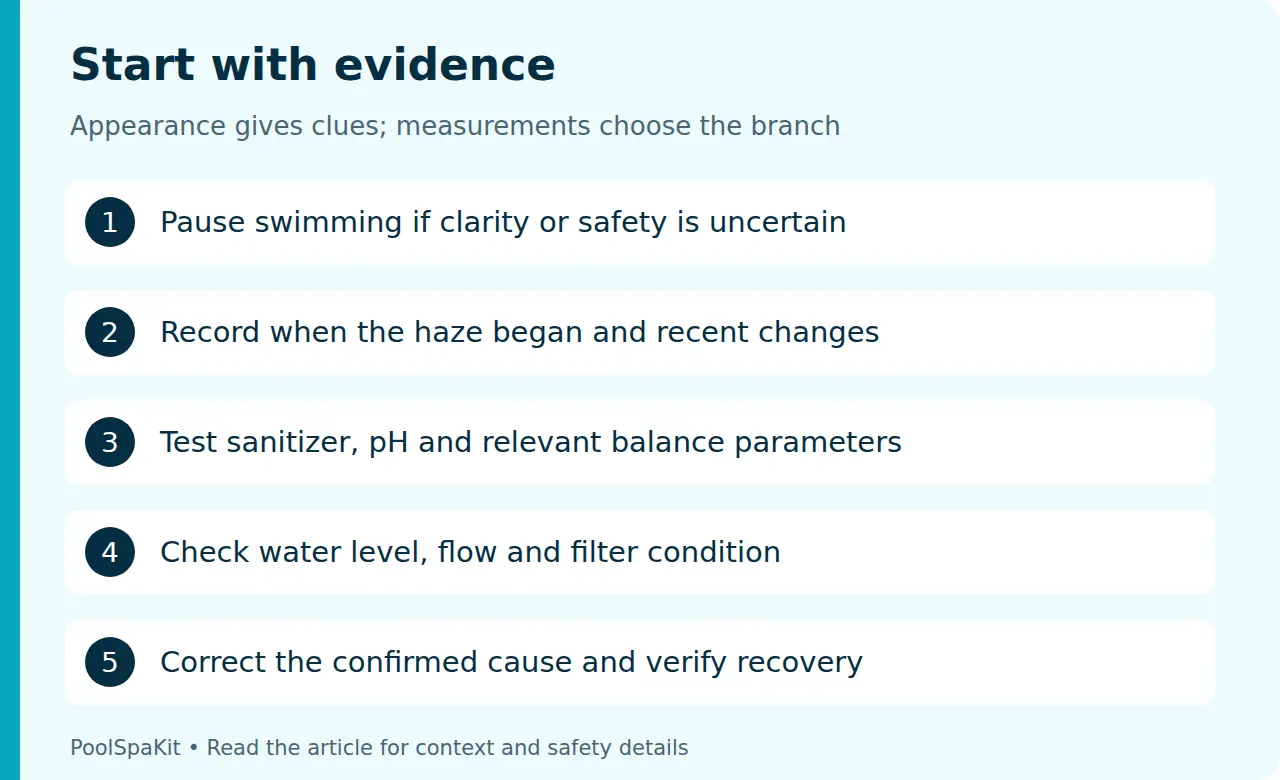
First: test, observe and record
Write down when the haze appeared and what happened beforehand: a storm, party, top-up, chemical addition, treatment for algae, filter cleaning or pump fault. Note whether it is white, gray or greenish, whether walls feel slippery, and whether return flow seems normal. Color gives clues; it does not prove the cause.
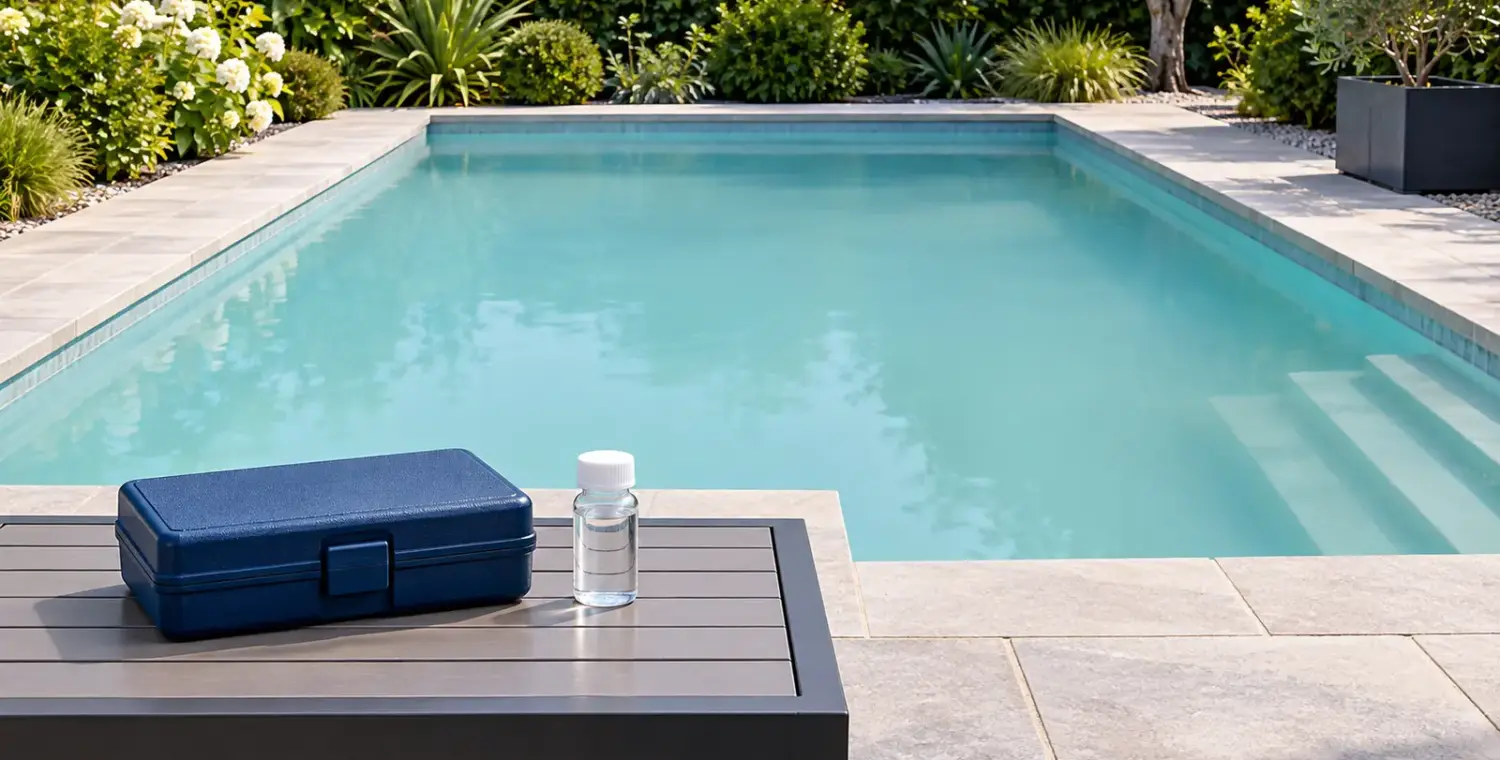
For a chlorine pool, measure free chlorine, total chlorine and pH. Include total alkalinity, calcium hardness and cyanuric acid where relevant. Use the tests required for another sanitizer system rather than substituting chlorine measurements. Check reagents and follow sample-collection and test instructions.
CDC recommends free chlorine of at least 1 ppm in pools, or at least 2 ppm when cyanuric acid or stabilized chlorine is used, with pH 7.0–7.8. These are public-health minimums and a pH range, not an algae-treatment dose or a complete operating target for every stabilized pool. Follow applicable labels, equipment requirements and local guidance.
Inspect from the deck: operating water level, baskets, visible return flow, alarms and the filter pressure gauge. Compare pressure with the recorded clean-filter baseline at the same pump speed. A single gauge reading without that context can be misleading.
Cloudy-water diagnostic table
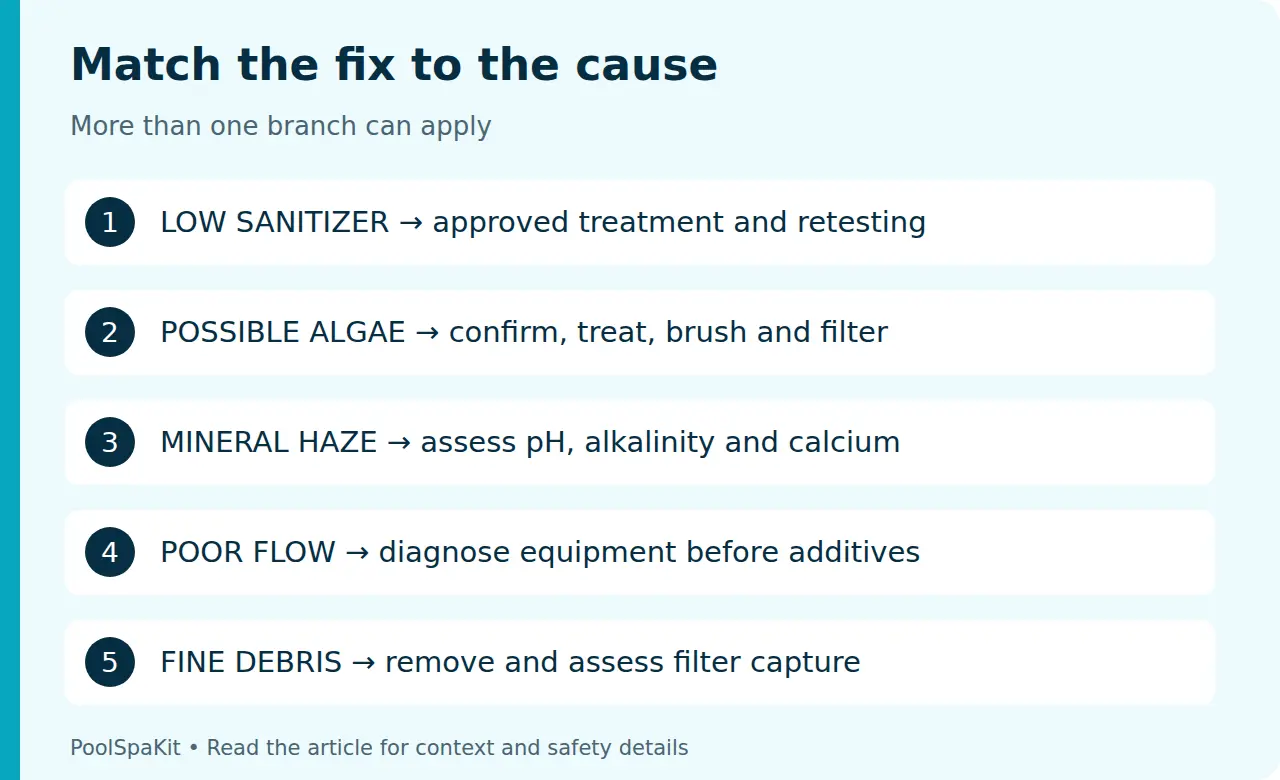
More than one branch can apply. Correct a confirmed sanitizer problem while also investigating poor filtration; one does not rule out the other.
| Symptom | Test or check | Likely cause | Recommended next step |
|---|---|---|---|
| Haze after heavy use | Free/total sanitizer, pH, filter condition | Added contaminants, depleted sanitizer, or particles | Restore the approved care program, remove debris, and verify filtration. |
| Greenish haze or slippery surfaces | Sanitizer, pH, stabilizer if relevant; inspect walls | Possible developing algae | Confirm diagnosis; use the compatible algae-treatment label and brush/filter as directed. |
| White haze after a chemical addition | Product history, pH, alkalinity, calcium hardness | Possible mineral precipitation or treatment-related particles | Stop blind additions; obtain a balance assessment and filter the resulting particles. |
| Cloudiness with weak returns | Water level, baskets, pressure, pump alarms | Restricted flow or circulation fault | Use manual-approved owner checks; escalate unresolved faults. |
| Haze after rain or wind | Sanitizer/pH, debris and flow | Suspended dirt, changed chemistry, or both | Clean, retest and correct only confirmed problems. |
| Readings look acceptable but haze persists | Repeat reliable tests; inspect filter and treatment history | Remaining particles, filter bypass/damage, or incomplete diagnosis | Assess capture and filtration before choosing a compatible clarifier. |
Branch 1: sanitizer is low, unreliable or being consumed
Use free chlorine to understand the available chlorine residual; total chlorine alone is not equivalent. Taylor explains that total chlorine includes free and combined chlorine. Use your kit’s directions to assess both rather than treating a high total reading as proof that enough free sanitizer remains.
If free sanitizer is below the approved operating range, restore it using the actual product label and measured pool volume. Identify why it fell: recent heavy use, missed treatment, feed-system trouble, debris or possible algae. A saltwater generator is still part of a chlorine-care system and must be checked for normal operation.
If the test unexpectedly reads very low after a substantial chlorine treatment, do not immediately add more. Taylor warns that sanitizer above 10 ppm can bleach some chlorine samples and produce a false-low result. Use a test and procedure suitable for the expected concentration, following the kit’s instructions or requesting professional testing.
For a stabilized pool, include cyanuric acid in the assessment. A routine chlorine reading should be interpreted in the context of that system’s guidance, not merely compared with the lowest possible public-health minimum.
Branch 2: early algae is plausible
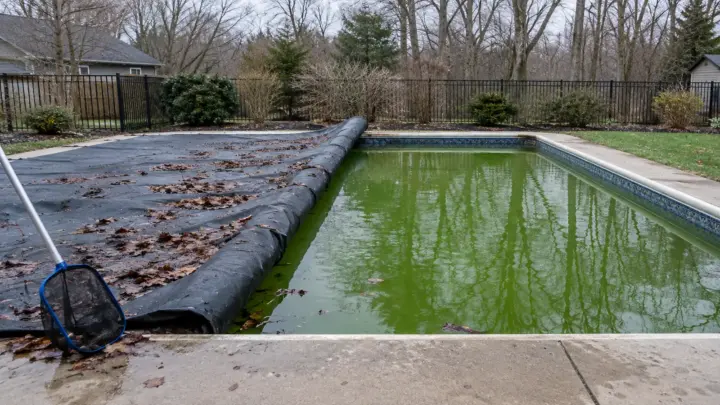
Greenish haze, slippery surfaces and a sanitizer problem make algae a reasonable suspect. They do not prove that every colored pool is an algae problem; dissolved metals can also change water color. Check water measurements and recent treatment history.
If algae is confirmed, use a treatment appropriate to the actual sanitizer system, surface and equipment. Brush with a surface-compatible tool, remove debris, and maintain filtration according to the treatment and equipment instructions. Continue measuring rather than assuming one addition completed the job.
As algae is treated, suspended material can remain for the filter to remove. That can explain continuing haze, but do not automatically declare every cloudy post-treatment pool “dead algae.” Recheck sanitizer, balance and filter performance if the water is not improving.
This branch is a diagnosis route, not a universal algae-eradication recipe. Persistent recurrence or incompatible product history is a reason to obtain qualified help.
Branch 3: pH, alkalinity or calcium is involved
White or milky water, especially after a chemical addition, calls for a balance check. Test pH, alkalinity and calcium hardness together. Include water temperature and relevant stabilizer corrections if a saturation-index assessment is used.
Taylor describes calcium-carbonate balance as an interaction between these measurements, not a verdict based on calcium alone. Scaling conditions can allow calcium carbonate to leave solution and contribute to cloudiness or deposits. A high hardness reading does not automatically explain every white pool.
Do not add acid based only on the appearance of the water. Confirm the measurements and select a label-directed correction suitable for the pool. Likewise, do not add calcium because another pool type’s general target appears higher than your reading.
If source water or repeated treatments create a persistent mineral issue, discuss suitable options with a qualified service provider. This guide does not recommend casually draining a pool to lower hardness; water replacement has structural, disposal and equipment implications.
Branch 4: filtration or circulation is failing
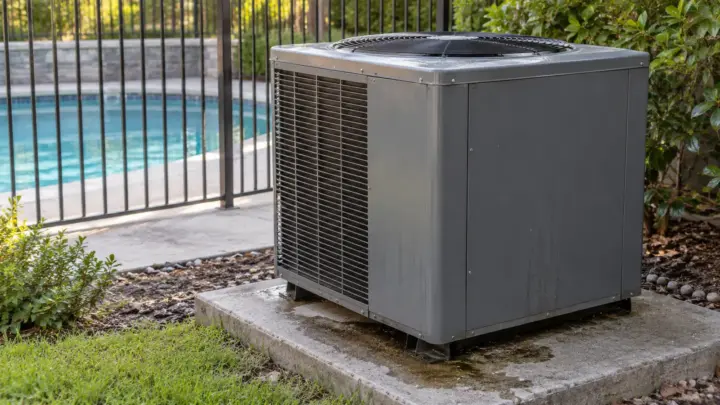
A working motor is not proof that the filter is receiving and processing adequate water. Low water, blocked baskets, air entry, a restricted filter or an equipment fault can interrupt the process.
Pentair’s Posi-Clear RP manual identifies low water and suction-side faults as causes of air entering a system. It also requires pressure comparisons at the same pump speed. Use these as diagnostic principles and consult your equipment’s own instructions for any intervention.
- Higher pressure than the clean baseline: check whether the filter needs its prescribed cleaning.
- Unusually low pressure with poor flow: investigate water supply, baskets and possible pump or suction problems.
- Continuing dirt return: ask about damaged media, internal seals or bypass, rather than endlessly adding clarifier.
- Persistent bubbles or alarms: use owner-level troubleshooting and escalate unresolved faults.
Filter safety: Shut down and prevent automatic restart, then relieve pressure exactly as the manual directs before opening a filter. Never loosen a pressurized lid, clamp or locking ring. Trapped air can cause violent separation. Electrical work, pressure testing and uncertain repairs belong with a qualified professional.
Clean the right filter the right way
Sand filters, cartridge filters and DE filters do not share one cleaning routine. Backwash only equipment designed for it and use the valve sequence in its manual. Clean cartridges according to their instructions; restore DE media as directed after the relevant service.
Do not change media or add filter aids without checking compatibility. If cleaning does not restore expected flow or clarity, inspect further rather than assuming the filter simply needs more chemicals. Use your model’s cleaning trigger rather than a universal pressure number.
Runtime matters, but hours alone are not the answer
Confirm that the pump actually ran its planned schedule, that the chosen speed supports connected equipment, and that water reaches the filter. A longer schedule cannot fix a broken pump, blocked suction path or filter bypass.
Manufacturer educational guides suggest different daily runtimes. That variation is a reason to check system requirements, actual flow and water conditions rather than promise one number clears every pool. Recovery may require more filtration than the normal schedule, within the equipment and treatment instructions.
Branch 5: suspended debris remains
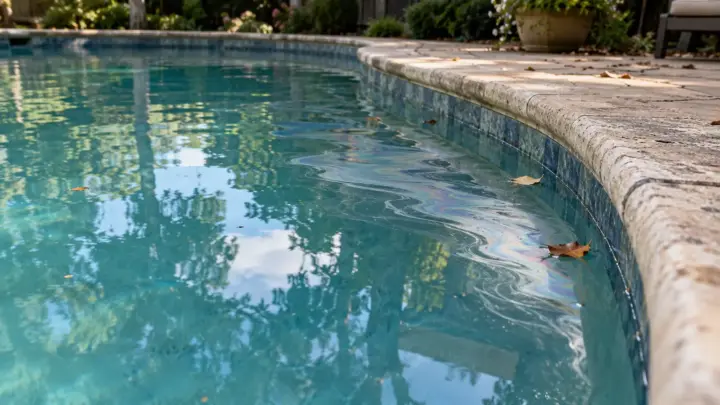
Wind, rain and swimmers can introduce fine particles even when water tests are acceptable. Skim, brush and vacuum with the correct method for the debris and surface. Check whether the filter is collecting material and whether its cleaning condition changes during recovery.
Clarifier may help compatible filters capture fine particles. Flocculant is a different process and may require settling and a permitted waste-removal method. Read the product’s filtration and vacuuming requirements before purchase; do not assume both products work with every cartridge system.
Use them only after diagnosing chemistry and equipment. An additive cannot repair poor circulation. Avoid stacking products or repeating doses faster than the label allows; a lack of immediate visual change is not permission to add more.
Why “just shock it” can miss the cause
If inadequate sanitizer or a compatible algae-treatment program calls for shock, it can be part of the fix. If the cause is mineral imbalance, damaged filtration or suspended dirt, the treatment needs to address that cause too.
EPA distinguishes oxidizers from products with sanitizing or algae-control claims. Read the active ingredient and purpose, not just “shock” on the package. Never mix treatment products together or add incompatible products without the label-directed separation and circulation.
How to know whether the fix is working
Track three things: water measurements, visible clarity and equipment behavior. Compare observations under similar lighting. Record additions and filter service so you can distinguish a gradual improvement from a recurring fault.
Do not promise yourself an overnight cure. Particle load, water condition and equipment vary. If readings remain acceptable but haze does not improve after the treatment’s stated interval, obtain a fresh water analysis and equipment assessment rather than buying another bottle.
Resume swimming only after the water is clear enough for safe visibility, chemistry meets applicable requirements, and all label waiting and re-entry conditions are satisfied. A clear surface after an additive is not sufficient evidence by itself.
Frequently asked questions
Can cloudy water be safe if chlorine looks normal?
A normal reading alone does not resolve visibility, test interference or filtration concerns. Keep swimmers out while the cause is uncertain, especially when the bottom is obscured.
Should I run the pump continuously until the pool clears?
Follow the equipment and corrective-treatment instructions. First establish that flow and filtration work; additional runtime is useful only when water is actually being processed properly.
Does every cloudy pool need clarifier?
No. It is an option for compatible systems with a particle-capture problem after chemistry and equipment have been assessed.
Research checked September 30, 2026. We only claim hands-on testing when we’ve actually tested the product ourselves.
Sources and references
Use the exact product label and model manual for your system; general guidance is not a universal dosing recipe.
- CDC: Home Pool and Hot Tub Water Treatment and Testing
- American Red Cross: Going Swimming? Look for These 3 Things First!
- US EPA: Use of the Term Shock in Swimming Pool, Hot Tubs, and Spa Products
- CDC MMWR: Pool Chemical Injuries in Public and Residential Settings
- BioGuard Canada: Cloudy Water
- HTH Pools: Why Is My Pool Cloudy? Causes and How to Fix It
- Poolife: Solutions to Common Pool Problems
- Pentair: Posi-Clear RP Cartridge Filter Installation and User’s Guide
- Taylor Water Technologies: Professional Water Testing Resources
- Taylor Water Technologies: Understanding and Managing Calcium Hardness in Pool & Spa Water
- Taylor Water Technologies: The Difference Between Free, Combined, and Total Chlorine in Pool Water