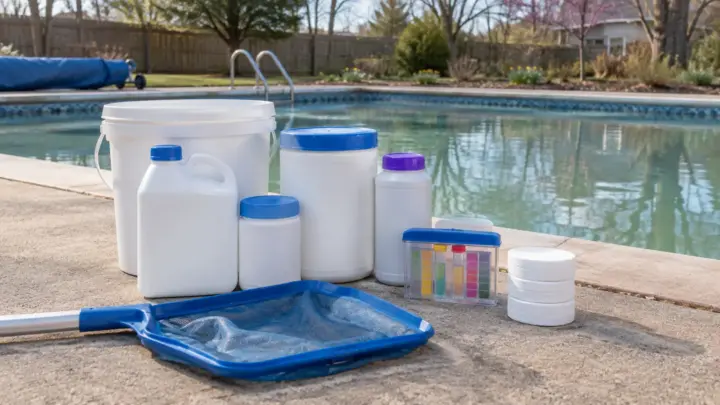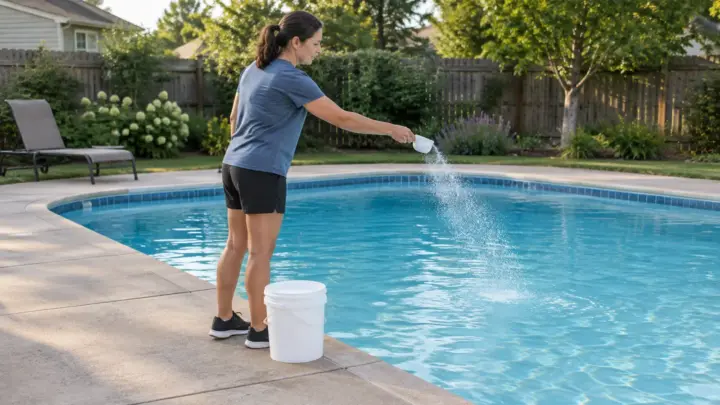
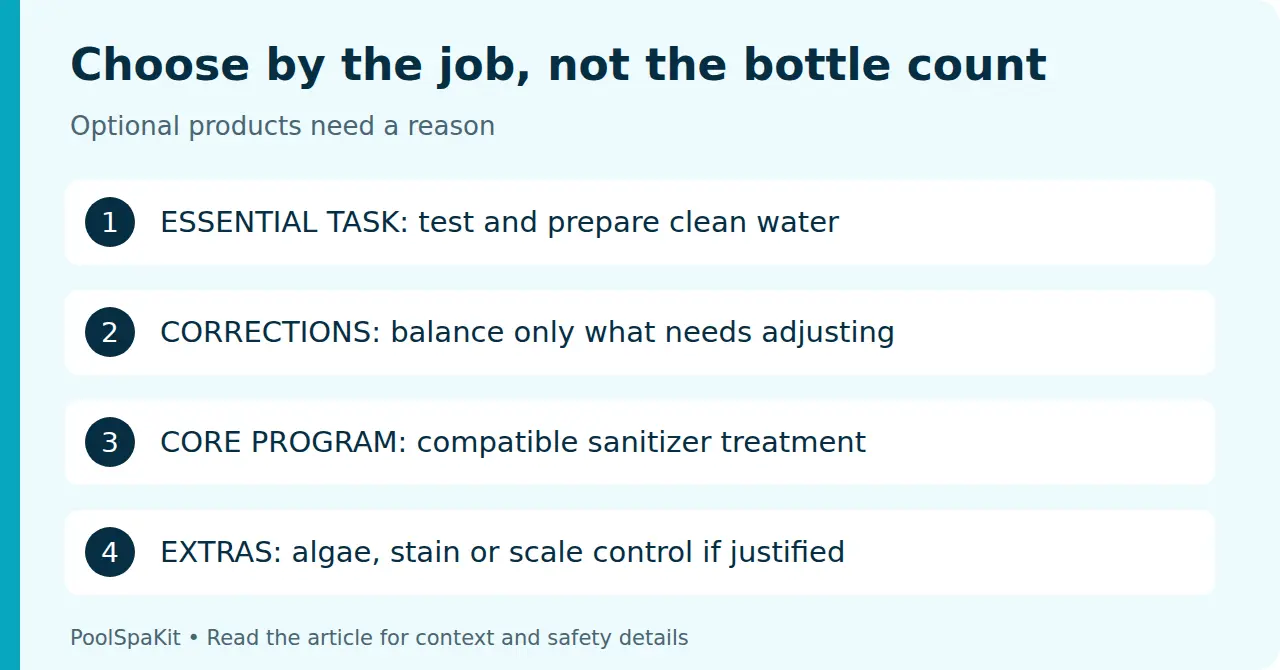
The essential part of pool closing chemistry is preparing clean, tested water and using a compatible sanitizer or closing treatment as directed. It is not buying every bottle labeled “winter.” Balancing products are needed when testing shows a correction is necessary; algaecide, stain control and other extras depend on the water, equipment and approved care program.
A closing kit can be convenient, but its contents do not establish what every pool needs. Before shopping, identify your sanitizer system, water volume, current test results, surface material and any history of algae, scale or metal staining. Those details make a useful chemical list possible.
Safety first: Never mix chlorine with acid, combine different chlorine products, or mix pool chemicals together in a container. Use the actual labels, add products separately, wear the specified protective equipment and provide the required circulation intervals. Closing chemicals do not replace physical winterization of pumps, filters or plumbing.
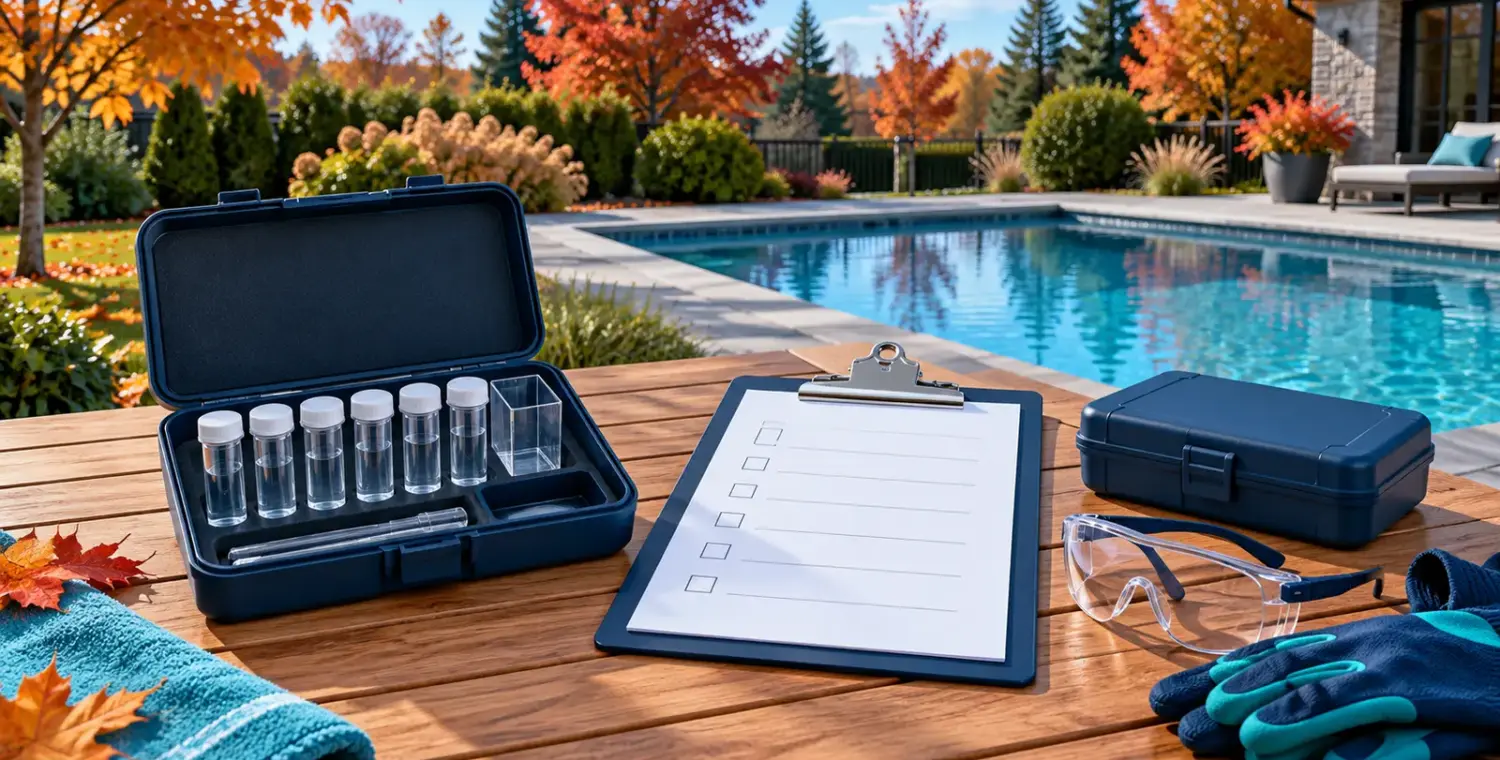
Closing checklist: reference ranges and order
Use these numbers as reference points, not universal targets. The two sources below do not fully agree, and your pool surface, sanitizer system and the closing products’ labels decide the actual targets and doses.
| Reading | Hayward closing guide (the week you close) | CDC home-pool guidance (year-round) | What decides it for your pool |
|---|---|---|---|
| pH | 7.2–7.8 | 7.0–7.8 | Surface and equipment requirements |
| Total alkalinity | 80–120 ppm | No figure given | Your sanitizer program and surface |
| Calcium hardness | 180–220 ppm | No figure given | Surface type: plaster and vinyl differ |
| Free chlorine | 1.0–3.0 ppm before adding winter algaecide | At least 1 ppm; at least 2 ppm with CYA or stabilized chlorine | The closing product’s label |
Hayward’s figures are closing targets from its closing guide. CDC’s are year-round minimums for home pools, not closing targets.
Order and timing
- Remove debris, then test sanitizer, pH, total alkalinity and calcium hardness, plus CYA and metals where relevant.
- In the week you close, make only the corrections your results call for, one product at a time, with the label’s circulation time between additions.
- Shock as the product label directs. Hayward says to let chlorine come down to 1.0–3.0 ppm before adding winter algaecide, and never to add shock and algaecide at the same time.
- Add optional products, such as stain or scale control, only if your water or its history justifies them.
- Then winterize the equipment and plumbing and fit the cover. Chemicals do not protect pipes from freezing; see how to winterize a pool pump and filter.
Essential tasks versus optional products
Think in terms of jobs rather than a fixed number of chemicals. Every pool needs a suitable water-care plan. The number of products needed to achieve it varies.
| Job or product | When it belongs in the plan | What it cannot replace |
|---|---|---|
| Testing and balancing | Essential tasks. Buy balancing chemicals only for measured corrections. | Cleaning, sanitizer or equipment protection. |
| Compatible sanitizer treatment | Follow the pool’s approved sanitizer/closing program and actual label. | Physical removal of leaves and sediment. |
| Shock or oxidizer | When required by the approved closing program or diagnosed water condition. | All products called “shock” are not equivalent disinfectants. |
| Winter algaecide | A program-specific preventive addition, selected for compatibility. | Correct sanitizer control or treatment of an unresolved problem. |
| Stain or scale control | When testing, source water, surface requirements or previous problems justify it. | Correct balance, diagnosis, or removal of an existing stain. |
| Clarifier or other extras | Only for a specific need and a compatible filtration method. | Working filtration or a clear-water diagnosis. |
Start with cleaning and a reliable water sample
Remove leaves, brush the surfaces and vacuum debris before final treatment. If the water is cloudy, green or stained, investigate now. Adding a kit and covering the pool makes it harder to see whether the underlying problem was resolved.
Measure sanitizer, pH, total alkalinity and calcium hardness. Check cyanuric acid where relevant to the chlorine system, and request a metals test if fill water or staining history suggests a problem. Test the parameters required by any specialist system rather than forcing every pool into a chlorine checklist.
Use the test instructions and usable reagents. Taylor cautions that reagents and comparators from different manufacturers are not automatically interchangeable. An improvised test procedure is a poor basis for buying or dosing chemicals.
Record the readings and the approximate water volume. Poolife emphasizes knowing how much water the pool holds before calculating treatment. Confirm whether the volume is stated in liters, US gallons or imperial gallons; do not transfer the same numerical “gallon” dose between units.
Balance before closing, using the right targets
Balancing means checking whether water chemistry suits the pool surface and equipment. It does not mean raising every reading to a high winter target. Use the builder’s or manufacturer’s specifications and the treatment program’s guidance.
pH, alkalinity, calcium hardness and water temperature need context. For example, a plaster pool’s mineral-balance requirements should not be copied automatically to a vinyl-lined above-ground pool. Where a saturation-index assessment is used, ask which inputs and temperature assumptions apply to winter conditions.
Taylor’s published water-quality guidance explicitly says general parameter ranges do not supersede product labels or local requirements. That is a useful reason to avoid a universal table of “perfect closing numbers.” A specific target can be appropriate, but only after the pool, system and source are identified.
Make only the indicated corrections, in the sequence required by your program. Allow the label-directed circulation period and retest as instructed. Do not combine an acid adjustment and sanitizer addition as one job. Keep enough operating time available before equipment shutdown.
Sanitizer: the foundation, not a one-time guarantee
The closing treatment must be compatible with the sanitizer system already in use. A saltwater chlorine generator belongs to a chlorine program; it is not permission to neglect measured water chemistry. Non-chlorine systems require their own approved procedures and compatibility checks.
Use the instructions for the actual product and measured pool volume. A dose from a neighbor’s pool can be wrong even when the pools look similar. Product strength, current residual, water condition and formulation can differ.
Do not assume one closing addition guarantees acceptable water throughout every winter. Keep the cover and winter inspection plan in the picture. If later treatment is needed, ask how to add and distribute it safely in your closed system; do not tip concentrated chemicals into stagnant equipment.
Shock: read beyond the name on the front
“Shock” does not identify one ingredient or one function. EPA’s guidance distinguishes products with antimicrobial claims from oxidizers that do not sanitize or control algae. A non-chlorine oxidizer may address non-living contaminants without providing the required disinfectant residual.
Check the active ingredient, permitted use and label claims. Do not assume a bag of non-chlorine oxidizer and a chlorine-based shock are interchangeable. Do not combine them, substitute the same dose, or use a stronger-than-labeled treatment because the pool will be covered.
If the closing program requires shock, use its actual product instructions and sequencing. If you are treating visible algae or a contamination incident, that is a separate corrective task, not simply a reason to add an arbitrary extra bag at closing. Resolve the condition and verify the result before proceeding.
Algaecide: a compatible preventive option
Some manufacturer winter programs include an algaecide. BioGuard’s Arctic Blue kit, for example, pairs its shock with its algae-protection product. That demonstrates a particular program, not proof that every pool requires the same combination.
Select an algaecide permitted for your sanitizer, surface and equipment, and follow its winter-use directions. If the label calls for a particular sequence or sanitizer condition, respect it. Do not treat “more” as better or stack products from different kits without checking compatibility. For when an algaecide is useful at all, see do you need algaecide in a pool.
Ask what problem the product is intended to prevent in your situation. An owner with a recurring algae problem should also review water preparation, debris control and cover management. A preventive bottle cannot explain why the water was already turning green.
Scale, stains and metals: use evidence
Scale prevention and metal-stain control are related ownership concerns but not the same diagnosis. Mineral balance, water temperature and surface requirements belong in a scale assessment. Metals testing and the history of discoloration belong in a stain assessment.
BioGuard identifies source water, equipment corrosion and some pool products or devices as routes by which metals can enter water. It also notes that changes in pH or shock treatment can make dissolved metals precipitate and stain surfaces. If your pool has that history, get a water analysis before choosing a closing treatment.
A sequestrant can help keep metals bound in water; do not assume binding automatically removes them. Ask whether the proposed product prevents staining, treats an existing stain, or supports a separate removal process. These are different claims and may require different procedures.
Do not add a stain remover to an unknown mark as a diagnostic experiment. Photograph the area and provide the water results to a qualified service provider. Optional stain and scale products can be useful when justified, but they should not be purchased automatically for water without an identified need.
Why closing kits differ
Kits package a manufacturer’s particular program. They can vary in included products, pool-volume coverage, supported sanitizer types and additional requirements. A kit may not include the balancing chemical your test results call for, even if the box says “complete.”
Compare kits by the instructions, not by how many containers they include. Check which products must be purchased separately, when treatments are added, how long circulation must continue, and whether there are water-condition prerequisites.
Do not pool leftover ingredients from two kits into a homemade winter formula. Keep each product in its labeled original container. If one component is unsuitable, ask the manufacturer about a compatible alternative rather than improvising.
A practical buying decision
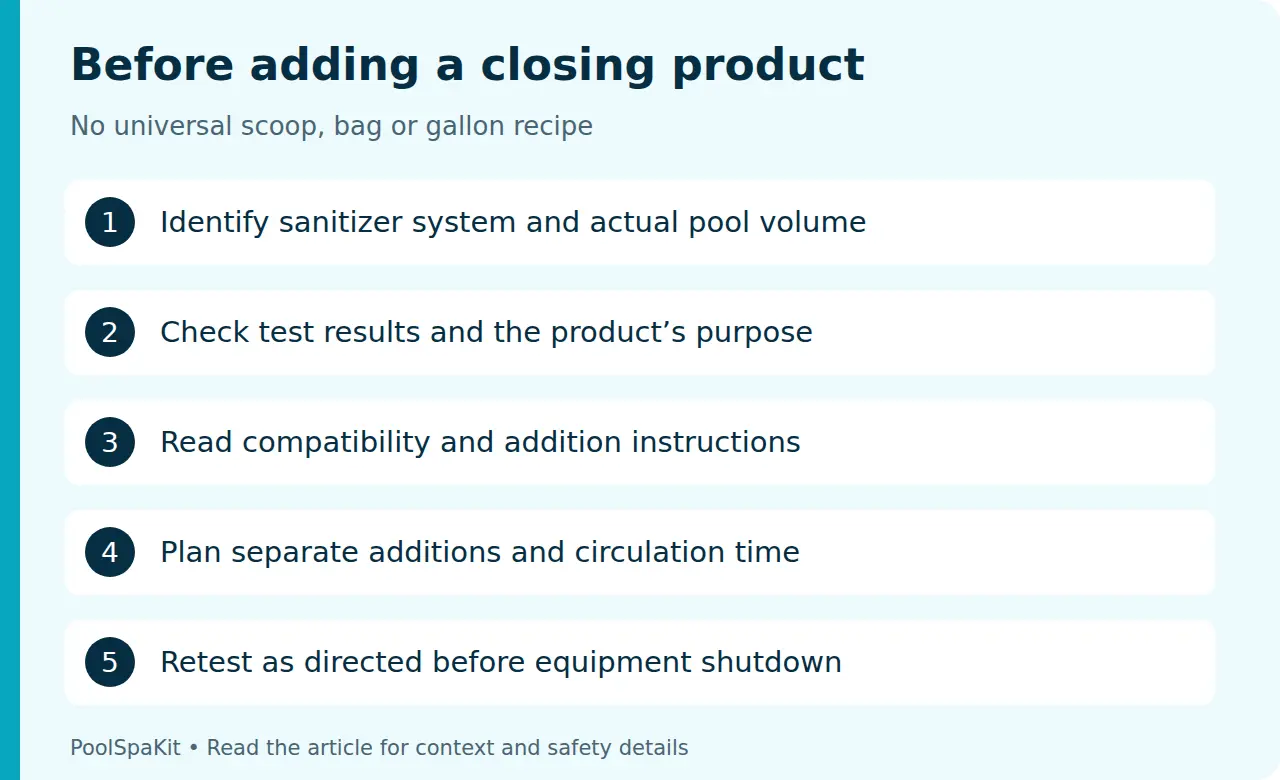
- Identify the system. Write down the sanitizer type and equipment restrictions.
- Test and diagnose. Record water results and visible problems.
- List necessary corrections. Buy only the balancing products those results justify.
- Confirm the closing program. Identify the compatible sanitizer or shock treatment and any required preventive additions.
- Justify optional products. Match each to a test result, history or specific program requirement.
- Check timing. Finish label-directed treatment and circulation before shutdown.
For example, an owner whose balance measurements already meet the approved targets does not need to add a pH product simply because closing day has arrived. An owner with a documented metals problem needs a more specific discussion than “use a standard winter kit.” These are decision examples, not chemical recipes.
Handle and store leftovers safely
Use the label’s storage conditions. EPA’s pool-chemical storage alert explains that moisture and accidental contact between incompatible chemicals can trigger dangerous reactions. Keep products dry, separated and secured away from children and pets.
Do not consolidate residues into a common container or reuse a scoop across incompatible products. Dispose of unwanted chemicals through the locally approved route. Product labels and local requirements differ across the United States, Canada, United Kingdom and Australia; a US registration statement is not a global authorization.
Frequently asked questions
Do I need every product in a winter closing kit?
Follow a compatible kit as its manufacturer directs, but choose the program before purchasing it. Do not assume a generic kit suits every pool or replaces separate balance corrections.
Can closing chemicals keep equipment from freezing?
No. Equipment drainage, line protection and cover installation are separate physical tasks. Do not pour closing products into plumbing as a substitute for winterization.
Is there one correct dose for all pools?
No. The actual label, formulation, volume, current measurements and purpose determine dosing. If any of those inputs is uncertain, resolve it before adding chemicals.
Research checked September 30, 2026. We only claim hands-on testing when we’ve actually tested the product ourselves.
Sources and references
Manufacturer guidance is model-specific; public-health guidance does not set a universal winter dosing recipe.
- US EPA: Use of the Term Shock in Swimming Pool, Hot Tubs, and Spa Products
- US EPA: Safe Storage and Handling of Swimming Pool Chemicals
- CDC MMWR: Pool Chemical Injuries in Public and Residential Settings
- BioGuard: Off Season Products
- BioGuard: Closing Your Pool
- Hayward: Ten Essential Steps to Closing Your Pool
- CDC: Home Pool and Hot Tub Water Treatment and Testing
- BioGuard: Metal Staining
- Poolife: Basic Pool Maintenance
- Taylor Water Technologies: Taylor Water Testing Technical FAQs