If hot tub water smells bad, pause bathing and check the water, filter and cover before choosing a treatment. A sharp chemical smell, a musty cover and stale water can point toward different maintenance problems, but smell cannot measure sanitizer or tell you which germs are present. The safe fix starts with reliable tests and the care instructions for your actual spa.
Do not pour in extra chlorine simply because the odor seems strong. Do not add fragrance to conceal it. Record what changed, where the smell seems strongest and the current water results. This guide helps you prepare that record and decide whether approved routine care is enough or service is needed.
First, locate the odor without exposing yourself
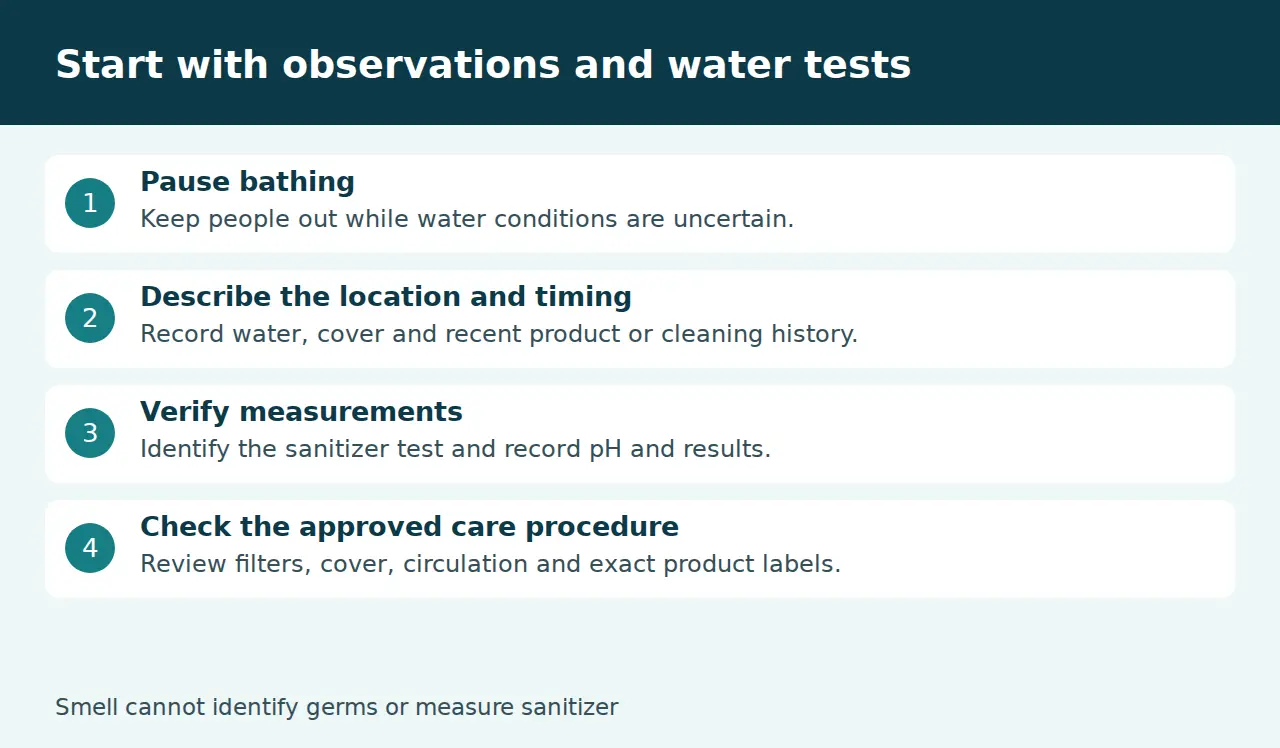
Keep people out while investigating unusual odor or uncertain water conditions. From a normal standing position, note whether the problem seems associated with the water, the cover or the surrounding space. Do not lean over the water to inhale deeply, run jets to create a stronger sample or inspect electrical compartments.
Write down when you noticed the smell: after heavy bathing, opening the cover, adding a product, cleaning, refilling or returning after an absence. Include the exact products and dates. “Chemical smell after treatment” is a useful description; it does not prove an overdose.
If there are strong fumes, breathing discomfort or a suspected chemical mixing incident, leave the area and seek emergency or poison-control advice appropriate to your location. Do not attempt to neutralize an unknown chemical reaction with another product.
Common odor clues and what to check
| Observation | Possible maintenance clue | Next useful check |
|---|---|---|
| Sharp chlorine-like odor | Chloramine formation or a product-related water-care issue | Identify the system and measure the relevant sanitizer readings and pH |
| Musty or stale water | Inadequate sanitation, accumulated contamination or neglected maintenance | Test, review circulation and check the maintenance history |
| Odor strongest at the cover | Dirty surfaces or damaged, waterlogged cover components | Inspect accessible cover surfaces and the manufacturer’s care instructions |
| Odor after cleaning or treatment | A recent input or incomplete approved rinse | Retain the product label and describe the process to the dealer |
Manufacturer explanations differ. Hot Spring connects chlorine odor with chloramines and low pH in its troubleshooting table; Jacuzzi describes a chemical scent in terms of sanitizer buildup. Those descriptions are not interchangeable diagnoses. Measurements and product history decide the next step.
For chlorine-treated water, CDC explains that chlorine can combine with swimmer waste to form chloramines, also called combined chlorine. These can contribute to irritation and unpleasant air conditions. A chlorine-like smell therefore does not establish that usable free chlorine is high.
For a bromine or another approved care system, use its own test and maintenance instructions. Do not apply a chlorine combined-reading interpretation to a bromine result without the test maker’s guidance. Changing sanitizers is a separate compatibility decision, not an odor remedy to improvise.
Test the water before adding chemicals
Identify what your kit measures and follow its sampling and reading directions. Record sanitizer and pH, then any additional measurements required by the spa care program. In a chlorine system, keep free and total chlorine distinct. If your method supports a combined-chlorine calculation, use its instructions and report the original readings too.
CDC recommends testing chlorine and pH at least twice daily, with extra checks during heavy use. Its general pH guidance is 7.0–7.8. Compare your results with the exact spa and product instructions as well; this general range does not replace every model’s care requirements or establish treatment quantities.
Unexpected results deserve verification. CDC warns that chlorine above 10 ppm can bleach a DPD test and make the reading falsely low or zero. If you have added chlorine repeatedly and still see zero, stop the dosing loop and obtain a reliable measurement using the test maker’s recommended method.
Check the kit’s condition, reagent instructions and measurement range. Tell a dealer about recent oxidizers or other treatments so they can assess potential test interference with the actual method. An unexplained result should remain unexplained in your log rather than being rewritten as a confirmed shortage.
CDC recommends against cyanuric acid and stabilized chlorine products in hot tubs. Some manufacturer care programs have their own product requirements. If your current program and public-health guidance conflict, ask the manufacturer or qualified provider to reconcile them. Do not convert products or apply a pool’s stabilizer plan to a spa on your own.
Check the filter and normal circulation
Review when the filter was last serviced and whether normal circulation is confirmed. Write down any warnings or changes in operation. A running display or audible motor does not resolve an unexplained flow problem. Follow the manual and get service for persistent alarms or abnormal operation.
Before removing a filter, follow the spa’s shutdown and access directions. Hot Spring’s maintenance guidance describes rinsing cartridge pleats and using an approved filter cleaner when needed. The correct procedure, cleaner and replacement criteria depend on the actual filter and spa.
Do not substitute household detergent or run the spa without its required filter. Complete the specified rinse and permitted restart, then reassess the water. Cleaning a cartridge is a maintenance step; it does not establish that sanitation or all contamination has been corrected.
If foam accompanies the odor, our hot-tub foam troubleshooting guide covers possible residue inputs and the limits of defoamers. Reducing visible bubbles does not verify safe water or fix an unresolved odor source.
Inspect the cover separately
A cover can have its own maintenance problem even when the water tests appear normal. Follow the maker’s lifting instructions, using help when needed. Look at accessible surfaces for dirt, damage, sagging or unusual heaviness. Do not stand on the cover or take apart sealed components to inspect them.
Use the cleaning procedure for the cover’s actual material. Hot Spring distinguishes polyester cover care from other cover products and specifies a rinse without soap on the underside in that guidance. A cleaner approved for one finish is not automatically suitable for another.
Hot Spring also identifies waterlogged foam and damaged vapor barriers as cover-replacement concerns, with bacteria or mildew possible inside compromised components. Repeatedly spraying the outside will not necessarily repair that condition. Ask the cover maker or dealer about replacement if it is damaged, persistently smelly or increasingly difficult to handle.
Keep cover observations separate from water readings in the record. A cleaner-smelling cover does not prove the tub is ready for bathing, and a good water result does not make a damaged cover sound. Each needs its own follow-up.
Choose a supported treatment, not a stronger guess
Once the measurements and maintenance checks identify a problem, use a corrective step approved for the spa and sanitizer program. Confirm the exact product, water volume, handling, circulation and reentry instructions before adding anything.
Manufacturer troubleshooting pages may suggest oxidation, balance correction or a water change for particular conditions. They do not supply a universal dose for every spa. “Shock” is a treatment category with differing products; the word alone does not identify a quantity, compatibility or safe wait time.
CDC chemical-safety guidance emphasizes following labels, using appropriate protective equipment, keeping products in original containers and separating incompatible materials. Never mix spa chemicals together. Do not transfer products into unlabelled jars or attempt to combine cleaning and sanitation treatments into one homemade mixture.
A persistent problem may require a manufacturer-directed water change and cleaning. Check the approved procedure for the shell, plumbing and refill. A purge product or drain sequence should be used only when supported by the spa and product instructions, with a clear disposal plan.
In freezing conditions, do not drain casually or leave vulnerable plumbing exposed. Our winter spa-care guide helps frame seasonal maintenance questions. Ask your service provider to plan any necessary water change around the installation and weather.
Verify conditions before anyone returns
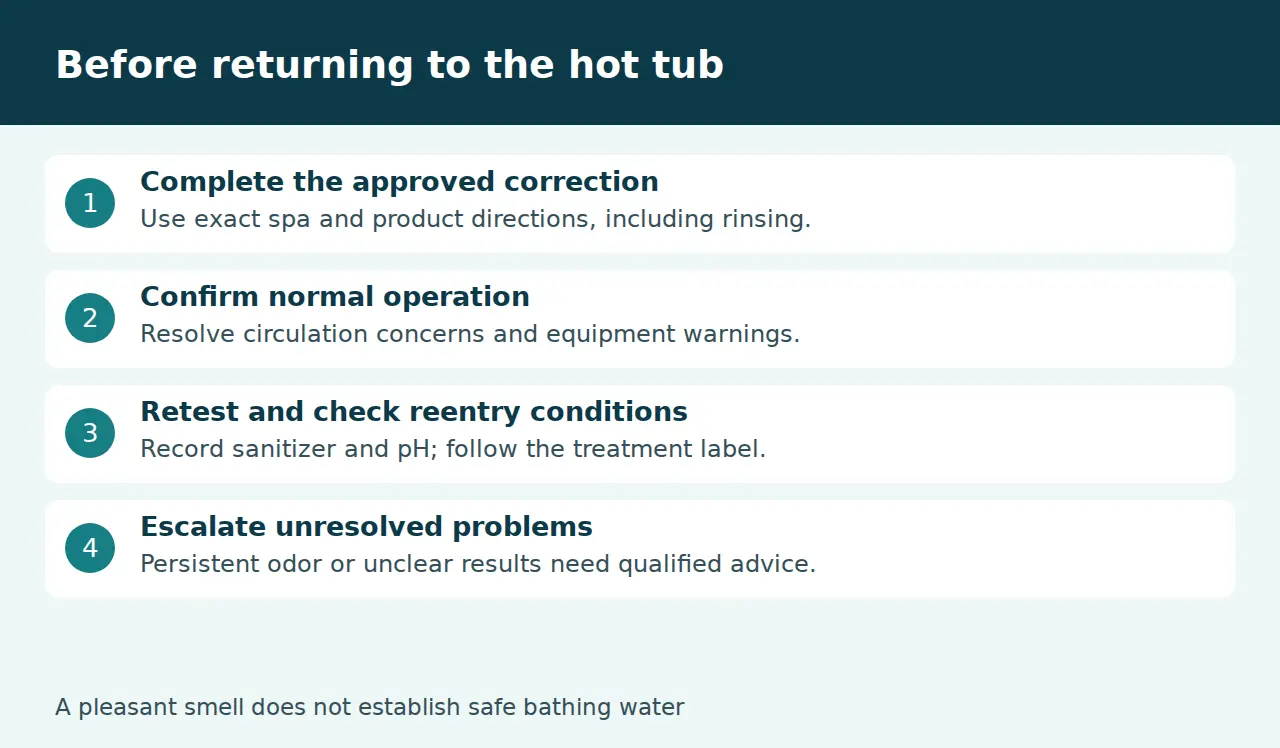
After the approved treatment and restart, record the new tests and observations. Confirm that equipment is operating normally and that the applicable sanitizer, pH and product reentry conditions are met. The disappearance of an odor is only one observation, not the clearance rule.
If the odor returns, compare the records rather than repeating the same treatment indefinitely. Ask what remains unresolved: a recurring input, insufficient approved sanitizer care, a filter issue, cover damage or an equipment fault. Provide the service provider with measurements and product names instead of only a smell description.
When to get professional or medical help
Arrange qualified spa service when readings cannot be reconciled, normal circulation is uncertain, odor persists after approved maintenance or water replacement is needed but the procedure is unclear. Keep the tub out of use until appropriate conditions can be verified.
Odor cannot diagnose Legionella or exclude it. CDC explains that infection can occur from inhaling contaminated hot-tub mist. If you develop cough, shortness of breath, fever or muscle aches after using a hot tub within the past two weeks, seek medical advice promptly and tell the clinician about the exposure.
For your next maintenance record, use five fields: date and time, sanitizer and pH results, odor location, recent inputs, and the action taken. That gives you a way to recognize recurrence early and gives a professional the information needed to recommend a supported fix.
Research checked September 30, 2026. We only claim hands-on testing when we’ve actually tested the product ourselves. Featured image is an original illustration.
Sources and references
- CDC: Home pool and hot tub water treatment and testing
- CDC: Chloramines and pool operation
- CDC: Pool chemical safety
- CDC: Preventing Legionella from hot tubs
- Hot Spring: Water care and troubleshooting
- Jacuzzi: Signs and symptoms your hot tub water needs maintenance
- Hot Spring: Maintenance and tips
- Hot Spring: When should I replace my spa cover?