
A pool alkalinity result that looks too high or too low is a reason to check the water’s buffering, not a signal to add a chemical immediately. First confirm the test, compare it with pH and read the requirements for your sanitizer, equipment and surface.
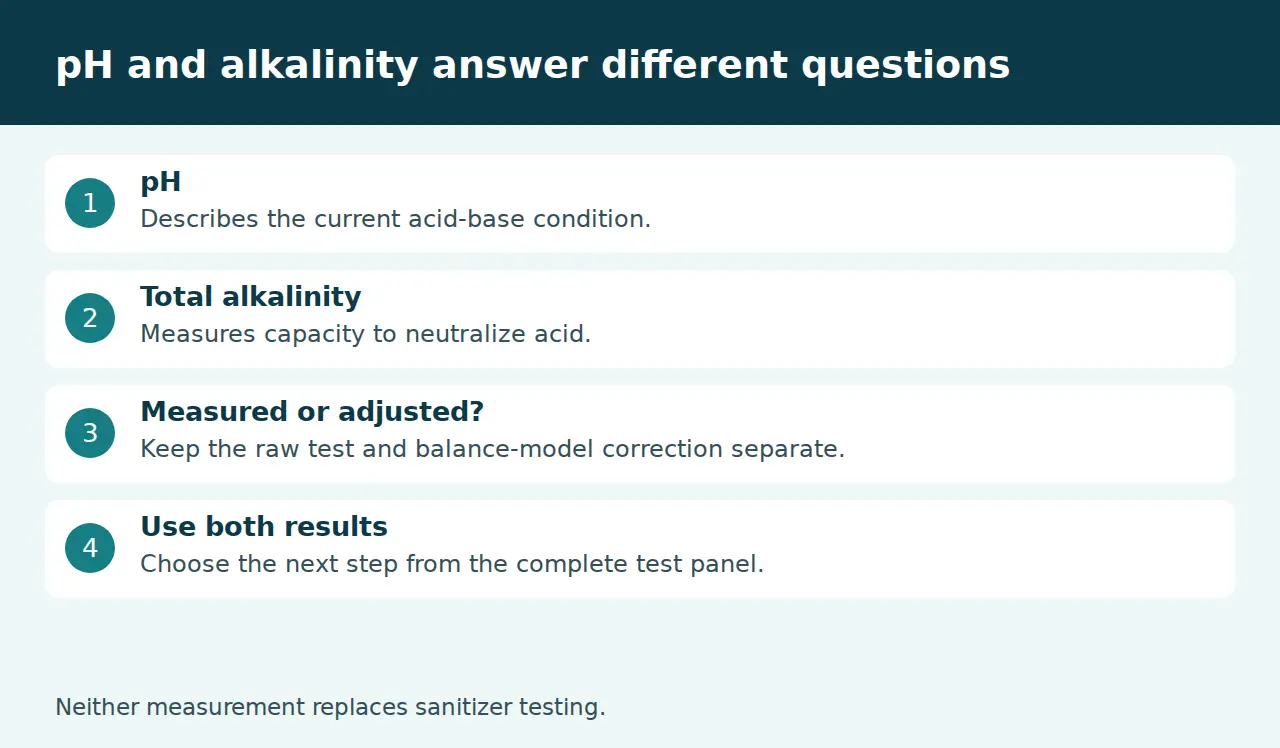
Total alkalinity and pH are related, but they answer different questions. Understanding that distinction helps prevent the frustrating cycle of adding acid, then adding an increaser, then wondering why the water still will not settle.
What total alkalinity means
Total alkalinity, often shortened to TA, describes water’s capacity to neutralize acid. In typical pool water, bicarbonate and carbonate are important contributors. Think of pH as the current condition and alkalinity as part of the chemistry affecting how that condition responds to an input.
The US Geological Survey’s explanation of alkalinity describes it as a property of water arising from dissolved substances, rather than a single chemical. More buffering can reduce the change produced by an acid input. It does not mean pH cannot change, or that the highest possible alkalinity is desirable.
Alkalinity is commonly reported as a calcium carbonate equivalent. That reporting convention does not mean the test measures calcium hardness. If a test sheet lists both TA and calcium hardness, keep them as separate results even when their units look similar.
For the routine sampling and test-panel basics, use our pool water testing guide. This article focuses on interpreting an abnormal alkalinity result and deciding what information you need before correcting it.
Why there is no single alkalinity target for every pool
The useful operating range depends on the pool’s treatment system, equipment and surface requirements. A broad chart on a test bottle may be a starting reference, but it cannot resolve every combination of sanitizer, pH, calcium hardness, temperature and stabilizer.
Check the instructions for the products and equipment actually installed. Ask whether the range being discussed refers to measured total alkalinity or a value adjusted for a water-balance calculation. Those are not interchangeable labels.
Pool owners in the US, UK, Canada and Australia should also consider locally applicable requirements. A historical public-pool advisory or commercial operating rule is not automatically a residential target. Where your manual and another chart disagree, get an explanation of the scope before treating either as a universal answer.
Confirm the alkalinity reading
Follow the exact test procedure
Use a fresh representative sample and the kit’s stated volume, reagents and endpoint instructions. A drop test depends on the specified method: changing the sample size or substituting a reagent can change what each drop represents. A strip reading also needs its own timing and interpretation instructions.
Check reagent age, storage and compatibility if a result differs sharply from your history. Record the method alongside the result when comparing a home kit with another test. Two numbers from different methods do not, by themselves, show that the water changed.
Watch for interference and adjusted values
Taylor’s technical FAQs identify high-sanitizer interference in certain alkalinity tests. An unusual color sequence can require a kit-specific procedure; it should not be interpreted using an improvised endpoint or a correction borrowed from another kit.
The same FAQs explain that cyanuric acid can contribute to an alkalinity titration. For some water-balance calculations, a correction is made to estimate carbonate alkalinity. Follow the chosen method or calculator’s instructions, keep the original measured TA in your log, and label any adjusted value separately. Do not overwrite a measured result with an unexplained subtraction.
If borates or other buffering treatments are used, disclose them to the person interpreting the balance calculation. A water-balance model needs appropriate inputs; a single apparent “ideal” TA number cannot supply the missing context.
What low alkalinity can mean
With less acid-neutralizing capacity, water can be more sensitive to acid additions. pH may therefore change more readily. That is a buffering concern, not proof that every low-TA pool already has a low pH or damaged equipment.
Review recent acid treatment, the sanitizer product’s instructions and any significant water replacement. Test the replacement water instead of assuming it has the same alkalinity as the pool. If repeated pH corrections preceded the low result, include every addition in the history rather than only the most recent one.
The practical concern is how pH and the wider water balance behave. If pH is also outside the required range, keep swimmers out while the problem is assessed. If pH is currently satisfactory, do not ignore the buffering issue, but avoid an urgent blind addition based only on the word “low” on a chart. When a confirmed low result does need raising, how much baking soda raises alkalinity gives the dose arithmetic.
What high alkalinity can mean
High TA may make an acid-driven pH adjustment more demanding. It can also be part of a pattern in which pH rises as carbon dioxide leaves the water. It does not permanently lock pH in place. A pool can have substantial buffering and still show a recurring pH rise.
Look for recent alkalinity increaser, significant refill water and treatment decisions based on unconfirmed measurements. Where water features or other aeration coincide with pH drift, record that operating pattern. Do not disable equipment functions required for safety simply to change a chemistry trend.
Scaling or cloudiness requires a wider investigation. Taylor’s water-balance guidance describes the interaction of pH, alkalinity, calcium hardness, temperature and dissolved solids. High TA alone does not prove that a deposit is calcium scale or that filtration is working correctly.
If visibility is poor, follow the separate diagnostic branches in our cloudy pool water troubleshooting guide. Do not use a satisfactory alkalinity result as permission to swim in water whose sanitizer or visibility remains unsuitable.
Read pH and alkalinity together
| Confirmed findings | Useful next question | Avoid this shortcut |
|---|---|---|
| Low TA and low pH | What acid input or treatment change preceded both results, and what correction suits this system? | Repeated acid additions or an uncalculated large increaser dose. |
| Low TA, satisfactory pH | Does buffering need adjustment under the pool’s instructions? | Assuming pH must be raised simply because TA is low. |
| High TA and high pH | How can acid treatment be controlled while monitoring both values? | Adding all the calculated acid at once without label-based planning. |
| High TA, low pH | Is the test reliable, and how will a staged balance plan protect pH? | Adding acid just to chase TA while overlooking the low pH. |
These are diagnostic prompts, not treatment recipes. They show why the words “alkalinity low” or “alkalinity high” are insufficient instructions. Include sanitizer results and relevant surface or equipment limits in the final plan.
Raising low alkalinity safely
Sodium bicarbonate is commonly used to raise total alkalinity. Choose an appropriate pool product and follow its label using reliable pool volume and a confirmed starting result. A product’s trade name alone does not establish its concentration or suitability.
Do not assume an alkalinity correction will place pH exactly where it needs to be. After the label-directed addition and mixing, measure both again. If pH requires separate attention, plan that next step from the new results rather than assuming two products can be added together.
Check what the proposed adjustment does to the rest of the water balance, particularly where there are surface-care requirements. A small number on one part of a test sheet does not justify disregarding the manufacturer’s overall chemistry instructions.
Lowering high alkalinity without losing control of pH
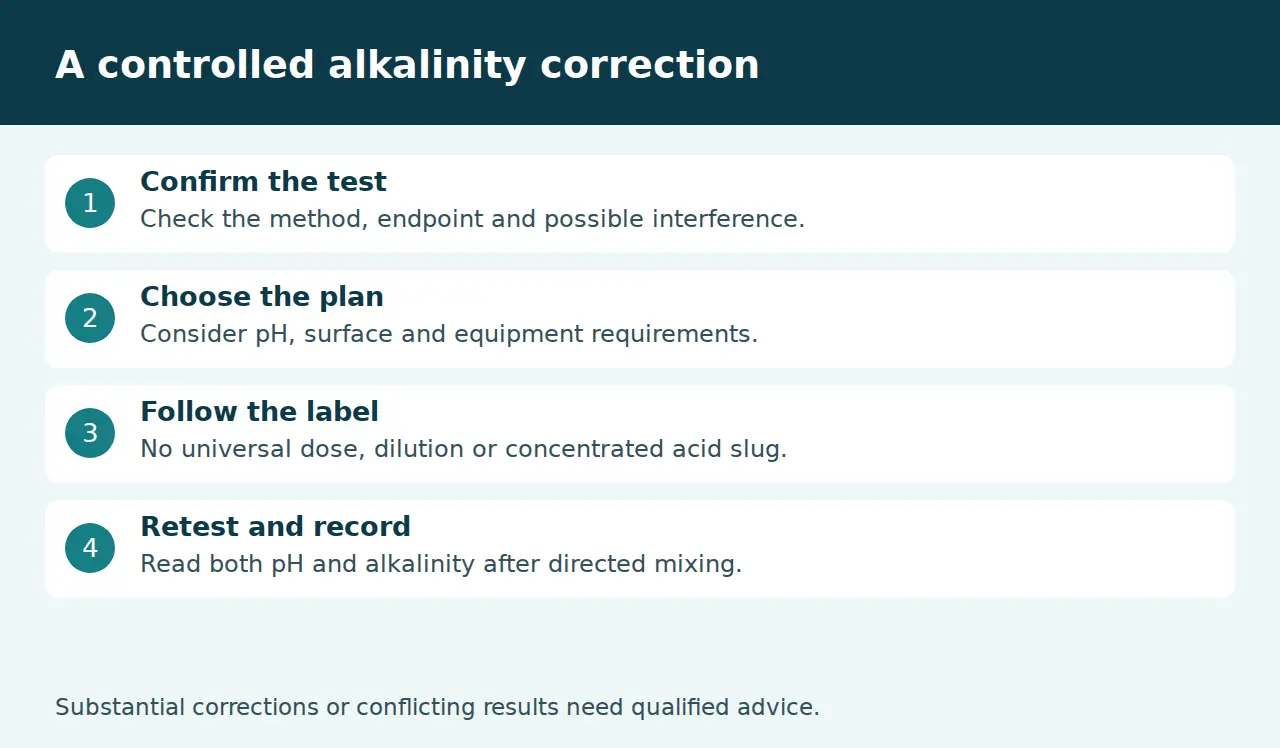
Acid treatment reduces alkalinity and lowers pH. That coupling is why a substantial correction needs a controlled plan, repeated measurements and attention to the pool’s operating limits. This guide supplies no universal acid amount, dilution ratio or time between additions.
Orenda’s discussion of alkalinity reduction explains how acid reacts with bicarbonate and how subsequent carbon dioxide loss can let pH rise again. That pH recovery does not undo the acid’s consumption of alkalinity. Appropriate aeration can be part of a professionally planned process, but its suitability depends on the pool and equipment.
Do not concentrate acid in one spot to “target” alkalinity. Orenda specifically warns against column pouring or slugging acid. Follow the exact product’s application instructions, protect surfaces and fittings, and seek qualified help if the correction is substantial or pH is already low.
Keep a record that explains recurrence
Record measured TA, pH, sanitizer, test method, chemical additions and significant refill events. Include the actual product and amount used, without treating that amount as a reusable dose. When a value returns to its previous level, this record helps distinguish continuing inputs from a testing or interpretation problem.
Keep chemical handling separate from the diagnosis. Health Canada’s safety guidance advises following labels, using suitable protective equipment, keeping chemicals in their original containers and never mixing different products. Follow circulation and re-entry instructions as well.
Ask for help if the results are implausible, both pH and alkalinity need major correction, or visible equipment or surface damage is present. Give the professional your surface type, equipment model, treatment products and full test history. An alkalinity number without that context is a limited starting point.
Common questions
Does high alkalinity mean high pH?
No. Alkalinity is buffering capacity; pH describes the current acid-base condition. Their relationship matters, but neither result can replace the other. Measure both before deciding on a product.
Will raising alkalinity fix low chlorine?
An alkalinity adjustment is not a sanitizer treatment. Continue checking sanitizer and pH against the applicable instructions. Water balance and adequate disinfection both matter.
Should I adjust a number that is only slightly outside a chart?
First check the chart’s scope, your equipment requirements and the test method’s resolution. Confirm the reading and trend. A thoughtful decision based on the whole system is more useful than repeatedly treating small apparent changes without context.
Research checked October 1, 2026. We only claim hands-on testing when we’ve actually tested the product ourselves. Featured image is an original illustration.
Sources and references
- Health Canada: Swimming pool and spa cleaning
- NSW Health: Public Swimming Pool and Spa Pool Advisory Document
- Taylor Technologies: Technical FAQs
- Taylor Technologies: Maintain water balance to protect your pool and spa
- US Geological Survey: Alkalinity and Water
- Orenda Technologies: How to lower total alkalinity without lowering pH too much
Additional technical references: USGS: alkalinity reporting convention; Orenda: carbonate alkalinity and carbon dioxide equilibrium.