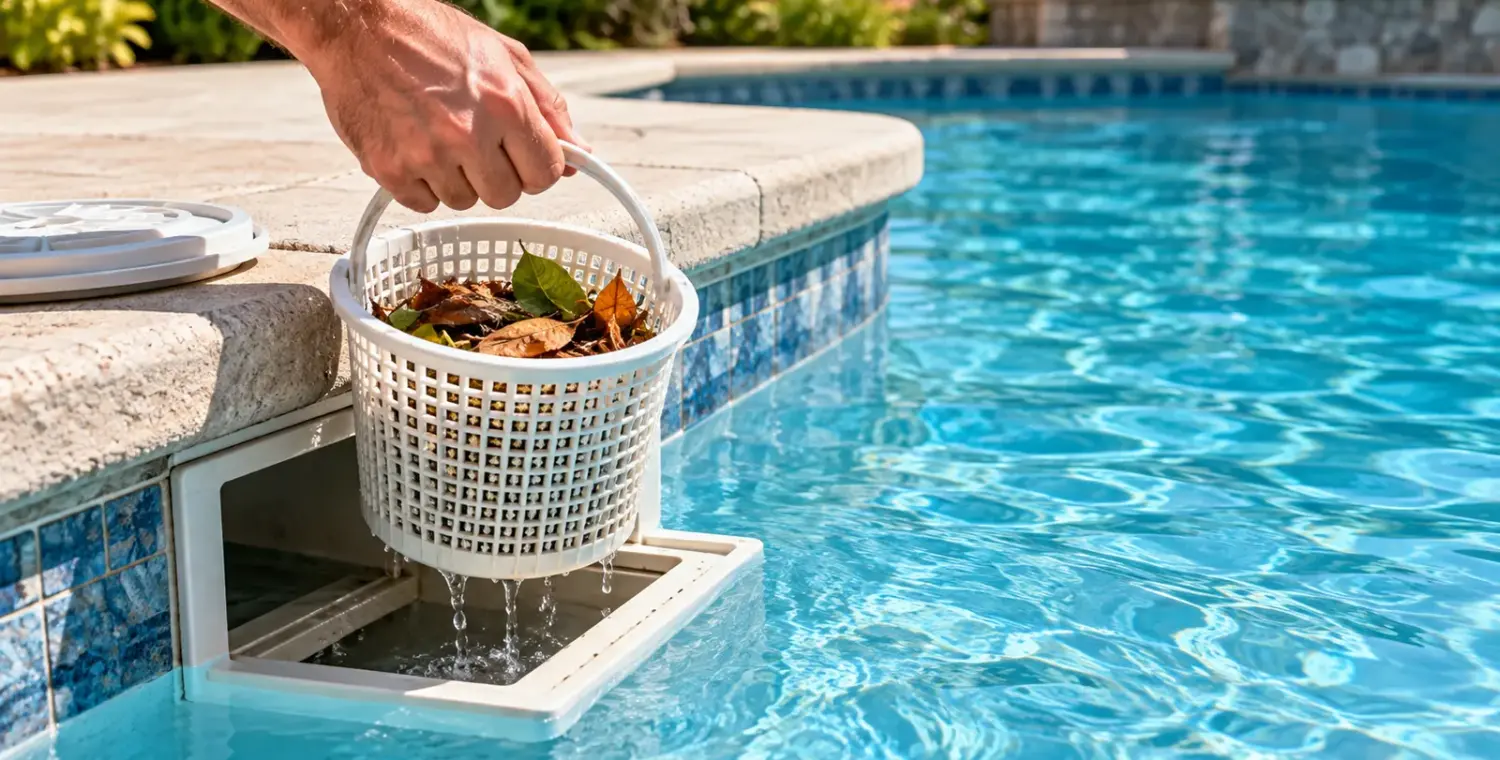
The skimmer basket is the small strainer just inside the skimmer opening at the edge of your pool. It catches leaves, insects and other floating debris before that material reaches the pump. Emptying it is one of the quickest jobs in pool care. Letting it fill up, though, can quietly affect how well the pool skims and how the pump runs.
This guide explains how often to check the basket, why it matters, and how to empty it safely. It keeps three kinds of advice apart: what equipment manufacturers actually say, what is general maintenance practice, and what depends on your own pool’s conditions.
The short answer
Check the skimmer basket regularly and empty it whenever it holds debris. There is no single interval that is right for every pool. One manufacturer’s skimmer guide gives a concrete starting point: Pentair’s Bermuda skimmer instructions say to check the strainer basket every few days for accumulated leaves and debris and to empty it as required. Treat that as a baseline for those skimmers, then check more often whenever your pool collects more debris.
| Type of guidance | What it says | How to use it |
|---|---|---|
| Manufacturer guidance (Pentair Bermuda skimmers) | Check the basket every few days; empty it as required | Follow it for that equipment; check your own skimmer’s manual |
| Manufacturer guidance (pump and filter manuals) | Clean the pump strainer and skimmer baskets regularly | No fixed interval is given; keep baskets clear |
| U.S. Department of Energy guideline | Skimmer baskets need to be checked and cleaned regularly | Supports a routine check, not a specific schedule |
| Condition-dependent decision | Debris load changes with season, trees, wind and use | Shorten the interval when the basket fills faster |
What the skimmer basket does
Most pools draw part of their circulation through one or more skimmers at the waterline. A hinged flap called the weir lets surface water spill in, and the basket underneath strains out larger debris. Water then continues to the pump, which has its own strainer basket, and on to the filter. The skimmer basket is the first line of defense: it keeps leaves and similar material out of the plumbing and the pump.
Because the basket sits in the flow path, its condition affects everything downstream. A clear basket lets the skimmer pull floating debris off the surface. A packed basket restricts that flow.
How often to check the skimmer basket
Equipment makers describe basket care as routine rather than as a fixed calendar:
- Skimmer manufacturer: Pentair’s Bermuda skimmer guides tell owners to check the strainer basket every few days for accumulated leaves and debris and to empty it as required.
- Pump and filter manufacturers: Pentair’s pump guide and Hayward’s filter manual both say to clean the pump strainer and skimmer baskets regularly, to protect the equipment and keep the system working properly.
- Energy guidance: a U.S. Department of Energy guideline on pool pumps states that skimmer baskets need to be checked and cleaned regularly.
None of these sources sets one universal number of days, and you should not treat any interval as a rule for every pool. A practical approach is to look into the skimmer as part of your normal pool checks and empty the basket whenever debris has collected, rather than waiting for it to be full.
When to check more often
How fast a basket fills depends on what lands in your pool. As general maintenance practice, check more often:
- in autumn or whenever nearby trees are shedding leaves, seeds or blossoms;
- after storms, strong wind or heavy rain;
- during periods of heavy swimming or parties;
- after landscaping, mowing or construction near the pool;
- when you notice debris floating on the surface longer than usual.
A pool under a screen enclosure or a cover may need less frequent attention. Your own observations are the best guide: if the basket is regularly half full when you check it, check sooner.
Why a full basket matters
A neglected basket is more than a cosmetic problem:
- Poorer skimming. In Pentair’s troubleshooting table, an obstructed skimmer basket is listed as a cause of a pool surface that is not clean and of inadequate skimming. The remedy is simply to clean the basket.
- Risk to the pump. Pentair warns that low water levels or clogged skimmer baskets may damage the pump through loss of prime, when the skimmer pulls air, or cavitation, when the skimmer clogs. This warning appears in its installation notes for residential setups where the skimmer is not connected to an equalizer or main drain line, so the exact risk depends on how your system is plumbed.
- Air in the system. The same guide notes that air pulled in by skimmers can be trapped in filter tanks, which may be a safety hazard. If your skimmer regularly vortexes or sucks air, Pentair advises raising the water level or contacting a pool service professional.
If the pump has already lost prime or water has stopped moving, the basket is only one possible cause. Our guides to a pool pump losing prime and a pool pump that is not circulating water walk through the wider troubleshooting.
Safety first
Skimmers and drains are part of the pool’s suction system, so treat them with respect:
- Keep hands, hair and loose items away from suction openings and drains. CPSC’s Pool Safely program advises staying away from drains in a pool or spa and teaching children not to play around drains.
- Never swim in a pool with a broken, loose or missing drain cover. Pool Safely says such a pool should be closed until it is repaired, and a U.S. Department of Energy guideline describes a broken or missing drain cover as a serious health risk.
- Keep the skimmer lid in place. Pentair warns that a lid that is not properly secured, or one that is worn or damaged, can give way when stepped on and cause serious injury. Replace a worn or damaged lid.
Step by step: emptying the skimmer basket
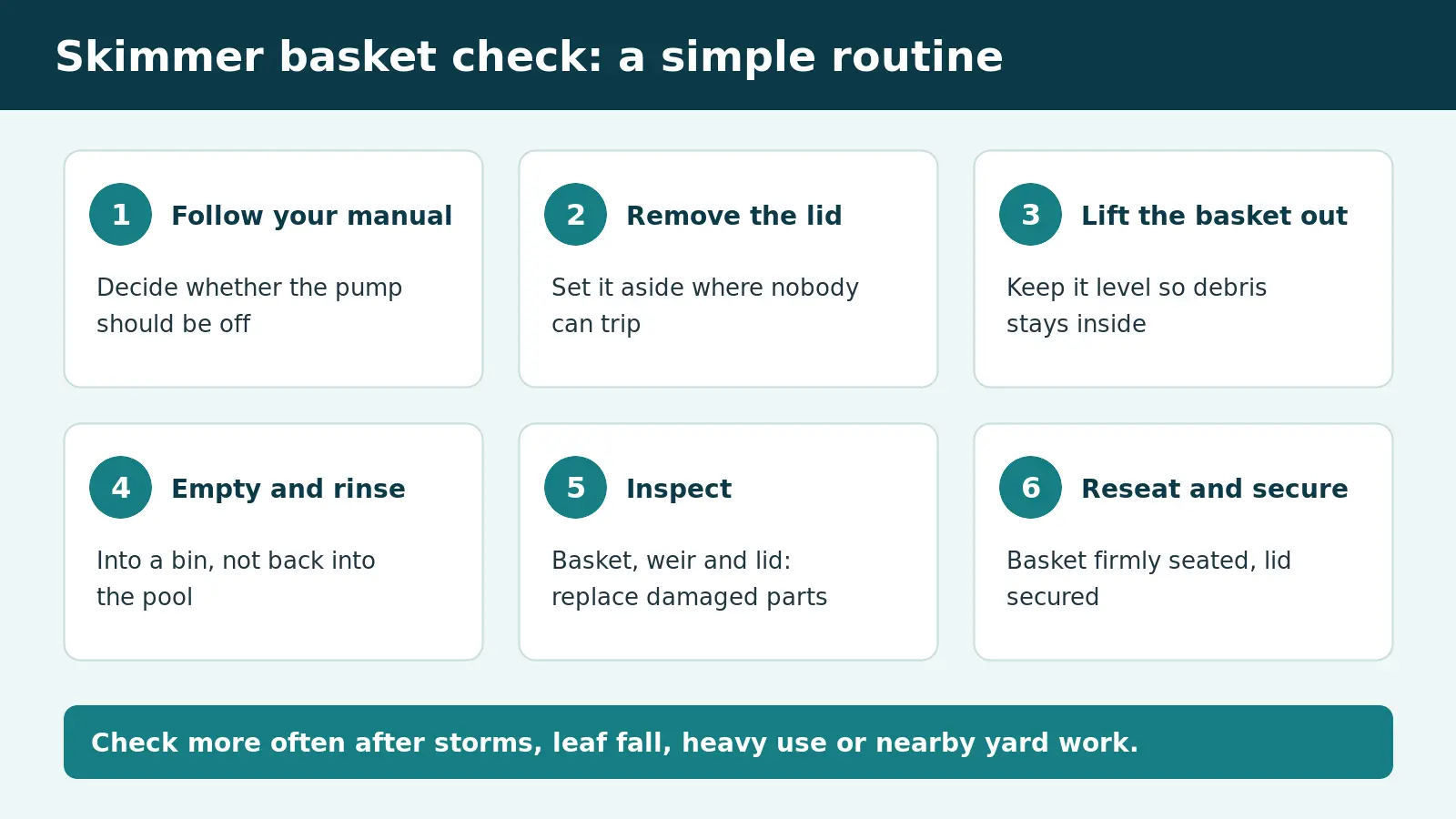
Check your skimmer and pump manuals first, because designs differ. A typical routine looks like this:
- Decide whether to stop the pump. Follow your equipment manual. Where the manual does not say, switching the pump off is a simple general precaution so the basket is not under suction while you lift it and loose debris is not drawn toward the pump.
- Remove the skimmer lid from the deck and set it aside where nobody will trip over it.
- Lift the basket out by its handle, keeping it level so debris stays inside.
- Empty it into a bin or compost, not back into the pool or onto the deck. Rinse it with a garden hose if debris is stuck in the mesh.
- Inspect the basket. Look for cracks, a broken handle or a damaged rim. A damaged basket can let debris pass through to the pump, so replace it with the correct part for your skimmer.
- Check the weir. Pentair recommends periodically checking that the weir moves freely and replacing it if it is damaged or worn.
- Reseat the basket firmly in its seat, then put the lid back and make sure it is secure.
- Restart and watch the system briefly if you switched it off, following your pump manual.
Skimmer basket vs pump strainer basket
Many pools have two baskets, and they are easy to confuse:
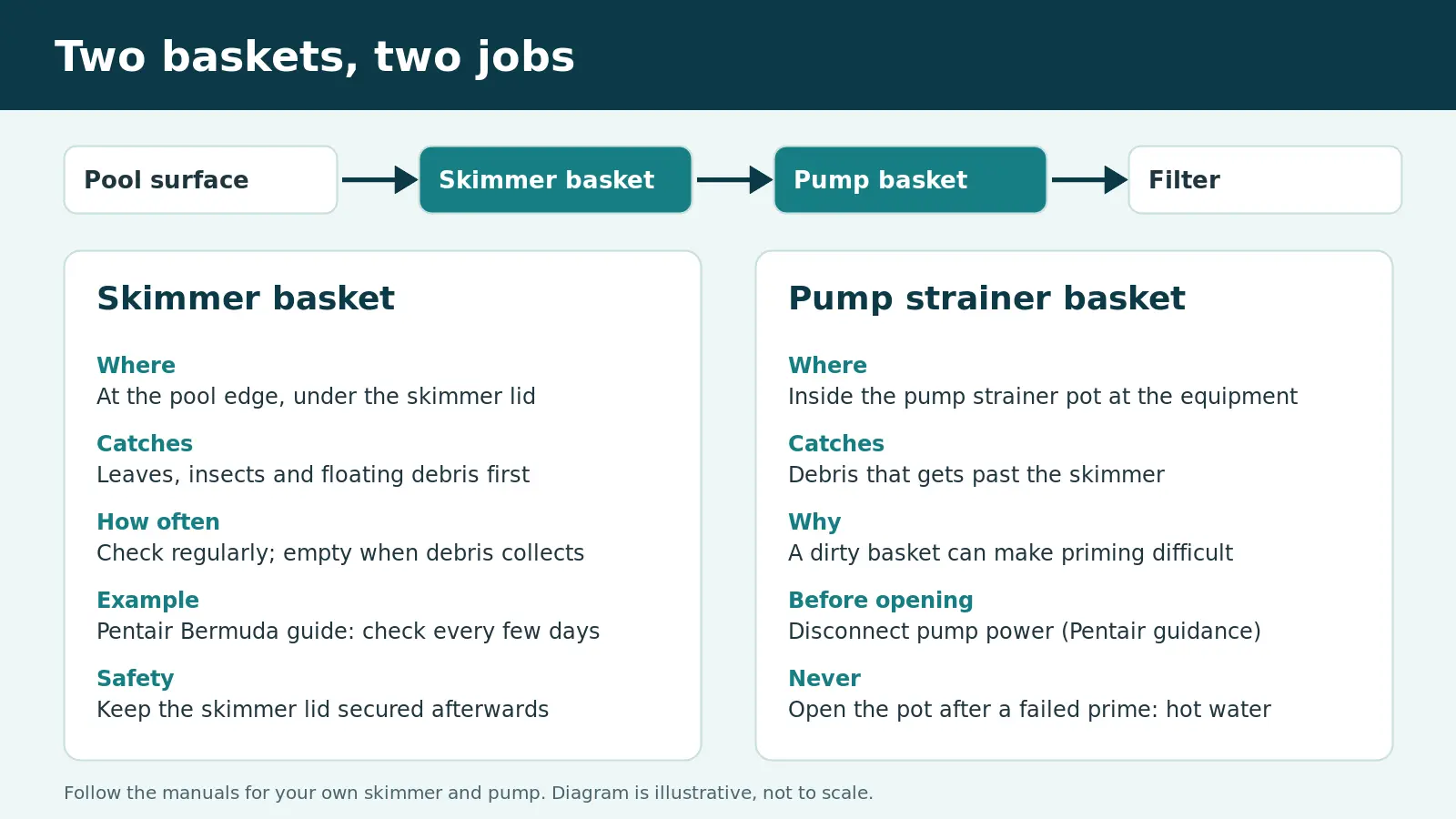
- Skimmer basket: at the pool edge, under the skimmer lid. It catches floating debris first and is the one most owners empty often.
- Pump strainer basket: inside the pump’s strainer pot at the equipment pad. It catches what gets past the skimmer. The Department of Energy guideline notes that a dirty pump basket can affect pump and system performance and make the system difficult to prime.
The pump basket needs extra care. Pentair’s pump guide says to disconnect power to the pump at the circuit breaker before servicing the pump, and warns not to open the strainer pot if the pump failed to prime or ran without water in the pot, because it may hold vapor pressure and scalding hot water. If you are unsure, leave the pump basket to a pool professional. Rising or falling filter pressure is a separate question covered in our guide to pool filter pressure that is too high or too low.
Check the water level while you are there
The skimmer can only do its job when the water surface is at the right height in the opening. If the level drops too low, the skimmer can pull air. The right level depends on the skimmer: Pentair’s Bermuda skimmer guides specify keeping the water at least 1½ to 2 inches above the bottom of the skimmer opening, and another passage of the same guides describes about halfway up the opening. Use the figure in your own skimmer’s manual. If the level keeps dropping between top-ups, see our guide to telling evaporation from a leak.
Seasonal notes
Basket care continues all season, but closing the pool changes the routine. Pentair’s Bermuda guides list removing the skimmer lid, basket and float as part of winterizing, after the water has been lowered below the skimmer inlet. Closing procedures depend on your pool and equipment, so follow your manuals and see our checklist on how to winterize an above-ground pool where it applies.
When to call a pool professional
Emptying the skimmer basket is an owner task. Call a qualified pool professional if the skimmer keeps pulling air even with a clean basket and a correct water level, if a cracked skimmer body, lid or drain cover needs replacing, if the pump will not prime, or if you are unsure how to service the pump strainer pot safely. Equipment manuals differ between brands and models, and the manual for your exact skimmer and pump takes priority over any general guide, including this one.
Sources
- Pentair: Bermuda Vinyl Skimmer Installation and User’s Guide
- Pentair: Bermuda Gunite Skimmer Installation and User’s Guide
- Hayward: Pro Series Top-Mount Sand Filter Owner’s Manual
- U.S. Department of Energy, Building America: Measure Guideline for Pool Pumps
- U.S. CPSC Pool Safely: The Terrain of Drains: What Makes Them Safer
- Pentair: SuperFlo Pump Installation and User’s Guide
Research checked October 1, 2026. We only claim hands-on testing when we’ve actually tested the product ourselves. Manufacturer guidance applies to the named products; follow the manuals for your own equipment.