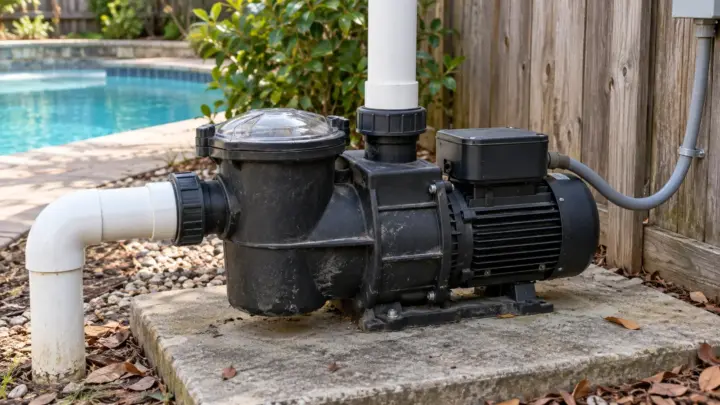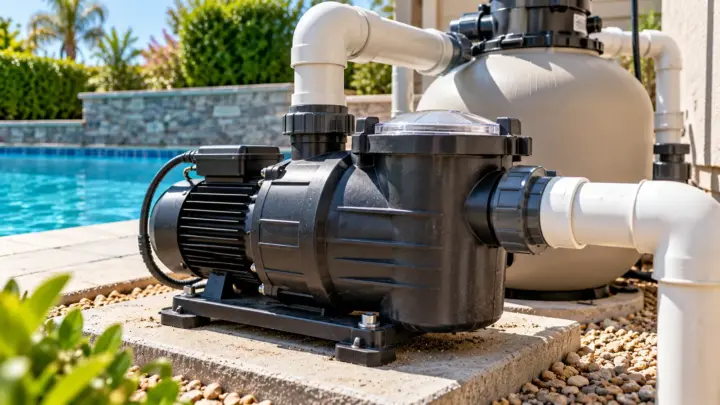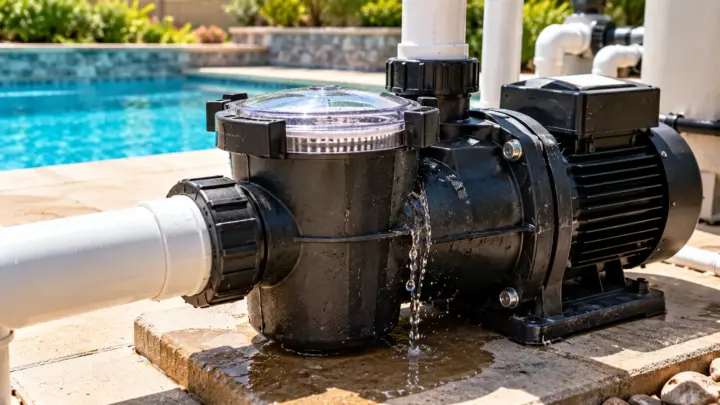
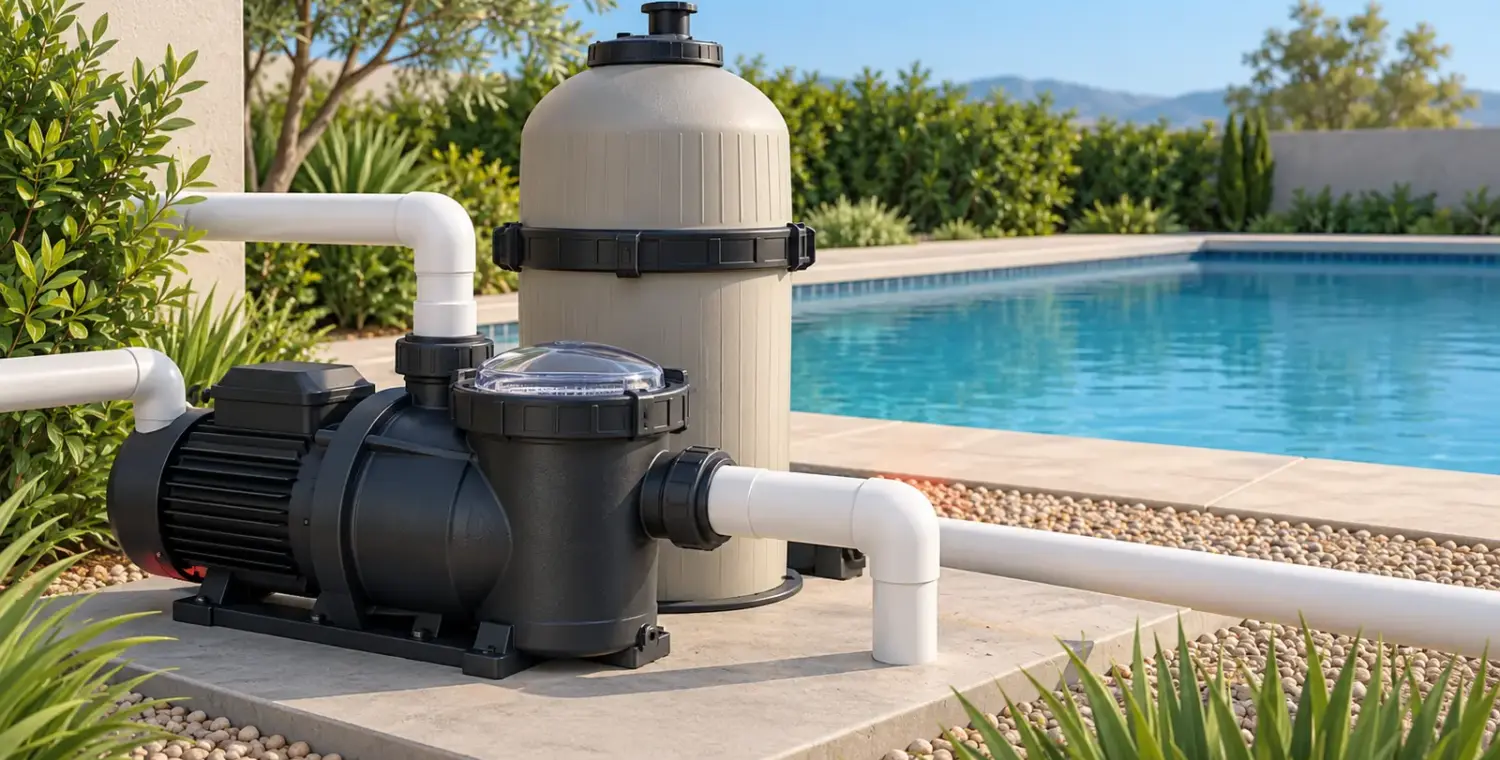
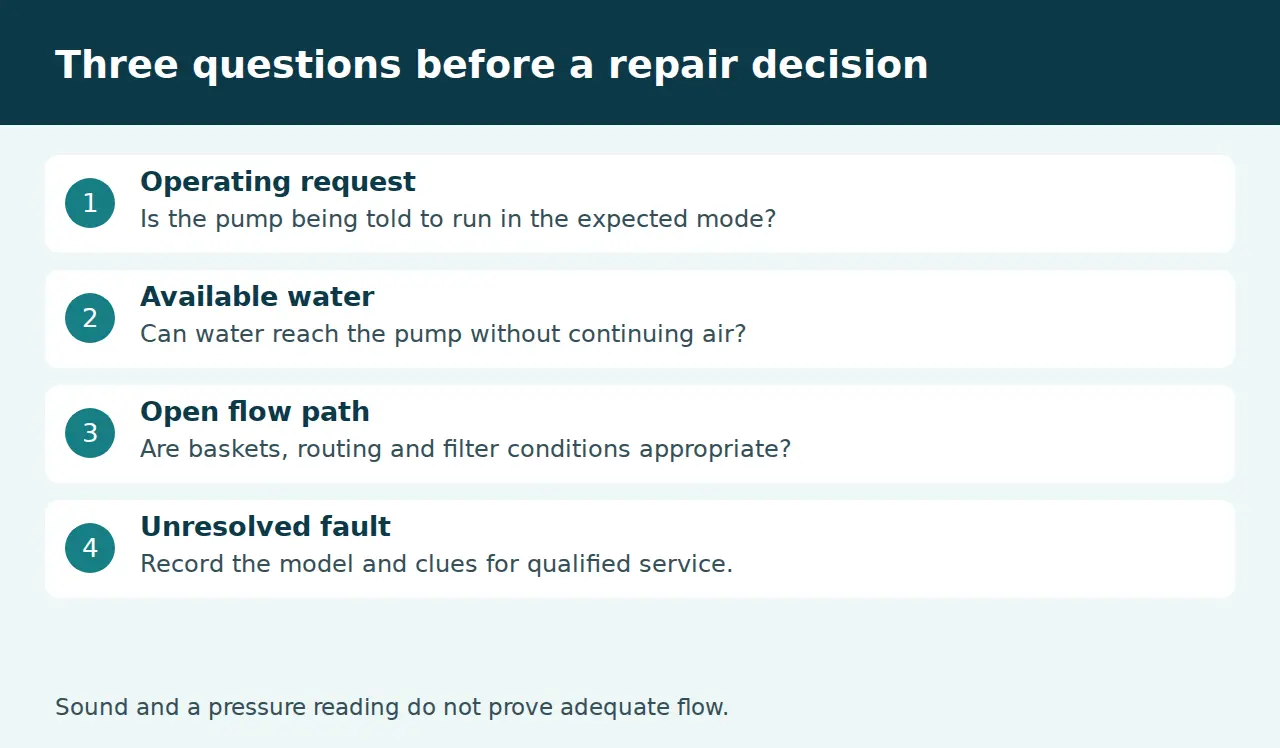
If your pool pump is not circulating water, first determine whether it is being told to run, whether it has water available, and whether something is restricting the flow path. A motor sound, illuminated display or pressure reading cannot answer all three. Stop dry-running or unsafe equipment before trying to restore circulation.
This is a first-check guide for residential owners. It helps you record useful clues and recognize permitted maintenance; it does not authorize electrical testing, pump disassembly or opening a pressurized filter. Use the manuals for the exact pump, filter and connected equipment, and call qualified service when the cause or safe procedure is unclear.
Shut down if the equipment is unsafe
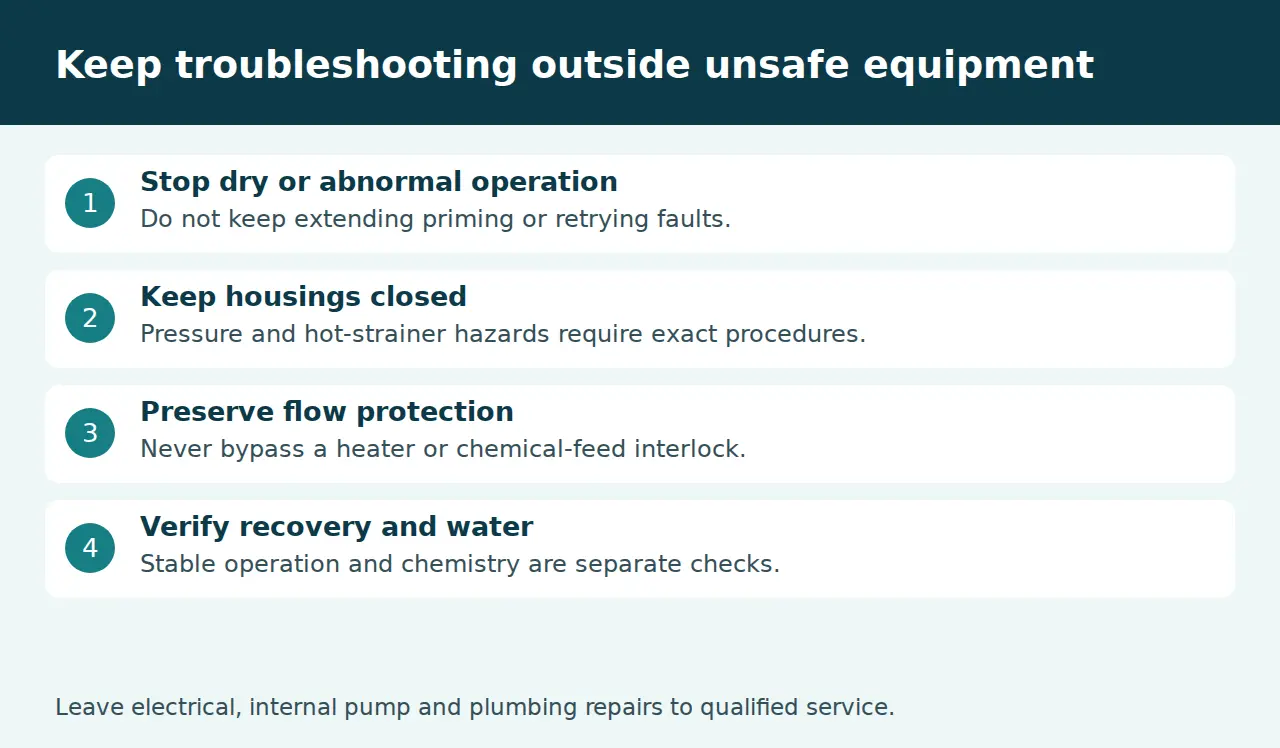
Stop operation if the pump runs dry, overheats, makes severe abnormal noises, has a cracked or leaking housing, or shows an electrical fault. Do not repeatedly reset a protective device to make it run. Flooded equipment or damaged wiring needs qualified assessment before use.
Do not open a failed-to-prime or dry-running pump immediately. Pentair warns that its strainer can contain scalding water and vapor pressure. Cooling, power isolation, pressure relief and the correct valve arrangement must be established under the exact manual before access. Do not loosen a filter clamp, lid, gauge or fitting to see whether water is present.
Keep people away from suction outlets. Never use your hand or body to test suction, remove a drain cover, or operate the pool with a broken, missing or loose suction cover. Shut down equipment safely from an accessible dry location; if electrical safety is uncertain, keep away and seek emergency or qualified assistance as appropriate.
Describe what “not circulating” looks like
Write down whether the pump is silent, starts then stops, sounds as though it is running without normal return flow, or moves some water but much less than usual. Record displays and alarms before any permitted adjustment. These branches can lead to different investigations.
Observe accessible controls and return movement from the deck. Do not reach into suction openings. If only one return seems weak while others look normal, record that distinction rather than concluding the entire pump has failed. Observations are clues, not measured flow rates or proof of a defective component.
Choose the appropriate first-check branch
| Observation | Safe first information | Service boundary |
|---|---|---|
| Silent pump, no expected operation | Schedule, selected mode, visible status and alarm history | Do not open electrical compartments or test live voltage |
| Starts then stops | Exact fault message, heat or water-supply observations | Persistent faults need qualified diagnosis |
| Running with air or little visible water | Pool level, recent lid service, baskets and valve history | Stop dry operation; do not open a hot strainer |
| Water present, poor return flow | Basket condition, unchanged routing and filter baseline | Internal obstructions and pressure equipment need service |
| A connected device reports no flow | Model-specific message and circulation observations | Never bypass its flow protection |
Check the operating request before suspecting a failure
Compare the current time and selected mode with the commissioned schedule. A pump intentionally outside its operating period is a different situation from one that should be running but cannot start. Note recent changes to automation, cleaning modes or the pump’s own controls.
On variable-speed equipment, normal filtration and other operating stages may use different settings. Record the displayed stage and any error rather than choosing an arbitrary high speed. Pump programming, external controls and restart behavior vary by model. Consult its owner’s instructions or ask the installer to verify the request.
Our pump type comparison explains those control differences. The pool pump runtime guide is useful for checking an established schedule after the circulation fault has been resolved. Additional hours cannot correct a blocked path or unsafe pump.
Do not turn fault recovery into repeated retries
A fault code belongs to its exact model and manual. Save its wording and the circumstances. Do not use another brand’s reset procedure or erase the history with a factory reset. If the pump repeatedly stops, trips protection or fails its permitted startup, leave it off and seek service.
A service technician may need to investigate the power supply, controls or internal assembly. Homeowners should not open the motor or drive enclosure, change wiring, or attempt live electrical measurements. The presence of a display is not evidence that every electrical component is safe or working.
Confirm water is available to the pump
Check the pool level against the pool and skimmer requirements. Low water can allow the skimmer to draw air and prevent reliable prime. Note whether the problem began after a level drop, water disposal or work on the circulation system.
Where there is a clear pump lid, observe the chamber without opening it. Continuing air or little water supports investigating the water-supply and priming branch, but does not identify a particular leak. A lid seal, suction plumbing or valve arrangement may be involved.
Use only the model’s permitted priming and restart procedure after safe shutdown conditions are met. There is no universal “let it run for another few minutes” answer. A pump that cannot establish stable water movement should be stopped rather than left operating unattended.
Look for basket restrictions
Debris-filled skimmer and pump baskets can limit the water supply. Inspect what is safely visible from outside first. Heavy leaf fall, recent storms or a long interval since inspection can help explain why this changed, but basket appearance alone does not exclude other faults.
If basket cleaning is an owner-permitted task, follow the exact shutdown, cooling where needed, power-isolation, pressure-relief and access instructions. Prevent automatic restart. Reinstall the required parts correctly before the full restart procedure. If you cannot establish safe access, arrange service instead.
Do not reach through the pump basket opening to search for an obstruction, remove a suction fitting or operate without protective components. A blockage in plumbing is a professional investigation, not a reason to insert tools into a running system.
Review the water route and recent valve changes
Photograph labelled valve positions and compare them with your known normal configuration. A recent backwash, cleaner change or service visit may have left the system in a different mode. The pump needs the correct available suction and discharge routes for that installation.
Do not randomly change unfamiliar valves or move a multiport valve while operating. Follow the exact equipment’s shutdown and positioning rules. A valve’s handle direction may not mean what you expect; ask the installer to identify the routes if labels are missing or unclear.
If a newly installed pump has never circulated satisfactorily, the installation needs assessment. Our pump sizing guide explains how equipment requirements and plumbing resistance fit together. Buying a more powerful pump is not an appropriate substitute for finding the fault.
Use filter pressure as a clue, not a verdict
A dirty filter or restricted discharge path can reduce circulation. Record the gauge reading, pump setting and operating mode only when doing so is safe. Compare readings with an established clean-system baseline under the same configuration rather than a universal normal pressure.
The filter pressure guide covers the distinction between pressure and flow and why high or low readings need context. A faulty gauge can mislead you; no pressure reading by itself proves that a pump or filter is the failed part.
Filter maintenance must follow its maker’s safety instructions. Pentair’s current safety page recommends professional maintenance of its filters. Do not loosen the housing to “release a blockage,” backwash every filter type, or copy cartridge-cleaning instructions onto a DE or sand system.
Leave impeller and plumbing faults to qualified service
Pentair’s diagnostic tables include obstructed or incorrectly functioning internal pump parts and restricted plumbing among no-flow causes. These possibilities are useful to explain why exterior checks may not solve the problem. They do not make internal inspection an owner task.
Give the professional your pump model, alarm record, visible water and basket observations, known valve configuration and the last time circulation was normal. Include recent repairs or equipment replacements. Avoid deciding that a new motor, seal or impeller is required before diagnosis.
Check connected equipment without bypassing protection
A salt chlorine generator or heater may report insufficient flow. The message can reflect a real circulation problem or a device-specific fault, so consult that device’s manual as well as the pump’s. Record whether the message appeared after a speed change or alongside abnormal water movement.
Never bridge, defeat or adjust safety protection simply to force chemical production or heating. Chemical-feed systems must not continue feeding without the required circulation. Qualified service should assess unresolved flow and interlock problems.
Verify recovery before returning to normal use
After a supported correction, use the complete restart procedure and stand clear of pressure equipment where instructed. Confirm stable normal operation and resolved alarms. A motor running briefly is not enough; record whether the original water-movement problem returns.
If circulation has been interrupted, check water condition separately. Use the pool water testing guide and applicable sanitizer instructions before swimming. Clear water or renewed flow does not establish an adequate disinfectant residual.
Common questions
The motor is humming. Is water definitely moving?
No. Sound is not a flow measurement. Stop abnormal operation and record accessible water, control and alarm observations without approaching moving or energized parts.
Should I clean the filter first?
Not automatically. Start with the no-flow branch and operating history. The water supply, controls, baskets, valves or internal pump may be involved, and pressure equipment needs its own safe maintenance procedure.
Can I swim while waiting for the repair?
Keep the pool out of use if equipment or suction safety is unresolved, visibility is poor, or sanitizer and pH conditions cannot be verified. Arrange repair and water checks rather than assuming the pool remains suitable because it looks familiar.
Research checked October 1, 2026. We only claim hands-on testing when we’ve actually tested the product ourselves. Featured image is an original illustration.
Sources and references
- Pentair: SuperFlo VST/VS and SuperMax VS Installation and User Guide
- Pentair: SuperFlo High Performance Pump User Guide
- Pentair: Pool and Spa Equipment FAQs
- Pentair: 7 Servicing Tips for Variable Speed Pumps
- Pentair: 4 Safety Tips for Servicing Pool Filters
- US CPSC: Steps for Safety Around the Pool
- Pentair: Pool Filter Product Safety and Help Center
- CDC: Home Pool and Hot Tub Water Treatment and Testing
- CDC: Pool Chemical Safety