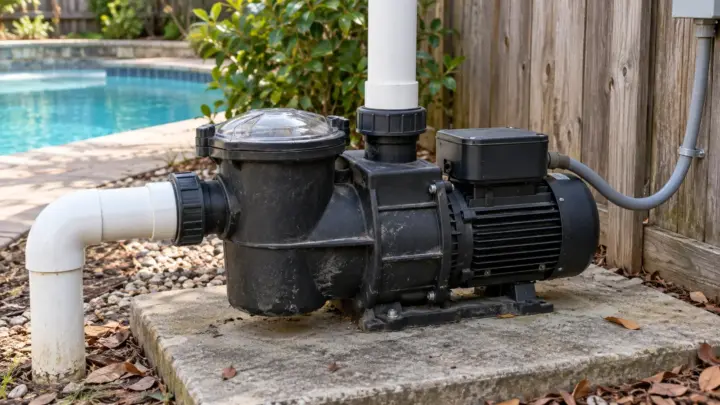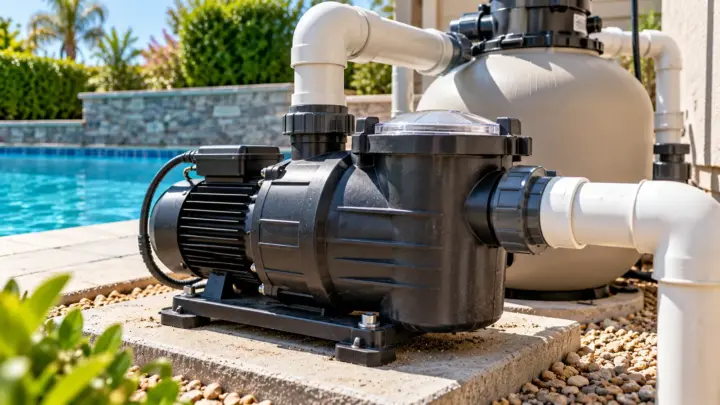

Run your pool pump long enough, at suitable flow settings, to meet your installation’s filtration, sanitizer, heating and cleaning needs. There is no single number of hours that proves every residential pool is adequately maintained. Start from the commissioned schedule or manufacturer and installer advice, then evaluate actual operation and water tests before making a change.
This guide explains how to build that decision. It is for an operating residential pool, not new plaster startup, commercial pool compliance, contamination cleanup or a system that has lost normal circulation. Those situations need their own instructions.
Is six or eight hours a day enough?
A familiar number is a starting question, not a verified answer. ENERGY STAR uses six hours versus continuous operation to illustrate reduced pumping energy and discusses splitting cycles for debris collection. The page does not establish six hours as sufficient for every salt cell, heater, pool or weather condition.
The Australian Government recommends minimizing unnecessary pumping while using the lowest recommended speed that maintains hygiene, and consulting the supplier about adequate run times. Apply the same approach to your own installation: identify its requirements and verify the result.
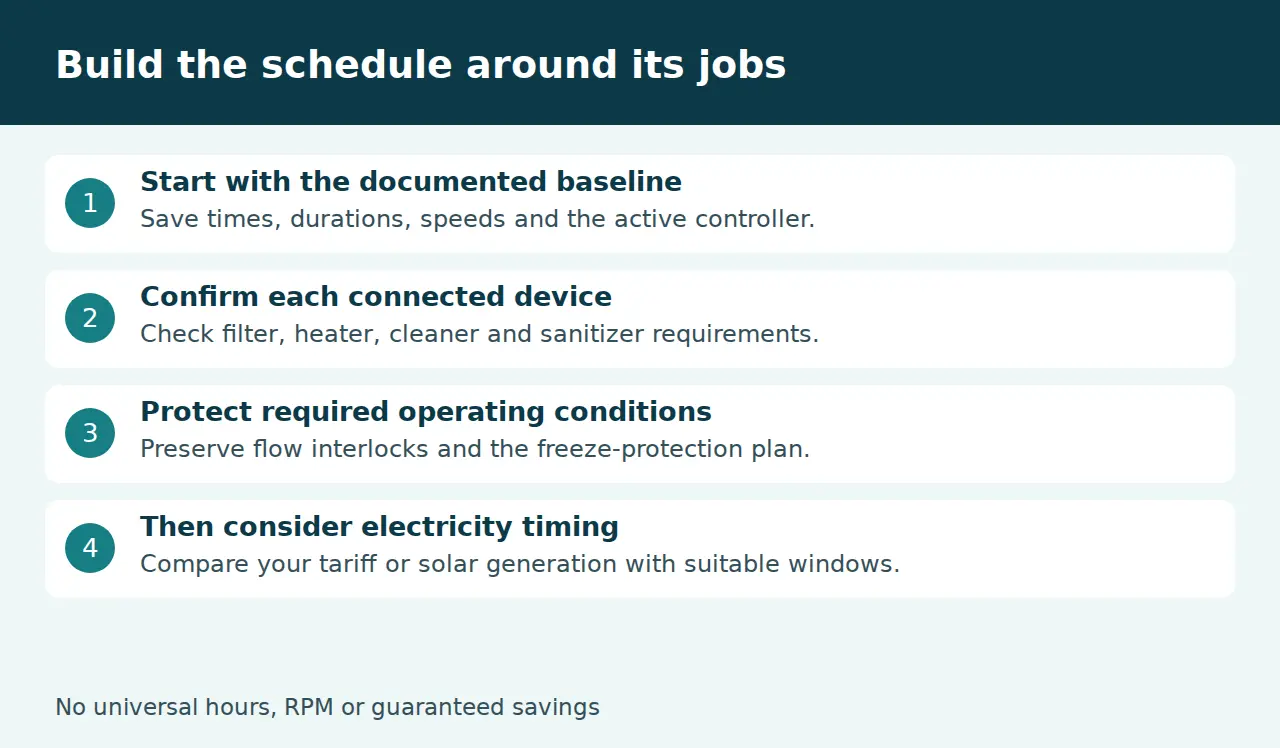
Before changing anything, photograph the current schedule. Write down start times, durations, speeds, equipment modes and who configured them. A recent reduction made by someone else is useful context. If you have no safe baseline, ask your installer to establish one instead of trying progressively shorter schedules while the water deteriorates.
List the jobs your pump must support
| Job | What to confirm | Record beside the schedule |
|---|---|---|
| Filtration and surface collection | Appropriate system flow and normal operation | Filter condition, observations and operating mode |
| Salt chlorine generation | Required flow, enabled production and sufficient output opportunity | Cell model, output setting and status lights |
| Heating | Heater instructions and control requirements | Heating window and specified operating conditions |
| Pump-dependent cleaning | Cleaner’s operating instructions | Cleaning window and required setting |
| Freeze protection or special care | Installation-specific protective plan | Conditions that override ordinary scheduling |
Put the exact manual beside each task. Do not take one component’s minimum as the correct setting for the whole installation. If requirements conflict, have the installer reconcile them. Increasing speed blindly can also move the system outside an equipment rating.
Keep pool volume and actual flow distinct from pump horsepower. Our pump sizing and flow-rate guide explains the information needed to match circulation equipment. A motor label alone does not tell you what your installed system moves at a particular setting.
Use turnover arithmetic carefully
Dividing pool volume by flow gives a nominal time to move an equivalent volume through the system. Keep the units compatible. For an illustrative 20,000 US gallon pool with constant measured flow of 40 US gallons per minute, the calculation is 20,000 ÷ 40 = 500 minutes, or 8 hours 20 minutes.
That is a worked arithmetic example, not a runtime recommendation. It assumes the stated flow is real and sustained. It does not demonstrate that each parcel of water passed through the filter, that sanitizer is adequate or that every connected device operated correctly.
If actual flow is unknown, write “unknown” on the worksheet. Do not substitute a marketing maximum, a different pump’s curve or an unconfirmed display estimate. Ask your installer how flow was determined and what operating conditions apply to that measurement.
For schedules with several speeds, keep a separate row for each stage. A total of operating hours hides the difference between stages. Review the system with the filter in its specified operating condition; a schedule designed around an unexplained flow problem is not a reliable energy plan.
Why variable-speed schedules can run differently
Variable-speed pumps allow different operating settings for different jobs. Government energy guidance describes slower pumping for filtration and higher settings when needed for other tasks. Longer operation at an appropriate lower setting may therefore be part of a sensible commissioned schedule.
Do not infer energy use from hours alone. Compare measured or documented electrical consumption under comparable conditions. A long low-speed block and a short higher-speed block can have different power demands; your pump and system determine the actual values. To turn measured watts and hours into a cost, see how much it costs to run a pool pump.
Keep the scope of manufacturer examples clear. Pentair’s SuperFlo-family guide provides a factory schedule and custom programming instructions, but also describes external-control operation and priority behavior. Copying its factory hours or button sequence to an unrelated pump would ignore both the model and the installation.
If you are evaluating an existing variable-speed schedule, identify which stage serves which job. Label a stage “filtration,” “heater” or “cleaner” only after confirming that purpose. An unexplained high-speed period may have a legitimate function that should be checked before deletion.
Saltwater pools need an output check
A salt chlorine generator produces chlorine while its operating conditions permit it. The IntelliChlor manual links output control to pump operation and specifies that insufficient flow prevents production. A shorter pumping schedule can therefore reduce the opportunity for production even when the percentage setting is unchanged.
Watch the actual status indicators and test the water; a powered display is not proof of adequate output. Do not bypass a flow switch or add salt to clear an unrelated warning. Temperature restrictions, salinity requirements and control behavior belong to the exact generator model.
When a runtime change coincides with falling chlorine, restore a known suitable program if appropriate and review the entire sanitizer plan. Raising the percentage setting is not a universal answer. Keep swimmers out if required water conditions cannot be verified, and follow the approved corrective treatment and reentry instructions.
Choose the time of day after the operating requirements
Set the required operating windows first, then examine electricity timing. For a home with solar generation, Australian guidance includes setting the pool timer for daytime use and checking the monitoring app. For time-of-use tariffs, compare your actual rate periods and any export trade-off.
Do not assume night operation is always cheapest or daytime operation is always best. Record the tariff source and date in your household worksheet. Pool care must still fit the chosen windows, and local noise restrictions may also matter.
Split cycles can be useful for surface-debris collection, as ENERGY STAR notes. Before choosing them, check the pump and automation instructions for starting behavior, priorities and dependent equipment. A handwritten plan that differs from what the controller actually runs is not a completed schedule.
Change one setting and keep a review log
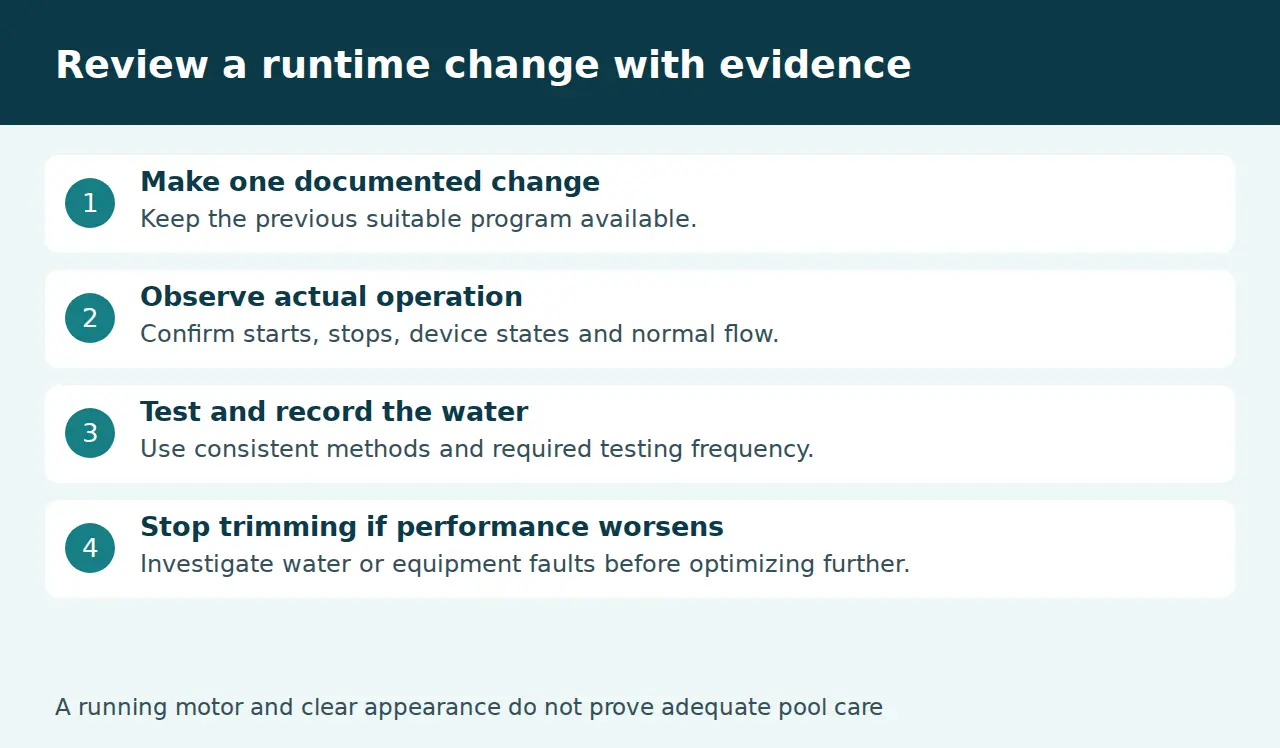
Only optimize a pool that has stable water care and normal equipment operation. Establish what will count as a successful change before making it. Keep the same test method and comparable observation times so you can distinguish a schedule effect from a different sampling routine.
- Save the previous program and identify the reason for the proposed change.
- Confirm that every required task and protective condition remains covered.
- Change one documented parameter through the approved controls.
- Check that the real start, stop and operating modes match the plan.
- Record water results, clarity, debris and equipment warnings.
- If performance worsens, stop trimming time and investigate rather than making several compensating changes at once.
Use our pool water-testing guide to organize the measurements. Clear-looking water alone does not establish adequate sanitizer. Continue the frequency required by your care program, with extra checks when conditions demand them.
Reassess after seasonal and usage changes
A program should have a review trigger. Record changes in pool use, debris, cover use and equipment configuration, and ask whether the existing program still meets its requirements. Treat those changes as reasons to review the program with your installer.
Ordinary efficiency trimming must not defeat freeze protection. The Pentair pump guide distinguishes winterization from operation during temporary freezing conditions. Follow the protective plan for your installation and local weather; a timer is not a guarantee against damage during an outage.
After power loss, check the controller’s actual time and program using its instructions. Also confirm that the installation is safe to restart. Do not open electrical equipment or reset repeatedly through unresolved faults.
If extra hours do not solve the problem
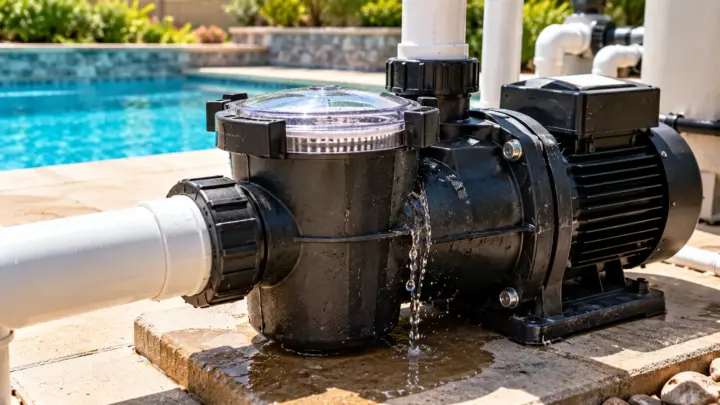
A pump running without normal flow needs diagnosis, not a longer appointment in the timer. Pentair’s troubleshooting guide includes inadequate water supply, air and restrictions among possible causes. Stop unsafe operation and seek appropriate service.
For unusual pressure observations, use the filter-pressure guide to prepare a record at comparable pump settings. Do not open pressurized equipment or interpret readings taken at different speeds as directly equivalent.
Ask a service provider to review the schedule when you cannot confirm flow, connected-device requirements, control ownership or persistent water-quality problems. Give them the original program, proposed change, test history and model numbers. The goal is a documented schedule that works for your pool and can be reviewed when conditions change.
Research checked September 30, 2026. We only claim hands-on testing when we’ve actually tested the product ourselves. Featured image is an original illustration.
Sources and references
- ENERGY STAR: Pool Pumps
- Australian Government: Pool pumps
- Australian Government: Get the most from your solar system
- Pentair: SuperFlo VST / VS / SuperMax VS user guide
- Pentair: IntelliChlor IC15/20/40/60 user guide
- US DOE Building America: Replacing Single-Speed Pool Pumps with Variable Speed Pumps