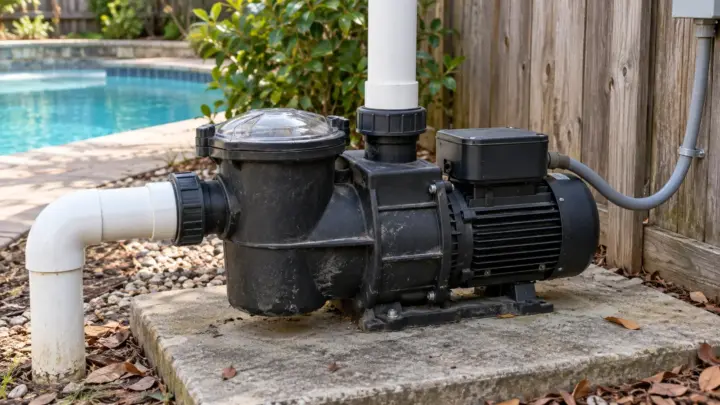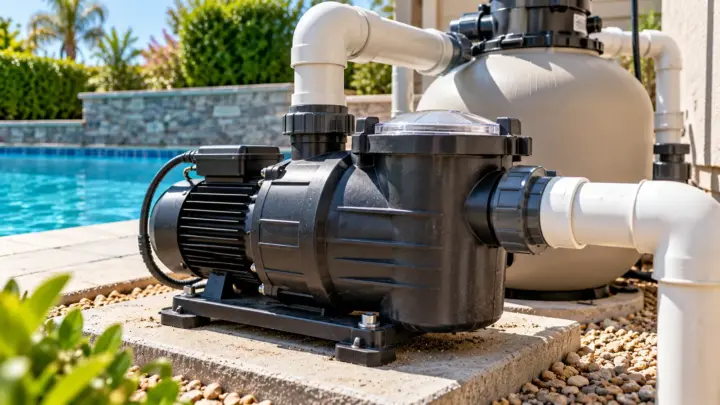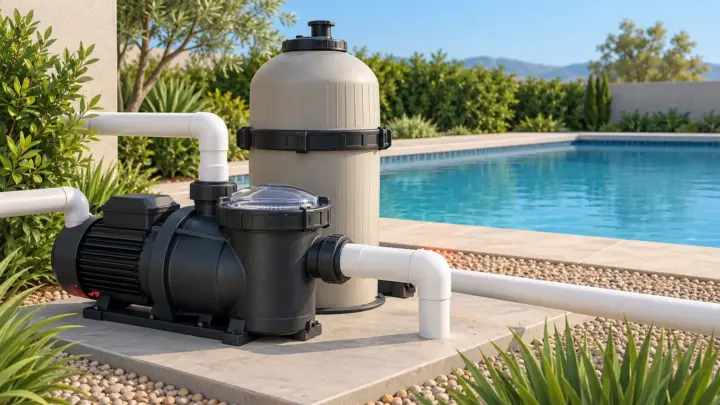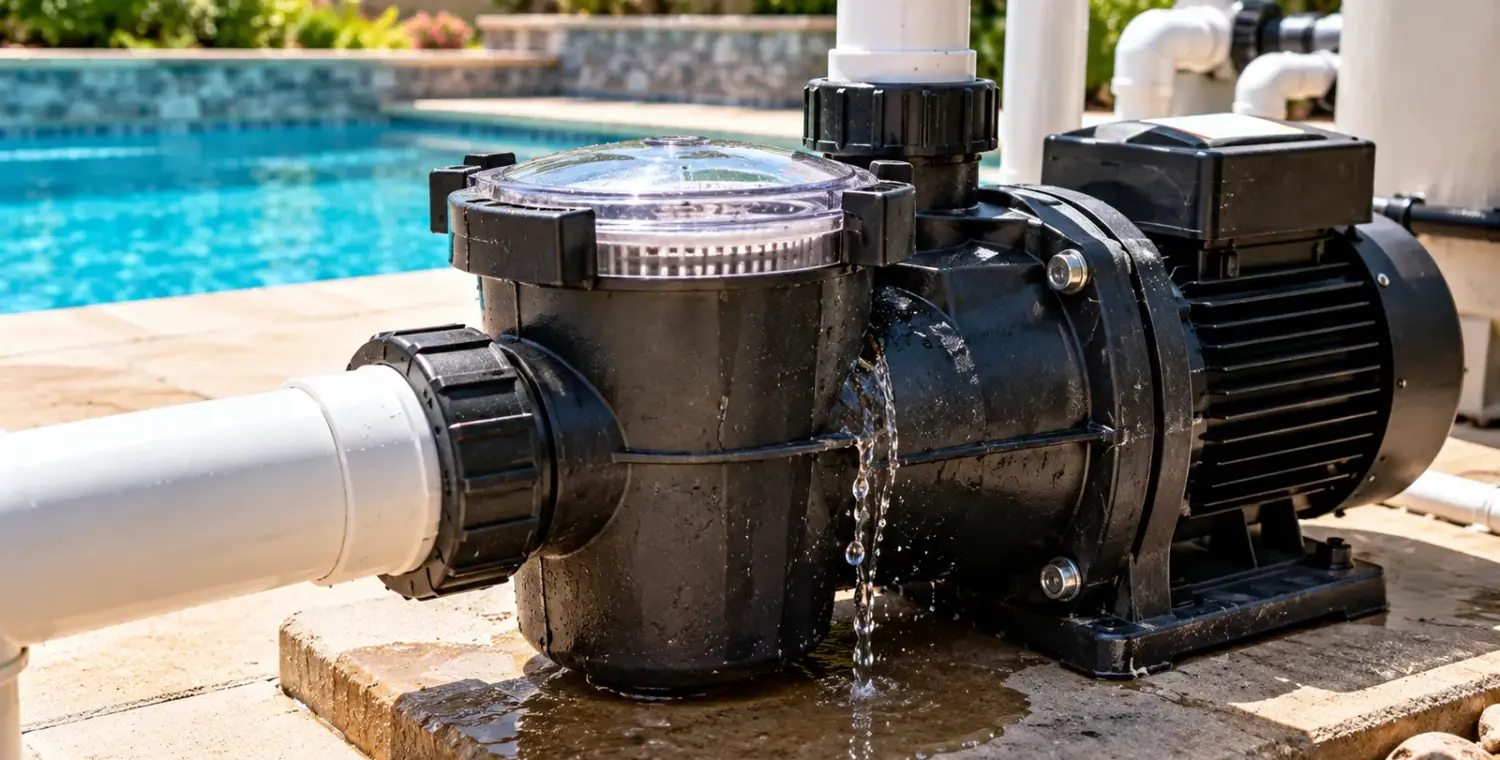
Water around a pool pump is worth tracking down quickly. Most pump leaks start at a handful of places: the strainer lid O-ring, the drain plugs, the threaded pipe connections at the inlet and outlet, the housing gaskets, and the shaft seal between the pump and the motor. Where the water appears is the best clue to where it comes from. If the water is coming from the heater rather than the pump, see pool heater leaking water.
The short answer
Switch the pump off, dry the area, then watch where water reappears when it runs. Water at the lid or drain plugs often points to an O-ring. Water at the pipe connections points to the threaded fittings. Water dripping from under the joint between the pump and the motor usually points to the shaft seal, which manufacturers say should be replaced by qualified personnel. Do not keep running a pump that leaks badly or lets water reach the motor.
Key takeaways
- Pentair and Hayward both say that running a pump dry can damage the mechanical seal and cause leaking.
- Seals and gaskets wear out. Hayward says they have a finite life and should be inspected frequently.
- Over-tightening plastic fittings can crack them; Hayward warns against it.
- Water reaching the motor is a reason to stop and call a professional.
Safety first
- Power off: Pentair says to always disconnect power to the pump at the circuit breaker before servicing. Water and electricity together are a shock risk. Hayward also says to replace damaged wiring immediately.
- Pressure: Hayward’s steps before removing the strainer cover are to stop the pump, close the suction and outlet valves, and release all pressure using the filter’s manual air relief valve.
- Do not start a leaking pump: Hayward says that if water leaks from anywhere on the pump or filter when you fill the strainer housing, do not start the pump.
Why a small leak matters
A slow drip may not look serious, but it can lead to bigger problems. US Motors (Nidec), a motor manufacturer, notes that moisture trapped in a pool pump motor can cause corrosion and that nearly one-half of all pool pump failures can be traced to leaky pipe joints or pump seal failures. A leak can also waste water, and on the suction side it can let air in instead of water.
Where to look
| Where you see water | Likely source | Owner check or professional? |
|---|---|---|
| Around the strainer lid | Lid O-ring dirty, dry, damaged or out of place | Owner check (power off, pressure released) |
| At the bottom of the strainer pot | Drain plug or its O-ring | Owner check |
| Where pipes thread into the pump | Threaded fitting, tape or cracked fitting | Owner inspection; professional if cracked |
| Between the pump housing and the motor, dripping underneath | Shaft seal or housing gasket | Qualified professional |
| On or inside the motor | Seal failure letting water reach the motor | Stop and call a professional |
Lid O-ring and drain plugs
The strainer lid seals with an O-ring. Pentair’s SuperFlo guide says it is important to keep the lid O-ring clean and well lubricated and to make sure it is properly placed when you reinstall the lid. Hayward says not to use petroleum-based lubricants on gaskets, O-rings or plastic parts, only silicone-based ones. Check that the O-ring is seated, clean, and not flattened or cracked, and replace it with the part specified for your pump.
Drain plugs at the bottom of the strainer pot also have O-rings. A drip there after winterizing or draining is often a plug that is loose or a worn O-ring.
Threaded fittings at the ports
Pipes often thread into the pump’s inlet and outlet. Hayward’s Super Pump manual says to tighten fittings only enough to prevent leakage and not to over-tighten, which may cause damage. If leaks occur, it says to remove the connector, clean off the old PTFE tape, re-wrap and re-install. It also says not to use plumber’s pipe dope on these plastic components because it may cause cracking. If a fitting or port is cracked, have it replaced.
Shaft seal leaks
The shaft seal stops water from following the motor shaft out of the pump. A leak here usually shows as water dripping from under the joint between the pump housing and the motor. Common reasons, according to manufacturers:
- Running dry: Pentair says that if the pump is run dry, the mechanical seal will be damaged and the pump will start leaking, and the seal must be replaced. Hayward explains that water acts as a coolant and lubricant for the seal.
- Wear: Hayward says shaft seals occasionally must be replaced due to wear or damage.
- Damage during service: Pentair notes that seal faces will leak if they are scratched or marred.
Hayward states that only qualified personnel should attempt rotary seal replacement. Replacing a shaft seal involves taking the motor off the pump, so it is not a basic owner task.
Worn gaskets and O-rings
Hayward says pool and spa components such as seals and gaskets have a finite life and should be inspected frequently and replaced at least every ten years, or sooner if they are damaged, cracked, missing or not securely attached. That interval is Hayward’s guidance for its products; check your own manual.
Suction side vs pressure side
Where the leak is in the system changes how it shows up. On the pressure side (after the pump), water is pushed out, so you see drips or spray. On the suction side (before the pump), a leak may pull air in instead. Hayward notes that suction air leaks show up as bubbles coming from the return fittings on the pool wall, and that a self-priming pump will not prime if there are suction air leaks. If that sounds familiar, see Pool Pump Losing Prime. Air on the suction side can also make a pump noisy.
When to call a professional
- Water is coming from between the pump and motor, or reaching the motor.
- A fitting, port or housing is cracked.
- The leak continues after you have checked and reseated the lid O-ring and drain plugs.
- Any repair needs the motor removed, wiring disturbed or plumbing cut.
Hayward states that its pump should be installed and serviced only by a qualified professional, and electrical work must follow local codes.
FAQ
My pool is losing water. Is it the pump?
It can be, but a pump leak is usually visible at the equipment pad. If the pad is dry, see Pool Water Level Keeps Dropping to check evaporation versus a leak elsewhere.
Can I keep running the pump until it is fixed?
A slow drip at the lid may be fixable right away. For a shaft seal leak or anything wetting the motor, stop and get it checked. Hayward says not to start a pump that leaks when the strainer housing is filled.
Can I use any lubricant on the lid O-ring?
No. Hayward says to use silicone-based lubricant only, not petroleum-based. Use what your manual specifies.
Sources
- Hayward (Australia): MaxFlo Variable Speed Pump Instruction Manual (30-LITINSB006)
- Pentair: SuperFlo High Performance Pump Installation and User’s Guide
- Hayward: Super Pump Series Owner’s Manual (SP2600X5 etc.)
- Nidec Motor Corporation / US Motors: Pool Pump Motors: Pool Troubleshooting Guide (e-book)
Research checked October 1, 2026. We only claim hands-on testing when we’ve actually tested the product ourselves. Manufacturer guidance applies to the named products; follow the manuals and labels for your own equipment.