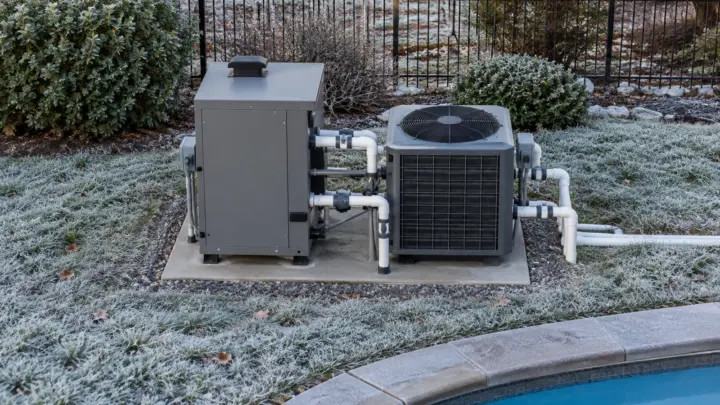
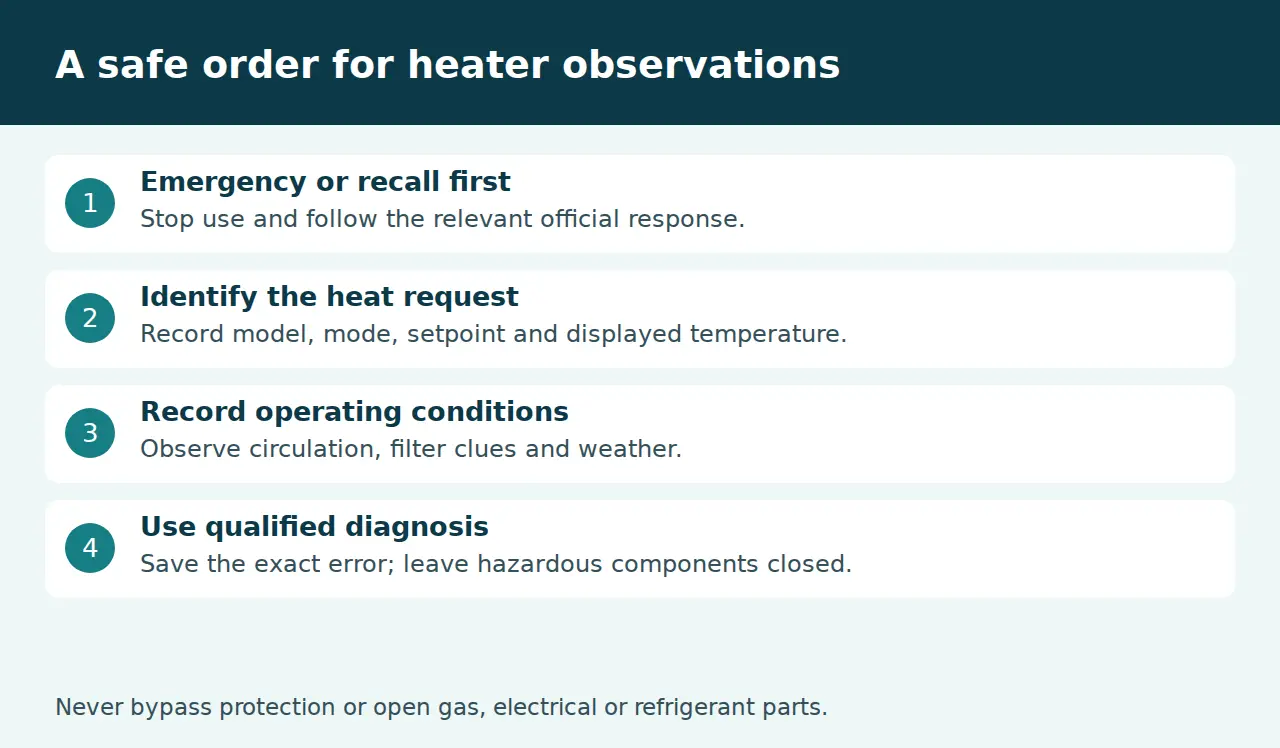
A pool heater that is not heating may have no active heat request, insufficient water flow, a control or supply fault, or conditions outside its operating limits. Start with safe exterior observations: the selected mode, setpoint, displayed temperature, circulation and exact error message. Do not open gas, electrical, combustion or refrigerant components to investigate. If the heater is dripping or leaving water around its base, use the separate guide to a leaking pool heater.
Gas heaters and heat pumps do not behave identically. This guide helps residential owners separate observations and prepare a useful service request. The exact model manual, installation requirements and local rules determine permitted adjustments and repairs.
Stop immediately for gas, electrical or combustion concerns
If you smell gas, do not try to light the heater or another appliance. Do not operate electrical switches or use a phone in the affected area. Move away and contact your gas supplier or emergency services from a safe location, following their instructions. This is an emergency response, not a routine restart check.
Carbon monoxide is odorless: an absence of smell does not establish combustion safety. If a CO alarm sounds or exposure is suspected, move to fresh air and obtain emergency help. CPSC advises against returning or reusing a suspect appliance until the relevant authorities and qualified service have addressed the situation.
Keep clear of equipment with damaged wiring, flooding, scorching, unusual exhaust, severe noise or repeated electrical protection trips. A heater that has been submerged needs qualified assessment before reuse. Do not keep resetting a fault or defeat a safety device to see whether it will heat.
Check whether the exact model has a recall
Check the manufacturer’s current notices and your country’s product-safety authority using the exact model and serial information available safely. Do not remove a panel simply to look for a label; use the documentation or ask the service provider when identification requires unsafe access.
US notice checked October 1, 2026: CPSC’s September 17, 2026 recall covers Hayward HDFS400 Universal-HC pool heaters because of a carbon monoxide hazard. Its remedy directs affected owners to stop use and contact Hayward for qualified inspection and repair. See the official recall and identification details; this is not a claim about all Hayward heaters.
Recall status can change. An affected unit should follow the recall remedy rather than the ordinary troubleshooting steps below. Readers in Canada, the UK and Australia should also check their local notices and the manufacturer for the exact regional model.
Identify the heater and describe the symptom
Record the make, model, fuel or heat source and whether automation controls it. Separate “never starts,” “starts then stops,” “runs but heats slowly” and “shows a flow or service message.” Include whether this is new equipment or a change in a previously working system.
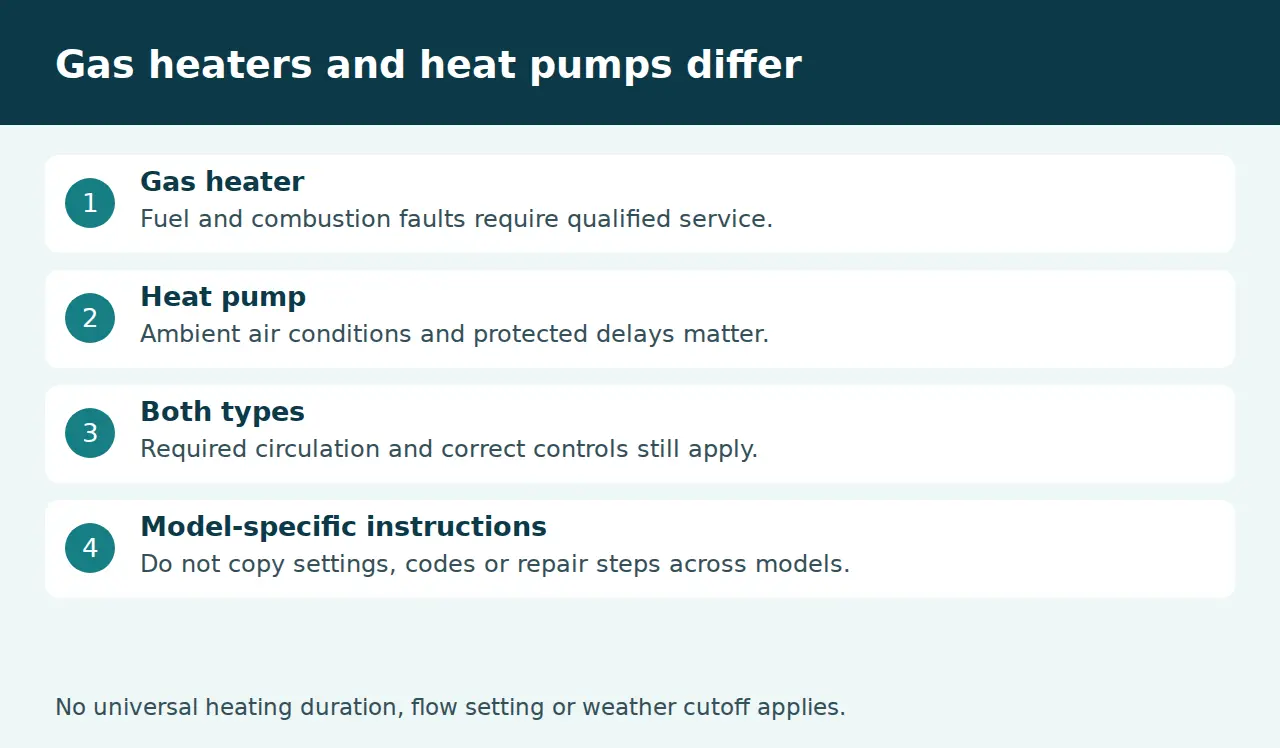
A heat pump transfers heat from surrounding air using an electrically powered refrigeration system. A gas heater uses its specified fuel and combustion system. Other heating systems need their own instructions; the checks for one category do not establish the correct procedure for another.
Use the symptom to choose your first checks
| Symptom | Useful exterior information | Next boundary |
|---|---|---|
| No heat request shown | Mode, setpoint, displayed temperature and schedule | Ask installer about unresolved automation setup |
| Flow or system message | Normal pump operation, water level and filter reading | Do not adjust a pressure switch or bypass protection |
| Heat pump waiting or defrosting | Exact message, weather and the manual’s delay description | Do not force restart or change service settings |
| Starts and shuts down repeatedly | Model-specific fault and operating history | Stop and request qualified diagnosis |
| Runs but expected warmth is absent | Comparable temperature observations and actual heating period | Have capacity, conditions and installation assessed |
Check mode, setpoint and the controller
Compare the selected pool or spa mode with the water body you intend to heat. Check the displayed water temperature and requested setpoint without raising it beyond permitted or suitable use conditions. If the controller believes the requested temperature has been reached, there may be no call for heat.
Where automation is present, establish which control owns the request. Record both the heater’s display and the automation’s selected heating source. A setting on an app does not prove that the heater received the intended command or that the plumbing is routing water appropriately.
Use only normal owner controls described in the manual. Do not copy instructions to set a different heater to its maximum temperature, perform a factory reset, open a control box or change installer configuration. If the handover is unclear, ask the installer to confirm the intended operating setup.
Confirm that normal circulation is available
Heaters require their specified water flow. Check the pool level and accessible observations of pump operation, return movement and alarms. A running motor alone is not proof of adequate flow through the heater, and a heater’s flow warning should not be dismissed because some water appears to move.
Note any recent pump-speed or schedule change. Our pump runtime guide explains why the schedule must support connected equipment. The pump sizing guide explains equipment flow requirements and system fit. Neither supplies a universal heater speed or minimum flow for your model.
If the pump is dry-running, overheating or not operating normally, stop that unsafe condition and arrange appropriate service. Do not force the heater to operate through it. A protection switch is part of the safety system, not an obstacle to overcome.
Review baskets and filter clues safely
Debris in accessible baskets and filter restriction can reduce the water reaching equipment. Inspect what is visible without opening running or pressurized assemblies. Record when the baskets and filter were last serviced and whether the problem began after heavy debris or maintenance.
Compare a safely observed filter pressure with the clean-system baseline at the same pump setting and valve configuration. The filter pressure guide explains why a reading needs that context. A gauge does not directly measure heater flow, and a low reading does not prove the filter is the cause.
Perform only owner-permitted maintenance using exact isolation, pressure-relief and restart instructions. Never loosen a filter clamp, lid or fitting to restore heat. Arrange professional service when safe access, component condition or the maker’s permitted task is uncertain.
Record bypass and valve positions rather than guessing
Some installations have manual or automated bypass arrangements. Their correct positions depend on the installation and whether heating is requested. Pentair’s MasterTemp manual describes an automatic bypass that changes routing during heating; the UltraTemp diagnostic material also includes bypass-related flow concerns.
This is not a universal instruction to close every bypass. Photograph accessible labelled positions and compare them with the established configuration. Do not move an unfamiliar valve while equipment operates, force an actuator, or close a route that could restrict discharge. Have the installer verify uncertain routing.
For a heat pump, include weather and protective delays
AHRI defines a heat pump pool heater as using ambient air as its heat source and lists ratings under different air temperature and humidity conditions. Pentair likewise explains that heating performance relates to those conditions. A change in weather can alter performance without identifying a broken part.
Read the manual’s permitted operating conditions and displayed low-ambient or defrost messages. No single outdoor temperature cut-off applies here to every heat pump. Keep the exterior airflow area clear according to the maker’s instructions, and keep hands and hair away from fans. Do not remove guards or reach inside to clear an obstruction.
Heat pumps may have sensing, compressor restart and defrost delays. Record the exact state and follow its timing instructions. Repeated switching or service-menu changes can interfere with the intended protection; a waiting message does not by itself prove a failure.
When heating is simply slower than expected, record a representative pool temperature with a suitable thermometer, the observation time, weather and actual operating period. Ask the provider to assess expectations against the installation and model documentation. This guide makes no promise of degrees gained per hour or a fixed heating duration.
Keep supply checks outside hazardous components
Record known utility interruptions or a fuel delivery issue and any visible controller status from a safe location. Supply problems can belong in the service history, but do not test live voltage, open electrical panels or work on fuel connections to investigate them.
For gas equipment, leave ignition, burners, venting, gas pressure and fuel conversion to appropriately qualified technicians. Do not use a flame to find a leak or attempt to light an automatic-ignition heater by hand. For a heat pump, leave refrigerant, compressor and internal electrical work to qualified service.
A flooded or damaged unit, recurring trip or safety fault needs assessment before another attempt. Local licensing and service requirements apply in the US, Canada, UK and Australia; the credentials required for gas or refrigerant work may differ from routine pool maintenance.
Save the exact error and a useful service history
A code belongs to the specific model and manual revision. Save its wording, selected mode and when it appeared. Do not interpret a code as an automatic instruction to replace the sensor named in it, or apply another manufacturer’s code table.
- Model identification and controller arrangement.
- Heat request, displayed temperature and exact message.
- Whether circulation appeared normal and any pump fault.
- Recent filter, valve, schedule or equipment changes.
- Weather and comparable temperature observations for slow heating.
- Recall checks, flooding, gas concerns or protection trips.
For persistent faults, the technician should assess the whole operating system. Water chemistry also matters to equipment care: our calcium hardness guide explains whole-system balance and scaling context. A heater problem alone does not justify an aggressive chemical cleaning treatment.
Confirm recovery and water conditions separately
After the approved correction or repair, follow the complete manufacturer’s restart procedure. Confirm that the original alarm or unstable operation has resolved and that heating behaves as expected for the conditions. A brief ignition or fan sound is not a completed verification.
Use the pool water testing guide to check water conditions separately before use. Heating does not establish sanitation, and water temperature should be suitable for the intended swimmers or bathers.
Common questions
Should I increase pump speed until it fires?
Use the verified operating setup and exact equipment guidance. If required flow is uncertain, ask the installer to assess it. Arbitrary speed changes and bypassed protection do not establish safe heating.
Can I reset the heater’s safety switch?
Do not open or adjust safety components. A fault requires its exact instructions and qualified diagnosis when unresolved; repeated resets are not a substitute for repair.
Does cool weather explain every failure?
No. Ambient conditions are especially relevant to heat pumps, but controls, circulation and other faults still need consideration. Gas heaters have different operating and safety requirements.
Research checked October 1, 2026. We only claim hands-on testing when we’ve actually tested the product ourselves. Featured image is an original illustration.
Sources and references
- Pentair: MasterTemp Pool and Spa Heater Installation and User Guide
- Pentair: UltraTemp Heat Pump Installation and User Guide
- US CPSC: Carbon Monoxide Fact Sheet
- US CPSC: Hayward Universal-HC Pool Heater Recall
- AHRI: Heat Pump Pool Heaters Certification Program
- Pentair: Know Your Pool Equipment: Pool Heaters
- Pentair: Pool and Spa Equipment FAQs
- Pentair: 4 Safety Tips for Servicing Pool Filters