Size a pool heater with the Department of Energy’s sizing rule: pool surface area (sq ft) × temperature rise (°F) × 12 = Btu per hour. The temperature rise is your target water temperature minus the average air temperature of the coldest month you want to swim.
Example: a 16 × 32 ft pool (512 sq ft) heated to 82°F where the coldest swimming month averages 62°F needs 512 × 20 × 12 = 122,880 Btu/hour. That means a 125,000 Btu heater.
The formula gives a warm-up of about 1 to 1¼°F per hour with 3½ mph of wind. For faster heating, DOE says to multiply by 1.5 (about 1½°F per hour) or 2.0 (about 2°F per hour).
Step by step
- Surface area. Length × width of the water for a rectangle. Surface area matters more than gallons, because the surface is where heat is lost.
- Target temperature. Say 82°F.
- Coldest month’s average air temperature for the months you’ll heat. Use local climate normals for the earliest and latest months you’ll swim, for example 62°F.
- Rise: 82 − 62 = 20°F.
- Multiply: 512 × 20 × 12 = 122,880 Btu/hour. For a faster 1½°F per hour warm-up: 512 × 20 × 12 × 1.5 = 184,320 Btu/hour.
- Round up to the next size you can buy. DOE lists standard heat pump sizes of 75,000, 100,000 and 125,000 Btu.
The example pool holds about 19,000 gallons at a 5 ft average depth. Volume affects how long the first warm-up takes, but the sizing rule runs on surface area.
Heat pumps: read the cool-weather rating
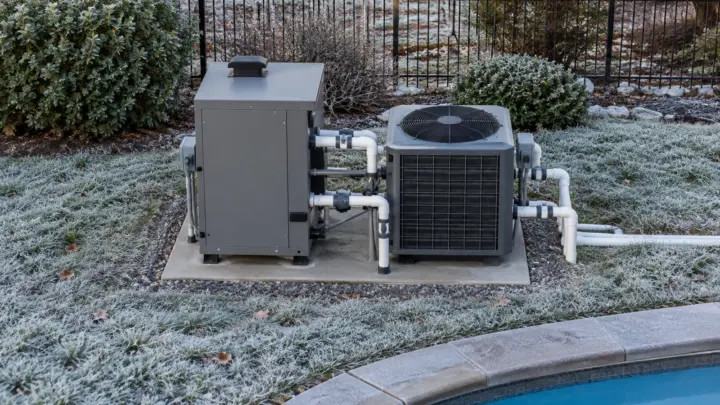
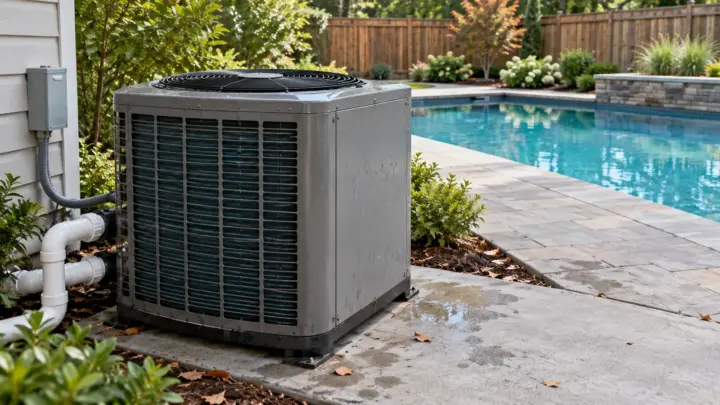
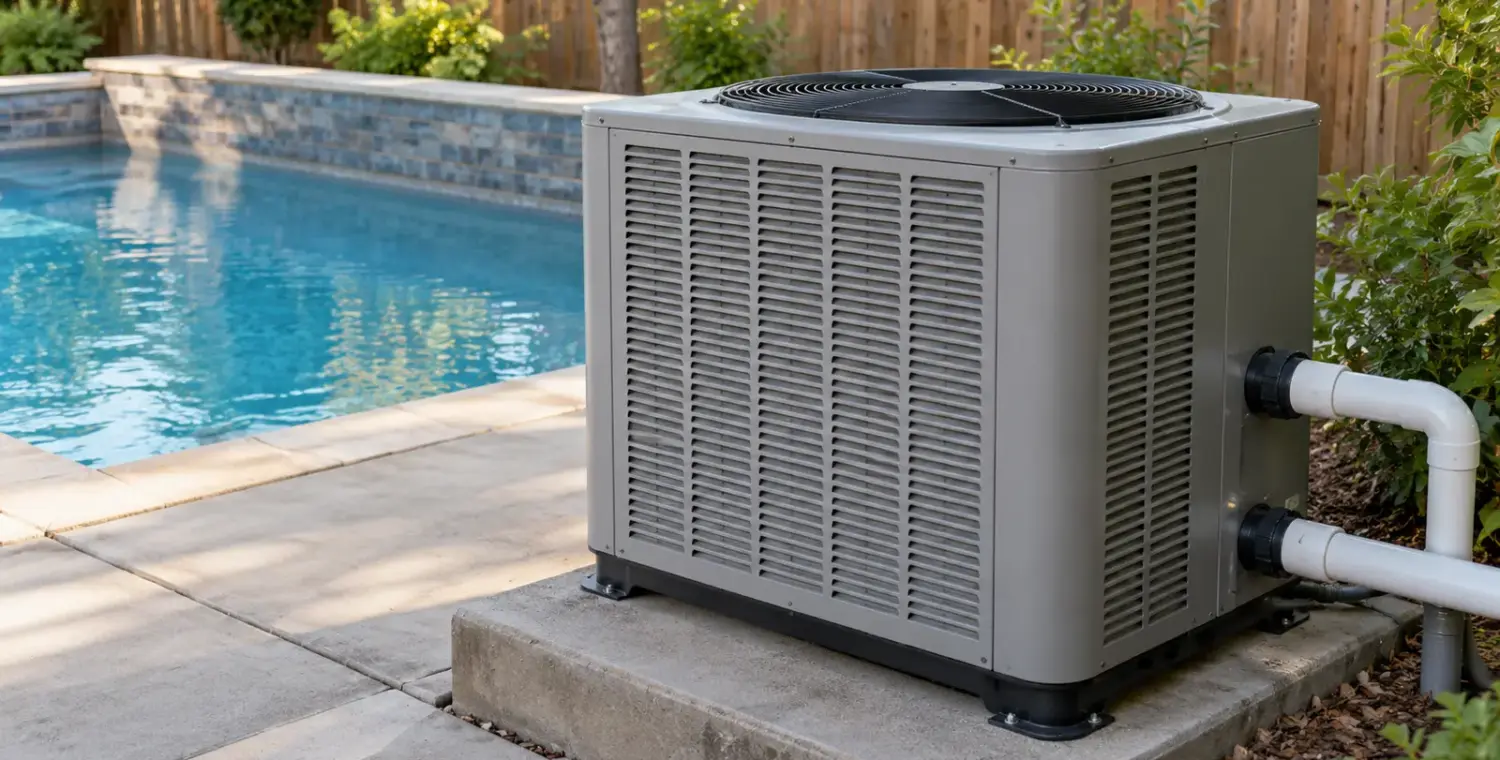
Heat pump output falls as the air cools. Federal test conditions are 80°F air, 63% relative humidity and 80°F water, and typical COPs run 3.0 to 7.0. Pentair’s catalog shows how much a rating moves for one model, the UltraTemp 110:
| Air / humidity / water | Output | COP |
|---|---|---|
| 80°F / 80% / 80°F | 110,000 Btu/hour | 6.1 |
| 80°F / 63% / 80°F | 101,000 Btu/hour | 5.8 |
| 50°F / 63% / 80°F | 70,000 Btu/hour | 4.0 |
If you swim in spring and fall, compare models at the 50°F rating. A heat pump sold on its 110,000 Btu headline delivers closer to 70,000 Btu/hour on a 50°F day. DOE also notes that windy sites, low humidity and cool nights all need a larger heater.
Gas heaters: input vs output
Gas heaters are usually sold by fuel input. Output is input × efficiency. The federal minimum efficiency is 82%, and the best units reach 95%. At 82%, a 150,000 Btu input heater delivers about 123,000 Btu/hour, just enough for the example pool. ENERGY STAR says gas suits pools that need occasional rapid heating, while heat pumps are good at holding a set temperature over a long season. Our heater types guide compares them.
A cover changes the answer
ENERGY STAR says covering a pool when it’s not in use can cut heating costs by 50%–70%. A cover doesn’t change the formula, but it decides whether a borderline heater keeps up overnight. See whether a solar cover keeps a pool warmer and how long it takes to heat a pool.
Before you buy
Gas lines, venting and the heat pump’s electrical circuit are licensed installation work. Confirm the heater’s required water flow with your pump (our pump sizing guide explains flow). Never bypass a flow switch or other heater safety device to get a heater running.
Sources
- U.S. Department of Energy, Energy Saver: Heat Pump Swimming Pool Heaters (archived copy captured 2025-01-10; original page now removed)
- U.S. Department of Energy, Energy Saver: Gas Pool Heaters (archived copy captured 2025-01-21; original page now removed)
- Pentair: 2025–2026 Pool Product Catalog: Heaters and Heat Pumps
- ENERGY STAR (EPA/DOE): Pool Pumps: pool heating and cover guidance
Research checked 2026-10-08.