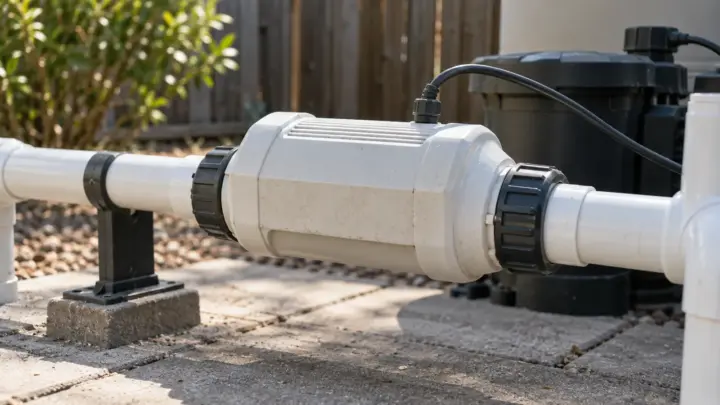

A variable-speed pump usually deserves the first look when your pool needs different circulation settings for filtration, heating, cleaning or chlorine generation. A single-speed pump offers one operating speed, so the purchase question is whether a particular model meets your installation’s needs and applicable requirements at an acceptable operating cost. The answer depends on equipment fit, the commissioned schedule and the full installed price.
Use this guide to compare proposals for a residential circulation pump. It does not rank specific products or provide an installation procedure. A current pump that works safely does not automatically need replacing simply because a newer category exists.
What changes when the speed can change?
Single-speed describes a pump operating at one motor speed while running. Variable-speed describes a pump that can operate at different selected speeds. That flexibility lets an installer set different operating stages for different jobs instead of using one setting for the entire day.
ENERGY STAR explains that conventional pumps may be set for a more demanding task and consequently move water faster than necessary during ordinary filtration. Australian Government guidance similarly describes slower operation for filtering and faster operation when another task requires it. Neither description supplies the correct setting for your particular system.
The benefit comes from using the flexibility appropriately. Buying adjustable controls and then running at an unnecessarily high setting throughout the schedule does not demonstrate an efficient result. Conversely, reducing speed until a connected device stops working defeats the purpose of circulation.
Compare the two options by the same questions
| Decision point | Variable speed | Single speed |
|---|---|---|
| Operating flexibility | Several settings can serve different tasks | One operating speed when running |
| Energy assessment | Compare power and duration for every stage | Compare power and total running time |
| Controls | Check programming and exact automation compatibility | Check permitted switching and controller compatibility |
| Equipment fit | Every proposed stage must serve connected equipment appropriately | The selected pump must serve required jobs without exceeding equipment limits |
| Ownership costs | Obtain installed and service quotations for the actual model | Obtain the same information; category alone does not set a price |
This comparison deliberately leaves prices and service life blank. Local quotations and model documentation are more useful than assigning every pump in one category a fixed cost, lifespan or reliability grade. Ask each supplier to answer the same questions so the proposals can be compared fairly.
Start with the installation, not horsepower
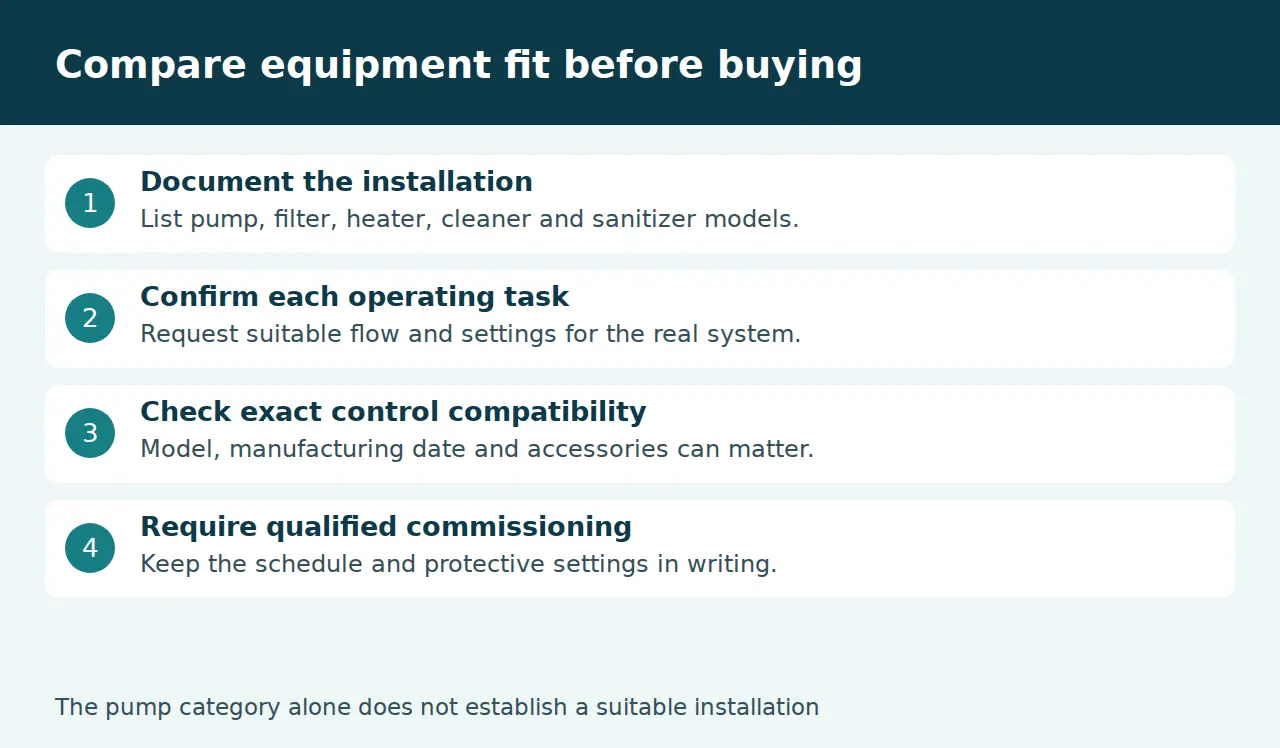
Collect the pool volume, existing pump model, filter model, heater, cleaner, sanitizer equipment and automation details. Photograph accessible labels and the current controls. Give that information to a qualified installer, together with the actual tasks your system needs to perform.
Our pool pump sizing and flow-rate guide explains why motor size alone is not enough. Ask the installer to document the expected operating flow and equipment ratings rather than choosing the largest pump that fits the pad.
Australian energy guidance recommends the smallest effective pump and professional supplier advice. The useful principle is avoiding unnecessary pumping while meeting the system’s requirements. Do not transplant an Australian star-rating label or a suggested pump size to a different market without checking its relevance.
If poor flow, unusual noise or air is already present, have the fault assessed before treating replacement as the solution. A new motor does not explain an unresolved plumbing restriction. Describe the symptoms without opening electrical or pressurized equipment.
Connected equipment can decide the operating plan
List each circulation-dependent task and its exact manual requirements. Filtration, heating, a pump-driven cleaner and a salt chlorine generator can impose different conditions. The installer should reconcile these with the pump and filter ratings.
Pentair’s IntelliChlor Plus and LT FAQs describe flow and temperature protection and identify insufficient runtime among possible causes of low chlorine. That illustrates why low-speed operation must be checked against the actual sanitizer system. It does not establish one minimum flow for every brand or model.
Ask what happens in each operating mode: ordinary filtration, heating, cleaning, priming and seasonal protection. A proposal is incomplete if it names an efficient pump but leaves these modes unexplained. Do not bypass a flow switch to make an attractive low-speed schedule appear workable.
Once the equipment needs are clear, our daily pool pump runtime guide helps you organize the schedule review. More hours at an appropriate setting can have a different energy cost from fewer hours at another setting.
Estimate energy from power and time
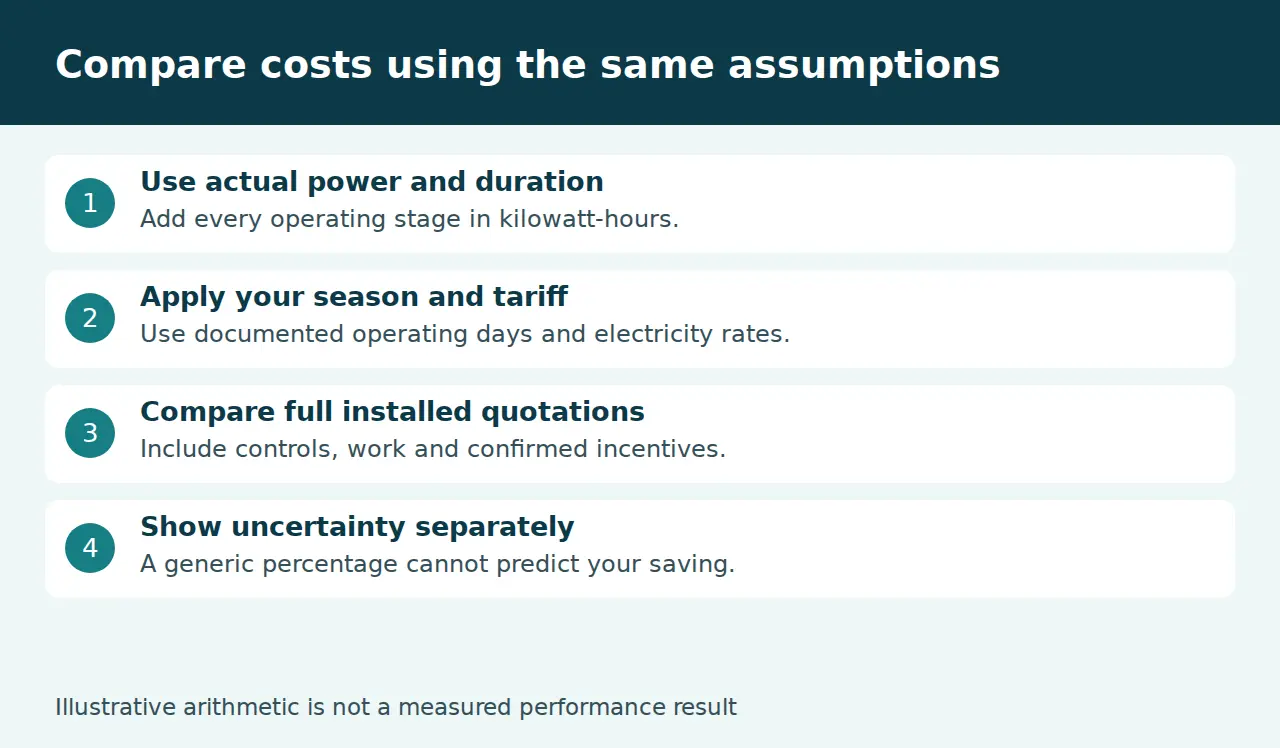
For each operating stage, multiply electrical power in kilowatts by time in hours to obtain kilowatt-hours. Add the stages, then apply the operating season and electricity tariff. Use measured or properly documented inputs, with the conditions that produced them.
The DOE Building America guide describes evaluating current consumption and estimating the new pump’s use. Its historical examples are useful for the method, not today’s electricity price or a guaranteed replacement result. Let a qualified person obtain any measurements requiring access to electrical equipment.
Do not use horsepower as a substitute for electrical consumption, or assume a displayed maximum describes an entire day. Ask whether the estimate includes higher-demand stages, priming and seasonal changes. If an input is unknown, label it unknown and request evidence rather than inventing it.
A worked example with illustrative inputs
Suppose the existing program uses 1.2 kW for six hours: 1.2 × 6 = 7.2 kWh per day. Suppose a proposed program uses 0.25 kW for ten hours plus 1.0 kW for two hours: 2.5 + 2.0 = 4.5 kWh per day.
The difference is 2.7 kWh daily. Over an illustrative 180-day season, that is 486 kWh. At a flat price of 0.20 currency units per kWh, the energy difference is 97.20 currency units per season. An extra installed cost of 600 would take about 6.2 such operating seasons to recover through that energy difference alone.
These are invented arithmetic inputs, not tested pumps or a recommended schedule. The example does not establish adequate water care or equipment flow. It excludes repairs, financing, tariff changes and other ownership costs. Replace every input with documented values before using the worksheet for a purchase. Our pool pump running-cost guide walks through the watts × hours × rate arithmetic.
Read savings claims with their comparison intact
ENERGY STAR presents several comparisons on its pump page, including certified versus standard pumps and single-speed replacement language. Those comparisons have different baselines. A percentage from one cannot be applied to an unrelated pair of models and a different schedule.
Ask a supplier what the quoted saving compares: equal tasks, equal seasons, the same tariff and a commissioned operating program? Obtain the assumptions in writing. A payback estimate based on continuous operation of a pump you actually run seasonally can mislead your decision.
Check installed cost rather than pump-only cost. Include compatible controls, permitted electrical or plumbing work, commissioning, tax and any confirmed rebate. Keep uncertain incentives out of the base case, then show them as a separate scenario.
Programming and repair questions belong in the quote
A variable-speed label does not guarantee a particular app, communication protocol or flow-control feature. Pentair’s SuperFlo-family guide distinguishes external control options by model and manufacturing date. Compatibility needs confirmation for the exact pump and controller, including required accessories.
Ask who will configure the program and leave a written copy. Find out how you will recognize the active mode, restore a saved setting and obtain support after a power interruption. Choose controls you can use reliably rather than counting menu options.
Request warranty terms and local service information for both proposals. Ask which components can be serviced, where replacement parts are obtained and what the quotation excludes. This article makes no category-wide promise about repair costs or electronics lifespan.
If sound is a concern, ask about the proposed operating conditions and placement. ENERGY STAR describes quieter variable-speed operation, but that is not a guaranteed decibel result beside your bedroom. Do not use an unsafe enclosure to address noise.
Commissioning is part of the purchase
Qualified installation matters for electrical, suction and pressure safety. Follow the exact manual and applicable local requirements; do not copy a wiring procedure from a general comparison. Ask the installer to confirm current product eligibility in your jurisdiction before ordering.
At handover, request the documented schedule, operating checks, protective settings and normal filter observations. Use our filter-pressure guide to understand why comparisons need a baseline at the same pump setting.
Verify water care after a permitted schedule change rather than judging success by a running motor. Keep the installation’s freeze-protection plan intact. The new pump’s program must work with the rest of the care system.
Which makes sense for your pool?
Evaluate variable speed first when task-specific operation is useful and the installed proposal documents suitable settings and realistic costs. Evaluate a single-speed model only against the same equipment, eligibility and ownership questions. A lower purchase price is one input, not the whole comparison.
If the existing pump is functioning and no change is urgent, obtain the evidence before deciding. If replacement is necessary, prioritize a compatible, properly commissioned installation. The strongest quotation explains how the pump will serve your actual pool and how its energy estimate was calculated.
Research checked September 30, 2026. We only claim hands-on testing when we’ve actually tested the product ourselves. Featured image is an original illustration.