Bromine and chlorine can both be part of a hot tub sanitation program. The useful choice starts with your spa’s approved products, installed water-care equipment and the testing routine you can keep up. A sanitizer that sounds convenient is a poor choice if your particular spa does not allow it.
For a new owner, collect the spa model, owner’s manual, water volume, installed ozone or UV equipment, and any salt system details before buying chemicals. For an existing owner, identify the current program before changing anything. Clear water, a mild smell or a floating dispenser cannot establish that the water is ready for bathing.
Bromine vs. chlorine at a glance
| Decision | Chlorine program | Bromine program |
|---|---|---|
| First check | Exact chlorine form and system approved for your spa | Exact bromine form, dispenser and equipment approved together |
| Main sanitizer test | Free chlorine; combined chlorine when troubleshooting | Bromine test with the correct kit scale and instructions |
| Automatic production | A compatible salt system generates chlorine | Do not assume a chlorine generator can run a bromine program |
| Convenience | Depends on manual dosing or approved automation | Depends on permitted product form and feed system |
| Cost question | Include product use, tests and any system consumables | Include product use, tests and approved dispensing equipment |
| Still required | Testing, balanced water, cleaning and filter care | Testing, balanced water, cleaning and filter care |
The table compares programs, rather than promising a winner based on sanitizer name. Two tubs using chlorine may have very different maintenance tasks; a tablet-based bromine routine may be unavailable in a spa whose manufacturer prohibits compressed products.
Start with compatibility, before cost or convenience
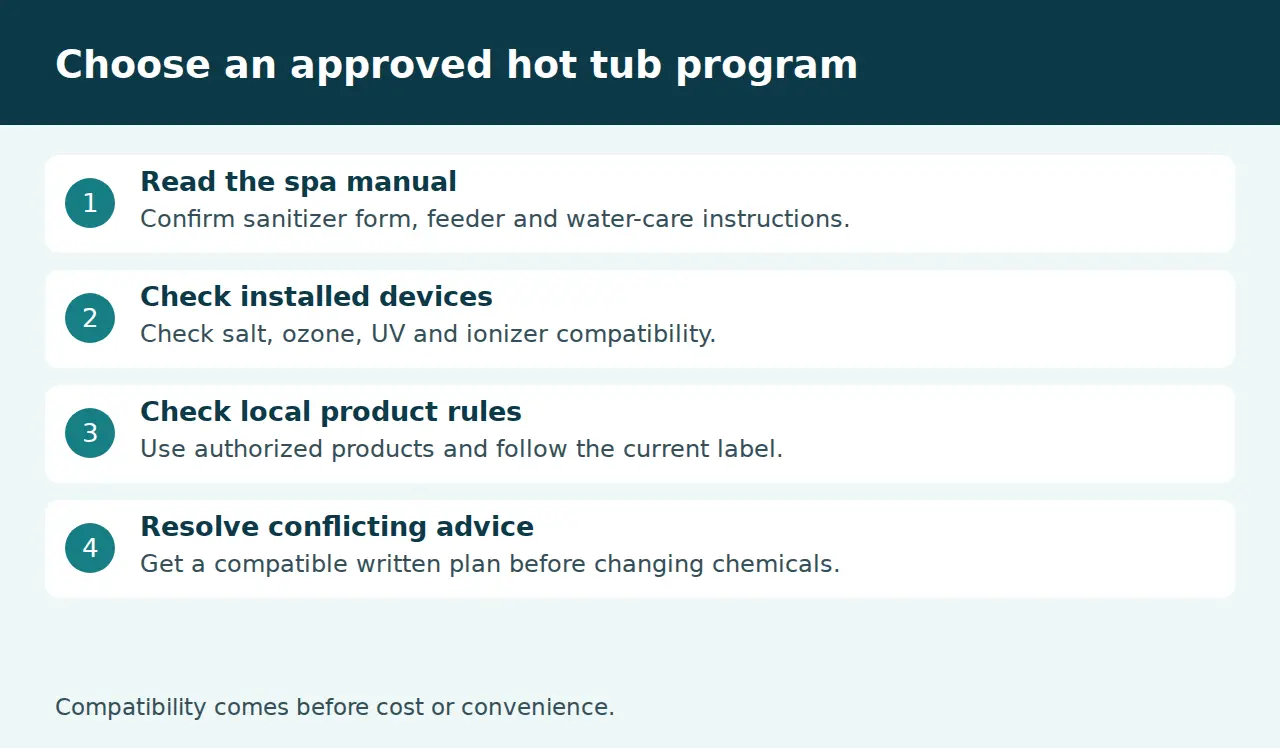
Read the water-care section of the manual for your exact spa and any separate treatment-device manual. Write down the permitted sanitizer, product form, feeder and testing method. An instruction for a swimming pool is not automatically suitable for a hot tub, even when the chemical name looks familiar.
Hot Spring’s maintenance guidance is a useful example: it directs owners to their manuals and warns against tri-chlor and compressed bromine or chlorine products. That is brand guidance to check against the relevant model, not a prohibition applying to every spa. It also shows why a generic recommendation to buy a bromine floater can be wrong.
Take supplemental equipment seriously. Health Canada’s household guidance says not to combine sodium bromide or other bromine products with ionizers/electrolysis, ozone-generating devices or UV devices. This Canadian advice should not disappear inside a general claim that bromine works with all hot tubs. Outside Canada, check local product authorization and the exact device and chemical instructions.
If instructions conflict, ask the manufacturer or qualified water-care professional for a compatible written program. Do not disable equipment or substitute an unapproved chemical to make an online routine fit.
What choosing chlorine involves
A chlorine program may involve manual additions or an approved salt chlorine generator. Saltwater sanitation still uses chlorine: the device makes it from dissolved salt. Owning a generator does not remove the need to measure the sanitizer in the water or maintain the equipment.
For testing, distinguish free chlorine from total chlorine. A total-only result cannot tell you how much free chlorine is available. Choose a kit that measures the parameters your program requires, and follow its sampling, reagent and reading instructions.
There is an important source disagreement to resolve before choosing a chlorine product. CDC recommends against cyanuric acid and chlorine products containing it, including dichlor and trichlor, in hot tubs. Some manufacturer water-care programs specify stabilized chlorine forms. This guide follows CDC’s caution and does not recommend stabilized chlorine as a universal spa choice. If your manual specifies it, ask the manufacturer and a qualified professional how to meet public-health guidance with an approved program. Do not replace it with a random pool chemical.
Chlorine concentration can be reduced by contaminants from bathers, sunlight and jets that create mist. A calendar reminder to add a product is therefore only part of the routine; a current water test is what tells you whether the routine is working. If chlorine keeps running low, see what to check when hot tub chlorine is too low.
What choosing bromine involves
Consider bromine when the exact spa and equipment permit a complete bromine program. Check whether that program uses a particular granular product, an approved dispenser or another specified format. Do not assume that products described as “spa bromine” can be substituted freely.
Testing differs from chlorine. Taylor describes measuring total bromine, while chlorine care distinguishes free and combined chlorine. Use the bromine scale on a suitable comparator or the explicit method supplied with your kit. Reading a chlorine scale as bromine can lead to a mistaken treatment decision.
Some owners choose bromine hoping for less noticeable odor. Taylor describes differences between bromine and chlorine byproducts, but that does not guarantee a comfortable soak for every person or make smell a water-quality test. If odor is the problem you are trying to fix, use the hot tub odor troubleshooting guide to investigate the water and maintenance first.
Bromine still needs the approved oxidation, cleaning and water-balance routine. A dispenser is a delivery tool; it cannot confirm sanitizer concentration, compensate for ignored test results or make poorly maintained water safe.
Set a testing routine with the right targets
CDC’s hot tub prevention advice specifies at least 3 ppm free chlorine or 4 ppm bromine, with pH 7.0–7.8. These are minimum guidance values, not doses or complete operating ranges. They do not authorize bathing at any higher sanitizer concentration.
Health Canada’s residential spa guidance gives 3–5 ppm sanitizer. Keep that Canadian guidance separate from CDC’s bromine minimum rather than averaging the numbers into a worldwide target. Follow the applicable local requirements and product instructions, including upper limits and reentry conditions. If the instructions cannot be reconciled, keep the tub out of use while obtaining professional advice.
CDC recommends testing chlorine and pH at least twice daily and more often with heavier use. Check the current approved routine for bromine too. Test before deciding the tub is ready, and record readings during busy periods so repeated shortfalls become visible.
Use in-date reagents or strips, a clean sample cell and the specified reading time. CDC warns that chlorine above 10 ppm can bleach a DPD test and produce a misleading low result. Taylor also notes that monopersulfate can interfere with some total/combined chlorine tests. If the result seems inconsistent after treatment, consult the kit instructions or obtain a properly performed second test before adding more sanitizer.
Compare the routine your household will actually follow
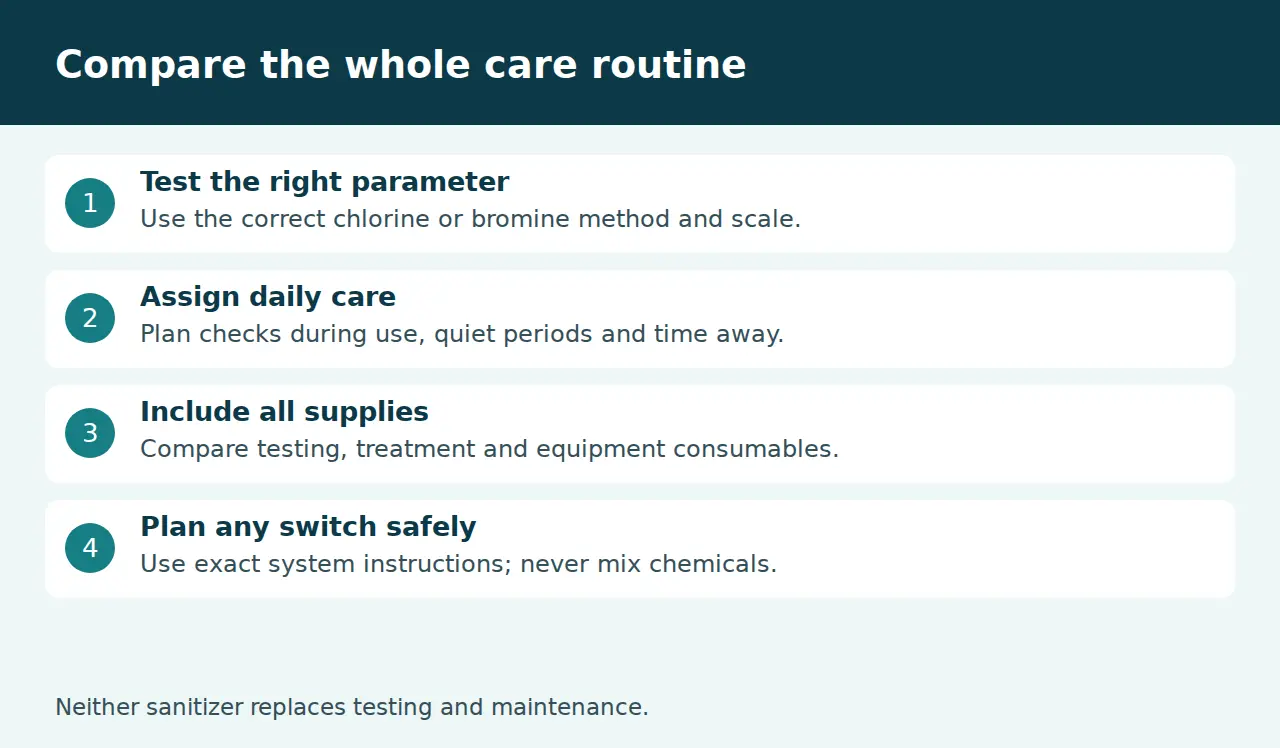
Build a short weekly care plan for each approved option. Who will test when the spa is used? Who checks it when nobody is soaking? What happens if the main person is away? Which tasks need a dealer visit, and which supplies must be kept in stock?
Ask for a demonstration of the particular feeder or controller, including how to recognize an empty supply and what to do about an unexpected reading. Do not count a tablet remaining in a feeder, or a powered-on display, as proof that the water has an adequate residual.
Include cleaning and filter care in both plans. Changing sanitizer will not replace those jobs. Foaming has its own diagnostic questions; our hot tub foam guide covers that problem separately. For a tub kept operating through cold weather, add the equipment checks in the winter hot tub care guide.
Compare total cost, rather than container price
Taylor generally describes chlorine sanitizer products as less expensive than bromine products. That is a starting point, not a quote for your tub. Compare local prices for the actual approved products and ask what else each program needs.
Use a worksheet with separate rows for sanitizer, approved oxidizer, testing supplies, balance products, dispensing equipment and any treatment-system consumables. Record package size and expected use under your household’s conditions. Mark estimates clearly until you have your own maintenance records.
A larger container may cost less per unit but still be a poor purchase if it is incompatible or difficult to store correctly. Keep chemicals in original containers, follow storage directions and avoid buying quantities based on a pool routine that your spa does not use.
Changing an existing program needs a plan
Do not pour the new sanitizer into the tub simply because the old reading is low. Ask for the switching procedure for your exact spa, feeder and installed equipment. Confirm any water replacement, plumbing cleaning, rinsing and restart requirements before you begin.
Never mix concentrated chemicals, transfer them into another product’s container or improvise feeder reuse. Handle products with the protection required by their labels. If water replacement is required, follow the spa manual and local disposal rules; obtain help if the procedure or equipment compatibility is unclear.
Canada update: Health Canada’s August 26, 2026 halohydantoin review proposes additional changes for certain uses and formulations. It is a consultation proposal, not a final blanket ban on bromine. Check the current registered product label and any final decision before purchasing; the separate household advice on incompatible devices already applies to this comparison.
Which choice makes sense?
Choose from the programs your spa actually permits. If an approved chlorine system already works reliably, compare the practical benefit of changing against the switch requirements. If an approved bromine program better fits your routine, check device compatibility and the test method before committing.
Bring the dealer a written list of your spa model, installed treatment devices, current products, recent test results and care schedule. Ask for a complete compatible program and clear reentry instructions. That gives you a decision you can maintain, rather than a winner based on a chemical name alone.
Research checked September 30, 2026. We only claim hands-on testing when we’ve actually tested the product ourselves. Featured image is an original illustration.
Sources and references
- CDC: Protecting yourself from Legionella in hot tubs
- CDC: Home pool and hot tub water treatment and testing
- Health Canada: Swimming pool and spa chemicals
- Hot Spring: Spa maintenance tips
- Taylor Technologies: Technical and support FAQs
- Taylor Technologies: Choosing between chlorine and bromine for your spa or hot tub
- Health Canada: Proposed special review decision PSRD2026-02