Keep hot tub pH and total alkalinity in the ranges required for your spa by measuring both, checking sanitizer separately, and making label-directed corrections with circulation and retesting. A pH problem does not automatically mean an alkalinity problem, and a normal reading for one does not guarantee the other is right.
If a result is unexpected, confirm the test before adding more chemicals. Small water volume makes guessing especially unhelpful. This guide explains how to choose the next check; it does not replace your spa manual or provide a universal dose.
pH and alkalinity answer different questions
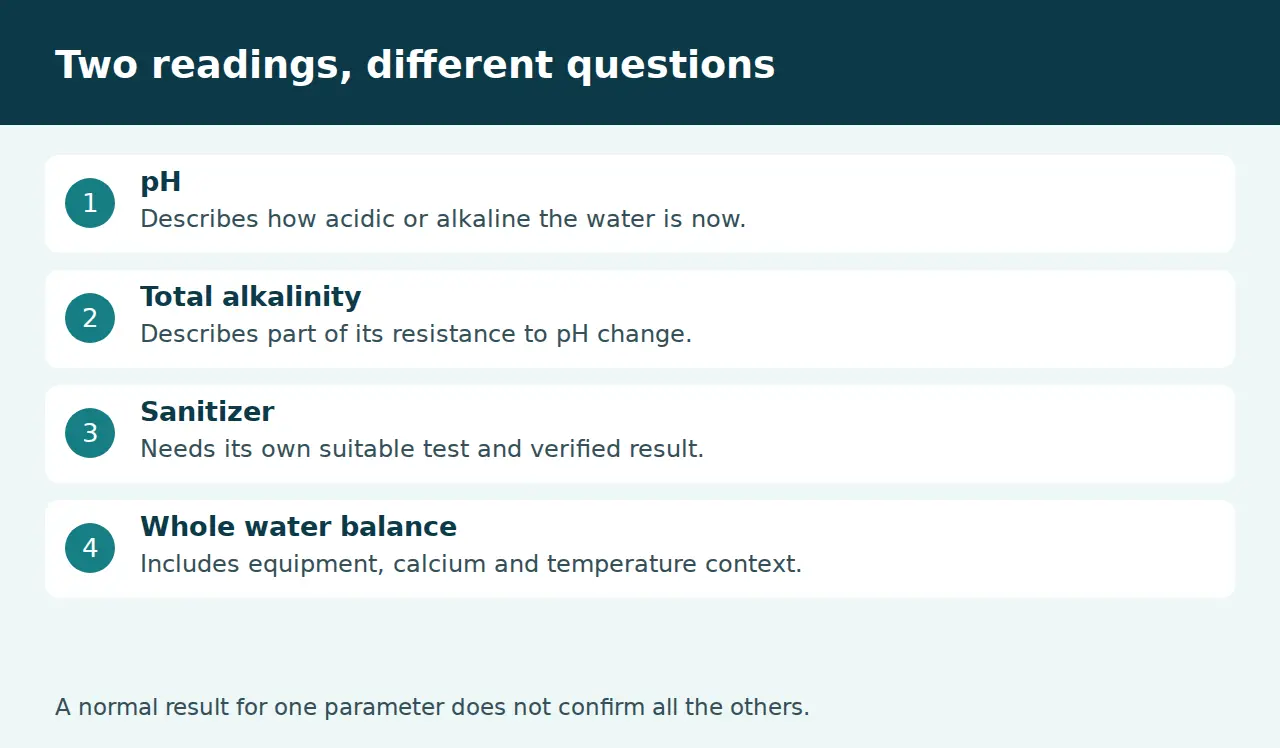
pH describes how acidic or alkaline the water is. Total alkalinity, usually abbreviated TA, describes its capacity to resist changes in pH. Think of pH as the current condition and alkalinity as part of the water’s buffering system. That comparison is useful, but it does not mean TA locks pH in place.
Water can have an acceptable pH while its alkalinity needs attention. Equally, an acceptable TA result does not prove that the pH is suitable for soaking. Record the two separately rather than treating the word “alkaline” as a diagnosis.
The Hot Spring Highlife manual explains that low TA allows pH to fluctuate more easily, while high TA can make pH adjustment difficult. These are reasons to examine both readings when corrections do not last, rather than repeatedly treating pH alone. See its water-maintenance and terminology sections in the references.
Why hot tub chemistry needs its own routine
A spa holds less water than a swimming pool, and a group of bathers can introduce substantial contamination relative to that volume. Warm water and vigorous jet operation also make a pool routine a poor substitute for spa instructions. Taylor’s spa chemistry guidance discusses these differences; they do not justify predicting an exact depletion rate for your tub.
Start with the actual filled operating volume specified or established for your model. Do not use outside dimensions, the capacity of a similar-looking tub, or a pool treatment table. Our guide to how many gallons a hot tub holds explains where to find that figure. Product concentration matters as well as volume.
For an owner, the practical consequence is simple: record the starting result, identify the intended correction, and verify what happened afterward. If you are unsure which bottle is appropriate for your sanitizer and equipment, pause and obtain advice from the spa supplier.
Which range should you follow?
CDC hot tub guidance gives a pH range of 7.0–7.8. Equipment manuals and sanitizer labels may use a narrower operating range or additional requirements. Treat the CDC guidance as a public-health reference, not permission to disregard your model’s instructions.
There is no single TA number in this article because sanitizer type, source water and equipment guidance affect the maintenance program. Write down the applicable pH and TA ranges from your own instructions. For UK, Canadian and Australian readers, also check local requirements and the labeling on the locally approved product; US guidance is not a worldwide legal standard.
If two applicable instructions disagree, ask the manufacturer or a qualified water-care professional to resolve the conflict. A separate example is sanitizer selection: CDC advises against cyanuric acid and stabilized chlorine in hot tubs, while some model manuals describe a dichlor program. Do not solve that difference by swapping products or converting a system on your own. Our bromine versus chlorine guide explains why compatibility belongs in the decision.
Validate an unusual reading first
Use the correct test and sample method
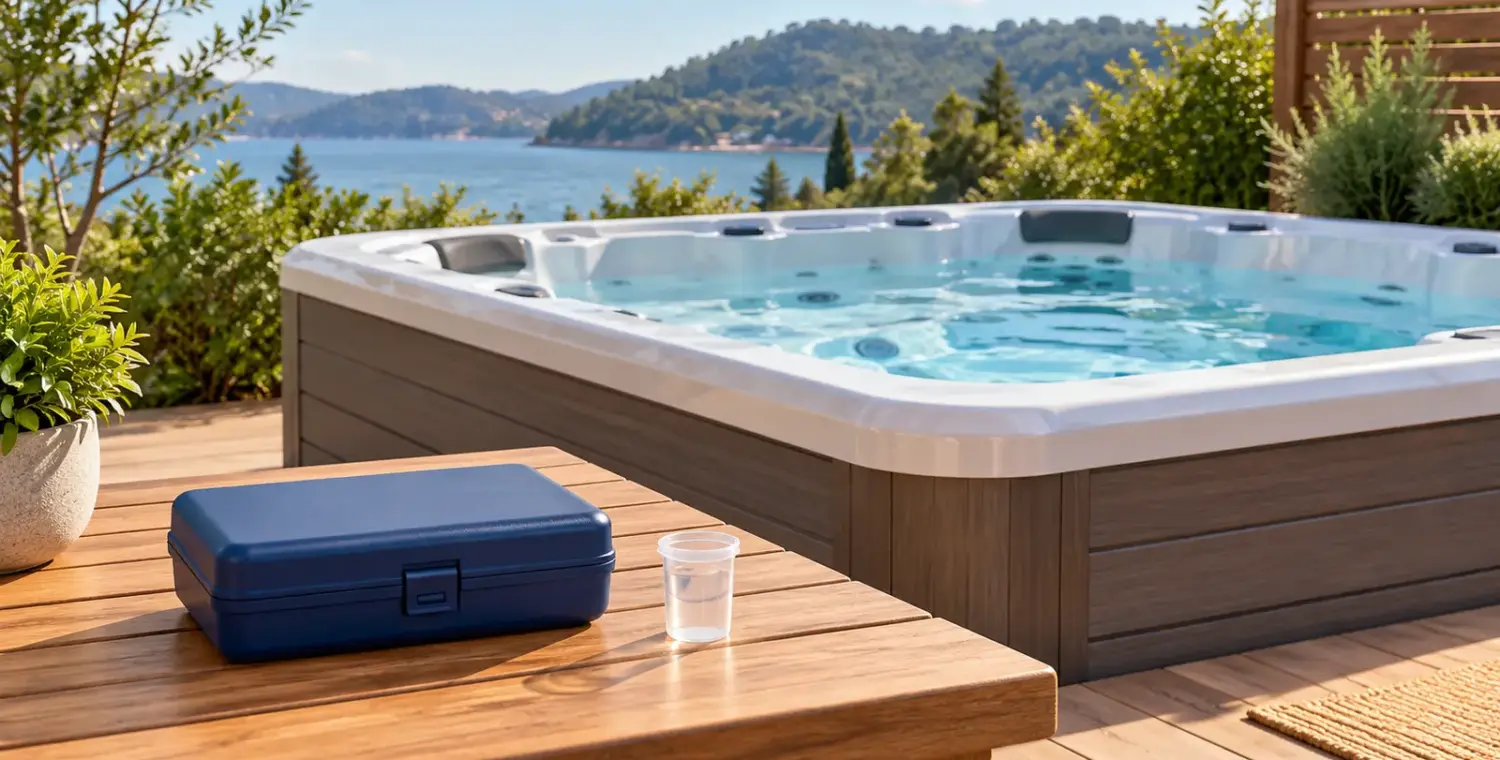
Check that the kit measures both pH and TA and is suitable for the sanitizer in use. Follow its sampling, reagent, mixing and reading instructions exactly. Use a fresh representative sample rather than water taken from the immediate chemical-addition location.
Inspect expiration dates and storage history. Read colors in the lighting specified by the kit and keep comparator cells clean. For the broader distinction between different test methods, see the water testing guide; apply your spa’s targets rather than copying pool targets.
Consider sanitizer interference
High sanitizer concentrations can interfere with some pH and alkalinity tests. Taylor documents unusual blue or purple pH endpoints and altered TA color changes in particular kits. A strange color following strong treatment should prompt a method check, not an automatic assumption that pH is extremely high.
Follow the remedy for the exact test kit or ask its manufacturer. Do not borrow a neutralizer quantity, dilution instruction or reagent from another kit. Those workarounds depend on the method and can introduce another error.
Use the pattern to choose the next check
| Observed pattern | Useful next check | Avoid assuming |
|---|---|---|
| pH repeatedly moves outside range | Confirm TA, test method, recent additions and refill history | That a bigger pH correction is automatically needed |
| TA is low but pH currently looks normal | Use the model’s TA instructions and plan a pH follow-up | That the normal pH makes TA irrelevant |
| TA is high and pH is difficult to adjust | Review the complete balance and correction program | That repeated unplanned additions are a safe shortcut |
| Cloudiness or deposits accompany high pH | Check calcium hardness, sanitizer and filtration as well | That all cloudiness is a pH problem |
| The pH test gives an odd color after treatment | Check sanitizer interference and kit instructions | That the comparator provides a reliable numeric result |
This table is a way to organize checks, not a diagnosis. Scale risk involves more than pH: calcium content and temperature matter too. Corrosion risk likewise depends on the overall water and equipment conditions. A balance calculation is not a test for pathogens.
A safe correction workflow
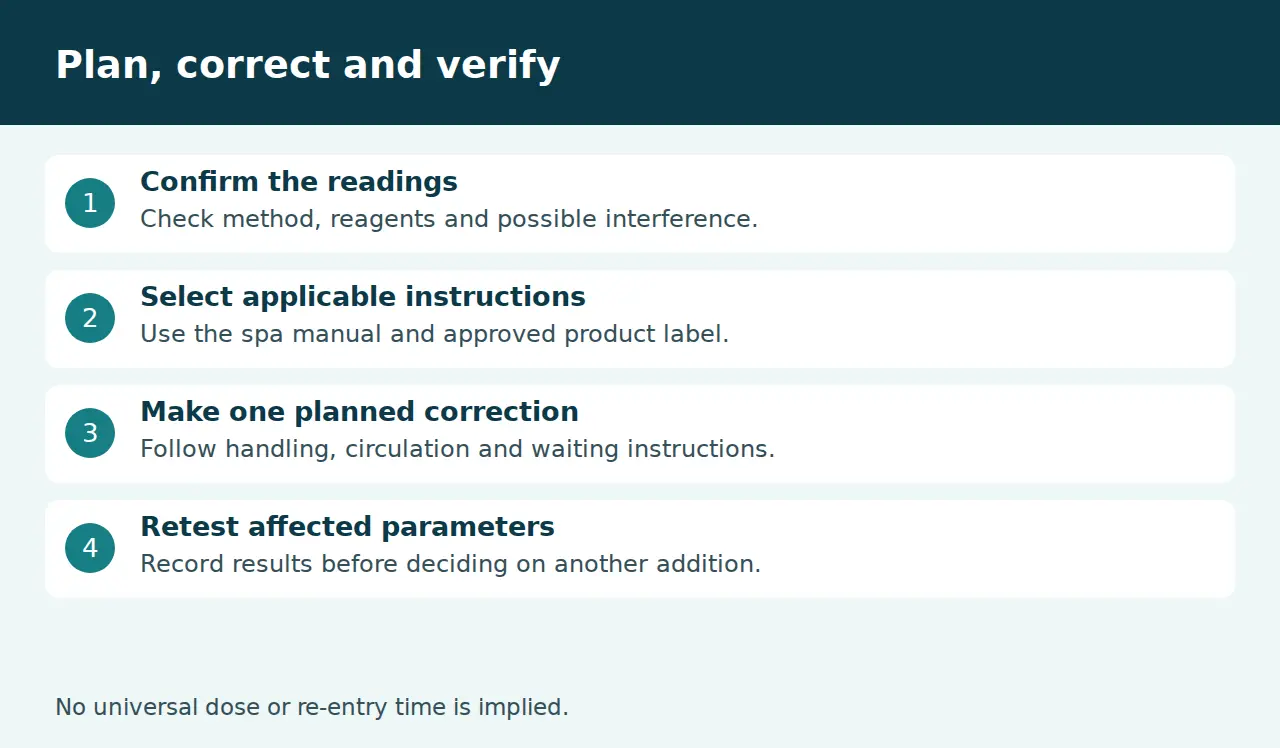
- Pause soaking while suitability is uncertain. Measure sanitizer, pH and TA. Check other relevant parameters required by the manual, particularly calcium hardness when deposits or cloudiness are present.
- Choose the instruction that applies. Identify the spa model, sanitizer program, filled volume and chemical concentration. Check that the product is approved for that equipment.
- Plan the sequence. Use the correction order in the applicable manual. TA corrections can affect pH, so do not treat the readings as unrelated jobs. Manuals may describe different startup and ongoing-maintenance procedures.
- Apply one planned correction. Follow the label and equipment instructions for protective equipment, addition location, circulation and cover handling. Keep everyone out of the water during treatment.
- Allow the prescribed mixing and waiting period. Do not substitute a generic internet timing rule for the actual instructions.
- Retest and record. Confirm both the intended parameter and any affected readings before deciding whether another correction is justified.
Keep chemicals in their original labeled containers, separately from incompatible products and away from children. Never combine concentrated products or use the same contaminated scoop across containers. Health Canada and CDC chemical-safety guidance support these precautions.
A product that lowers pH may also lower TA; a product intended to raise TA may affect pH. Check the label’s purpose and the complete follow-up result. Avoid the common cycle of adding one product to undo another without a recorded plan.
When a correction keeps failing
Make a short record of the problem before seeking help: date, current pH and TA, sanitizer reading, water age, fill or top-up history, treatment names, quantities actually used and when they were added. Include the test kit and any unusual colors. This is evidence from your own maintenance record, not a reason to invent missing measurements.
Ask whether the source water or the maintenance program needs review. A fresh fill can introduce different mineral conditions, and an older body of water may need a broader assessment. Repeated symptoms deserve investigation rather than endlessly adding balancing products.
Foam and odor can coexist with balance problems but have other causes. Use the dedicated guides to hot tub foam and bad-smelling hot tub water instead of treating appearance or smell as a pH test.
Build a routine that includes follow-up
CDC residential guidance recommends testing sanitizer and pH at least twice daily, and more often during heavy use. Health Canada gives daily water-chemistry checks. These recommendations have their own jurisdictions and scopes; your local requirements and system instructions also matter.
Include TA checks in the routine required for your spa, and check it when repeated pH drift needs investigation. Add follow-up checks after relevant treatment or a refill. Set reminders for the required tests rather than relying on a single weekly “water looks fine” inspection.
Winter does not remove the need to monitor an operating spa. If freezing conditions, absence from home or a planned shutdown complicate maintenance, use the model’s instructions and our winter hot tub water-care guide. Avoid starting a drain or extended shutdown without a safe plan.
Common questions
Should I adjust alkalinity or pH first?
Check both and use your spa’s procedure. TA is relevant to how pH responds, but a universal correction order cannot replace the exact startup or maintenance instructions. If readings are far outside requirements or instructions conflict, obtain qualified advice before treatment.
Does balanced pH mean the water is safe?
No. Sanitizer, contamination history and other operating conditions still matter. Clear water or comfortable-feeling water cannot prove disinfection. After treatment, re-entry depends on the applicable labels, verified results and equipment requirements.
Can I use my pool chemicals in the hot tub?
Only if the actual product label and spa instructions permit that use. Similar names do not establish equivalent concentration, dosing or compatibility. If the product is not clearly appropriate, ask the manufacturer rather than experimenting.
Research checked October 1, 2026. We only claim hands-on testing when we’ve actually tested the product ourselves. Featured image is an original illustration.
Sources and references
- CDC: Home Pool and Hot Tub Water Treatment and Testing
- Health Canada: Swimming pool and spa chemicals
- Taylor Technologies: Technical and Support FAQs
- CDC: Pool Chemical Safety
- Hot Spring / Watkins Wellness: 2025 Highlife Collection Owner Manual
- Taylor Technologies: The Unique Water Chemistry of Spas and Hot Tubs
- CDC: What You Can Do to Stay Healthy in Hot Tubs
- Taylor Technologies: Best Practices for Pool and Spa Water Testing