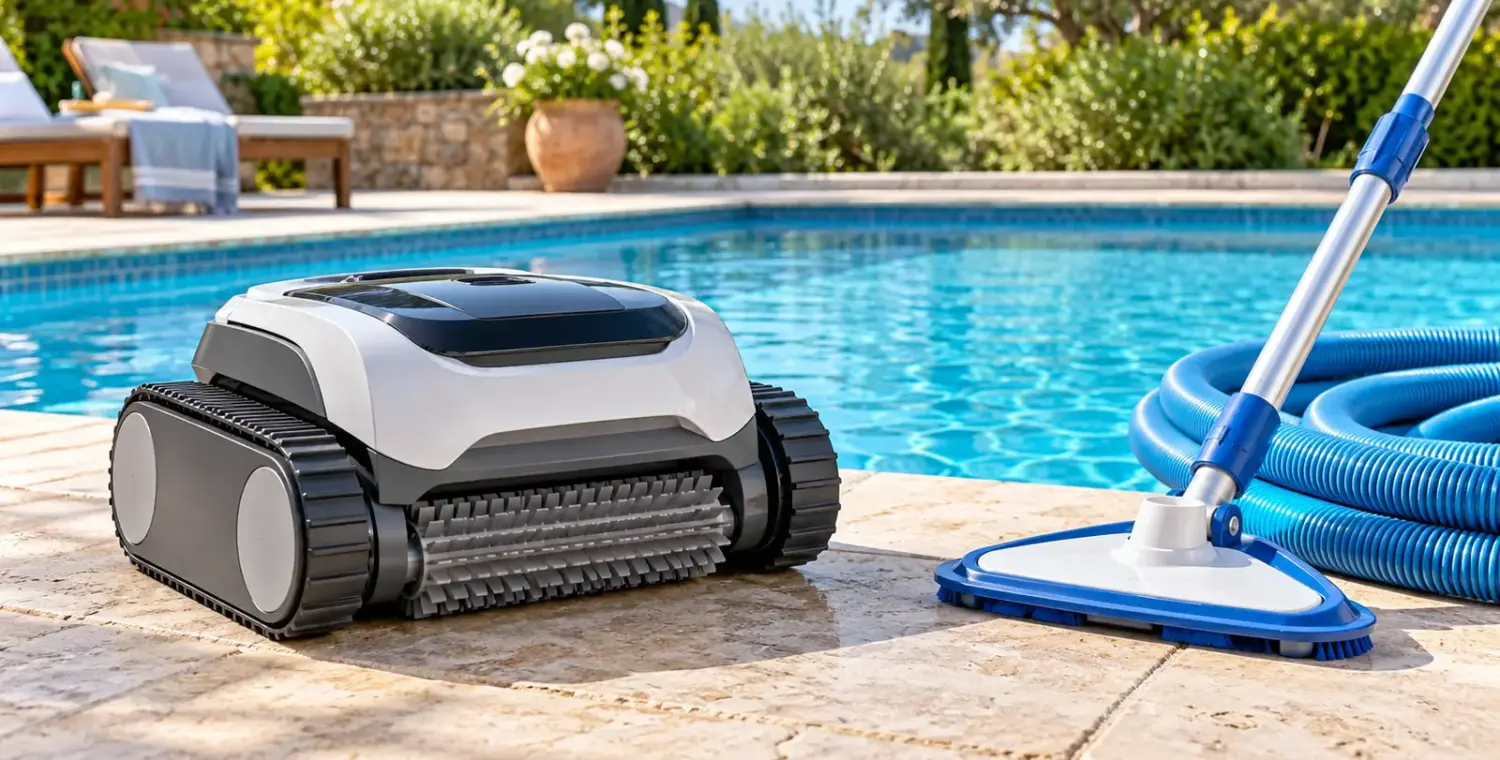
A manual pool vacuum is often the better fit when you want direct control over a few dirty spots and are willing to supply the labor. A robotic cleaner is usually more appealing when routine floor cleaning takes more time than you want to spend. Neither replaces water testing, brushing every missed surface, or maintaining the pool’s circulation system.
The useful question is not which machine is universally better. It is which approach fits your pool, the debris you see, your ability to lift and handle the equipment, and the cleanup routine you will actually follow. This comparison covers a traditional pole-and-hose vacuum and a self-contained robotic cleaner; it does not rank brands.
We only claim hands-on testing when we’ve actually tested the product ourselves.
What is the difference?
With a conventional manual vacuum, you guide a vacuum head across the floor using a telescopic pole. A hose connects to the pool’s approved vacuum arrangement. Where that arrangement draws through the circulation system, debris collection depends on the installed baskets and filter. Pentair’s ProVac II manual describes moving the head slowly and following its specific setup. Different heads and pool finishes require different compatibility checks. ProVac II instructions.
A typical corded robot carries its own drive and debris filter, powered through its supplied electrical system. It moves around the pool without you steering each pass. Some units clean only floors; other models add walls or waterline cleaning. For example, Pentair’s Prowler 920 documentation describes an onboard basket and selectable large- or fine-debris filters. That model is marked discontinued, so it illustrates equipment differences rather than a current product recommendation. Pentair’s model documentation.
A rechargeable handheld vacuum is another category, as is an automatic suction cleaner. Do not assume that advice for a corded robot or a hose-connected manual head applies to either. Identify the exact type before comparing costs or reading troubleshooting instructions.
Compare the jobs, not just the purchase price
| Decision | Manual vacuum | Robotic cleaner |
|---|---|---|
| Who directs the cleaning? | You steer the head and choose the passes | The cleaner follows its supported program |
| Where does debris go? | Depends on the approved hose/filter arrangement | Typically an onboard basket or filter |
| Small dirty corner | Direct targeted access if reachable | Depends on navigation and model access |
| Routine floor coverage | Repeated operator time | Less steering, but setup and filter cleaning remain |
| Main compatibility questions | Finish, head, hose, suction connection and filtration | Pool size, shape, finish, slopes, cable and lifting needs |
This table is an ownership comparison, not a performance test. A cleaner that works well on an open rectangular floor may still miss a shelf or unusual step. Obtain the manufacturer’s restrictions for the actual pool rather than deciding from a demonstration in a different setting.
Labor: where a robot saves effort and where it does not
The main practical advantage of robotic cleaning is avoiding the need to guide the head throughout each routine pass. You still place the unit, arrange its approved power supply or charging routine, retrieve it, empty its filter and store it correctly. Someone needs to check the result and brush or spot-clean missed areas.
Manual vacuuming makes those trade-offs visible. You choose the route, slow down where dirt remains, and stop when the job is complete. It also asks you to work around the pool edge, manage a pole and hose, and repeat that work when debris returns. Consider that routine realistically if mobility, reach or available time is limited.
Before buying a robot, try lifting a comparable dry unit if the seller permits it and ask how the manufacturer says to drain and retrieve it. Weight on a specification sheet does not tell you whether the handle, deck height and storage route suit you. Do not pull a cleaner out by its cable unless its own instructions explicitly permit that retrieval method.
Debris: leaves and fine dirt create different demands
For a few settled patches, manual control may be convenient. You can see the target and guide the head toward it instead of waiting for a navigation pattern. Reach, water visibility and the approved collection arrangement still matter. Scoop substantial loose leaves before asking a vacuum to collect everything in one pass.
For recurring debris spread over the floor, a robot with suitable filter capacity may make the repeated task more manageable. Check the actual inlet, basket and filter options. A large-debris basket and a fine filter serve different jobs; neither proves that every particle will be retained. Avoid unsupported promises about exact filtration size.
If the floor looks clean but water stays cloudy, do not treat that as a cleaner-selection problem alone. Suspended material, water balance, sanitizer and circulation need separate investigation. Our cloudy-water diagnostic guide helps distinguish those branches.
Pool size, shape and surface
For manual vacuuming, check whether the pole and permitted hose arrangement can reach every part of the pool without leaning dangerously over the edge. Confirm that the head is suitable for the surface. Equipment intended for one finish should not be assumed harmless on another.
For a robot, compare the manufacturer’s pool-size limit and cable or battery limitations with the real installation. Include ledges, steep transitions, drains, ladders and the steps you expect it to clean. “Wall climbing” does not necessarily mean that all steps and shallow shelves are included.
Ask a seller a concrete question: will this model handle this finish, these dimensions and this shelf? A written compatibility answer is more useful than a general claim that a cleaner suits most pools. Keep expectations narrow where the manual excludes a feature.
Maintenance and operating complexity
A hose-connected vacuum adds work to whichever collection path it uses. A loaded basket or dirty pool filter can change the available flow. Keep up with the installed system’s servicing instructions. Our filter-pressure guide explains why a reading needs the pump speed and clean baseline for context.
A robot separates much of debris collection into its own filter, but that filter is another item to empty, rinse, inspect and reinstall. A clogged robot basket is not an argument for reducing pool-filter maintenance. Cleaning equipment and circulation equipment have different jobs.
Simple does not always mean fewer parts. Manual equipment can have fewer controls but require more operator technique. A robot can reduce steering while adding a power supply, cable, program settings and replaceable wear components. Choose the type whose routine and support arrangements you understand.
Ownership costs without invented savings
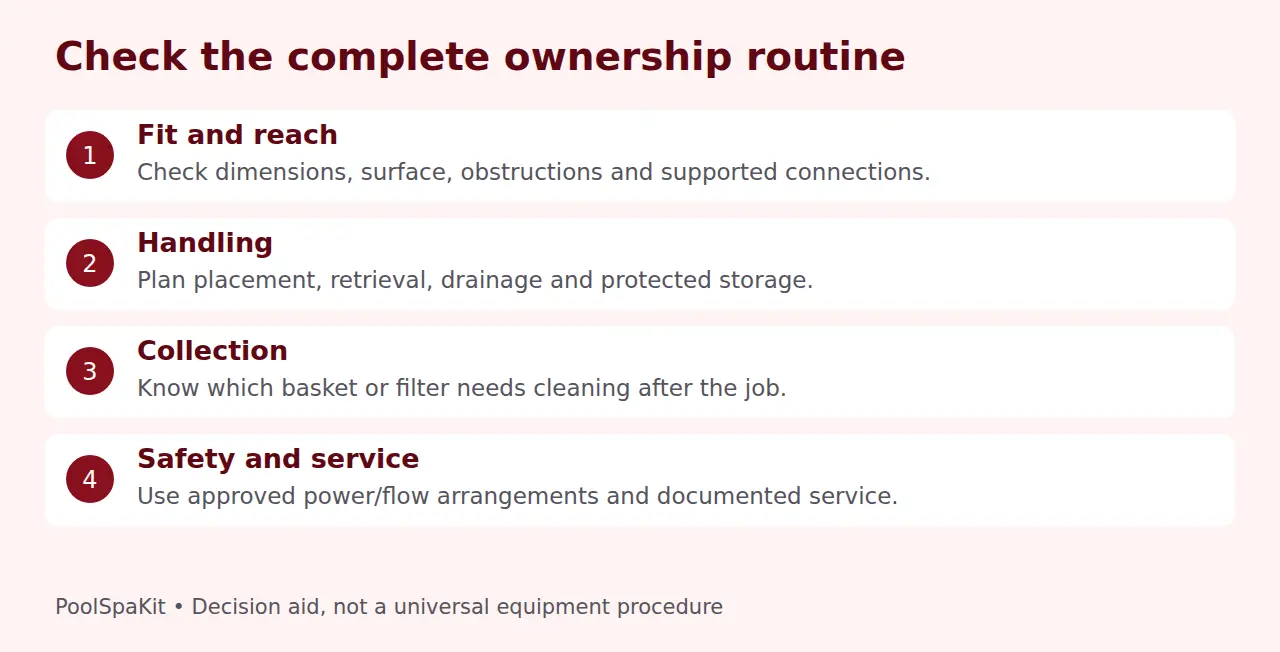
Compare the complete setup rather than only the cleaner sticker price. For manual equipment, list the compatible head, pole, hose and any approved connection parts you still need. For a robot, list the supplied accessories, replacement filter availability and any storage equipment you would use.
Then compare upkeep and repair access. Ask about replacement parts, warranty exclusions, who handles service and whether you must ship the unit. Warranty duration is not a reliable prediction of useful life. This article does not assign a universal lifespan or calculate savings without an actual model and electricity rate.
Your time has a value, but it is personal. Keep a short record of how long your present cleaning routine takes, including setup and cleanup. Use that record when deciding whether reduced steering justifies a different purchase. A robot should not be used as a reason to cut required circulation or sanitizer-production time; see planning your pool pump schedule.
Safety checks before either approach
Keep swimmers away from operating cleaning equipment and follow the exact manual. Hayward’s robotic safety instructions require removal before people enter, disconnection before examination, GFCI protection and no extension cord. Have a qualified electrician resolve an unsuitable supply, damaged cable or unexplained protective-device trip. Do not open energized equipment or bypass protection. Hayward safety instructions; CPSC electrical-safety guidance.
With suction equipment, never test an opening against your hand or body, alter protective fittings, or copy another pool’s valve arrangement. Pentair’s skimmer manual identifies hazardous suction and directs owners to the applicable vacuum and filter instructions. Stop for damaged covers, uncertain plumbing or lost circulation. Do not open a pressurized filter to improve vacuum performance.
Finally, a clean floor is not a sanitation result. CDC emphasizes checking chlorine and pH; neither manual nor robotic cleaning replaces that responsibility. Use the broader maintenance checklist to keep cleaning alongside testing, brushing and equipment care.
Which approach fits your household?
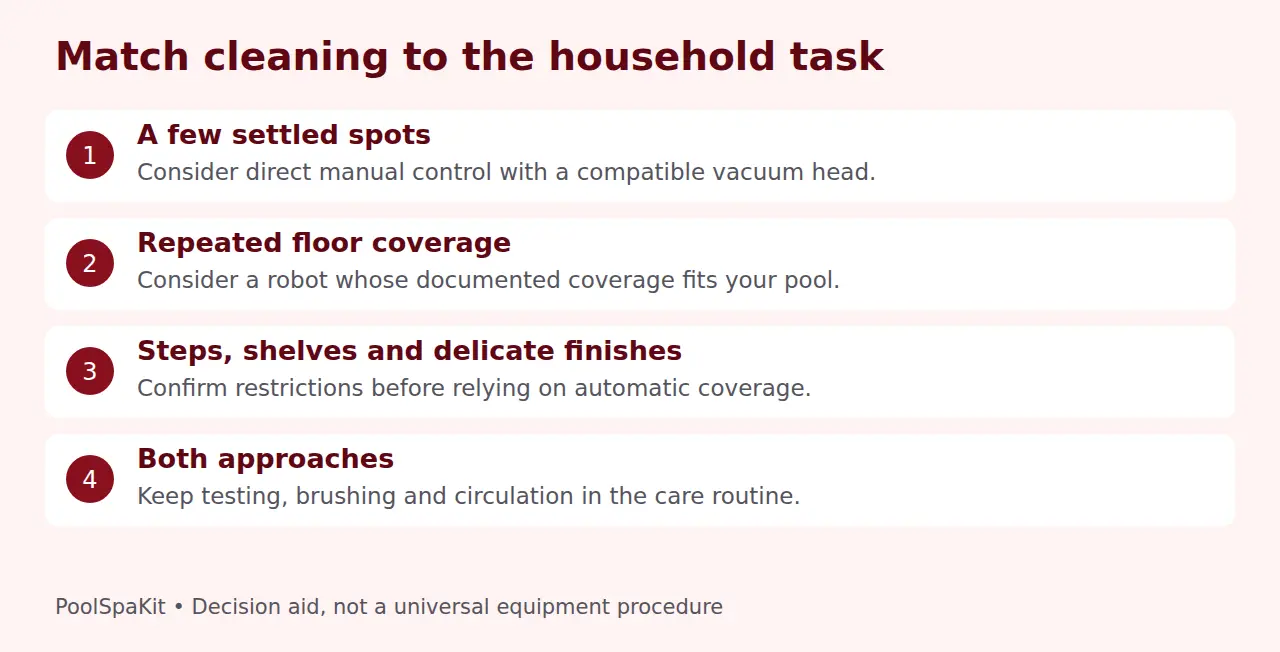
Choose manual vacuuming when direct control, occasional targeted cleanup and a familiar approved setup matter more than reducing steering time. Consider a compatible robot when routine coverage is the main burden and you can comfortably retrieve, clean and store it.
Keeping basic manual tools alongside a robot can be sensible for missed corners or unusual debris. That is a practical fallback, not proof that every owner needs two expensive cleaners. Identify the tasks you cannot currently complete, then choose equipment that addresses those tasks within your pool’s restrictions.
Research checked October 1, 2026. This guide is based on documented guidance and editorial analysis, not hands-on product testing. The featured image is an AI-generated editorial illustration.