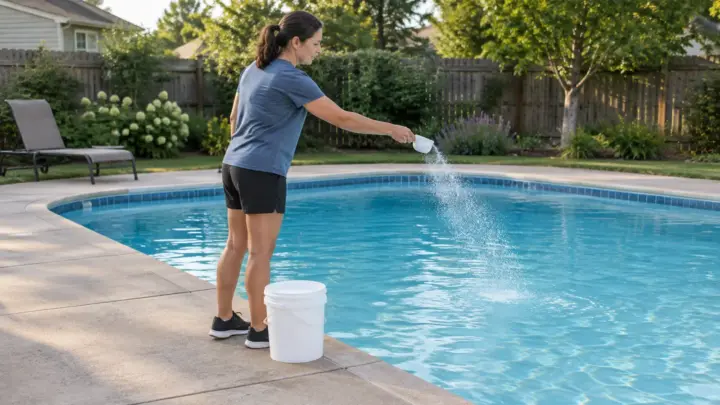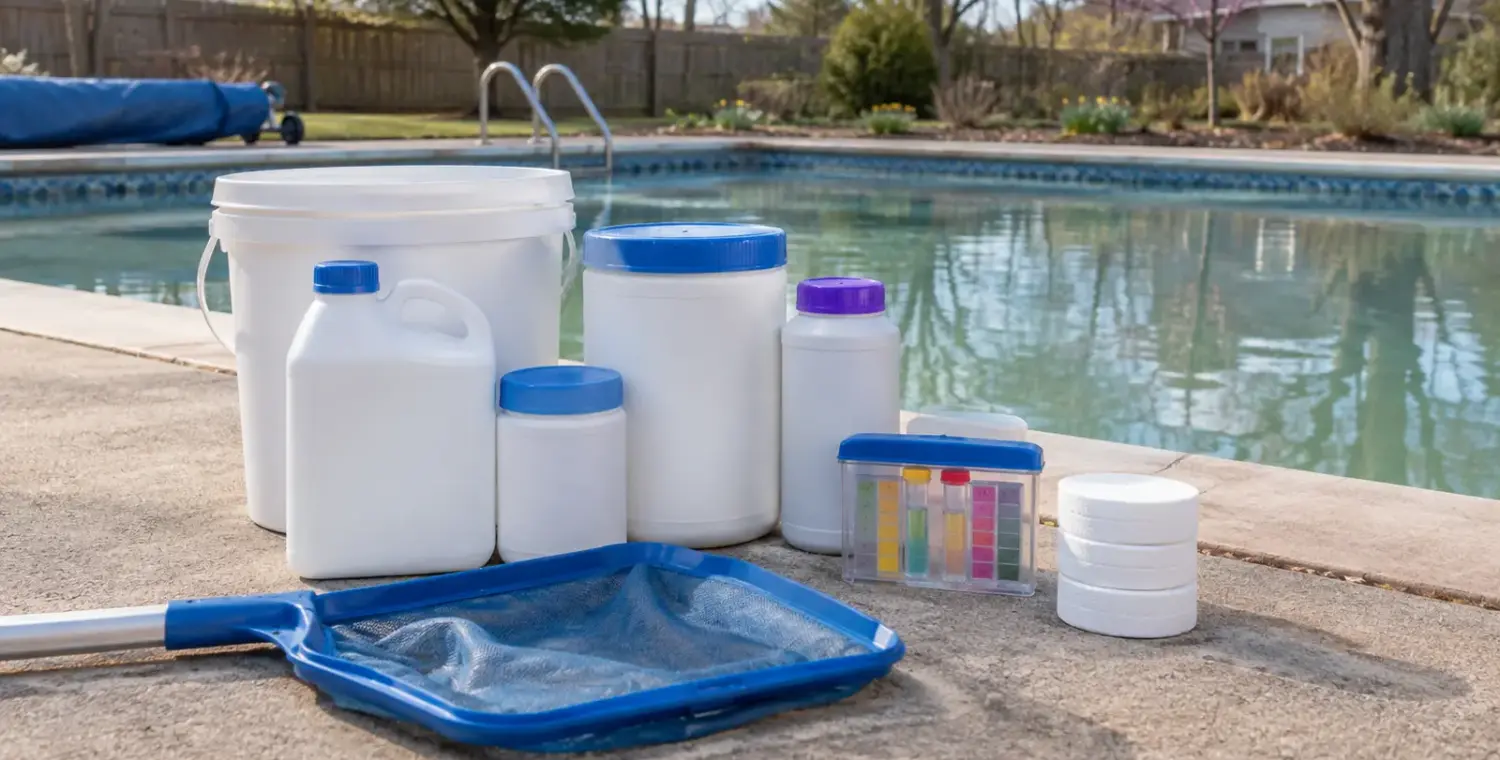
To open a pool you need four kinds of chemical: chlorine, shock, algaecide and balancers (products that move pH, alkalinity and calcium). That is Hayward’s minimum list for opening. The order is simple: get the water circulating, test and balance the water first, then shock. Hayward suggests shocking as the sun starts to go down, then leaving the pool overnight before you vacuum.
Before the cover comes off, check what is left from last season. Hayward’s advice is to make sure nothing has expired, so you don’t end up halfway through opening with an empty bucket. If your leftover chemicals have been sitting in a garage all winter, our guide on storing pool chemicals safely at home covers what to check.
The opening chemical kit, and what each item does
| Chemical | What it’s for at opening | Target to aim for |
|---|---|---|
| pH increaser or decreaser | Brings pH into range so chlorine works and pipes are protected | CDC: 7.0–7.8. Hayward’s chart: 7.2–7.8 |
| Alkalinity increaser | Raises total alkalinity, which helps hold pH steady | Hayward’s chart: 80–120 ppm |
| Calcium hardness increaser | Raises calcium if it tests low | Hayward’s chart: 200–400 ppm |
| Shock | A large chlorine dose to clear winter algae and built-up waste | Dose by the product label and your pool volume |
| Chlorine (everyday sanitizer) | Keeps a steady free chlorine level after the shock | CDC: at least 1 ppm; at least 2 ppm with stabilizer. Hayward’s chart: 1–3 ppm |
| Stabilizer (cyanuric acid) | Protects outdoor chlorine from sunlight | Hayward’s chart: 30–50 ppm |
| Algaecide | On Hayward’s minimum list for opening | Dose by the product label |
You also need a way to measure all of this. CDC says a DPD test kit gives the most accurate results and test strips are less accurate. Our guide to DPD vs OTO chlorine tests explains the difference.
Why the order matters
pH controls how well chlorine works. CDC states that as pH goes up, chlorine kills germs less effectively, especially above 8.0. As pH drops below 7.0, chlorine works harder but pipes are more likely to corrode or break down. Our reasoning follows from that: if you shock water with a high pH, a good part of that dose is wasted. Balancing first lets the shock do its job.
Hayward sets out the same order. Check the balance readings, adjust them, then shock “to get rid of all that winter algae buildup.”
The order to use them in
- Circulate and clean the filter. Hayward’s steps put the pump and filter back in service before the water treatment, and note you will likely need to backwash or clean the filter after winter. If the filter is not working properly, Hayward says to shut the pool down and call a pool professional.
- Test the water. Read pH, alkalinity and calcium, plus chlorine and stabilizer, so you have a full picture.
- Adjust the balancers. Bring alkalinity and pH into range, then calcium if it reads low. Retest before moving on.
- Shock. Hayward recommends waiting until the sun starts to go down.
- Leave it overnight, then vacuum. Hayward says to let the pool sit overnight after balancing and shocking, then vacuum the bottom.
- Settle into routine chlorine. Once the shock has dropped back, keep free chlorine at or above the CDC floor of 1 ppm (2 ppm if you use stabilizer). That number is a minimum, not a target.
Doses on every product label are given per amount of water, so know your volume before you buy. Use the pool volume calculator for that. The calculator gives an estimate of your volume from your measurements; the dose per gallon still comes from each product’s label.
Reading the numbers after shock
Two readings trip people up at opening.
- A chlorine test that reads zero right after shock. CDC warns that above 10 ppm, a DPD test can partly or fully bleach out and show a false low or 0 ppm. Don’t add more shock because of a blank result straight after dosing.
- Combined chlorine. Combined chlorine = total chlorine − free chlorine. Hayward’s chart puts the ideal at 0–0.2 ppm. CDC notes that most health departments cap it at 0.4 ppm or less for public pools. In CDC’s guidance for pool operators, superchlorination means raising free chlorine to 10 times the combined chlorine level.
When your targets are different
- Stabilized chlorine. Dichlor and trichlor contain cyanuric acid. If you use them or add stabilizer, CDC’s minimum free chlorine rises from 1 ppm to 2 ppm.
- Salt pools. Hayward’s chart lists 2,700–3,400 ppm salt, but your generator’s manual sets the real target. The salt calculator can help with the amount. The target salinity comes from your salt chlorine generator’s manual, not from a general chart. Pentair also notes that salt generator pools and plaster pools typically see a slow pH rise, so expect to keep pH reducer on hand. More on how generators work is in our saltwater pool basics guide.
- Hot tubs. CDC’s chlorine minimum for hot tubs is 3 ppm, and CDC recommends not using cyanuric acid or chlorine products with cyanuric acid in hot tubs.
- Algaecide. Hayward lists it as a minimum item, but whether you need it depends on your water. See do you need algaecide in a pool.
Handling the chemicals safely
Opening means handling acid and chlorine in larger amounts than usual. Pentair’s IntelliChem manual gives these warnings:
- When diluting acid, always add acid to water, never water to acid.
- Never mix liquid chlorine (sodium hypochlorite) and muriatic acid. Pentair warns that mixing chemicals with chlorine or chlorine residue in a container can create a deadly gas or an explosion. Don’t add acid and chlorine at the same moment without good water flow, because combining them without enough mixing forms a hazardous gas.
- Wear splash-resistant safety goggles and chemical-resistant gloves when handling acid and chlorine, and work outside in a well-ventilated area.
Next step: once the water is balanced and the shock has dropped back, switch to a routine testing schedule. Our guide on how often to test pool water sets one out by season, and the full spring opening checklist covers the non-chemical steps.
Sources
- Hayward: Opening Your Pool
- CDC: Home Pool and Hot Tub Water Treatment and Testing
- CDC: Chloramines and Pool Operation
- Pentair: IntelliChem Water Chemistry Controller Manual
Research checked 2026-10-23.