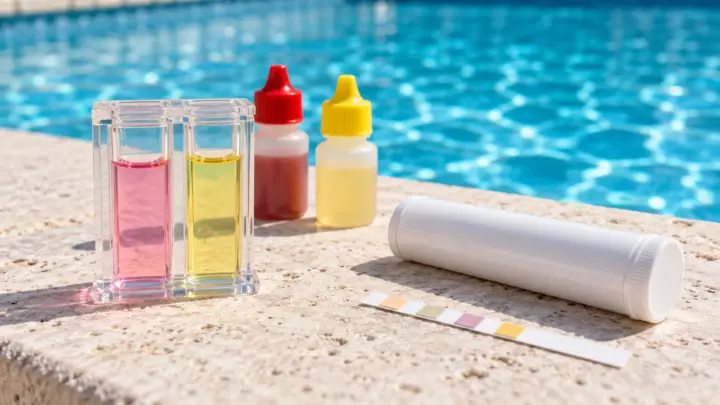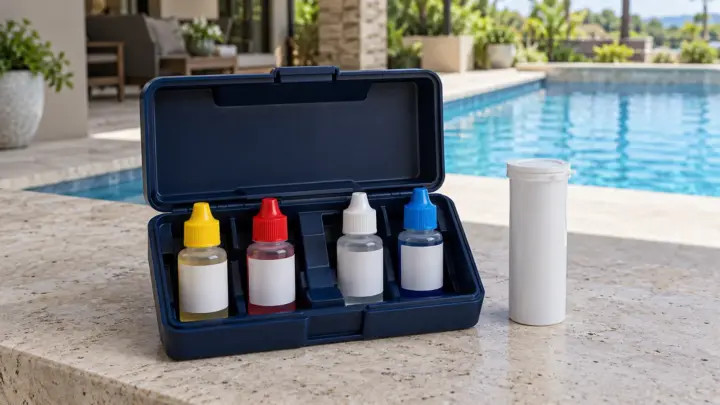
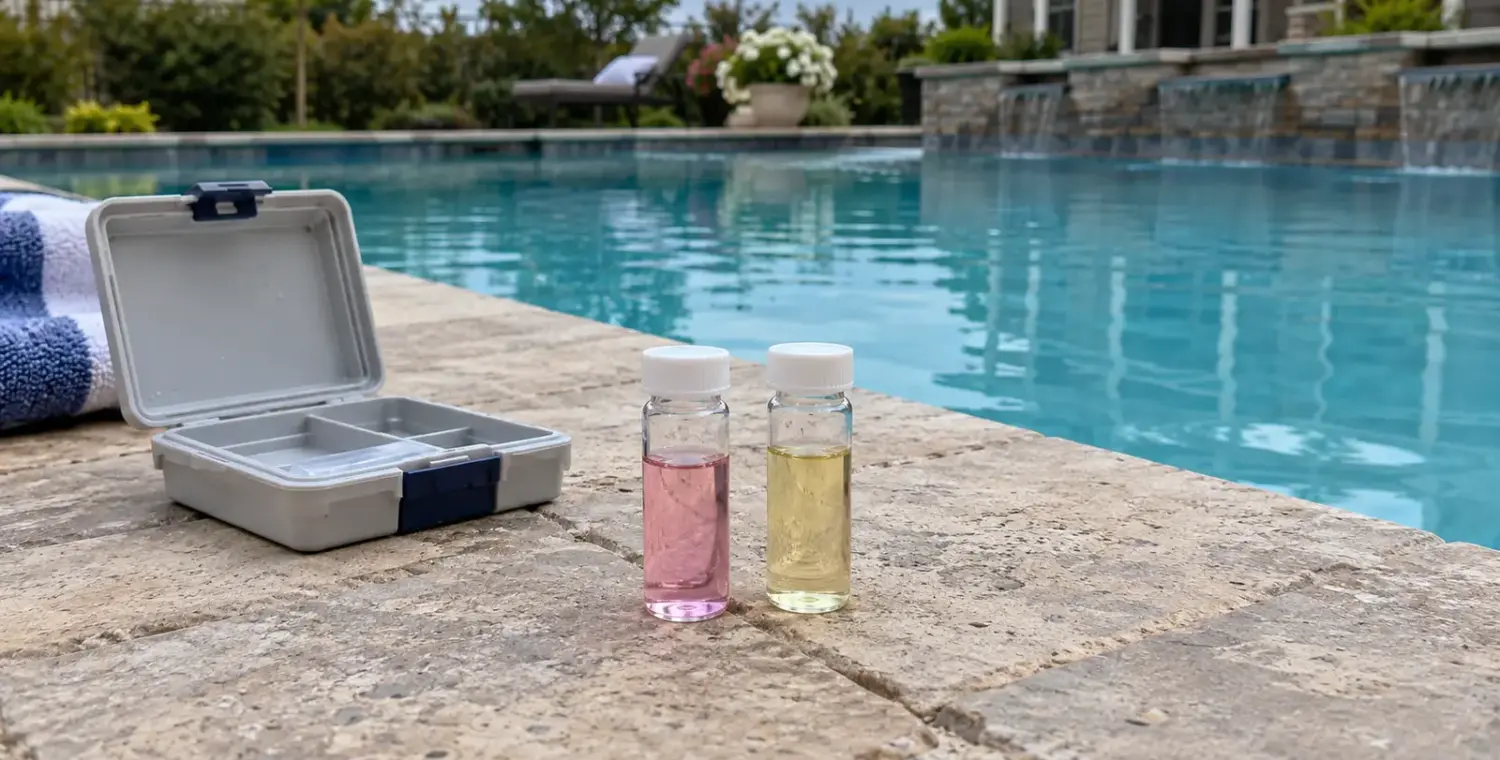
DPD tests can measure both free and total chlorine, and the difference between the two gives combined chlorine; OTO (called OT in some documentation) measures only total chlorine. For routine free-chlorine checks, that makes a DPD or FAS-DPD test the better choice. The pink-versus-yellow color matters less than this: a total-only result leaves the amount of available free chlorine unresolved.
For routine free-chlorine decisions, choose a method that actually reports free chlorine and follow its instructions. Both methods require careful sampling and reading. Neither the water’s appearance nor an attractive test color establishes that swimming is safe.
Start with the chlorine reading you need
Free chlorine is the available disinfectant measured by the free-chlorine procedure. Combined chlorine represents reacted chlorine forms; total chlorine includes both. Comparing a total result against a free-chlorine target risks overlooking that distinction.
For example, two samples with the same total result could contain different proportions of free and combined chlorine. A total-only test cannot separate those proportions. This explains why identifying the kit’s parameter comes before deciding whether a reading is satisfactory.
Keep pH alongside chlorine in the routine. The CDC home-pool testing guidance recommends DPD testing and explains that pH affects chlorine’s effectiveness. Our water-testing guide puts chlorine within the wider panel.
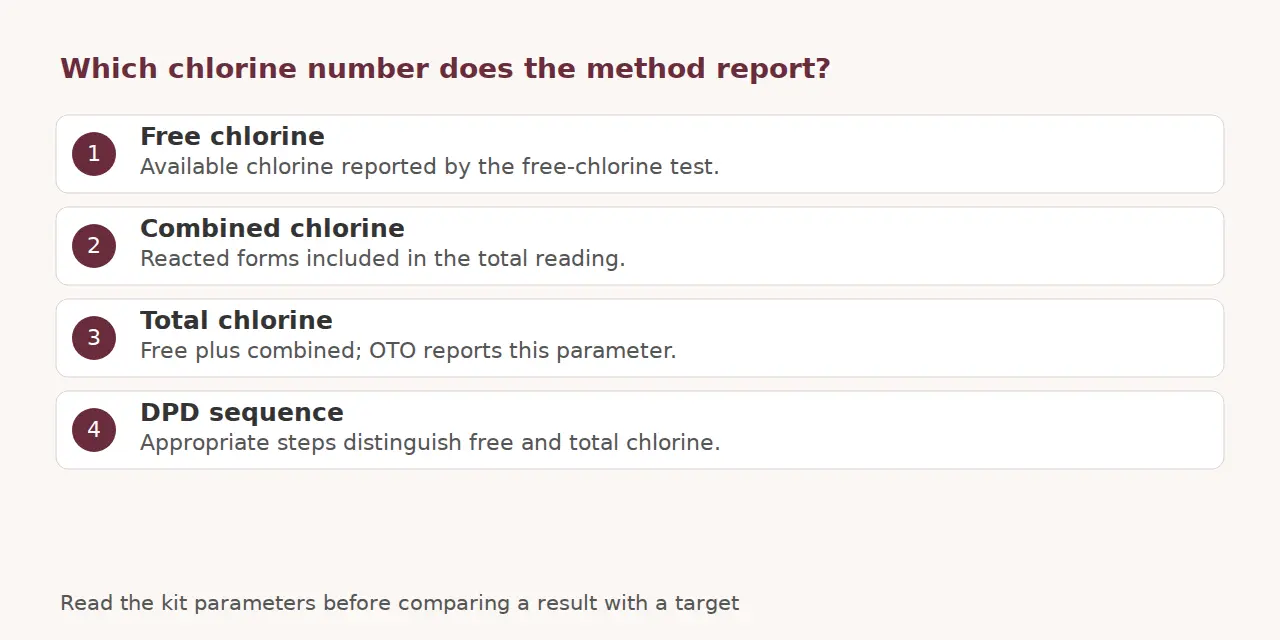
What changes between DPD and OTO?
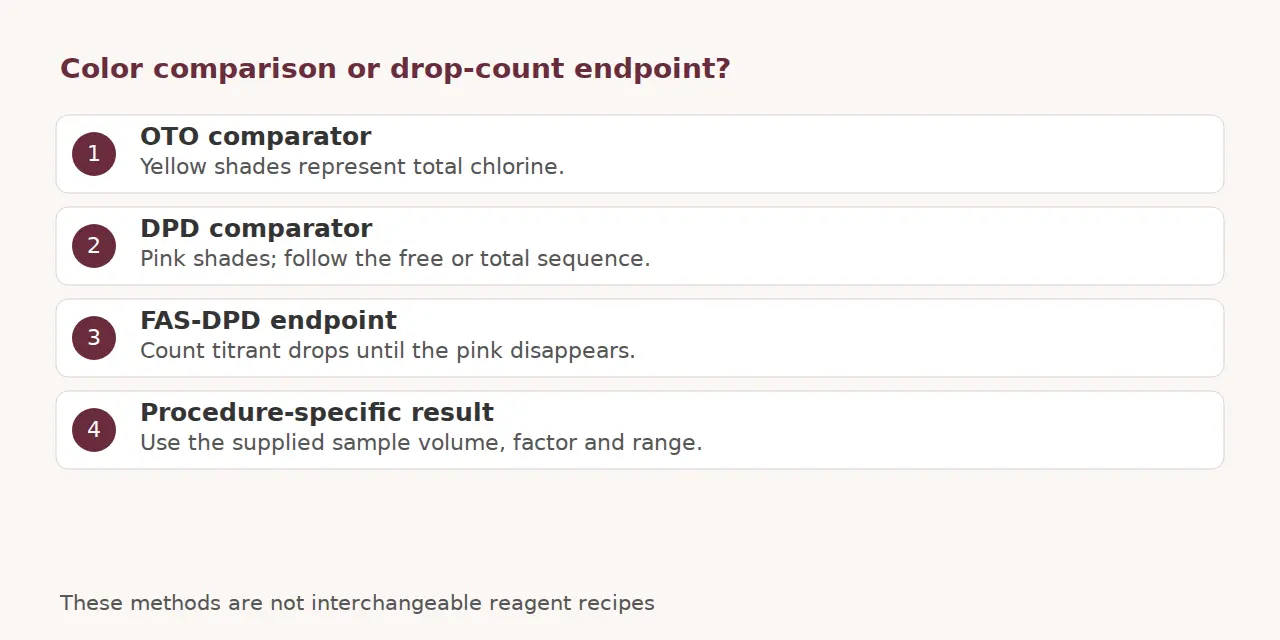
In ordinary DPD color comparison, the treated sample turns pink. The kit’s sequence determines whether the result represents free or total chlorine. Where both readings are obtained as directed, their difference gives combined chlorine.
OTO produces yellow shades and reports total chlorine. The K-1000 OTO kit’s test specification is a concrete example labeled “Total Chlorine.” A yellow response indicates chlorine information, but you still need a suitable free-chlorine measurement for a free-chlorine decision.
Use the comparator intended for the reagents. The manufacturer’s method FAQ distinguishes the yellow OT standards from pink DPD standards. Swapping reagents into a different block or interpreting them against the wrong scale defeats the comparison.
Read the instructions on your actual kit rather than copying another brand’s drops, wait time or range. A kit labeled DPD may have a different collection of tests from the next one on the shelf.
Where FAS-DPD fits
FAS-DPD still uses DPD chemistry, but replaces color matching with a drop-count endpoint. In the documented FAS-DPD procedure, indicator makes the sample pink and titrant is added until that color disappears. The reading uses the factor specified for the sample size.
This can help a reader who finds neighboring pink shades difficult to distinguish. It also adds a counting task and demands accurate sample volume and endpoint technique. The supported range and resolution belong to the specific procedure, not the method’s name alone.
Do the combined-chlorine stage only through the supplied sequence. Avoid borrowing a multiplier or combining numbers from unrelated procedures. Keep the method in your test log so later comparisons remain meaningful.
Resolve a surprising result before treating
- Collect fresh representative water and test promptly, using the required volume.
- Check reagent condition, drop technique, reading time and appropriate lighting.
- Clean the test cell as directed. Residue from a total-chlorine step can interfere with the next free-chlorine reading.
- Record recent treatments. The method FAQ identifies monopersulfate interference with certain DPD total and combined tests.
Testing-error guidance explains why those handling details matter. After substantial chlorine treatment, an apparent zero needs particular attention: CDC warns that chlorine above 10 ppm can bleach a DPD test to a false low or zero. Use the kit’s approved high-range or confirmation instructions rather than making up a dilution.
A practical choice for home testing
Read the test list before buying or using a kit. If you need free and combined information, confirm the complete DPD or FAS-DPD procedure provides it. If you already own an OTO kit, identify its total-only role and arrange appropriate free-chlorine testing rather than assuming the methods are interchangeable.
For convenience trade-offs beyond chlorine chemistry, see test strips versus liquid kits. With either format, public-health guidance keeps sanitizer verification and label instructions central. Pause swimming when sanitation is uncertain, confirm misleading readings and make only label-compliant corrections.
Research checked 2026-10-03.
Sources and references
- CDC: Home Pool Water Treatment and Testing
- Health Canada: Swimming Pool and Spa Chemicals
- Taylor Technologies: Technical and Support FAQs
- Taylor Technologies: How FAS-DPD Tests Free and Combined Chlorine
- Taylor Technologies: 3-Way Test Kit for Pools and Spas (OTO)
- Taylor Technologies: Solutions for 5 Water Testing Errors