Yes, pool test strips and reagents expire, and they don’t all expire on the same schedule. Go by the best-by or expiration date printed on each bottle or strip container, not the date you bought the kit; makers differ, with Taylor describing its reagents as effective for at least one year and AquaChek telling you to use the date on the strip container. Heat, moisture, contamination, or damaged packaging can make a reagent or strip unreliable even before the printed date.
Do not keep using an expired strip or suspect reagent simply because it still produces a color. A plausible-looking reading is not proof that the test remains trustworthy. Replace questionable supplies or obtain suitable confirmatory testing before using the result to make a chemical adjustment.
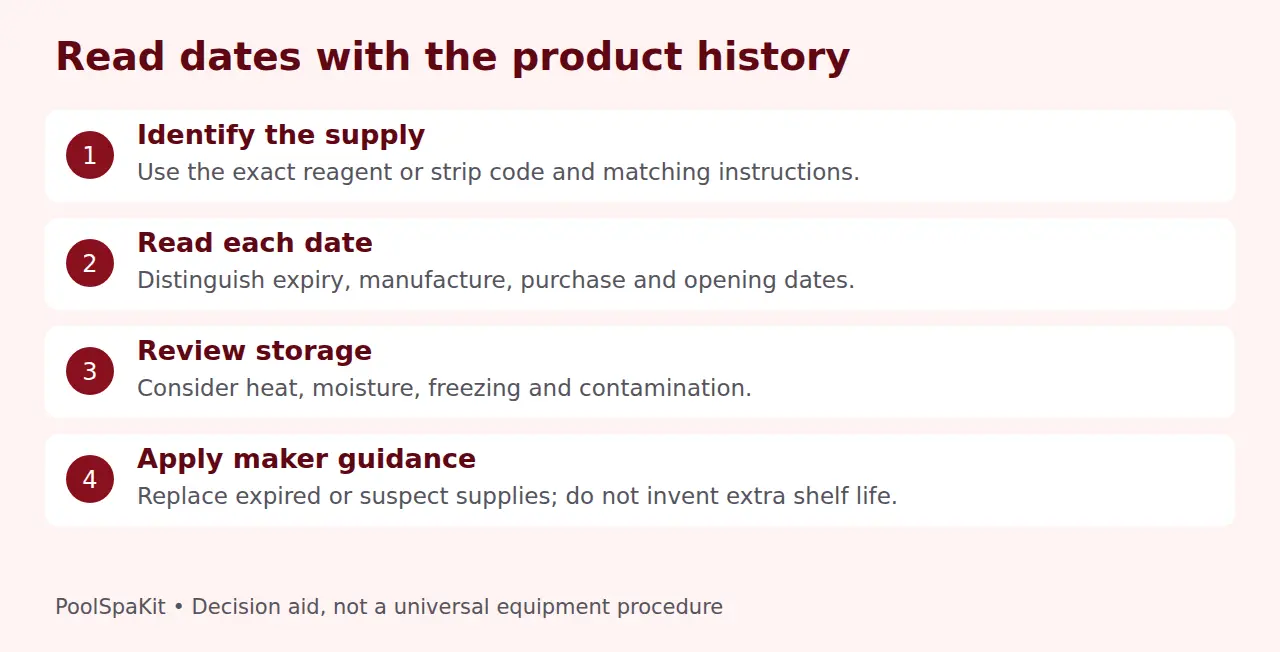
Read the date on each component, not only the case
A kit is a collection of supplies with potentially different histories. A replacement chlorine reagent may be newer than the pH indicator beside it. Strips bought as a refill may have a different date from those originally supplied. Check individual bottles, packages and any current product instructions.
Distinguish a printed best-by or expiration date from a manufacture date, lot number and purchase date. Taylor’s current technical FAQ identifies best-by dates and lot numbers on its labels; the lot helps the maker identify production history. A receipt tells you when you bought the item, not when it was made.
Do not guess at an unfamiliar batch code. Contact the manufacturer with the exact product and code, or ask your supplier to resolve it. A remembered decoding rule for another brand may lead to the wrong year or the wrong replacement decision.
If your product gives a separate after-opening limit, record the opening date and follow that limit as well as its printed expiry guidance. If it does not, opening the bottle does not create a new shelf-life promise. Retain the original packaging and label so the product remains identifiable.
Why online shelf-life numbers differ
Different chemical formulations and packaging do not necessarily age alike. Liquids, powders, tablets and reactive strip pads are different formats. Even reagents within one liquid kit may serve different reactions. A broad internet answer such as “all pool kits last two years” hides the information that actually determines whether your supplies are usable.
| Documented example | What the maker says | What it does not establish |
|---|---|---|
| Taylor reagent guidance | Its 2025 care article describes formulations effective for at least one year and replacement at the beginning of a season as good practice | A guarantee for badly stored supplies or every other brand |
| AquaChek visual strips | Its Water Testing101 page says to replace expired strips and use the container’s date | A fresh shelf-life clock starting at purchase or opening |
| LaMotte TesTabs | The product line advertises up to three years when stored properly | A three-year period for LaMotte liquids, strips or all opened packets |
Those examples differ because the products and formats differ. The useful takeaway is simple: check the label and current guidance for the reagent or strip you actually own. If an older booklet and a newer label seem to disagree, ask the manufacturer which instruction applies.
Manufacturer lifespan statements are not independent testing performed by PoolSpaKit. The practical lesson is to identify the supply and its conditions rather than adopt whichever advertised duration is longest. For the role of each measurement, use the pool water testing guide.
Storage can matter before the date arrives
Keep supplies in the conditions specified by the manufacturer. Taylor, for example, gives a consistent storage range of 36–85°F for its reagents and strips, away from direct sunlight and treatment chemicals. That is Taylor’s guidance, not a universal specification for every test product.
AquaChek advises room-temperature, low-humidity storage for its strips. Close the cap promptly and use dry fingers. LaMotte’s strip handbook also emphasizes dry handling and protection from extreme heat and moisture. A damp shed or hot car can be a poor place to keep supplies even when the container looks intact.
Choose a secure indoor location that meets the product’s requirements and keeps supplies away from children and pets. Bring the kit out to test, then return it to storage. Do not leave reagent bottles beside the pool as permanent accessories or store them with large treatment-chemical containers.
Keep bottles upright and correctly capped. Maintain the original label, bottle and any protective packaging. Repackaging supplies into an unlabeled container removes useful identification and can introduce contamination. Avoid transferring leftovers into another bottle to make a fuller one.
For strips, moisture protection is part of the packaging system. Follow the maker’s instructions for any desiccant or lined container; do not remove protective components casually. A wet pad has already been exposed to the substance it is meant to test.
Signs a reagent may be compromised
Inspect for leaks, damaged bottles, an unexpected change in appearance or new insoluble particles, while following the product’s safety directions. Compare with the manufacturer’s description for that exact reagent. Do not apply a color rule from one indicator to every bottle in the kit.
Taylor gives specific examples: its R-0003 DPD reagent should be colorless but can become increasingly yellow as it degrades, and its R-0004 pH indicator can change from red toward yellow or purple. Those examples are reasons to replace the affected product under Taylor’s guidance, not a universal diagnostic chart.
Absence of an obvious change does not prove continued accuracy. A reagent or strip can still be questionable because of date, storage history or contamination. Conversely, the intended original color differs across products; a colored reagent is not automatically spoiled.
Do not sniff, taste or mix supplies to judge condition. If a bottle is leaking or unidentified, keep it secure and seek the manufacturer’s safe handling and disposal advice. Do not add extra drops to compensate for a reagent that appears weak.
What if the kit froze?
Freezing calls for product-specific advice. Taylor notes that some of its liquid reagents may remain effective after thawing, while cracks or persistent particles are reasons for replacement. It expressly warns against thawing in a microwave or warm water. Do not turn that note into permission to salvage every frozen test product.
If the storage excursion, bottle condition or formulation is uncertain, obtain manufacturer advice or replace the affected supplies. A comparison with a trusted method can help investigate the result, but one plausible reading cannot certify the entire damaged kit.
Unopened supplies are not automatically fresh
An unopened package can still be old or have been stored badly. The remaining useful period depends on the product’s date and conditions, not whether you removed the cap today. Check dates when buying refills, particularly when you are purchasing supplies ahead of the next season.
Keep a brief inventory of product codes, dates and purchase/opening information. Use the oldest eligible supply first, while setting expired or suspect supplies apart so they cannot be selected accidentally. Do not mix strips from different lots into one container; you lose the matching label and history.
Seasonal replacement can simplify planning when the manufacturer recommends it, but it is not an excuse to ignore a shorter component date or damage between seasons. A pool operating year-round still needs a supply-management routine. The calendar start of summer is not a universal expiration event.
Audit the kit before relying on a surprising result
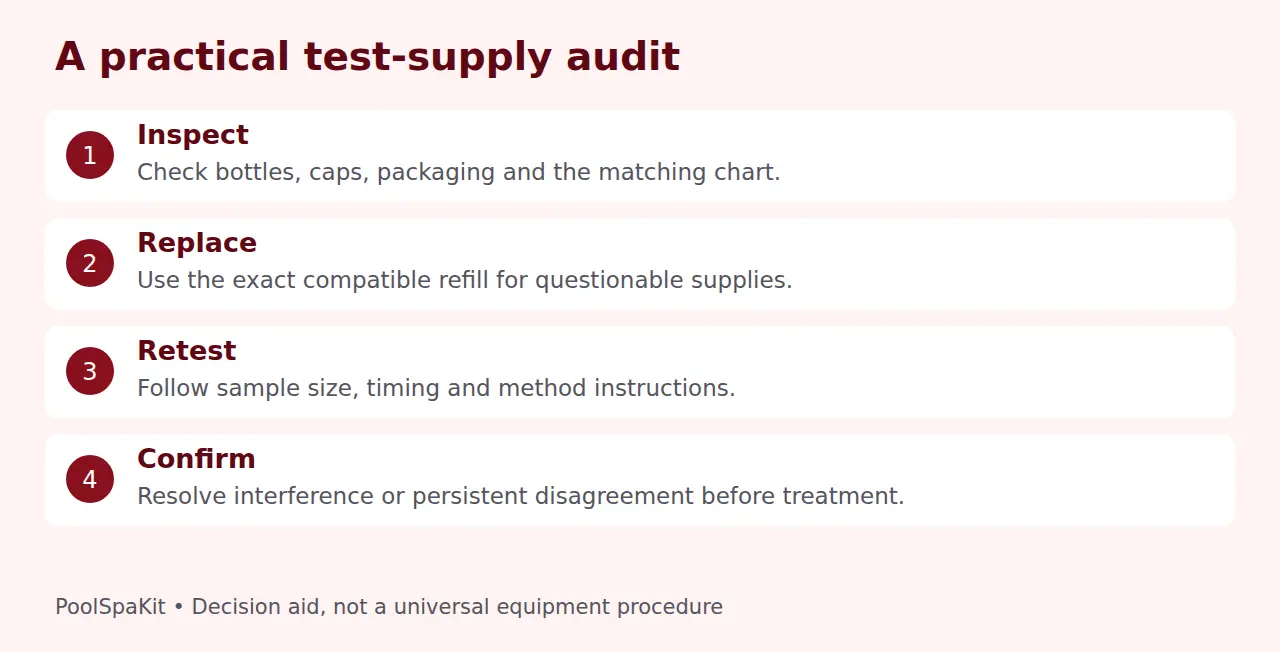
- Identify the exact test, reagent or strip and matching instructions.
- Check individual dates, lot information and applicable opening guidance.
- Review heat, freezing, moisture and contamination history.
- Inspect bottles, caps, packaging and the matching chart or comparator.
- Replace suspect supplies and repeat correctly with a fresh representative sample.
- Confirm unresolved readings using an appropriate method before treatment.
An unusual result is not always an expiry problem. Wrong sample volume, wrong reagent, timing, lighting or measuring different parameters can also explain disagreement. Keep these possibilities separate so you do not replace supplies and repeat the same procedural error.
CDC warns that chlorine above 10 ppm can bleach a DPD test, producing a false low or zero. After substantial treatment, do not assume that a clear sample proves the chlorine has vanished. Consult the method’s high-range instructions or obtain qualified testing rather than automatically adding more chlorine.
If uncertainty persists, contact the test manufacturer with the product code, lot, storage history, procedure and recent treatment. For cloudy pool water, combine reliable results with a broader diagnosis. A new bottle alone cannot solve an unidentified water problem.
Buy replacements that fit the actual testing plan
Choose the exact refill specified for the kit. Similar names do not establish interchangeable concentrations or comparator compatibility. Verify product codes with the manufacturer when uncertain, and avoid buying more than your household can reasonably use within the applicable guidance.
A replacement routine should support the required testing schedule. Keep enough eligible supplies for ordinary checks and foreseeable repeat tests, while avoiding a large stock that may age unused. This is a planning trade-off, not a promised cost saving.
Follow labels and local disposal requirements for unwanted reagents. Ask the maker or local waste authority when the disposal route is unclear. Do not pour miscellaneous leftovers together, put them into the pool as treatment or combine them with other chemicals.
Use confirmed readings and label-compliant treatment instructions to decide the next action. Keep swimmers out while relevant operating conditions remain unverified. Reliable supplies, correct technique and a usable record work together; none can be replaced by a reassuring color from an expired bottle.
Sources and references
- CDC: Home Pool and Hot Tub Water Treatment and Testing
- CDC: Use Pool Chemicals Safely
- Taylor Technologies: Technical and Support FAQs
- LaMotte: Insta-TEST Pool and Spa Owner’s Handbook, Code1510,12.01.23
- Taylor Technologies: Pool Testing Reagents: Care, Storage and Shelf Life, February11,2025
- AquaChek: Water Testing101
- LaMotte: TesTabs Tablet Reagents for Water Analysis