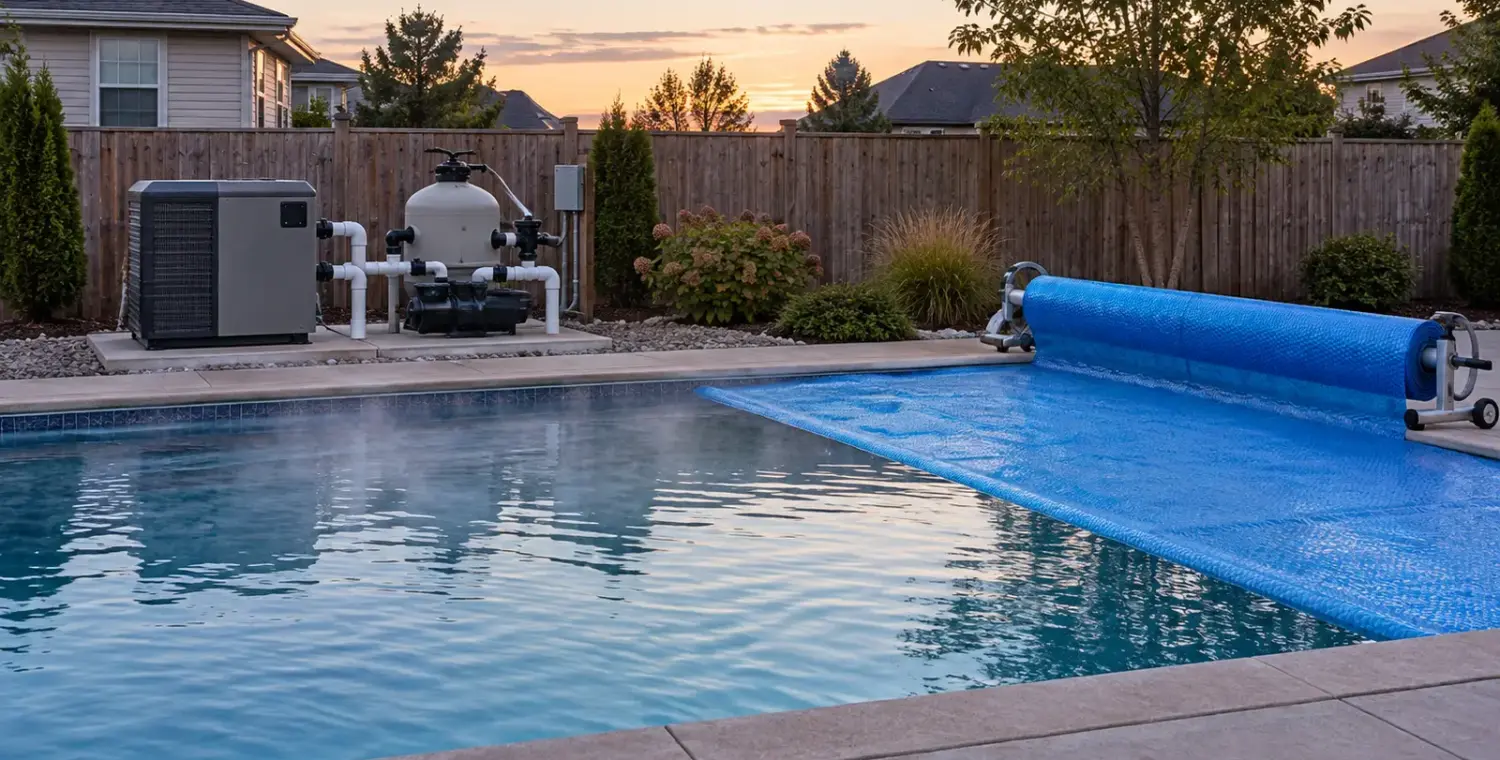
Short answer: DOE’s historical gas estimates for a 1,000-square-foot outdoor pool run $1,814 to $4,905 a season uncovered and $131 to $1,090 with a cover, depending on the city and the water temperature (78°F to 82°F). DOE says covering the pool when it isn’t in use can cut heating costs by 50%–70%.
Those figures assume an 80% efficient natural-gas heater, gas at $1.09 per therm and the pool left uncovered 8 hours a day. Gas costs a lot more than $1.09 in most places now, so re-price the table at your own rate (shown below).
This page covers heater fuel and electricity only. Running the circulation pump is a separate cost: see how much it costs to run a pool pump.
DOE’s historical season costs by city (gas heater)
These rows come from DOE’s Energy Saver table for 80°F water. All rows share the same assumptions: a 1,000 sq ft outdoor pool, an 80% heater, $1.09 per therm and 8 uncovered hours a day. Each city has its own season length, so the totals cover different numbers of months.
| City (DOE season) | Uncovered, 80°F | With cover, 80°F |
|---|---|---|
| Miami (Jan 1–Dec 31) | $3,880 | $796 |
| Los Angeles (May 1–Oct 31) | $3,237 | $414 |
| Chicago (May 1–Sep 30) | $2,823 | $403 |
| Dallas (Apr 1–Oct 31) | $2,616 | $382 |
| New York (May 1–Sep 30) | $2,594 | $403 |
| Seattle (Jun 1–Aug 31) | $2,431 | $578 |
| Phoenix (Mar 1–Oct 31) | $2,420 | $229 |
Moving between 78°F, 80°F and 82°F changes the bill a lot. Across the whole table, uncovered seasons run from $1,814 (Minneapolis at 78°F) to $4,905 (Miami at 82°F).
Re-price the table at your own gas rate
The table is only as current as its $1.09 per therm assumption. To update it, multiply a table figure by your rate divided by $1.09. Everything else (pool size, heater, climate, season, hours uncovered) stays as DOE assumed it. The result is still DOE’s scenario at a new price, not a forecast of your bill.
Getting a rate in therms: your gas bill may already show dollars per therm. If you only have a price per thousand cubic feet, divide it by 10.36: at 1,036 Btu per cubic foot, a thousand cubic feet is 10.36 therms, and 1 therm is 100,000 Btu. EIA’s U.S. average residential gas price for July 2026 was $26.45 per thousand cubic feet, or about $2.55 per therm. That’s a national average. Summer prices in EIA’s series run higher than winter ones (January 2026 was $13.96), so the rate on your bill matters.
Worked example (Chicago, 80°F): $2.55 ÷ $1.09 = a factor of 2.34. DOE’s $2,823 uncovered season becomes roughly $6,600, and the $403 covered season becomes roughly $940.
Why a cover changes the bill so much
DOE calls evaporation “by far the largest source of energy loss” from a pool. Raising a pound of water by 1°F takes just 1 Btu, but each pound of 80°F water that evaporates carries away 1,048 Btu. Warmer water, more wind and drier air all speed up evaporation. That’s why the same pool costs very different amounts in different cities.
- Use the cover every time. DOE’s advice for daytime swimmers: take the cover off just before swimming and put it back as soon as you’re done. A cover saves nothing if it stays rolled up.
- Expect a small trade-off. A transparent bubble cover may cut the sun’s heating of the pool by 5%–15%. That’s small next to the evaporation it stops.
- Block the wind. In windy spots, DOE suggests a windbreak of trees, shrubs or a fence, placed so it doesn’t shade the pool.
What else moves the cost
- Heater efficiency. Efficiency is usable heat out divided by fuel in. An 80% heater wastes 20% of the fuel, and some gas heaters now reach 89%–95%. Most gas heaters show their efficiency on the nameplate. To estimate the saving from an upgrade, DOE’s formula is: current annual cost × [1 − (current efficiency ÷ new efficiency)].
- Target temperature and season length. Each extra degree and each extra month adds to the bill, as the DOE table shows.
- How much you use it. DOE’s own rulemaking notes that heater run hours vary a lot with location, how often the pool is used and whether a cover is used.
- Heater size. Sizing affects how fast the pool heats up. See pool heater sizing in BTUs.
Electric heat pump and solar options
None of the sources used here has a DOE season table for heat pumps, so no city figure is given for them. Instead, use the one-time estimate below with the COP from your heater’s label and your electricity rate. DOE’s rulemaking says many heat pump pool heaters are rated at a COP of 6.0. Those ratings are measured at test conditions that often differ from conditions at your pool. Heat pumps perform best in warm, humid air, so expect less heat per kWh on cool days. EIA’s U.S. average residential electricity price for August 2026 was 18.16 cents per kWh, a national average. Your bill may differ.
DOE says gas heaters suit pools used only now and then: they heat quickly and can hold a temperature in any weather, which a heat pump or solar system can’t. DOE also says that, depending on climate and use, gas may not be the most cost-effective choice compared with those alternatives. These sources give no dollar figures for solar heating. DOE does note that a cover can reduce the size of solar system you need.
Cost of a one-time warm-up (worked example)
This is a different question from the season cost. It covers only the heat needed to raise the water once. It’s an ideal minimum. In practice the pool keeps losing heat to evaporation, wind and cool nights the whole time it warms (and gains some from the sun), so expect to pay more. It’s not a monthly cost.
Example: a 20,000-gallon pool raised 10°F. Water weighs about 8.33 lb per gallon (62.300 lb per cubic foot at 70°F), so that’s about 166,600 lb of water. At 1 Btu per pound per degree, it needs about 1.67 million Btu delivered to the water.
- Natural gas, 80% heater, $2.55 per therm: about 20.8 therms burned, about $53.
- Heat pump, COP 5, 18.16¢ per kWh: about 98 kWh (3,412 Btu per kWh), about $18.
- Propane, 80% heater, $2.689 per gallon: about 22.8 gallons (91,452 Btu per gallon), about $61. The price is EIA’s U.S. residential average for the week of October 19, 2026. EIA collects weekly propane prices only from October through March.
To run it for your pool, swap in your gallons, your temperature rise, your heater’s efficiency or COP and the rate from your utility bill. If you don’t know your volume, start with the pool volume calculator. The warm-up estimate starts from your pool’s volume in gallons; the volume calculator estimates it from your pool’s shape and dimensions.
Next step
Find your city (or the closest climate) in DOE’s table and multiply by your rate ÷ $1.09. Then compare the uncovered and covered columns. For most pools, the gap between those two numbers is the biggest saving available.
Sources
- U.S. Department of Energy (Energy Saver, archived): Gas Pool Heaters
- U.S. Department of Energy (Energy Saver, archived): Swimming Pool Covers
- U.S. Energy Information Administration: British thermal units (Btu)
- U.S. Geological Survey: Water Density
- U.S. Energy Information Administration: U.S. Price of Natural Gas Delivered to Residential Consumers
- U.S. Energy Information Administration: Average Price of Electricity to Ultimate Customers by End-Use Sector, by State
- U.S. Energy Information Administration: Heating Oil and Propane Update
- U.S. Department of Energy: Energy Conservation Standards for Consumer Pool Heaters
Research checked 2026-10-27.