Metals get into pool water two ways: with the fill water, and from things in and around the pool after it is filled. PHTA says the second route carries most of the load: “the majority of metals found in pool and hot tub water are introduced after the fill water” has been added. What prevents staining is a short list:
- keep pH at 7 or above and the water balanced;
- pretreat fill water that tests above 0.2 ppm total metals;
- keep dissolved metals tied up with a sequestering agent, or take them out of the water.
The rest of this guide covers where iron, copper and manganese come from, how they turn into stains, how to test for them and when the problem is probably not metals.
Which metals cause pool problems
PHTA names six metals that typically cause trouble in pools and hot tubs: iron, copper, manganese, cobalt, calcium and magnesium. Calcium and magnesium cause scale rather than coloured stains. The staining metals are iron, copper, manganese and, less often, cobalt.
Where the metals come from
Fill and top-up water
According to PHTA, nearly all municipal and well water used to fill pools contains some metals. Well water is the bigger risk. PHTA lists high iron and copper, tannins and iron bacteria as the main problems with filling a pool from a well. City water can pick up copper from the supply pipes, depending on what they are made of and how old they are.
Iron can hide in water that looks clean. The Minnesota Department of Health describes “clear-water iron” as water that comes out of the tap clear and turns red or brown after standing, because dissolved iron turns to rust once it meets oxygen.
Sources inside and around the pool
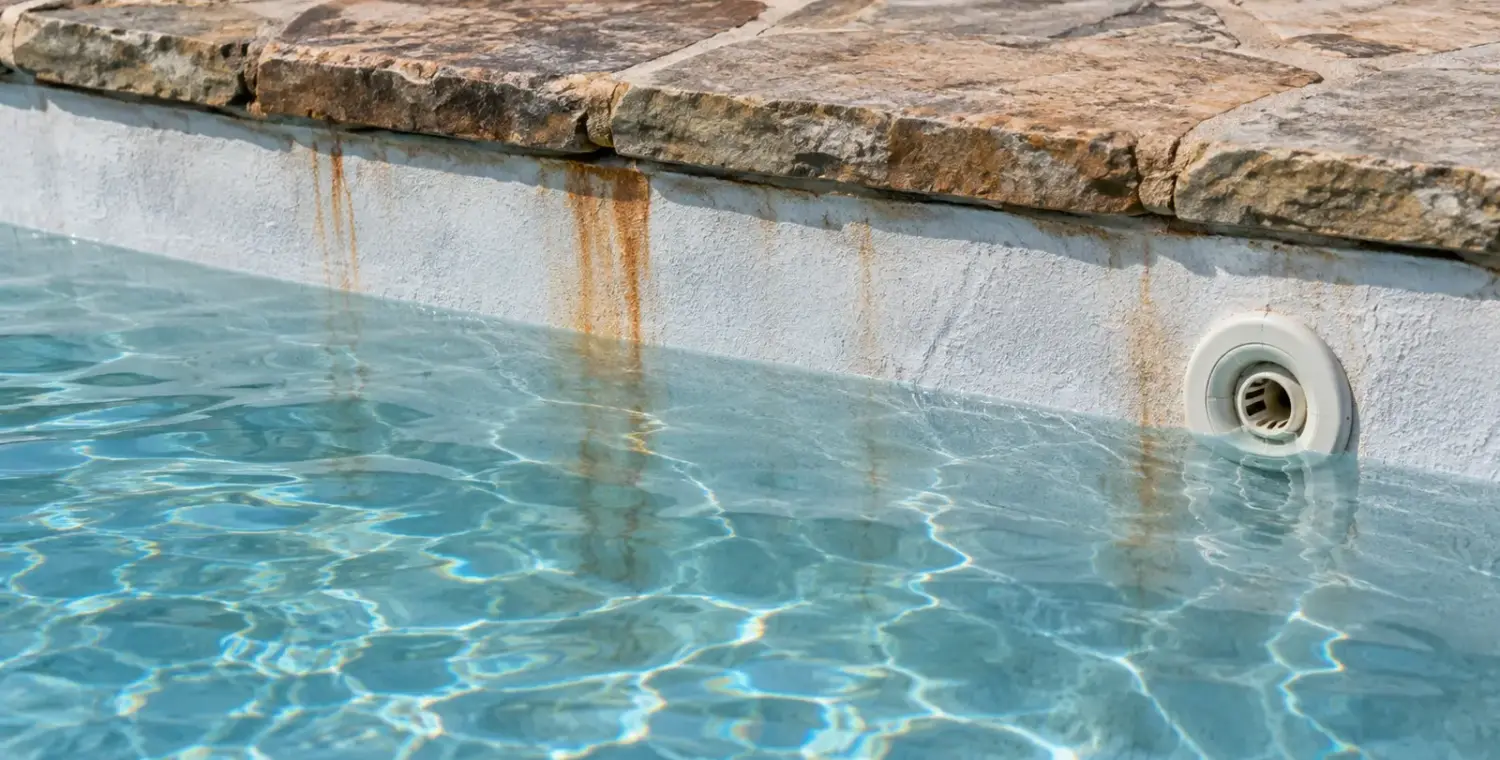
- Stone. Marble, flagstone and granite naturally contain iron, and PHTA says it can leach into the pool after every rain.
- The heater. Copper can come out of the heat exchanger in a gas heater when the water is not balanced.
- Products. Copper-based algaecides and mineral systems add metal to the water directly. If you are weighing whether to use an algaecide at all, see do you need algaecide in a pool?
- Runoff and irrigation. Metal-containing fertilizers, and sprinklers running reclaimed or well water, can all carry metals into the pool.
- Corrosion. Low pH, or water short on calcium or alkalinity, attacks equipment and plaster and releases the metals in them.
- Galvanic corrosion. Without a working bonding system, metal parts in contact with the water can dissolve. PHTA notes this gets worse in salt water.
How dissolved metal becomes a stain
Dissolved metal is invisible. It stains once it oxidizes and falls out of solution onto the surface. BioGuard’s guidance says the usual triggers are “an increase in pH or application of a shock product”. That explains why stains or colour often show up right after a shock or a pH correction. If the water itself turned brown after you added chlorine, see why pool water turns brown after chlorine; that page has the step-by-step checks.
Copper can also react with high cyanuric acid. PHTA says the result is a “characteristic purple surface stain or purple-colored” water called copper cyanurate.
Colour is a clue, not a diagnosis
EPA’s secondary drinking water standards link certain colours to certain metals. Those links describe drinking water and household fixtures, not pools, but they are a reasonable starting point:
| Metal | What EPA associates it with (drinking water) |
|---|---|
| Iron | Rusty colour, sediment, reddish or orange staining |
| Copper | Blue-green staining |
| Manganese | Black to brown colour, black staining |
In a pool, green water is usually algae. Brown can come from iron bacteria. A dark spot can be organic. Test before you treat.
How to test for metals
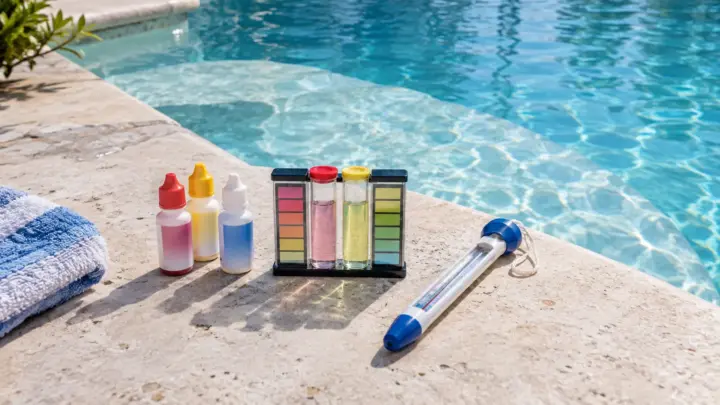
Your usual chlorine, pH and alkalinity tests do not measure metals. To confirm metals you need a separate iron or copper test, or a lab test. The test you use makes a big difference to the reading.
- Most kits read only part of the metal. PHTA says most iron and copper tests “measure only the free form of the dissolved metal”. Sequestered metal and oxidized particles are typically missed. Two-step total metal tests catch free, complexed and some oxidized metal better than one-step tests.
- Sequestrants make copper read low. PHTA’s testing bulletin says most copper tests measure only free, un-sequestered copper, and normal sequestrant levels push the result down. A low copper reading in a pool that already has sequestrant in it does not prove the copper is gone.
- Iron bacteria hide iron. Iron inside bacteria can’t easily be detected by a test, according to PHTA.
- Your hardness test can give a hint. PHTA says the normal endpoint of a calcium hardness titration is red to blue. “If the color change is red to purple, a high level of copper is usually the cause.” Treat that as a reason to run a copper test. It is not a copper measurement.
- Labs measure total metal. A laboratory can give you the exact amount of iron. Lab-grade total iron methods such as Hach’s FerroVer use a reagent that converts soluble and most insoluble iron into a form the test can read.
Test the fill water as well as the pool. PHTA recommends testing source water for metals before filling and checking it at least once a year. On city water, your utility’s annual water report lists what is in it.
Prevention: what actually stops staining
- Keep pH and balance in range. PHTA calls pH “the most significant factor” in stopping equipment and surfaces from releasing metals. Water below pH 7 is acidic and likely corrosive. Low calcium or alkalinity pulls calcium and carbonate out of plaster, along with the metals in it.
- Pretreat metal-heavy fill water. PHTA recommends treating source water with more than 0.2 ppm total metals before it goes in the pool. A sediment filter of 10 micron or less removes most larger oxidized particles, and adsorbent filters reduce dissolved metals. Avoid filling or topping up with untreated water above 1 ppm metals.
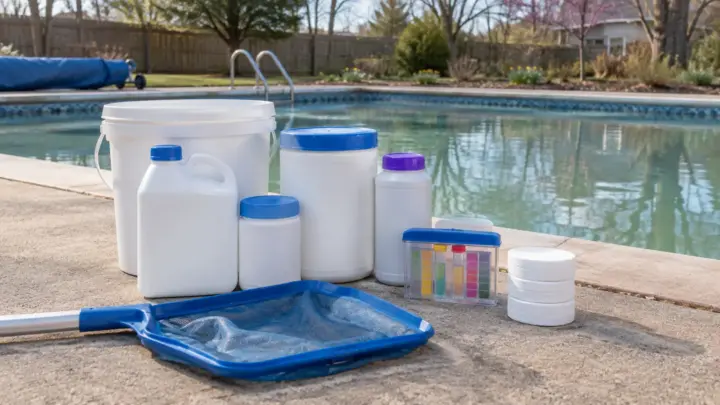
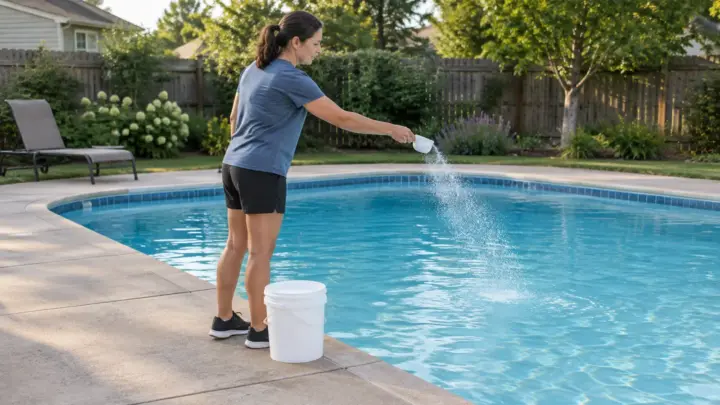
- Use a sequestrant continually, especially when adding water. PHTA says sequestering agents bond to dissolved metals and slow their oxidation by the sanitizer, which limits staining. The pool’s sanitizer keeps destroying the sequestrant, so follow the product label’s maintenance dosing on top of the first dose.
- Cut down on added copper. PHTA notes that keeping sanitizer at the correct level reduces the need for copper-based algaecides.
- Keep the bonding system working. PHTA says bonding should be tested at least annually and whenever you see corrosion, for electrical safety as well as corrosion control. This is electrical work: have a qualified electrician test it.
Sequestering is not removal
Sequestrants are often sold as “metal removers”, but PHTA is plain about it: they “only chelate the metals and do not physically remove them from the water”. The bound particles are too small for a pool filter to catch. PHTA lists only three ways to reduce the dissolved metal itself:
- draining part of the water and refilling with metal-free water;
- filtering the water through reverse osmosis;
- using insoluble natural or polymer adsorbents that bind the metals.
Removing the metal only lasts if you also fix the source. If you skip that, the stone, heater, well or algaecide keeps adding more.
Removing a metal stain that is already there
PHTA describes three steps:
- lift the stain off the surface;
- sequester the metal that is now dissolved in the water;
- take the metal out of the water.
Stains are lifted by adding ascorbic acid (vitamin C), citric acid, oxalic acid or a similar product to the water. The product label controls the amount. PHTA warns that stain removal with muriatic acid should only be done by an experienced pool service professional, because it can permanently damage the pool surface. PHTA also refers stubborn staining problems to a trained pool professional.
When it is probably not metals
PHTA admits that telling metal stains from organic ones “is occasionally challenging”. Its suggested approach is to look at the stain’s history, check your water chemistry, and spot test the stain with ascorbic or citric acid. One trap: stains caused by iron bacteria can disappear with ascorbic acid and then come back as soon as chlorine is restored. Cloudy water with no stain usually has a different cause; see cloudy pool water causes and fixes.
Copper levels to know
PHTA reports that the CDC recommends copper in pool and hot tub water not exceed 1.3 ppm. PHTA adds that staining may occur at lower levels. Don’t treat 1.3 ppm as a safe-from-stains target.
Next step
Get a metal test on both the pool and your fill water. Use a total-metal test or a lab if you already use a sequestrant. Then match the result to its source: pretreat the fill water, bring pH and balance back into range, and pick sequestering or removal. Add metal testing to your regular testing schedule whenever you top up from a well.
Sources
- Pool & Hot Tub Alliance (PHTA): Fact Sheet: Metals and Metal Staining
- Pool & Hot Tub Alliance (PHTA): Technical Bulletin: Common Interferences in Pool and Spa Water Testing
- Pool & Hot Tub Alliance (PHTA): Fact Sheet: Source Water and its Effects on Pool and Spa Maintenance
- BioGuard (BioLab): Metal Staining
- U.S. Environmental Protection Agency: Secondary Drinking Water Standards: Guidance for Nuisance Chemicals
- Minnesota Department of Health: Iron in Well Water
- Hach: Iron, Total: USEPA FerroVer Method 8008
Research checked 2026-10-28.