The amount of salt is gallons × ppm increase × 0.0000083454 = pounds. To raise a 20,000-gallon pool from 500 ppm to 3200 ppm, that is 20,000 × 2,700 × 0.0000083454 = 451 lb of salt, about 12 bags of 40 lb. The target comes from your generator’s manual: Hayward’s AquaRite wants 2700–3400 ppm (3200 ppm optimal), and Pentair’s IntelliChlor wants 3600 ppm.
Test the current salt level first, because the increase, not the target, is what you multiply.
Step by step
- Find your target in the generator manual (table below).
- Test your current salt. Hayward warns there may already be salt in the pool from prolonged chlorine use. Pentair’s built-in reading is only within ±500 ppm, so confirm a low or high reading with a salt test before a large addition.
- Subtract: target ppm − current ppm = ppm increase.
- Multiply: gallons × ppm increase × 0.0000083454 = pounds. In litres: litres × ppm increase ÷ 1,000,000 = kilograms.
- Add, brush, circulate, retest (details below).
| Generator | Target | Notes (manufacturer-specific) |
|---|---|---|
| Hayward AquaRite | 2700–3400 ppm; 3200 ppm optimal | New plaster: wait 10–14 days |
| Pentair IntelliChlor | 3600 ppm (range 3600–4500) | Shuts off below 2600 ppm; new plaster: wait at least one month |
These are two makers’ numbers, not a universal salt level. A third system can differ. Use the number in your own manual, and use the salt calculator for the pounds: the target salinity comes from the generator manual.
Worked examples
- Hayward’s chart, checked: Hayward’s Table 1 lists 320 lb for 12,000 gallons at 0 ppm going to 3200 ppm. The formula gives 12,000 × 3,200 × 0.0000083454 = 320 lb, so the two agree.
- 20,000 gallons, 500 ppm to 3200 ppm: 2,700 ppm increase = 451 lb, about 12 bags of 40 lb.
- Same pool to Pentair’s 3600 ppm: 3,100 ppm increase = 517 lb. The manufacturer’s target changes the bag count by about 66 lb.
- Metric: 75,000 litres from 0 to 3200 ppm = 75,000 × 3,200 ÷ 1,000,000 = 240 kg.
Not sure of your volume? Use the pool volume calculator: the calculator is for simple shapes and uses average depth. Keep the unit straight, because the formula above uses US gallons.
Which salt, and how to add it
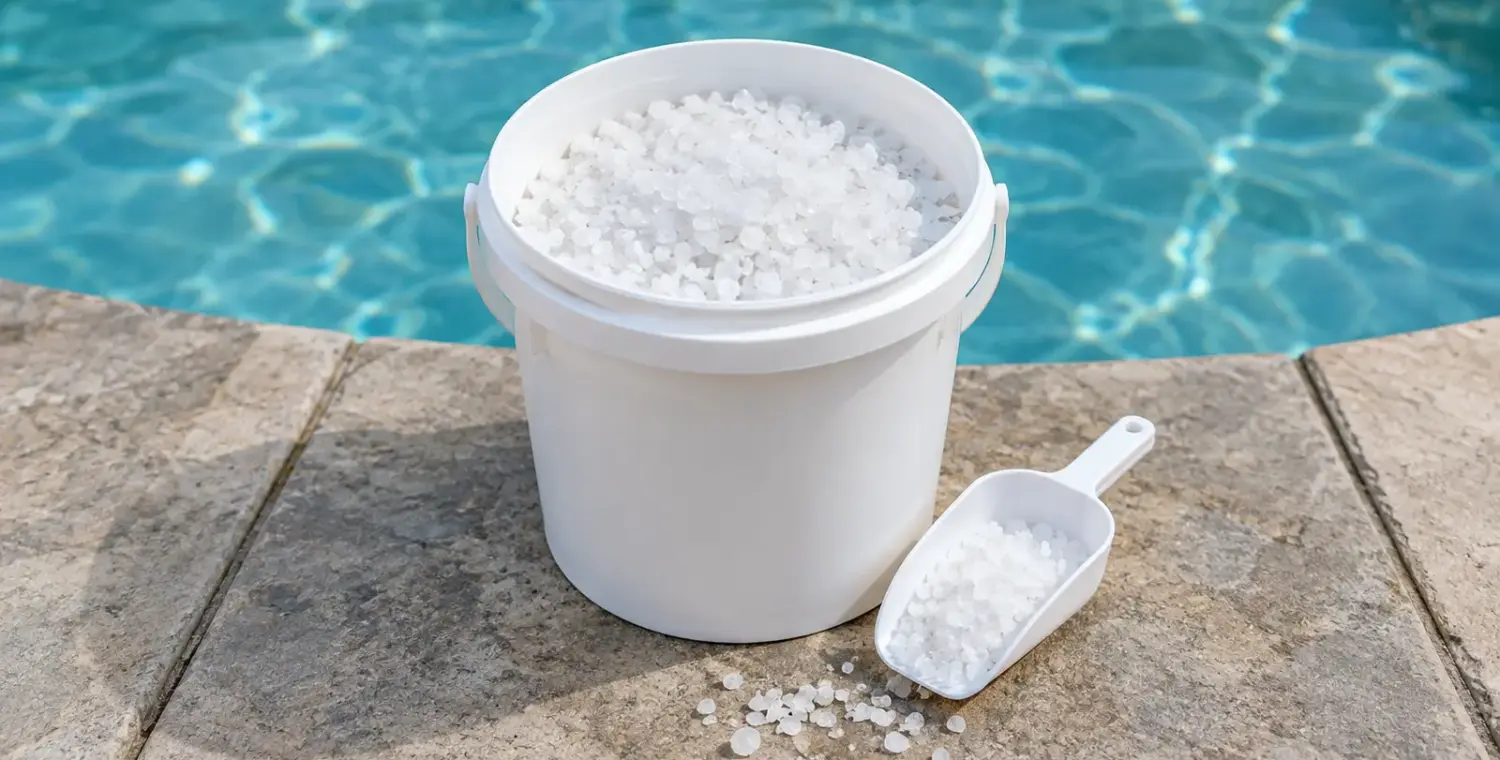
- Use pool-grade sodium chloride. Hayward calls for sodium chloride over 99% pure, usually sold in 40–80 lb bags as coarse solar salt. Do not use rock salt, salt with yellow prussiate of soda, salt with anti-caking additives, or iodized salt. Pentair adds: do not use calcium chloride or potassium chloride.
- Run the pump, pour it in, brush it around so it does not pile up on the bottom (Hayward).
- Wait for it to mix. Hayward says to run the pump 24 hours; Pentair says at least 24 hours after every addition before you take a reading. Hayward adds that the display may take 24 hours to respond.
- New plaster: wait 10–14 days (Hayward) or at least one month (Pentair), because salt is corrosive to fresh plaster. Follow your generator’s number.
Round up to whole bags and add in portions if you are unsure of the volume, then retest once the water has circulated. That keeps you from overshooting.
If the salt is too high
Hayward says the only way to lower salt is to partially drain the pool and refill with fresh water. The share to replace is (current − target) ÷ current. From 4000 ppm to 3200 ppm, replace 20% of the water. Fiberglass and in-ground vinyl-liner pools should never be emptied, so replace water in portions and ask your pool builder how far the level may be lowered.
Keep it in range
You only need more salt when water is replaced by backwashing, draining or splashing, not evaporation (Hayward). Pentair also wants cyanuric acid at 30–50 ppm; see cyanuric acid in pools. If the cell isn’t producing chlorine, start with what to check first, and see how to clean a salt cell and saltwater pool basics.
Sources
- Hayward: AquaRite Electronic Chlorine Generator Owner’s Manual
- Pentair: IntelliChlor IC15/IC20/IC40/IC60 Installation and User’s Guide
- Hayward: Chemistry Quick Start Guide (Table 1: pounds of salt for 3200 ppm)
- Pentair: What to do with your pool after a power outage
Research checked 2026-10-08.