A chlorine reading that looks too high usually has a simple explanation: too much product was added, a chlorinator or salt system is set too high, or less chlorine is being used up than usual. Before you change anything, it is worth confirming the reading, because very high chlorine can make a standard test show a falsely low result. This guide explains what “too high” means, how to check the reading, what causes it, and how to bring chlorine down safely without adding more chemicals than you need.
The short answer
Stop adding chlorine, confirm the reading with a careful retest, and let the level fall back into the range your equipment and local guidance recommend. Sunlight and normal pool use reduce chlorine over time. If you have a salt chlorine generator or automatic chlorinator, turn its output down according to its manual. Chlorine neutralizer products exist, but use them only according to their label, and never mix them with other pool chemicals.
Key takeaways
- There is no single “maximum” that every source agrees on. CDC publishes minimums; Health Canada gives a residential range; equipment makers give ranges for their own systems.
- Very high chlorine can bleach a DPD test, so a reading of zero can actually mean “very high”. Dilute and retest if the result does not make sense.
- The most common causes are overdosing, a generator or feeder set too high, and lower chlorine demand (for example, a covered pool).
- Strong “chlorine” smell and red eyes are usually caused by chloramines, not by too much free chlorine.
- The safest way down is usually time: stop adding chlorine and retest. Follow product labels and local rules for anything else.
What counts as “too high”?
Sources describe chlorine targets differently, so it helps to know what each one actually says.
| Source | What it says | Type of guidance |
|---|---|---|
| CDC (United States) | pH 7.0–7.8 and chlorine of at least 1 ppm in pools; at least 2 ppm in pools when cyanuric acid (stabilizer) is used | Minimums for home pools, not an upper limit |
| Health Canada | 1-3 ppm free available chlorine for residential pools | Residential range (Canada) |
| Pentair IntelliChlor guide | 2.0-4.0 ppm as the ideal range to maintain with that salt chlorine generator | Manufacturer-specific |
Evidence conflict: these numbers do not line up exactly. CDC sets a floor rather than a ceiling, Health Canada’s upper figure is 3 ppm, and Pentair’s range for its own generator goes to 4.0 ppm. In practice, “too high” means above the range that applies to your pool: your local health guidance, your sanitizer product label and your equipment manual. If they disagree, follow the label and manual for your products and ask a local pool professional or health department when unsure.
Confirm the reading first
A surprising result is a reason to retest before you act.
- Bleach-out: CDC explains that if the sample is more than 10 ppm chlorine, a DPD test might partially or totally bleach out, giving a false low or 0 ppm result. Taylor Technologies, a test kit maker, describes the same effect.
- Dilution retest: Taylor advises diluting the sample and retesting to estimate a high level. For a 1:1 dilution, multiply the result by two. Follow your kit’s instructions for how to dilute.
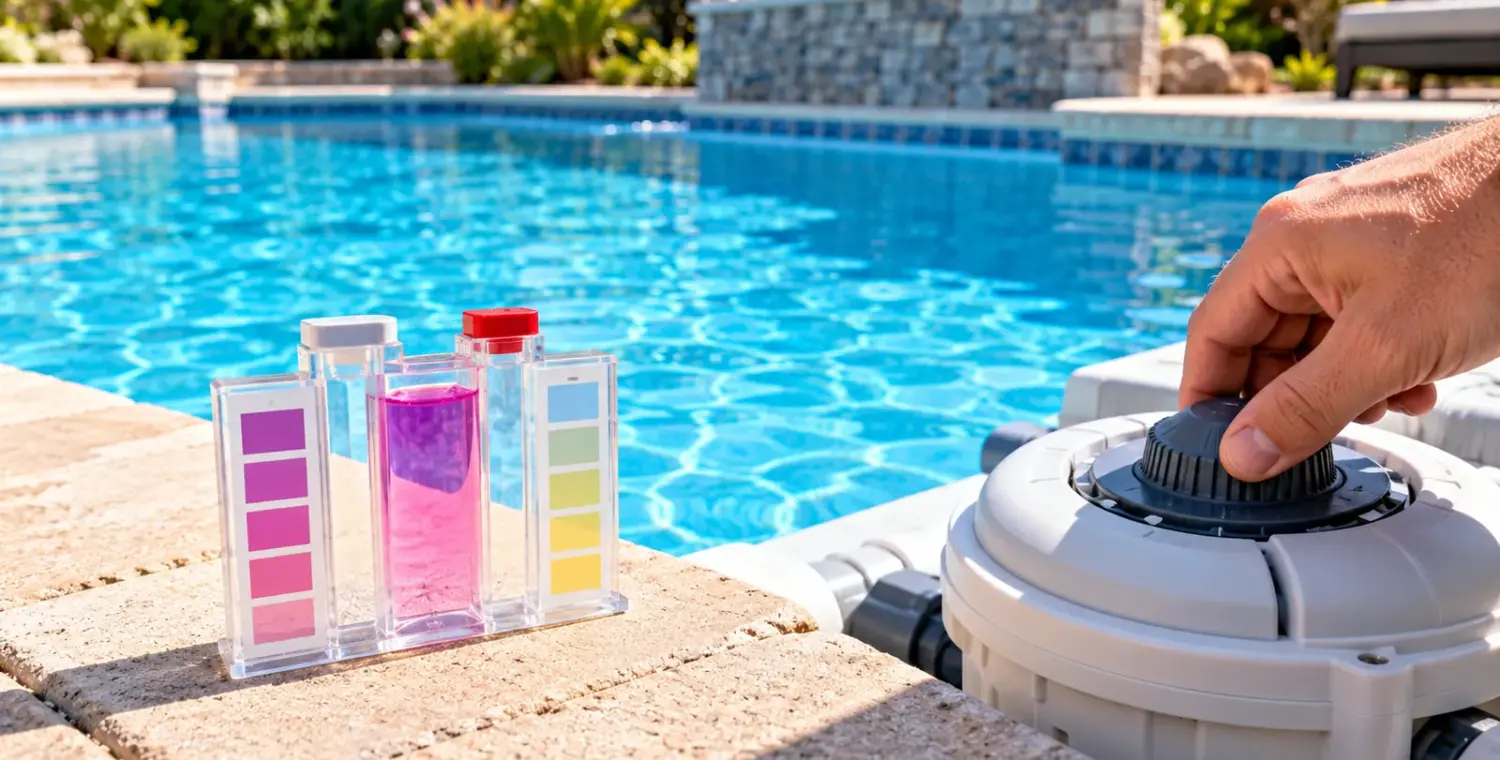
- Test strips: CDC notes that test strips are less accurate than a DPD test kit. Confirm a strip reading with a kit if it will change what you do.
Our pool water testing guide covers sampling technique and what each test measures.
Why chlorine runs high
Too much product added
The most common cause is simply adding more chlorine or shock than the pool needed, or adding a second dose before the first had been tested. If you recently shocked, see Pool Shock Explained for how to plan the next test.
A salt system or feeder set too high
Salt chlorine generators and automatic feeders keep producing or dispensing chlorine at their set rate. For example, Pentair’s IntelliChlor guide says to decrease chlorine production with the LESS button if free chlorine is too high. Other systems differ, so use your own manual. Our saltwater pool basics article explains how these units work.
Less chlorine is being used up
CDC lists swimmer inputs (sweat, dirt, pee) and sunlight among the things that reduce chlorine. When those are lower, for example when the pool is covered, unused or shaded, the same output can push the level up. Pentair notes that covered pools and vinyl liner pools need less chlorine with its generator and recommends turning output down while the pool is covered.
A test error
Old reagents, the wrong sample size or bleach-out can all mislead you. Retest before treating.
Symptoms people notice
Many complaints blamed on “too much chlorine” are actually caused by chloramines. CDC says that if you smell “chlorine” at a pool, you are probably smelling chloramines, which form when chlorine combines with sweat, dirt and pee. Chloramines can cause red and itchy eyes, skin irritation and rashes, and respiratory symptoms.
So a strong smell or stinging eyes is not proof that free chlorine is high. Our guide to why pool water burns your eyes explains the chloramine and pH causes. Only a test can tell you. If chlorine really is high, the symptoms people report are similar: eye and skin irritation. Anyone with breathing symptoms should leave the area and seek medical advice if they do not settle.
Is it safe to swim?
There is no universal “safe to swim” chlorine number that applies everywhere. A conservative approach is to keep everyone out until the reading is back within the range your local health guidance and product labels give, and until pH is back in range.
How to lower chlorine safely
- Stop adding chlorine. Pause floaters and feeders, and turn down a salt generator’s output following its manual.
- Retest to confirm. Use a DPD kit and dilute if bleach-out is possible.
- Let it dissipate. Minnesota’s pollution control agency notes that allowing water to age without adding chlorine lets chlorine dissipate. Sunlight speeds this up for an uncovered pool, and normal circulation keeps the water mixed while you wait.
- Retest regularly. Check chlorine and pH as it comes down so you do not overshoot into low chlorine.
- Consider a neutralizer only with care. Chlorine neutralizers are sold as pool products. Health Canada notes they do not need registration there because they are not intended to control disease-causing microorganisms. If you use one, follow its label exactly, add it on its own, and retest before adding anything else. Do not use a neutralizer to “fix” a reading you have not confirmed.
Do not drain to lower chlorine without checking local rules. Minnesota’s guidance says chlorinated water should not be discharged to any surface water, such as storm sewers, ditches, lakes or wetlands. Rules vary by city, state and country.
Handle chemicals safely
CDC notes that pool chemicals can injure people when mixed together or when protective equipment is not used. Keep these basics:
- Read and follow the full product label. Health Canada notes the label states how much to use and how to handle the product safely.
- Never mix chemicals with each other. Store them in their original labeled containers and keep incompatible products apart.
- Wear the protective equipment the label calls for, such as gloves and goggles, and keep storage and work areas well ventilated.
- Add the chemical to the pool water, unless the label says otherwise.
- Keep chemicals away from children and pets.
After chlorine comes down
Check pH as well. CDC notes that as pH goes up, chlorine’s ability to kill germs decreases, especially above pH 8.0. See our guide to pool pH. If you use stabilized chlorine, a high cyanuric acid level affects how you read and manage chlorine.
CDC recommends testing chlorine and pH at least twice per day, and more often when the pool is heavily used. For a routine you can follow, see how often to test pool water.
When to call a professional
- A salt generator or automatic feeder keeps producing high readings after you have adjusted it as the manual describes.
- You cannot get consistent test results.
- Someone has symptoms after swimming, or a chemical has been mixed or spilled. Contact poison control or emergency services if needed.
- You are unsure whether you can drain water under local rules.
FAQ
Why does my chlorine test show zero when I just added chlorine?
It may be bleach-out. CDC and Taylor both explain that very high chlorine (above 10 ppm) can make a DPD test read falsely low or zero. Dilute the sample and retest.
Will the sun lower chlorine?
Yes. CDC lists sunlight among the things that reduce chlorine levels. Removing a cover and waiting is often enough, but keep testing.
Is a strong chlorine smell a sign of high chlorine?
Usually not. CDC says a “chlorine” smell is usually chloramines. More on what a chlorine smell usually means. Test the water instead of judging by smell.
Sources
- CDC: Home Pool and Hot Tub Water Treatment and Testing
- CDC: Pool Chemical Safety
- CDC: Preventing Eye Irritation from Pool Chemicals
- Health Canada: Swimming pool and spa chemicals
- Minnesota Pollution Control Agency: Swimming Pool and Hot Tub Water Discharges
- Taylor Technologies: Technical and Support FAQs
- Pentair: IntelliChlor Installation and User’s Guide
Research checked October 1, 2026. We only claim hands-on testing when we’ve actually tested the product ourselves. Manufacturer guidance applies to the named products; follow the manuals and labels for your own equipment and chemicals.