Pool shock can help when a compatible treatment is needed to oxidize contaminants or carry out a label-supported higher-chlorine treatment. It will not repair a broken filter, solve every cloudy-water problem or replace routine sanitation. Before using it, identify the actual product, test the water and read its purpose, application and re-entry directions.
The word “shock” is the starting point for reading a label, not a dose. Products sold for occasional treatment differ in ingredients, claims and compatibility. This guide explains the decisions that come before adding anything, so you can choose a supported treatment rather than repeat a weekly ritual regardless of water conditions.
What does pool shock mean?
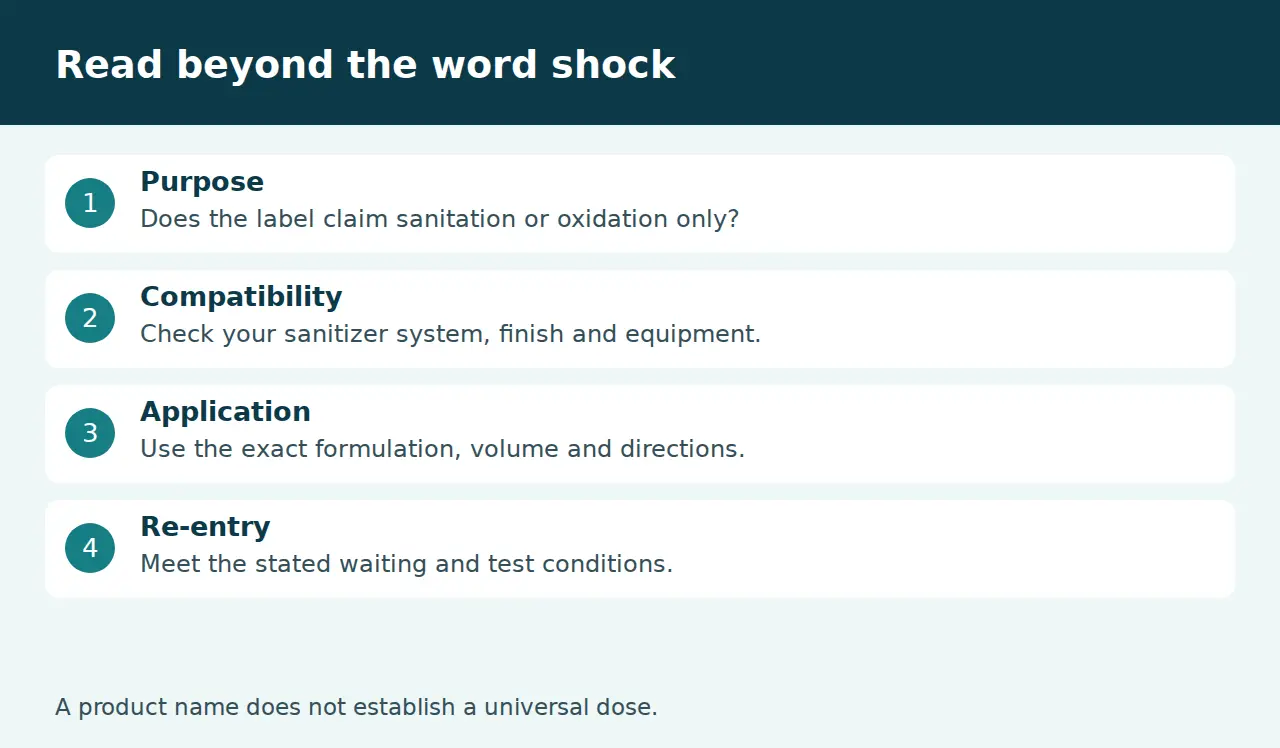
Owners may use “shock” to mean an occasional oxidizing treatment, a higher-chlorine treatment or a packet bought for cloudy water. These meanings overlap in everyday conversation, but they are not chemically identical. Routine chlorination maintains the required disinfectant residual; an occasional corrective treatment has a particular purpose and its own instructions.
The US EPA’s shock-labeling clarification and subsequent addendum distinguish microorganism-control claims from oxidation of non-living contaminants. An oxidizer-only product should not be treated as proof of sanitation simply because its name includes “shock.” Read the full label, including limitations, rather than relying on the front-panel slogan.
For a US product claiming control of algae or microorganisms, check its EPA registration and approved directions. Outside the US, the relevant authorization and labels differ. Neither a US registration number nor this general guide establishes approval for another jurisdiction or compatibility with your equipment.
Chlorine treatment versus non-chlorine oxidation
A chlorine product can have different routine and corrective directions. The formulation, concentration and approved uses matter. A non-chlorine oxidizer may be part of a care program for oxidizing waste, but an oxidizer-only claim does not replace the sanitizer that program requires.
Do not assume that two products with similar packaging are interchangeable. Identify the active ingredient, available concentration where stated, permitted pool or spa use and any equipment restrictions. Keep the container so you can show the exact label to a service provider if treatment does not work as expected.
When shock may help—and when another check comes first
Heavy use introduces contamination that can consume sanitizer. An approved care program may call for oxidation or a higher-sanitizer treatment in that situation. Algae treatment may also involve a compatible product with the appropriate claims. The needed action depends on the tests, diagnosis and label rather than swimmer count alone.
| Situation | Decision before treatment | Why shock alone may miss the problem |
|---|---|---|
| After heavy use | Measure sanitizer and pH; review the care program | A treatment still needs verification and continuing routine sanitation |
| Suspected algae | Confirm the cause and use a compatible algae-control program | Filtration and surface care may also need attention |
| Cloudy water | Check chemistry, visibility and equipment | Mineral imbalance or poor circulation is a different problem |
| Repeated low chlorine | Confirm the test and delivery system | A failed feeder or unreliable test can persist after additions |
| Contamination incident | Close the pool and obtain the appropriate incident response | Routine shock directions are not an emergency disinfection protocol |
Use our cloudy pool water guide when haze is the main symptom. For coloured water, the green-water troubleshooting guide explains why colour alone cannot distinguish algae from other causes. A stronger chemical addition cannot replace that distinction.
If chlorine falls repeatedly, work through the low-chlorine checks. Increasing a treatment while the delivery system remains faulty may leave the underlying problem unresolved. “It needed more shock” is not a useful conclusion without measurements and an explanation.
Test before selecting a product
For a chlorine pool, record free chlorine, total chlorine and pH using an appropriate test. Include alkalinity, calcium hardness and cyanuric acid where needed for the assessment. The pool water testing guide explains what each measurement can tell you.
Total chlorine does not substitute for free chlorine. If the method supports assessing combined chlorine, follow its instructions and retain the original readings. Do not apply a universal “multiply combined chlorine” recipe to determine treatment: product directions, the actual problem and test limitations still matter.
CDC’s residential guidance emphasizes suitable free chlorine and pH, not shock by a universal calendar. Its public-health minimums are not corrective-treatment quantities. In stabilized pools, CYA changes the chlorine context; a low-end minimum should not be treated as a complete operating target at any stabilizer concentration.
Stop and verify an unexpected zero after chlorine treatment. CDC warns that sufficiently high chlorine can bleach a DPD test to a false-low or zero result. Repeating a dose on that evidence can turn a measurement problem into an excessive-treatment problem. Use the test maker’s supported method for the expected concentration or obtain qualified testing.
Build a label-based treatment worksheet
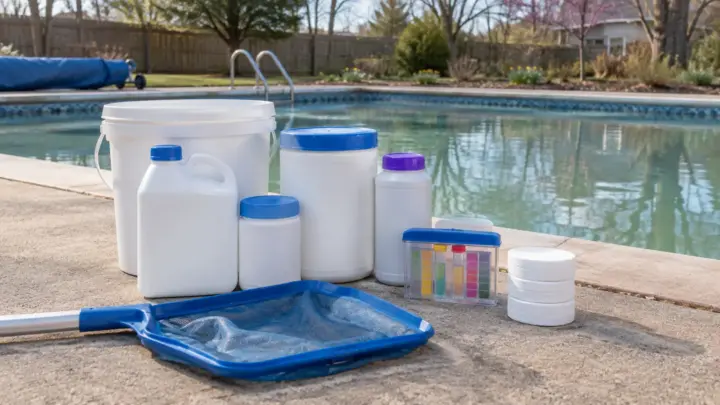
Write down these details before opening a product. Missing information is a reason to pause, not fill the gap with an online dose table.
- Purpose: What confirmed condition is being treated, and does the label support that use?
- Compatibility: Is it permitted for the sanitizer system, surface, feeder and connected equipment?
- Volume: Is the pool’s water volume known in the same units used by the label?
- Quantity: What does the actual formulation’s label require for this particular treatment?
- Application: Where and how is it added, with what protective equipment and operating conditions?
- Verification: When must you retest, and what exact conditions permit swimming again?
Check whether the directions distinguish routine care, oxidation and algae treatment. A quantity printed for one task should not be transferred to another. Read restrictions on treatment frequency and additional applications too; a lack of immediate visual improvement does not authorize another dose.
If the pool volume is uncertain, ask for it to be established before calculating treatment. Keep US and imperial gallons distinct when dealing with UK documentation. Do not convert litres or package sizes by mental approximation. This article gives no universal dose because both the inputs and the formulation can differ.
Handle the product and circulation safely
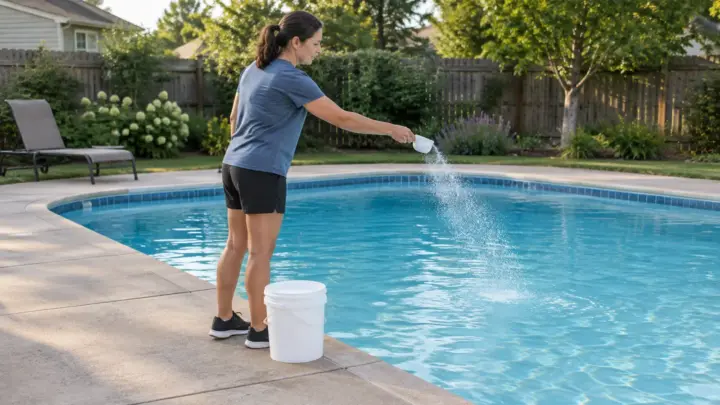
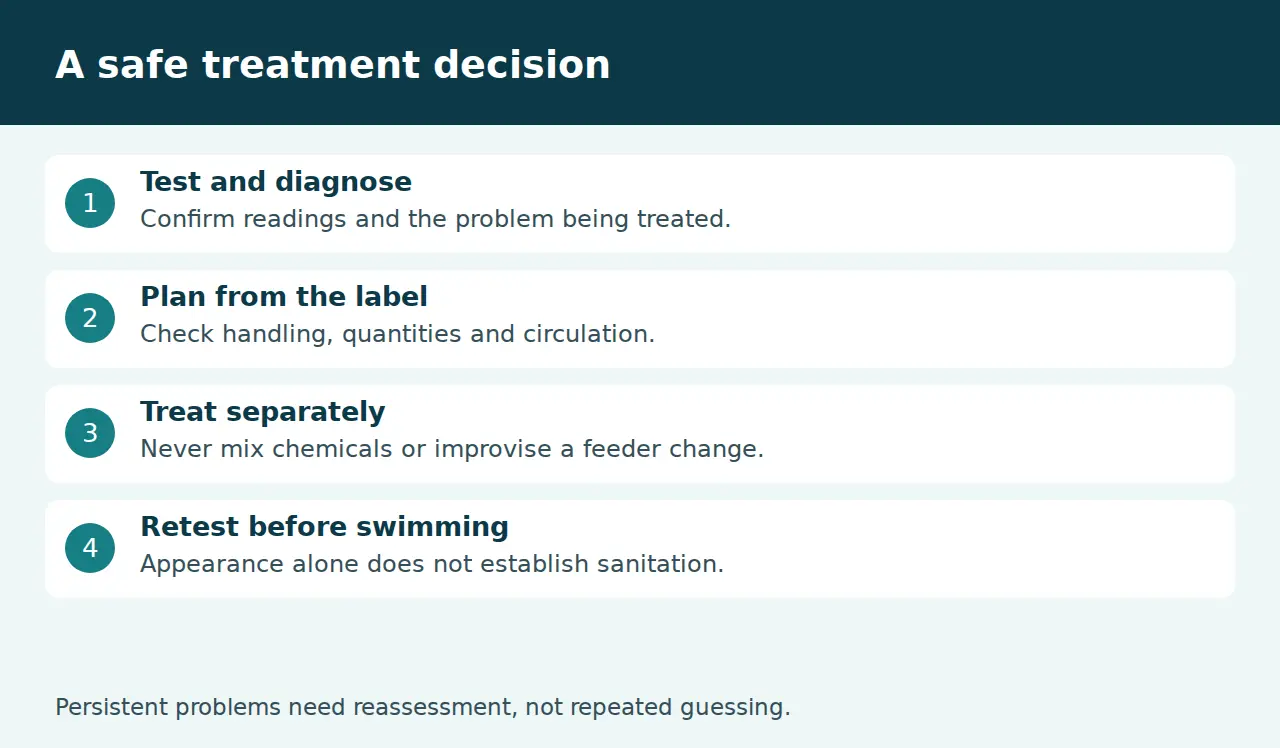
Keep swimmers out during chemical application. Use the label’s protective equipment and addition procedure. Open and handle one product at a time, keep measuring tools dedicated as directed, and never mix pool chemicals together. Do not add an unfamiliar product to a feeder intended for another chemical.
Only prepare or predissolve a product when its instructions require that method. A generic bucket technique is not safe for every chemical. Follow its directions for water, mixing, location and separate additions rather than combining chlorine and acid or different chlorine formulations.
Check that the required circulation is actually operating. A running display or audible motor cannot establish that water is moving normally. If circulation fails, stop the proposed treatment and obtain model-specific advice; do not bypass equipment protections to finish the job.
Keep products dry and in their original labelled containers under the specified storage conditions. Separate incompatible materials and secure access from children and pets. Do not return spills to a container or improvise a chemical spill cleanup. For fumes, exposure or suspected mixing, leave the affected area and seek appropriate emergency advice.
Retest before swimming, even if the water looks better
Follow the treatment’s circulation and waiting requirements, then measure the parameters it requires. Re-entry may depend on both time and a measured residual, plus visibility and the rest of the care program. “Wait until tomorrow” and “swim when clear” are not universal substitutes for the label.
Non-chlorine oxidation can complicate some tests. Taylor documents monopersulfate interference with particular total/combined-chlorine DPD measurements. Tell the tester what was added and use the kit’s supported interference procedure; do not subtract a guessed amount or reinterpret every result as usable free chlorine.
Record what was added, when, the operating conditions and the repeat results. If an endpoint is unclear or a reading is off-scale, get a suitable confirmation before reopening the pool. Health Canada notes that clear water can still contain microorganisms. Visual improvement is useful to record, but it is not a sanitation certificate.
If shock does not solve the problem
Return to the original diagnosis and compare the evidence. Did the sanitizer result change? Is circulation normal? Has visibility improved? Did the problem return after another event? Keep these observations separate rather than judging success from a stronger smell.
Persistent trouble calls for a fresh assessment, not a stack of additional products. Provide the professional with the pool type, volume, complete tests, CYA where applicable, exact treatments and equipment warnings. Ask what would establish the cause and what result should follow the proposed correction.
A faecal incident, illness concern, major spill or unknown chemical input needs its own response. CDC explains that some organisms tolerate chlorine much longer than others. This routine treatment guide is not a contamination-disinfection recipe and does not establish a guaranteed germ-kill time.
Common questions about pool shock
Should every pool be shocked weekly?
Use the frequency required by your actual approved program and product instructions, alongside testing and changing conditions. A calendar reminder can prompt assessment; it cannot establish that every pool needs the same weekly addition.
Can I use shock instead of maintaining chlorine?
No. Maintain the sanitizer residual the system requires. Occasional oxidation or corrective treatment has a different role, and an oxidizer-only product cannot stand in for sanitation.
Does a strong chlorine smell prove I need shock?
Smell is not a measurement or a dose calculation. For what that smell usually means, see why a pool smells like chlorine; for irritated eyes, see why pool water burns your eyes. Test with the appropriate method, review recent products and obtain advice if the water or air condition is concerning.
Can I apply this pool guide to a hot tub?
Use spa-specific directions and compatible products. CDC recommends against CYA and stabilized chlorine in hot tubs. Where a spa manufacturer’s approved program differs, have that disagreement resolved before switching products or treating the water.
Research checked October 1, 2026. We only claim hands-on testing when we’ve actually tested the product ourselves. Featured image is an original illustration.
Sources and references
- CDC: Home Pool and Hot Tub Water Treatment and Testing
- Health Canada: Swimming pool and spa chemicals
- US EPA: Use of the Term Shock in Swimming Pool, Hot Tubs, and Spa Products
- US EPA: Use of the Term Shock on Non-pesticide Labeling
- Taylor Technologies: Technical and Support FAQs
- CDC: Pool Chemical Safety