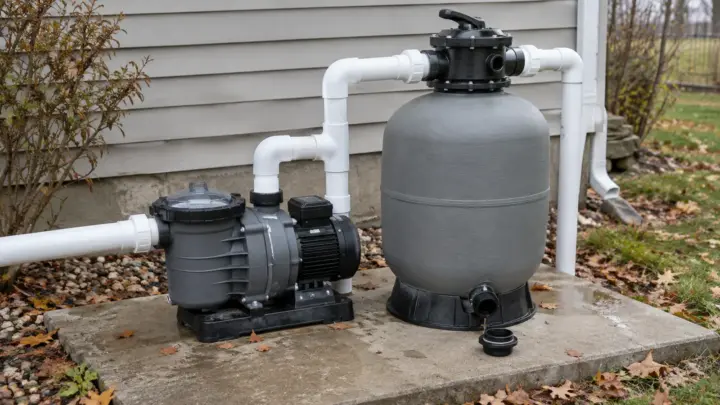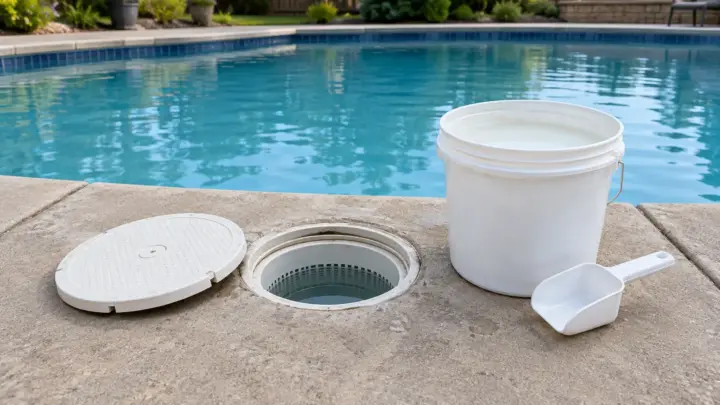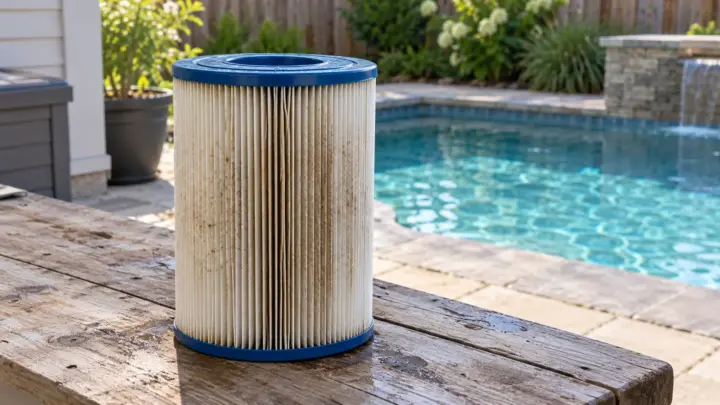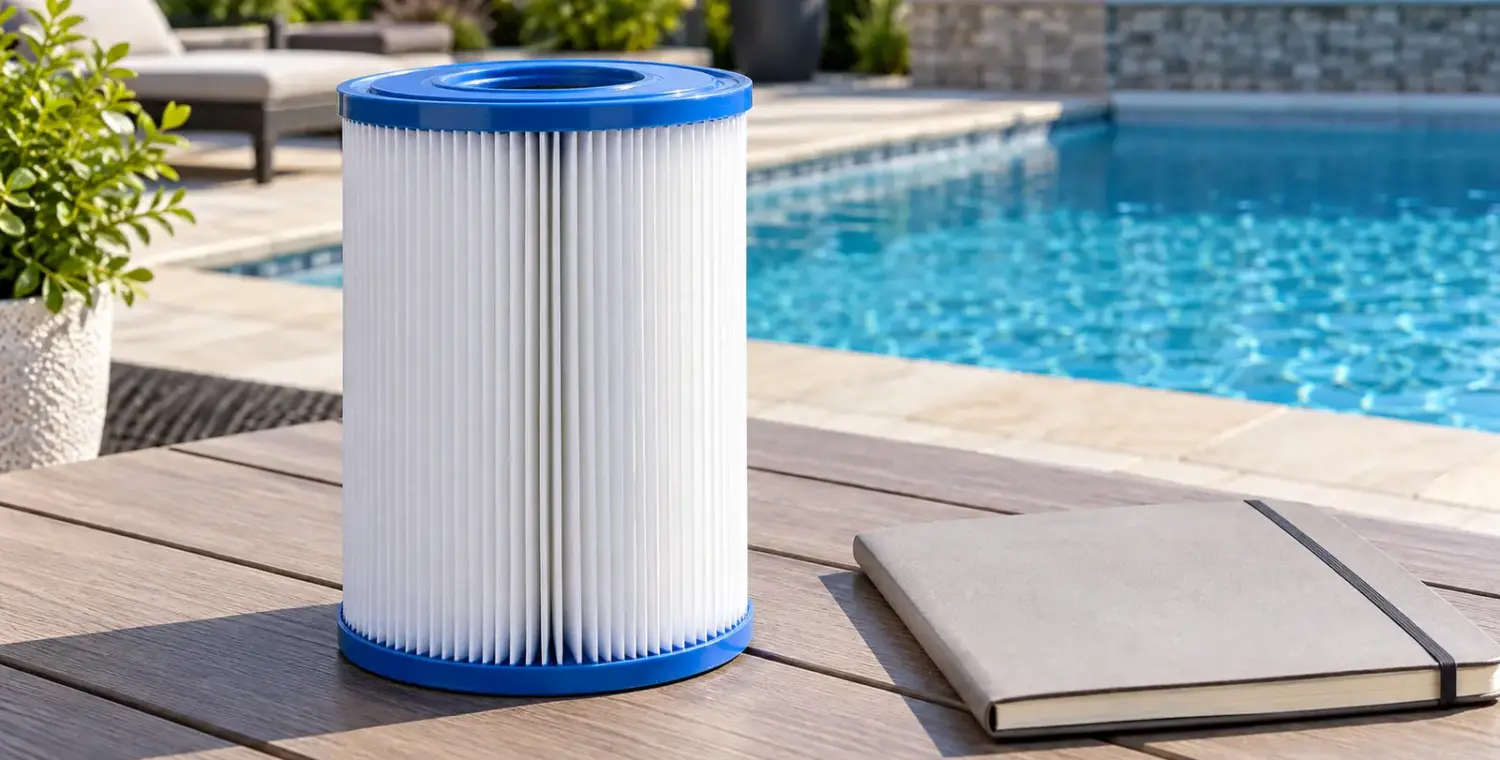
Sand, cartridge and diatomaceous earth (DE) filters remove suspended dirt as pool water circulates through them. Their main ownership differences are the material that captures particles, how that material is cleaned and what must be replaced or replenished. Choose an actual model that fits your pool system and maintenance habits, rather than choosing solely from a generic micron chart.
A cartridge filter avoids backwashing. A conventional sand filter is cleaned by backwashing its media bed. A grid-style DE filter uses a coating of approved DE material and needs the specified recharge after relevant cleaning. Those distinctions help narrow the choice, but the valve sequence, service trigger and media amount belong to the exact manual. For how a DE charge is worked out, see how much DE to add to a pool filter.
Sand vs. cartridge vs. DE at a glance
| Ownership question | Sand | Cartridge | DE |
|---|---|---|---|
| What captures particles? | An approved granular media bed | Pleated filter elements | Approved DE coating on supporting elements |
| Routine cleaning approach | Backwash and other steps specified for the valve and filter | Remove and clean elements under the opening procedure | Backwash or clean as specified, then restore coating |
| Cleaning-water consideration | Backwash discharge needs a permitted destination | No backwash; rinsing still uses water | Backwash or cleaning waste includes spent media |
| Recurring material care | Inspect media and internal components as directed | Inspect and replace compatible elements when needed | Replenish media and inspect supporting elements |
| Buying priority | Suitable system flow, valve and waste arrangement | Suitable capacity and practical access for element service | Suitable flow, approved media care and waste handling |
The table describes common residential arrangements, not every specialized filter design. Read the model name and manual before applying its cleaning category. A similar tank shape or a valve elsewhere on the pad does not establish what is inside.
How each filter works
Sand: water passes through a media bed
A sand filter holds an approved granular medium inside a tank. The media captures suspended debris as water passes through it. The exact grade and quantity are specified for the filter; internal parts direct the water and keep the media in place.
Pentair’s Triton NEO manual illustrates this arrangement and separates filtration from backwash and rinse modes. It also warns against changing the valve position while the pump is running. A generic explanation is not a substitute for the valve and filter instructions.
Cartridge: pleats provide capture area
A cartridge filter uses one or more pleated elements. For ordinary reusable cartridges, cleaning means accessing and rinsing the elements using the approved procedure. EPA WaterSense identifies the absence of backwashing as a water-efficiency advantage.
That does not make cleaning effortless or water-free. Ask whether you have enough space to remove the elements and a suitable place to clean them. Confirm the replacement part number and care method before treating any similarly sized cartridge as interchangeable.
DE: a coating performs the fine capture
A conventional grid-style DE filter relies on a coating applied to its supporting elements. Pentair’s FNS Plus guide specifies pre-coating with diatomite marked for swimming pools and spas. The coating is part of normal filtration, not an optional additive for that design.
Support grids or other elements, their seals and the coating all need appropriate care. Do not run an uncoated system when its manual requires media, and do not put DE into another filter type unless that filter’s manufacturer expressly approves it.
Cleaning is the biggest practical difference
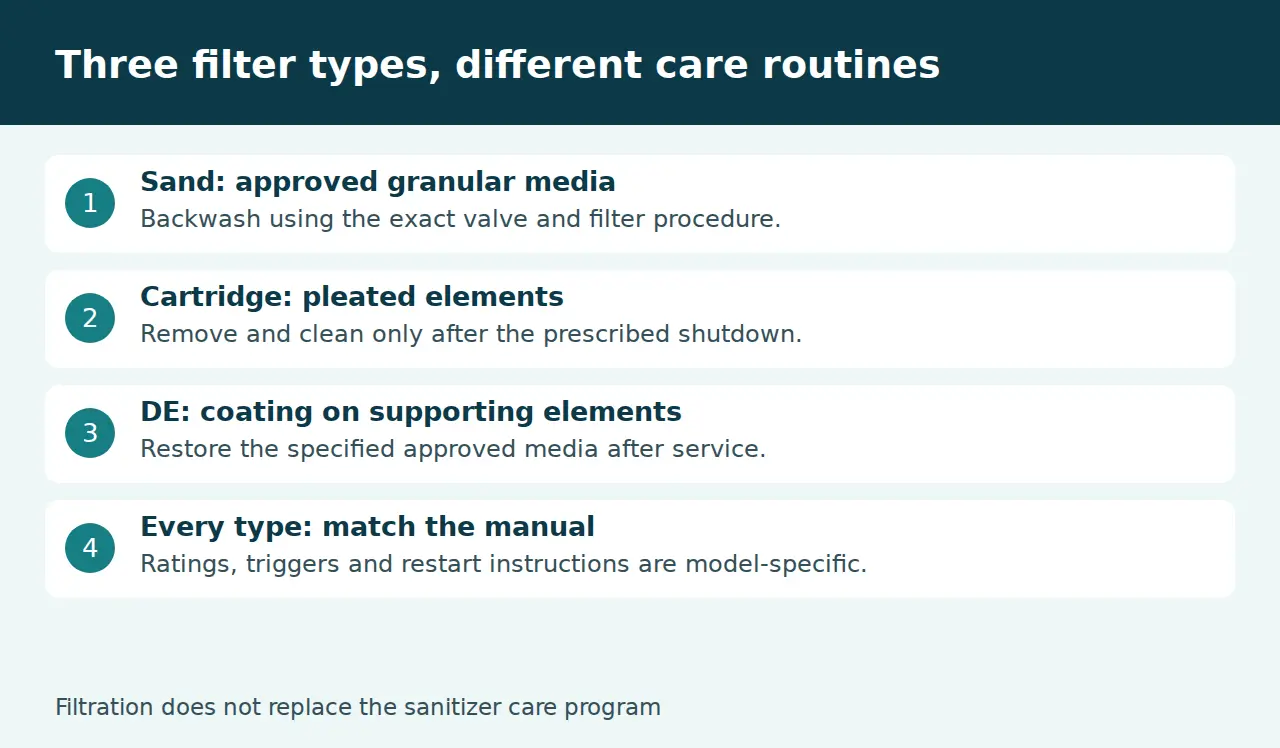
For sand, backwashing reverses the cleaning flow through the media and sends dirty water out of the system. The valve model determines how backwash, rinse and filtration are selected. Follow shutdown and restart requirements; do not copy another owner’s handle sequence.
For cartridges, follow the exact pressure-release and opening instructions before removing anything. Pentair’s Clean and Clear Plus guide describes rinsing with a garden hose and paying attention between pleats. Use only the rinsing method and cleaners approved for your actual elements.
For DE, distinguish backwashing from a full internal clean. The FNS Plus guide includes different procedures with and without a separation tank. It calls for the specified DE addition after backwashing. Ask the installer to explain the procedure for your configuration rather than assuming every cleaning removes the same amount of media.
Do not improvise a chemical soak from a general article. Cleaning agents, compatibility, order and rinsing depend on the equipment and product. If deposits cannot be removed through the approved owner procedure, obtain qualified advice.
Pressure safety applies to every type
Before opening a filter: shut down, prevent automatic restart and relieve all pressure exactly as the manual directs. Never loosen a lid, clamp, dome or locking ring on a pressurized system. Trapped air can cause violent separation. Uncertain service and pressure testing belong with a qualified professional.
Keep the full opening, closing and restart instructions available. A zero gauge reading alone should not replace the prescribed pressure-release procedure or resolve a damaged gauge. Do not tighten a leaking closure while the pump is operating.
With DE, follow the media label and filter manual for dust control and protective equipment. Pentair warns against inhaling dust and specifies approved protection in its coating instructions. Do not substitute a household or garden powder because it shares a familiar name.
If the tank, closure or valve appears damaged, stop owner-level service and arrange assessment. Replacement of an element does not repair a cracked pressure vessel. Keep people clear of uncertain equipment and follow the manufacturer’s safe shutdown guidance.
When should a filter be cleaned?
Record normal starting pressure under documented conditions, including pump speed where relevant. Compare later observations at the same operating setting. Pentair’s cartridge and DE guides explicitly pair original pressure with original pump RPM.
Use the cleaning trigger in your own manual. General charts and different manufacturers may present different intervals or pressure changes. A calendar reminder is useful for inspection, but it does not prove cleaning is needed or that a restriction is harmless until that date.
Our filter-pressure troubleshooting guide explains why both unusually high and unusually low observations need context. Longer pumping or repeated backwashing cannot resolve every circulation fault.
How much should micron numbers influence the choice?
A micron is a unit used to describe particle size. EPA’s residential guide presents a broad comparison in which DE has finer capture than common sand filtration, with cartridges between them. It also notes that cartridge performance can vary.
Keep a rating tied to its documented product and test conditions. A category-level number is not independent proof of how an installed filter will perform with your water, flow and maintenance. Ask for the actual model’s specification if fine-particle capture is central to the purchase.
Finer capture does not eliminate sanitation requirements. The Triton manual explicitly distinguishes filtration from sanitizing, and CDC emphasizes free chlorine and pH care. Continue the appropriate sanitizer program regardless of filter type.
Water use, waste and ownership cost
EPA’s technical sheet encourages filters that reduce or avoid backwashing. Cartridge systems offer that benefit, although element rinsing still requires water and a proper cleaning area. For a replacement, compare your actual cleaning routine rather than assuming a fixed annual saving.
For sand or DE, confirm where cleaning discharge may go under local rules. The FNS Plus separation-tank instructions call for spent DE disposal according to local codes and ordinances. Do not assume a storm drain, garden or street is an acceptable destination.
Obtain a complete installed quote: filter, compatible valve where required, plumbing changes, access arrangements and commissioning. Add the local cost of approved media, elements, cleaning products and service. Category comparisons do not supply today’s local prices.
Ask about parts availability and replacement criteria rather than adopting a universal number of years. Useful questions include which parts wear, what inspection is required and whether the quoted parts are genuine or manufacturer-approved compatible items.
Match the filter to the whole system
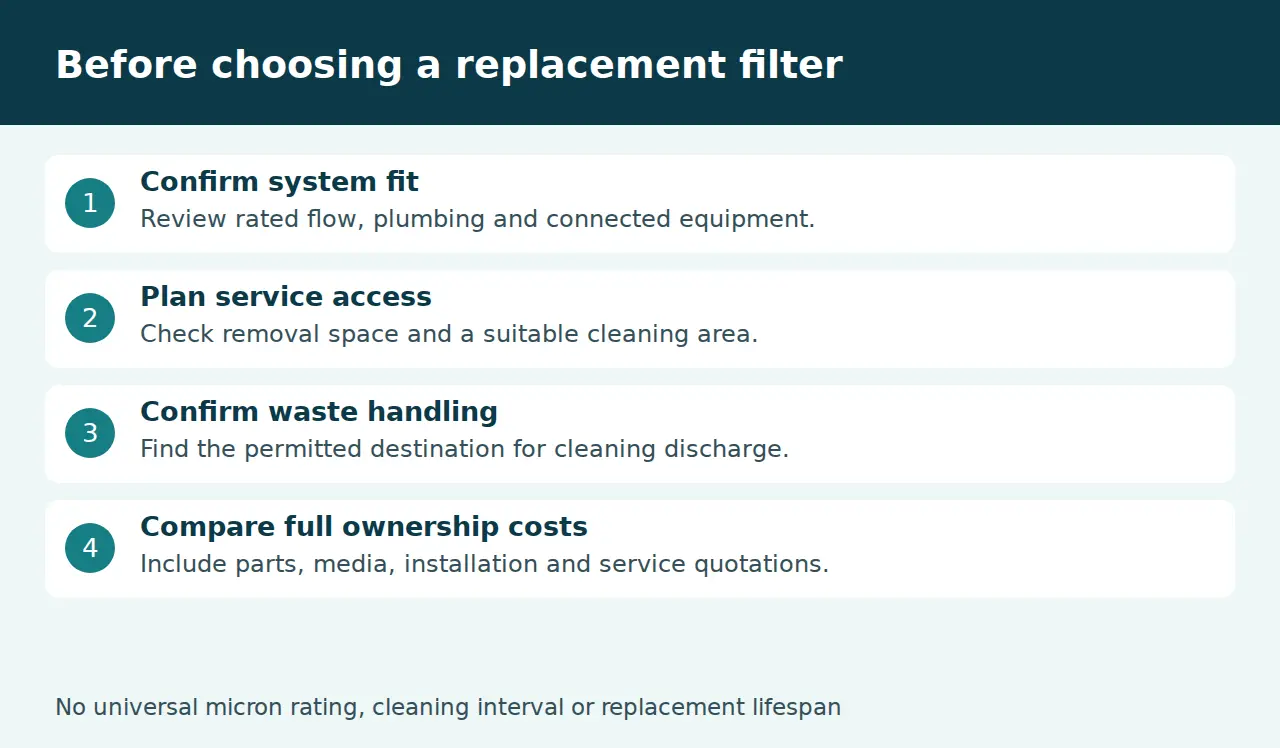
Check rated flow, installation space, plumbing and service clearance with the installer. Our pump sizing guide helps frame the hydraulic questions. A pump and filter need to work together across the intended operating modes.
Do not choose a replacement only because its tank looks larger. Capacity, internal design and permissible flow come from its documentation. Ask the installer to reconcile routine filtration with heating, cleaning and other connected tasks.
If you are changing filter types to solve cloudy water, verify the cause first. Our cloudy-pool guide covers chemistry, contamination and circulation alongside filtration. A different tank may not correct the original problem.
Which ownership routine fits you?
Consider sand when the proposed model and permitted backwash arrangement fit your needs. Consider cartridge when avoiding backwash is a priority and you can manage element cleaning. Consider DE when the documented capture performance is useful and you can follow its media and service requirements.
Before deciding, ask the supplier to show the exact manual, replacement materials and cleaning method. The most useful choice is one you can maintain safely within a properly matched installation. No filter type removes the need to test water or review abnormal equipment behavior.
Research checked September 30, 2026. We only claim hands-on testing when we’ve actually tested the product ourselves. Featured image is an original illustration.
Sources and references
- US EPA WaterSense: Jump into pool water efficiency
- US EPA WaterSense: Pools and outdoor water features technical sheet
- Pentair Europe: Triton NEO sand filter operating manual
- Pentair: Clean and Clear Plus cartridge filter guide
- Pentair: FNS Plus vertical-grid DE filter guide
- CDC: Home pool and hot tub water treatment and testing