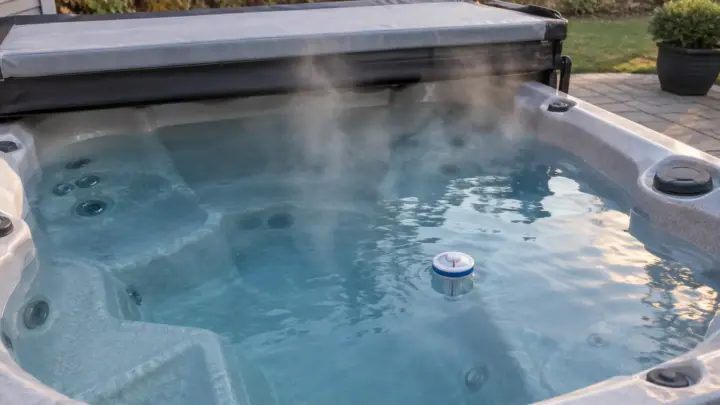
Set a hot tub between 100°F and 104°F for healthy adults, and never above 104°F. The U.S. Consumer Product Safety Commission (CPSC) says hot tub water temperatures should never exceed 104 degrees Fahrenheit and that 100 degrees is considered safe for a healthy adult. Hot Spring’s owner’s manual gives the same 104°F ceiling and calls 100°F to 104°F safe for a healthy adult.
Who should go lower
| Situation | Temperature | Source |
|---|---|---|
| Healthy adult, normal soak | 100°F to 104°F | CPSC, Hot Spring |
| Pregnant or possibly pregnant | 100°F maximum | CPSC, Hot Spring |
| Young children | Lower; special caution | CPSC, Hot Spring |
| Long soak (over ten minutes) | Lower than your usual setting | Hot Spring |
| Anyone | Never above 104°F | CPSC, Hot Spring |
- Pregnancy. CPSC says soaking in water above 102 degrees Fahrenheit can cause fetal damage during the first three months of pregnancy, and that pregnant women should stick to the 100-degree maximum rule. Hot Spring says pregnant or possibly pregnant women should limit spa water temperatures to 100°F (38°C).
- Children. Hot Spring says lower water temperatures are recommended for young children; children are especially sensitive to hot water. Hot Spring also says not to let children use the spa unless they are closely supervised at all times.
- Long soaks. Hot Spring recommends lower temperatures for extended use (exceeding ten minutes), and warns that extended use can cause hyperthermia.
- Health conditions and medication. CPSC says people with heart disease, circulatory problems, diabetes or blood pressure problems should obtain their physician’s advice before using hot tubs, and that people taking medications which induce drowsiness, such as tranquilizers, anti-histamines or anti-coagulants, should not use hot tubs.
Why 104°F is the ceiling
Too-hot water is a safety problem, not just a comfort one. CPSC says soaking in water heated to 106 degrees Fahrenheit can raise body temperature to the point of heat stroke, and that hot water can cause drowsiness which may lead to unconsciousness and subsequently result in drowning. Alcohol makes it worse: Hot Spring warns that alcohol, drugs, or medication can greatly increase the risk of fatal hyperthermia in hot tubs and spas.
Check the real water temperature
Do not trust the display alone. CPSC says hot tub thermostats may err in regulating water temperatures by as much as four degrees, so check the water with an accurate thermometer before you get in. A display showing 104°F could mean water near 108°F. Most controls cap the setting anyway: Hot Spring’s set temperature range is from 80°F to 104°F. If the tub can’t reach your setting at all, see hot tub won’t heat. For how long reaching it normally takes, see typical hot tub heat-up times.
Setting it when you’re not using it
Hot Spring says that when you go away you may wish to lower the spa temperature by five or ten degrees, but make sure your water stays constantly warm, because frozen water can damage the tub. Cold-weather care is in hot tub water care in winter. For the rest of the routine, see the hot tub maintenance schedule, the hot tub water testing guide and the hot tub and spa care guide.
Sources
- U.S. Consumer Product Safety Commission (CPSC): CPSC Warns of Hot Tub Temperatures
- Hot Spring Spas: Highlife Collection 2025 Owner’s Manual
- Hot Spring Spas: How to Winterize Your Hot Tub
Research checked 2026-10-12.