When pool pH is too high or too low, first confirm the reading, then consider why it changed. Adding a corrective chemical to an unreliable result can turn a small problem into a larger one. A useful plan also considers total alkalinity, sanitizer, calcium hardness and the instructions for your pool equipment.
This guide explains how to investigate an abnormal pH result and make a controlled correction. It does not supply a universal chemical dose: pool volume, product concentration, existing chemistry and equipment all matter.
What pool pH tells you
pH describes how acidic or alkaline water is. It is different from total alkalinity, which describes the water’s ability to resist an acid-driven change in pH. You can therefore have a high pH with a modest alkalinity result, or a reasonable pH with alkalinity that needs attention. Buying an alkalinity increaser simply because pH is low skips an important test.
For US home pools, CDC guidance recommends pH between 7.0 and 7.8. Treat that as scoped public-health guidance, not a worldwide specification. Your sanitizer label, heater or salt-system manual and surface-care instructions may require a narrower operating band. Hot tubs have their own guidance; see our guide to hot tub pH and alkalinity.
Owners in the UK, Canada and Australia should check locally applicable guidance and the products approved for their market. Public and commercial pools have additional obligations; their operating rules should not be copied into a home-pool dosing recipe. If instructions appear inconsistent, ask the relevant manufacturer or a qualified local pool professional to reconcile them.
Possible effects of high and low pH
| Finding | Why it matters | What to check next |
|---|---|---|
| Confirmed high pH | Chlorine’s germ-killing performance can fall. Calcium scale becomes a concern when the rest of the water balance favors it. | Free chlorine, total alkalinity, calcium hardness and equipment limits. |
| Confirmed low pH | Water can damage equipment and contribute to an unfavorable balance for calcium-containing surfaces. | Acid additions, chemical feed, total alkalinity and the surface-care manual. |
| Eye discomfort, cloudiness or deposits | These observations do not identify pH as the cause. | A fresh water sample and the wider chemistry picture. |
A clear pool is not automatically adequately disinfected. Conversely, a cloudy pool does not prove that its pH is high. Our cloudy pool water guide covers other branches, including filtration and sanitizer problems, that may need separate attention.
Do not deliberately keep pH low to make chlorine work harder. Public-health limits and equipment protection still apply. Likewise, an acceptable pH reading cannot compensate for insufficient sanitizer; use the low chlorine troubleshooting guide if the free-chlorine result is also unsatisfactory.
Confirm the pH result before adding anything
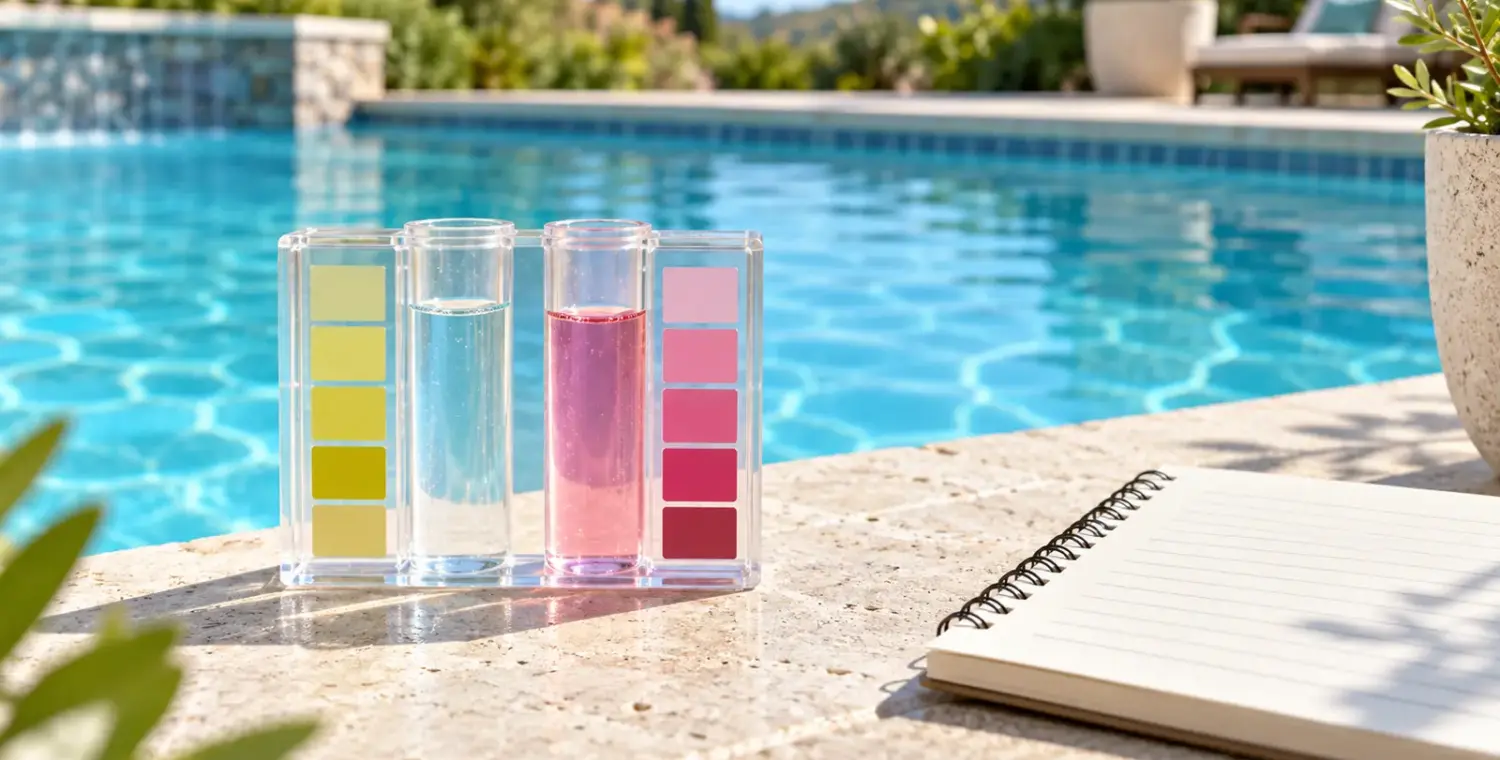
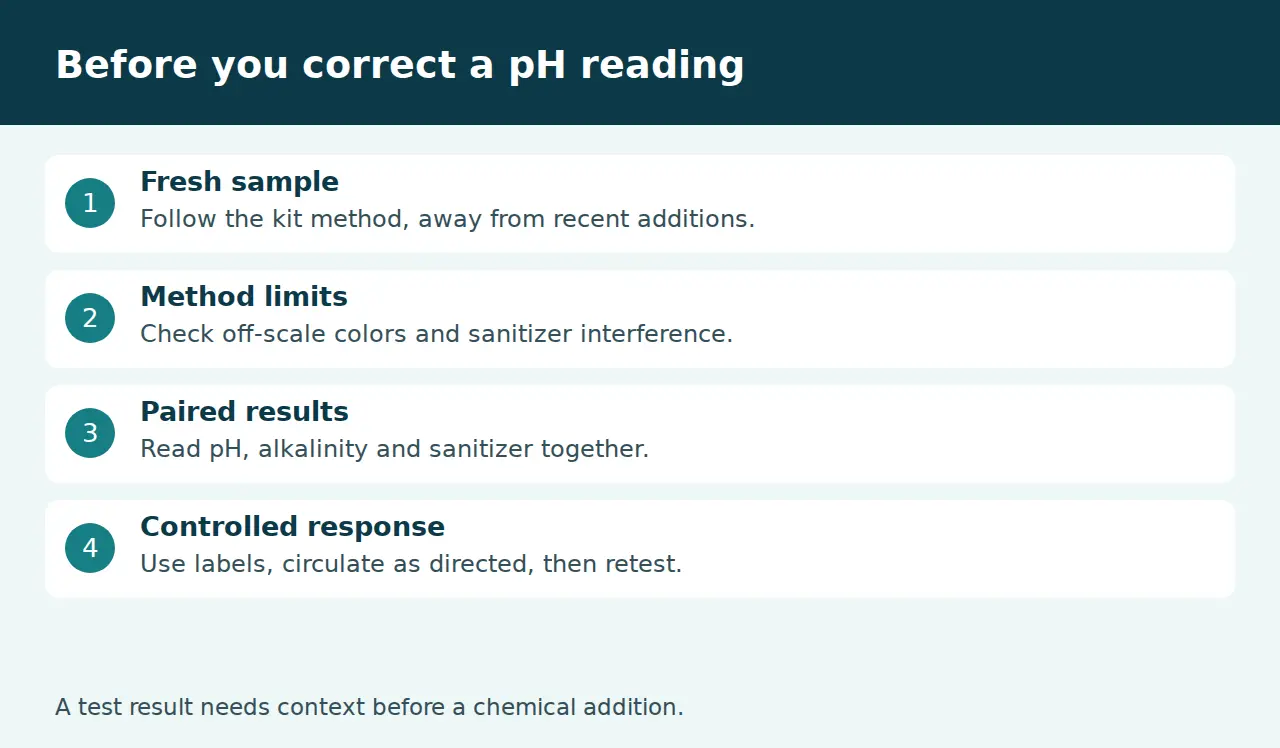
Start with a fresh sample collected as your kit specifies, away from a recent chemical addition or a concentrated return stream. Follow its sampling depth, sample volume, reagent quantity, mixing and reading instructions. The pool water testing guide explains how to keep the wider test routine consistent.
Check the method’s limits
A result at the top or bottom color on a comparator may only show that the sample is outside its measuring range. It does not establish the exact pH beyond that scale. Do not calculate a large dose from an assumed value. Confirm it using an appropriate method or professional test.
High sanitizer can also interfere with some colorimetric pH methods. Taylor’s technical FAQs describe false blue or purple colors in certain phenol-red tests at elevated sanitizer levels. Their correction procedure is specific to the kit; adding an improvised neutralizer can create another error. Check the exact instructions and seek confirmation if necessary.
Use the reagent specified for the comparator. Taylor explains that its R-0004 and R-0014 pH reagents have different concentrations and are not interchangeable between their intended comparators. A similar-looking bottle is not sufficient evidence that a refill is suitable. For an electronic meter, follow its own calibration, probe storage and maintenance instructions.
Why pool pH keeps rising
Carbon dioxide loss and water movement
In typical carbonate-buffered pool water, loss of dissolved carbon dioxide can raise pH. Orenda’s explanation of carbon dioxide equilibrium describes this process and the role of carbonate alkalinity. Aeration from water features or other turbulence can speed that exchange.
This helps explain why a reading can rise again after an acid correction. It does not mean you should accept an unlimited rise or use a calculator’s equilibrium estimate as a public-health target. Check whether a water feature or operating pattern coincides with the trend, while maintaining the requirements for safe equipment operation.
Chemical inputs and replacement water
Review the exact products added since the last satisfactory result. A pH increaser is an obvious input, but the sanitizer system and other treatments also belong in the record. Read their labels rather than assuming every product sold as “chlorine” has the same effect on water balance.
Test replacement water when significant refilling coincides with a change. Its pH and alkalinity provide more useful evidence than an assumption that tap water always resembles the pool. If an automated controller is involved, compare its measurement with a properly performed independent test before changing settings. A probe, feed or calibration problem needs its own investigation.
Why pool pH keeps falling
Look first for recent acid additions, repeated attempts to reduce alkalinity and the instructions for the sanitizer being used. Acid lowers pH and also consumes alkalinity. Repeating a previous dose simply because it worked once ignores how much buffering may remain.
Low total alkalinity can make pH more vulnerable to acid inputs. That is a reason to test both values together, not a reason to declare every low-pH result an alkalinity problem. A satisfactory alkalinity reading with low pH calls for a different plan from two low readings.
If pH falls unexpectedly with an automatic feed system, keep the pool closed and have the feed and measurement system assessed. Do not bypass interlocks or alter a chemical controller to compensate for a result you have not verified. Recent rain, refilling and maintenance belong in the history, but an event happening before a change does not prove it caused it.
A safe correction sequence
- Keep swimmers out while the result is unresolved. Confirm pH and sanitizer and meet label re-entry conditions before reopening.
- Read the whole test panel. At minimum, pair pH with total alkalinity and sanitizer. Include calcium hardness, temperature and other inputs when assessing scale or surface concerns.
- Choose the appropriate product. Use a pool product suitable for the intended adjustment and permitted for your setting. Check its active ingredient, strength and application directions.
- Work from reliable pool volume and measured chemistry. Follow the label or qualified treatment plan. If the test is off-scale or the volume uncertain, resolve that uncertainty first.
- Allow the specified circulation and mixing. Follow the product and equipment instructions, then retest before deciding whether another addition is needed.
- Record the response. Note the product, amount actually used, timing and subsequent pH and alkalinity readings. Use that history to investigate recurrence.
Acid products commonly lower pH; sodium carbonate products commonly raise it. These descriptions explain their roles, not how much to add or how to apply them. Concentrations, hazards and application rules vary. Sodium bicarbonate is commonly used to raise alkalinity and should not automatically be substituted for a pH correction product.
Never mix chemicals together or use the same measuring equipment without following its cleaning instructions. Keep products in their original labeled containers and use the protective equipment specified by the label. Do not invent a dilution method: follow the exact product’s directions. Health Canada’s pool chemical safety guidance reinforces these precautions.
Stop the cycle of repeated pH adjustments
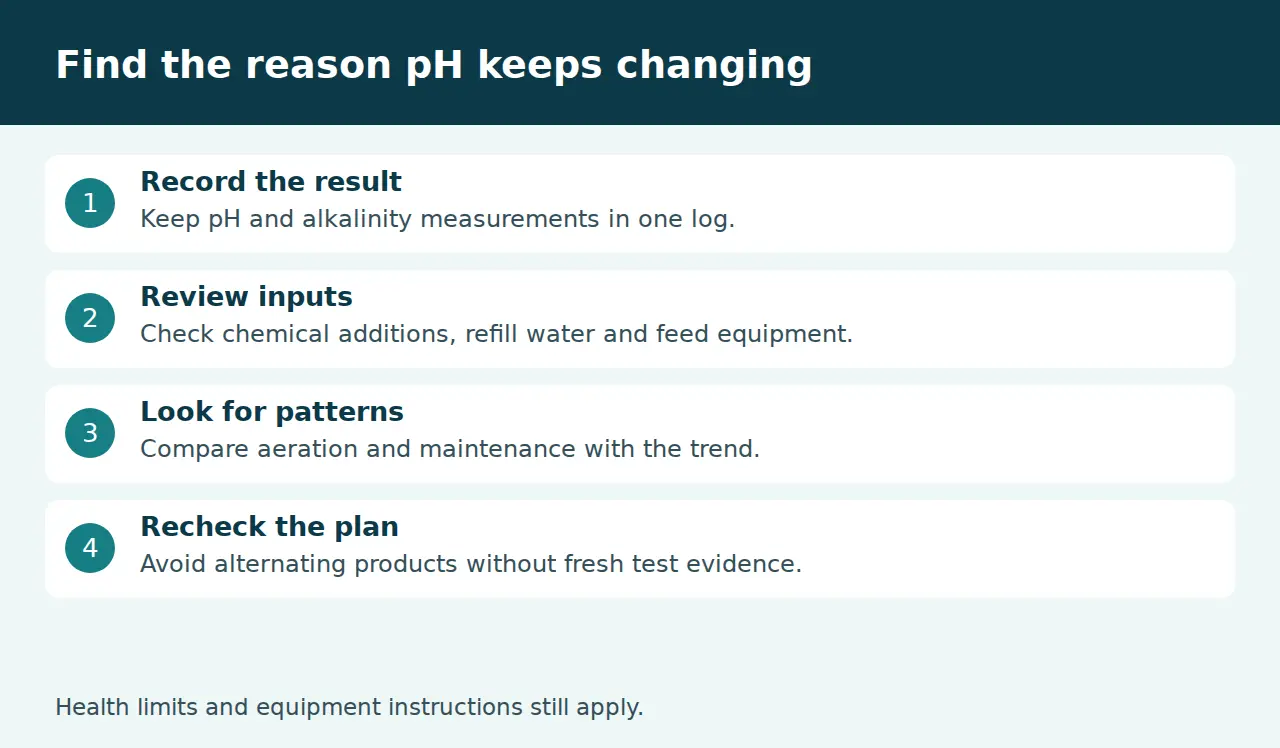
If pH repeatedly drifts, compare several properly performed tests under reasonably consistent conditions. A log should include pH, alkalinity, sanitizer, chemical additions, refill events and major changes in aeration. This makes a recurring input easier to distinguish from one poorly collected sample.
Do not alternate acid and pH increaser simply to chase each new color. Each addition can change the conditions for the next one. Ask for help if both pH and alkalinity need substantial correction, or if the response differs sharply from the label-based expectation.
A saturation-index calculation may help assess calcium carbonate balance. It needs the right inputs and interpretation, as Taylor’s water-balance guidance explains. It is not a test for pathogens or a certificate that the water is safe to swim in. Nor does one index diagnose every possible form of corrosion.
Common questions
Should alkalinity always be corrected before pH?
The two affect each other, so alkalinity deserves attention in a lasting plan. But an “always first” rule should not delay assessment of an unsafe pH or encourage a large blind addition. Keep the pool closed when necessary and choose the sequence from verified results, labels and the pool’s requirements.
Can I use the same dose as last week?
Only a fresh, appropriate calculation or label-based treatment plan can establish today’s addition. The same pool volume does not mean the same buffering or starting pH. Retest rather than treating the previous amount as a standing instruction.
When should I call a professional?
Seek qualified help for off-scale readings you cannot confirm, rapid unexplained changes, suspected feed faults, visible surface or equipment damage, or conflicting product instructions. Bring your test history and exact product names. Those details support a useful diagnosis more than “the pH keeps going wrong.”
Research checked October 1, 2026. We only claim hands-on testing when we’ve actually tested the product ourselves. Featured image is an original illustration.
Sources and references
- CDC: Home pool and hot tub treatment and testing
- Health Canada: Swimming pool and spa cleaning
- NSW Health: Public Swimming Pool and Spa Pool Advisory Document
- Taylor Technologies: Technical FAQs
- Taylor Technologies: Maintain water balance to protect your pool and spa
- Orenda Technologies: What is the pH ceiling?