For a residential pool in use, start with frequent sanitizer and pH checks, then add the other tests required by your pool’s care program. CDC recommends checking chlorine and pH at least twice daily and more often during heavy use. Seasonal planning should add checks when conditions change, not assume that a cooler month or clear water makes testing unnecessary.
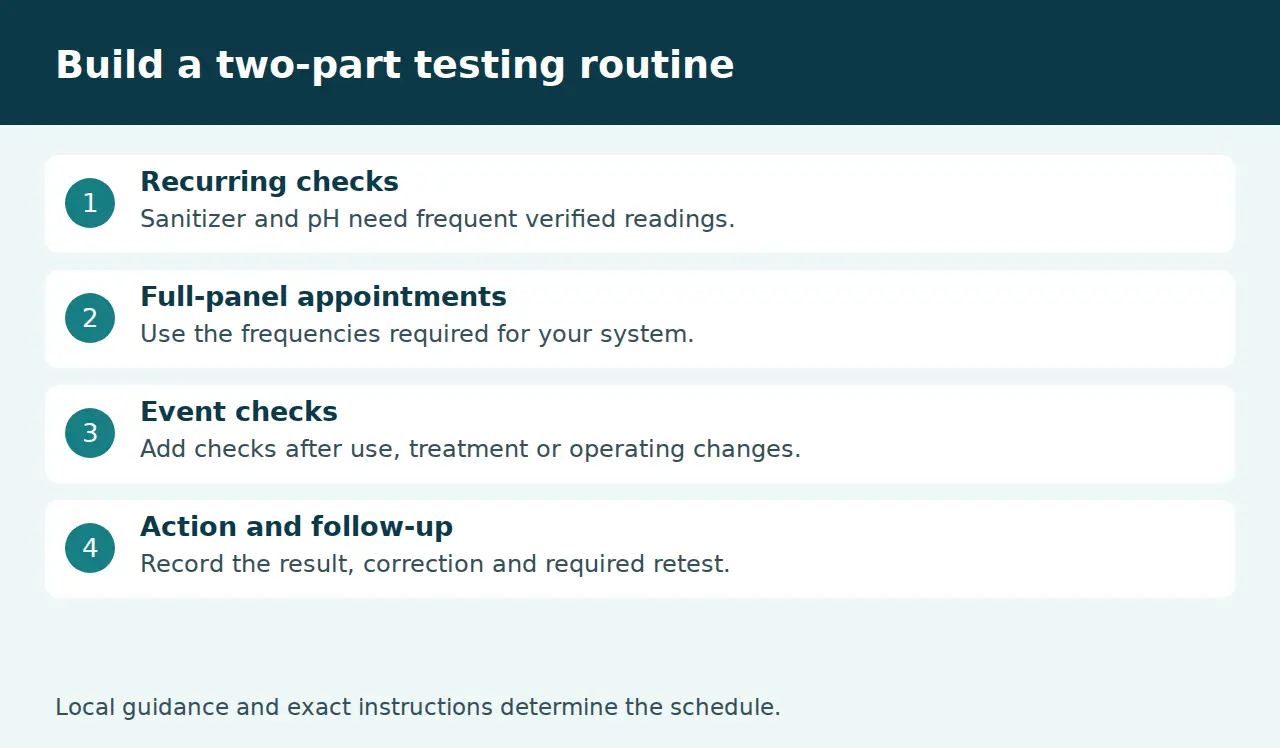
The practical schedule has two parts: recurring appointments and event-driven checks. A party, refill, treatment or equipment fault can make the next scheduled test too late. Use this guide to build a routine around your actual operating season, products and equipment, while keeping local requirements separate from general guidance.
Start with the guidance that applies to your pool
Write down your sanitizer system, pool finish, equipment models and the current instructions for testing and treatment. Keep the source of each frequency beside it. A public pool’s operational rule, a test maker’s educational suggestion and a residential chemical label do not necessarily describe the same situation.
The CDC frequency above is US residential public-health guidance. Health Canada recommends daily checks of sanitizer, pH, total alkalinity and calcium hardness. Taylor’s calcium-hardness article gives at least monthly CH testing as a manufacturer educational recommendation. These examples differ in purpose and scope; do not blend them into a supposed worldwide mandatory schedule.
Follow stricter applicable requirements and ask your supplier or qualified provider to resolve any conflict. The table below organizes the jobs; it is not permission to reduce a required test frequency. UK and Australian owners should use the same planning approach with their local advice, product labels and model instructions.
Which parameters need the most attention?
| Parameter | Recurring plan | Reasons for extra checks |
|---|---|---|
| Free chlorine or the approved sanitizer measurement | For US chlorine pools, use CDC’s at-least-twice-daily baseline and applicable product instructions | Heavy use, treatment, supply interruption or uncertain residual |
| pH | Check alongside sanitizer; retain any stricter program | Balance correction, refill, unexpected reading or changing trend |
| Total alkalinity | Use the frequency required by your care program and local guidance | Recurring pH instability, relevant chemical adjustment or water exchange |
| Calcium hardness | Use finish and equipment requirements; Taylor’s monthly advice is one scoped example | New source water, replacement, surface concern or balance reassessment |
| CYA where relevant | Include it in the stabilized-pool testing plan | Stabilizer/product change, water replacement or unclear chlorine context |
| Salt and system-specific readings | Use the exact equipment manual | Warning, refill, production problem or discrepancy with the display |
The pool water testing guide explains how to collect and interpret the measurements. Here the goal is deciding when to obtain them. A complete panel at opening does not replace the frequent checks needed later.
Keep raw results distinct from any calculated balance values. An adjusted alkalinity input for a particular saturation calculation is not another test frequency or a replacement for the measured total alkalinity record. Note the calculation method if your provider uses one.
Opening or restarting: establish a current starting point
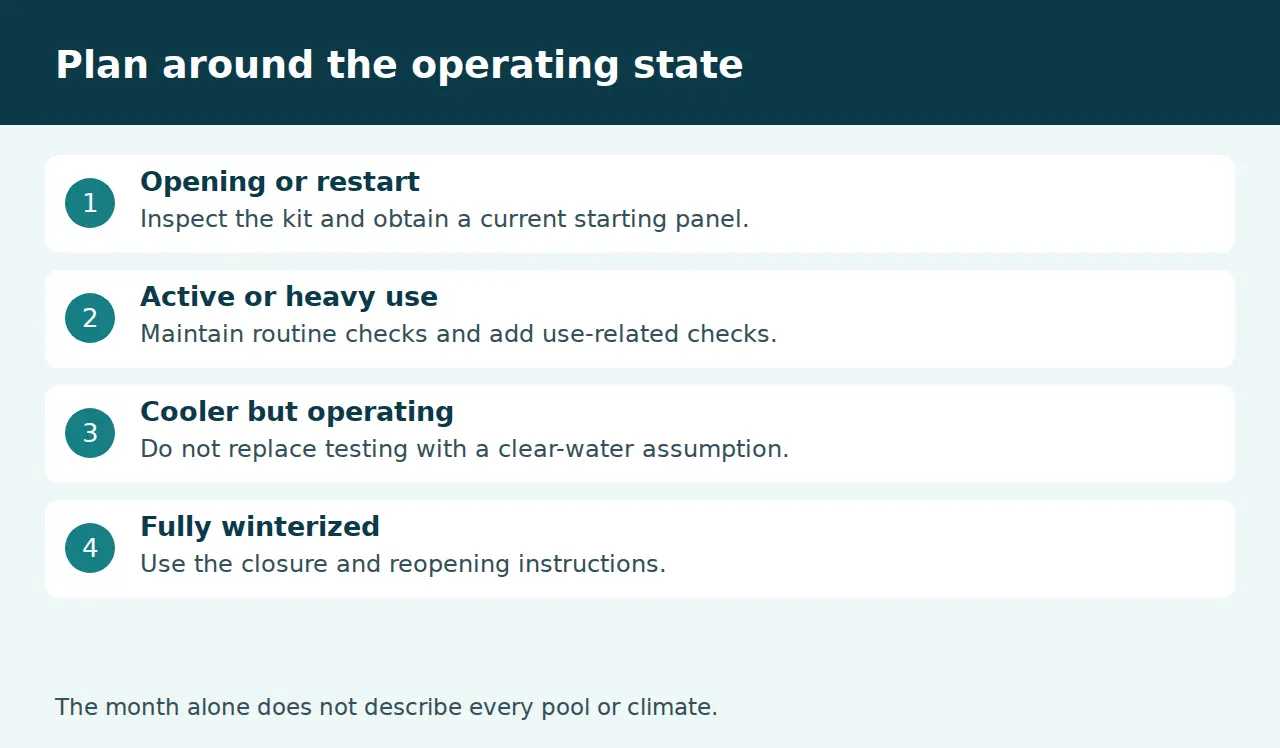
Before the first swim, inspect the kit and assemble the measurements required by the startup program. Water that sat through closure has a history you need to reassess. Do not copy last season’s results onto this year’s target sheet or assume that a clear opening is a complete pass.
Check expiry guidance, storage history, comparator condition and the current instructions. Taylor’s testing guidance explains that reagents deteriorate and that heat, cold, moisture and treatment chemicals can shorten their useful life. Replace questionable components under the maker’s advice rather than compensating with extra drops.
Record source-water and refill information where useful. A different supply or significant replacement is a reason to obtain relevant new balance results. Confirm normal circulation before taking a sample or making a treatment that depends on it. Follow the startup instructions for waiting, mixing and retesting.
Make the first log entry a usable baseline: date and time, method, readings, relevant water temperature, products used and any unresolved issue. A number without its measurement name or units cannot support a reliable comparison later.
Active season: make frequent checks easy to complete
Choose recurring times that fit household use and the applicable instructions. Keep the kit accessible in its permitted storage conditions and assign responsibility. “Someone tested it” is less useful than a dated entry identifying what was measured and what action followed.
Do not wait for water to change colour before checking sanitizer. Heavy use and contamination can change the care requirement, and appearance cannot show the disinfectant residual. A regular schedule should continue even when the pool looks stable.
For the broader panel, put the required appointments into the same record rather than relying on memory. Identify which parameter belongs to each appointment. If local guidance requires daily alkalinity or hardness checks, a less frequent educational example does not override it.
Use an unexpected trend to add a check rather than randomly increase every product. Our guides to high or low pool pH and high or low alkalinity help frame the next investigation. Repeated pH movement deserves a linked record of both measurements and recent corrections.
Heavy-use days need additional opportunities to verify
Check before use and add the checks required during heavy use, as well as after label-directed corrective treatment. Make a plan before guests arrive so that testing is not forgotten while the pool is busy. Do not choose a universal hourly schedule from this guide; the care program and conditions determine the extra checks.
If a result cannot be confirmed within the applicable operating requirements, stop swimming while you investigate. More tests are useful only if someone can interpret them and act safely. Record the issue and the instructions used for correction and reopening.
Cooler weather: distinguish operation from winterization
A pool still operating or available for swimming needs an active water-care plan. Lower use may change treatment needs, but it does not prove that the residual is suitable or remove the need to follow testing instructions. Organize the schedule around actual operation rather than the calendar name of the season.
Keep reagents protected from cold and heat under their storage directions. A kit left in an outdoor cabinet can have a different storage history from one kept indoors. An unusual result from poorly stored reagents needs confirmation before treatment.
A fully winterized pool follows its closure and monitoring instructions. Do not switch pumps on or move valves just to reproduce an active-season sampling routine. Ask the installer what checks are appropriate while closed and what must be reassessed at reopening.
“Winter” occurs at different times across these regions, and some residential pools operate year-round. Label a schedule “active,” “reduced use” or “winterized” rather than assuming a northern-hemisphere month describes every reader’s pool.
Saltwater and automation still need water tests
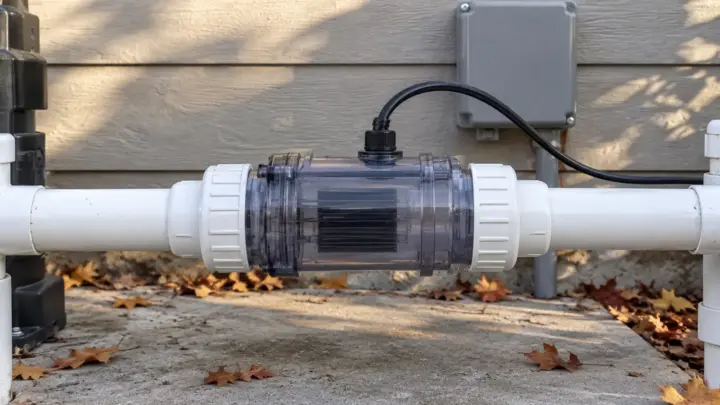
A salt chlorine generator produces chlorine; it does not remove the need to measure the sanitizer in the pool. Use its manual for salt testing, display interpretation, temperature restrictions and other required checks. Record whether it was actually operating when results were collected.
Automatic readings and alarms can be helpful, but use the independent checks and calibration requirements in the equipment instructions. A controller setting is not interchangeable with a verified water result. If the display and a suitable test disagree, investigate the method and equipment rather than averaging unexplained numbers.
Track CYA and stabilized-product inputs in the applicable pool program. A change of sanitizer product can make the stabilizer trend relevant even if you did not buy a separate conditioner. Do not add stabilizer just because one chlorine test is low.
Events that should trigger an extra check
- Heavy use or unusual debris: obtain the sanitizer and pH checks the changed conditions require, and review the broader panel if the diagnosis calls for it.
- Rain, overflow or significant refill: record what happened and reassess relevant chemistry instead of assuming the net effect.
- Chemical treatment: complete the product’s circulation and retesting requirements before a further addition or swimming.
- Circulation or feed interruption: resolve the equipment condition and verify water care before reopening.
- A confusing result: repeat correctly or arrange suitable testing before calculating a correction.
- Visible deposits or surface concern: review the required balance inputs; our calcium-hardness guide explains why one number cannot diagnose the whole problem.
A suspected faecal incident, illness concern or unknown chemical input needs a separate response. Extra routine tests do not turn the ordinary care schedule into an incident-disinfection protocol. Obtain appropriate guidance and keep people out while conditions remain unresolved.
A log that makes the next test more useful
Use columns for time, parameter, result and units, method, recent event, action and next check. Retain unexpected readings alongside the confirmation rather than deleting them. Write “uncertain endpoint” when that is the evidence; do not invent a precise number.
Use consistent sampling and reading instructions. A sample collected beside a return or immediately after treatment can answer a different question from a representative sample after the required circulation. Follow the test maker’s directions and test promptly.
Before dosing, verify the reading and use the exact product label and known water volume. Never mix chemicals. An apparent zero after a substantial chlorine addition deserves particular caution because some DPD methods can bleach at high concentrations. Follow the supported confirmation method instead of adding repeatedly.
Common scheduling questions
Is one weekly visit enough for all testing?
A weekly service appointment is not the same as the frequent sanitizer and pH checks recommended for an operating pool. Clarify what the provider does and who covers the checks between visits.
Can I skip checks while the cover is on?
Use the approved plan for that operating state. A cover or clear water does not measure sanitizer, and reopening for use still requires verified conditions.
What should I do after missing several checks?
Obtain current reliable measurements before use, note the gap and assess relevant equipment and treatment history. A missed period cannot be reconstructed from one normal-looking result.
Research checked October 1, 2026. We only claim hands-on testing when we’ve actually tested the product ourselves. Featured image is an original illustration.