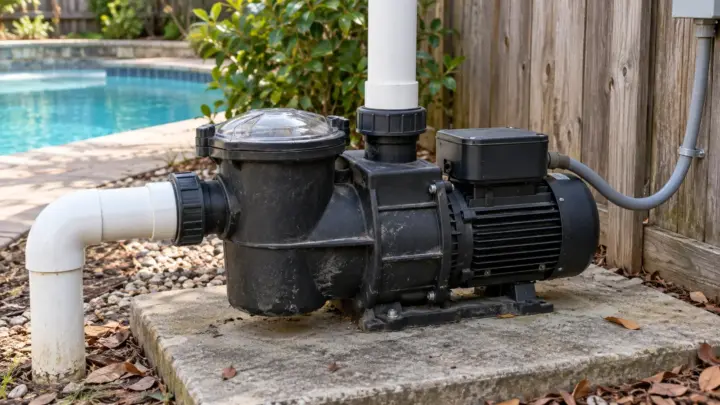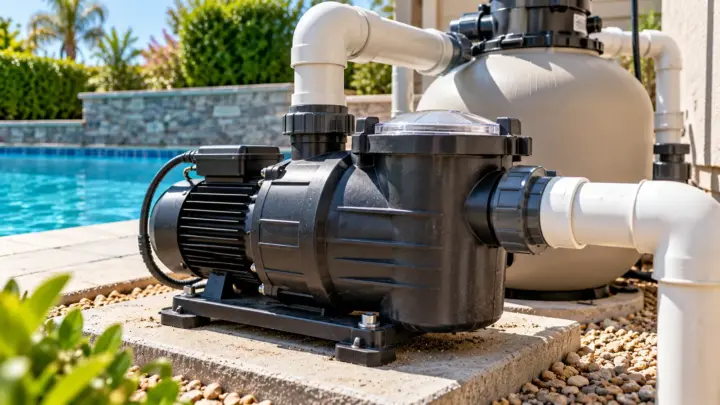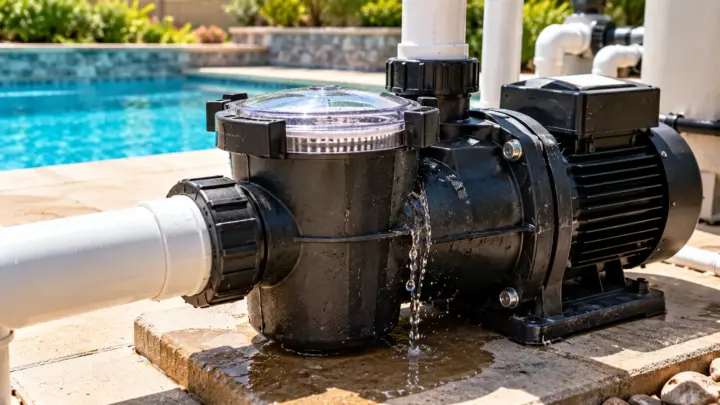
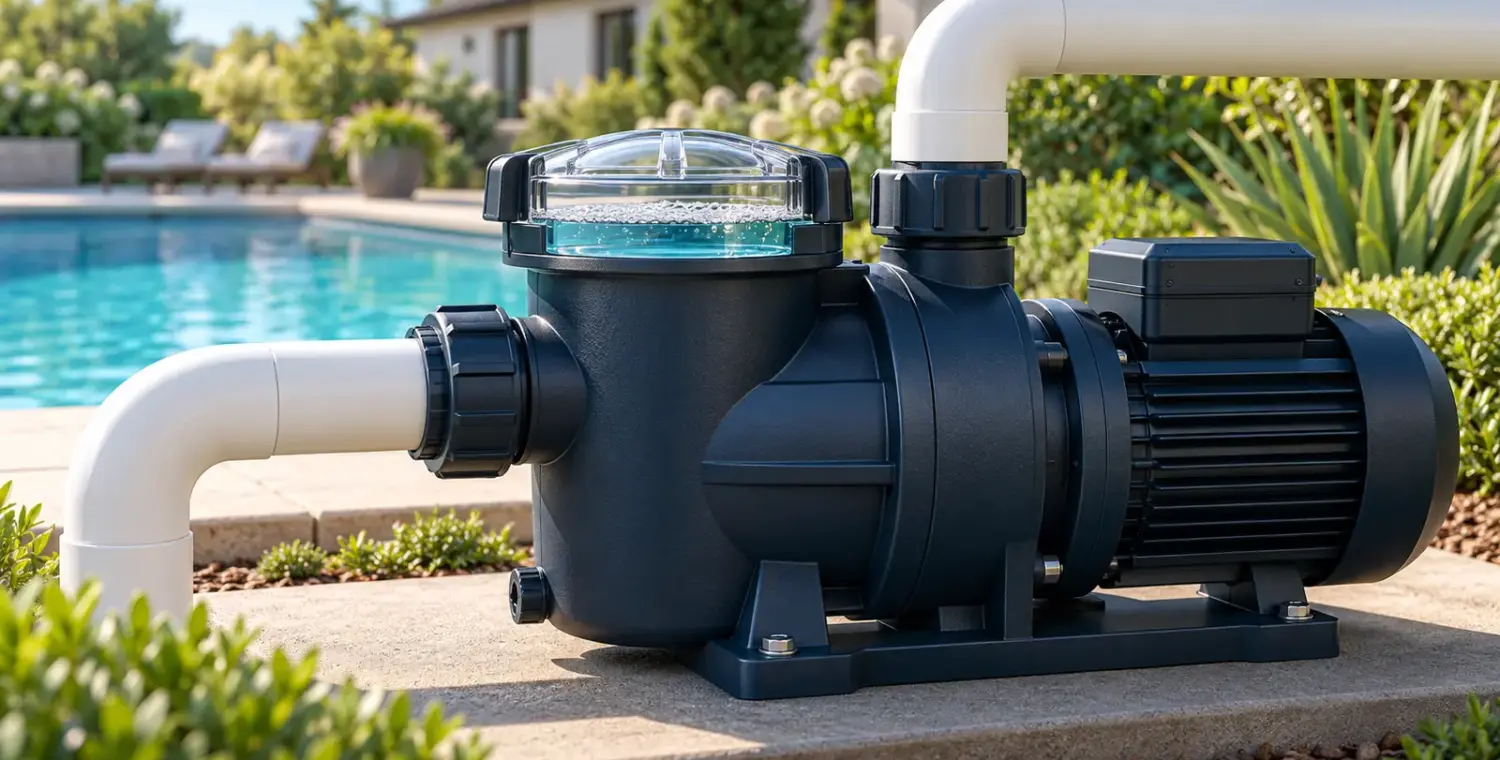
A pool pump that loses prime is failing to maintain the water path it needs to move water reliably. Low pool water, air entering on the suction side, a poorly sealed lid, debris or the wrong valve arrangement can all contribute. Start with when the problem happens and what you can observe safely. Repeatedly restarting a dry pump is not a repair.
This guide focuses on prime: the water supply and air conditions around the pump. It does not diagnose every reason a motor stops or a pool has weak circulation. Use your exact pump and filter manuals for maintenance and restart procedures, and leave plumbing, internal pump and electrical repairs to qualified service.
What does losing prime mean?
The pump needs water available through its suction plumbing and pumping chamber. During startup, a permitted priming sequence establishes that supply and clears air. A pump may fail to establish prime, establish it and then lose it, or need repeated attention after stopping. Those are different observations worth recording.
Where there is a transparent strainer lid, an unusually air-filled chamber can be a clue. It is not a complete diagnosis: lid designs differ, a brief startup air pocket differs from continuing air, and a broken or obscured lid cannot be assessed reliably from outside. Pair the observation with normal return flow and the manufacturer’s expected startup behavior.
Stop before troubleshooting an unsafe condition
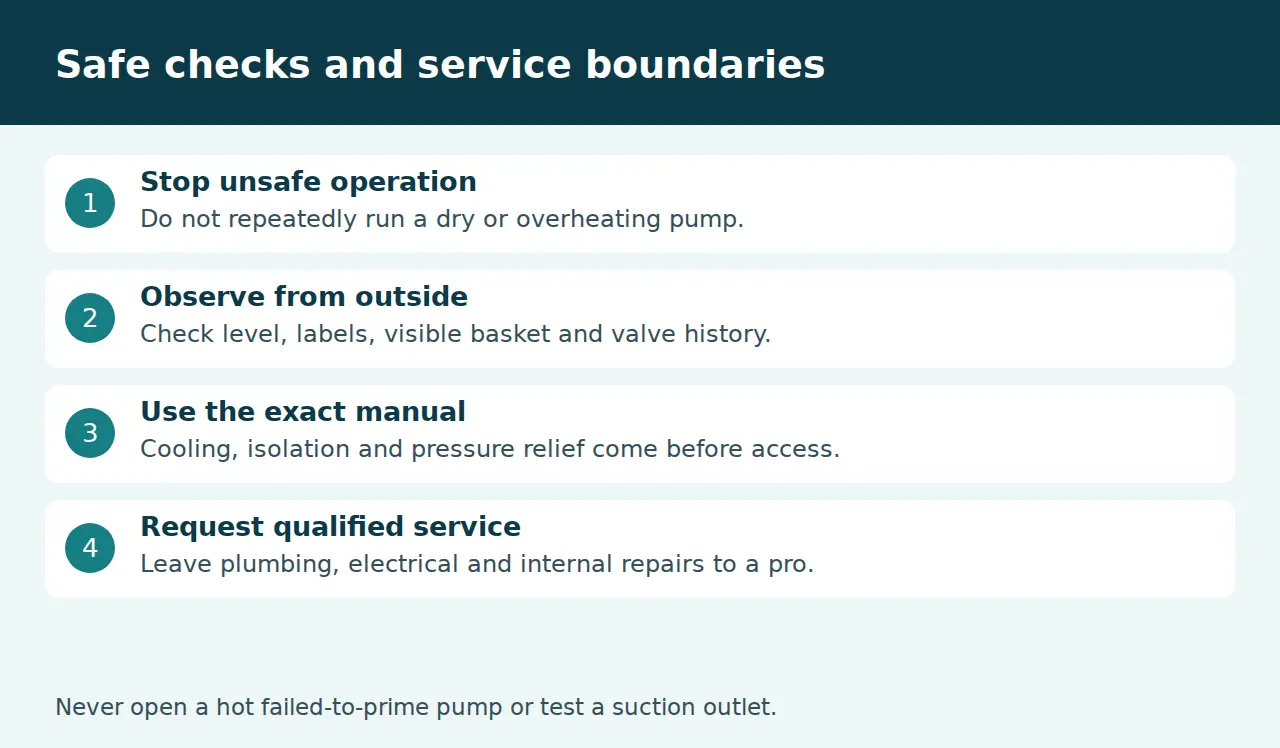
Shut down safely if the pump runs without water, becomes unusually hot, makes alarming noises, leaks around a damaged housing, or has an electrical fault. Do not keep extending its priming attempts. Pentair’s pump manuals warn that dry operation can damage the seal and that a failed-to-prime strainer may contain hot water and vapor pressure.
Do not immediately open the lid of a pump that has failed to prime or run dry. Follow the exact cooling, isolation, pressure-relief and valve procedure in its manual. If you cannot confirm those conditions, leave the equipment closed and call a pool professional. Switching off a timer is not the same as preventing an automatic restart.
Never put a hand near a suction outlet, remove a drain cover, or enter the pool to test suction. Keep everyone out if a suction cover is loose, broken or missing. Flooded equipment, unexplained protective-device trips and damaged electrical components need qualified attention.
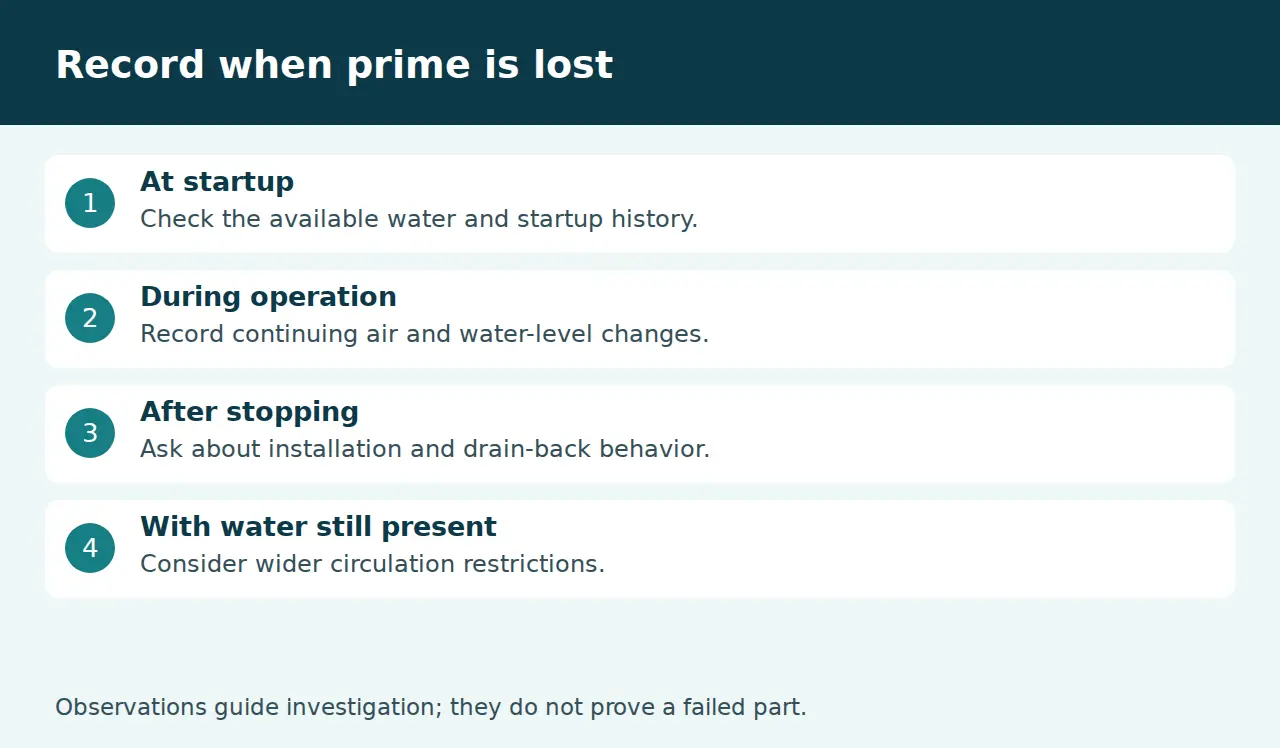
Record the pattern before changing anything
| Observed pattern | Useful next information | What it does not prove |
|---|---|---|
| Failure at every startup | Water availability, valve history, priming settings and recent service | That the motor must be replaced |
| Starts normally, then takes in air | Water level and whether air continues through the clear lid | Which seal or pipe is leaking |
| Problem began after basket cleaning | Lid seating and the exact owner’s maintenance procedure | That tightening harder is safe |
| Needs attention after each stop | Installation height, drain-back observations and changed plumbing | That a new valve is automatically the answer |
| Water remains present but returns weaken | Filter baseline, baskets and control settings | That prime is the only problem |
Take photographs of accessible labels and controls before changing settings. Record whether this follows a water-level drop, winter opening, basket cleaning or plumbing work. A technician can use that sequence much more effectively than a description such as “the pump is bad.”
Check that the pool can supply water
Inspect the water level from the deck against the pool and skimmer instructions. If water falls below the skimmer opening, the pump can draw air instead of a continuous water supply. Correct the cause of low water as well as the immediate level problem; otherwise, the next operating period may repeat it.
Do not assume every low level is a leak. Weather, use and water disposal can change it. Our guide to dropping pool water levels explains how to separate evaporation questions from a suspected leak investigation. Restore water only within the pool’s permitted operating level, with any local water restrictions in mind.
Look for obvious debris blocking the accessible skimmer basket. Do not reach into a working suction path or remove protective fittings. If the skimmer cannot receive water normally, or a damaged component prevents safe access, stop and request service rather than improvising a bypass.
Look at baskets without opening running equipment
A full skimmer or pump basket can restrict water reaching the pump. Where a clear lid permits it, inspect the pump basket from outside first. Note accumulated leaves or debris and whether the basket appears damaged. This observation can identify a maintenance task without exposing you to the pressurized system.
Only perform owner-permitted basket maintenance using the exact shutdown and access instructions. Those include preventing automatic restart and managing pressure safely. Above-water and below-water installations can require different valve arrangements during access; never copy a generic sequence without knowing your system.
Reinstall the correct basket and lid as specified. If this is not an owner task in your manual, let a service professional do it. Do not run the pump without required parts, reach into its inlet to find debris, or open the pumping chamber to inspect the impeller.
Consider the lid seal and suction-side air leaks
The manufacturer’s troubleshooting tables identify the strainer lid, its seal, suction plumbing and valves as possible air-entry locations. A problem that begins immediately after permitted lid maintenance makes the lid arrangement worth reviewing. That timing still does not rule out another fault.
When safe owner access is permitted, compare the seal’s condition and placement with the manual. Dirt on the sealing surface, damage or an incorrect replacement part can prevent proper sealing. Do not compensate by using tools to overtighten a lid or by adding arbitrary sealants.
Lubrication and replacement are model-specific
Use only the seal care and compatible materials specified for your pump. Advice for one lid or O-ring is not permission to coat every seal with the same product. A cracked lid, damaged housing or uncertain replacement fit needs service assessment.
Air elsewhere in the suction plumbing may not be located by a quick glance. Give a professional photographs of accessible joints, leak observations and the timing of the fault. Do not loosen plumbing while operating, patch a suspected pressure-bearing crack, or perform homemade leak tests involving suction outlets.
Review valves and recent plumbing changes
A valve in the wrong position can prevent the normal water supply or return route. Review labelled positions against your established operating arrangement and equipment instructions. Ask whether a cleaner connection, water feature, backwash operation or recent service changed that arrangement.
Do not randomly open or close every valve. Multiport and other equipment valves have their own restrictions, and an unfamiliar handle may control a different circuit. If the normal route is unclear, leave the pump off and have the installer identify and label it.
Likewise, a newly installed pump or changed suction layout should be checked as a system. Our pool pump sizing guide explains why matching the equipment to the plumbing matters. A larger replacement pump is not a justified first response to lost prime.
Account for pump location and programmed startup
Equipment above the pool water level has a different startup context from equipment below it. Pentair’s manuals distinguish their access and restart procedures. A technician should assess installation-related drain-back or difficult startup rather than prescribing a universal extra valve or pipe change.
Variable-speed pumps can have a dedicated priming program as well as normal operating schedules. Record the model, displayed messages and whether someone recently changed those settings. Follow its manual or have the installer restore an appropriate verified configuration; another pump’s speed and time values do not transfer automatically.
Our variable-speed and single-speed pump comparison explains the control differences. Once the fault is resolved, use the pump runtime guide for routine planning. Longer operation does not make a dry-running condition acceptable.
When the problem belongs to wider circulation troubleshooting
If water remains in the pump but flow is still poor, investigate the rest of the system with a professional where needed. The manufacturer’s diagnostic material also lists dirty filters and internal obstructions among low-flow causes. Read the filter pressure guide to interpret a reading against the same system’s clean baseline and operating configuration.
A pressure reading cannot locate an air leak by itself, and a low reading is not proof that the filter is healthy. Avoid cleaning or dismantling unrelated components solely because the pump has an air symptom.
What to give the service professional
- The pump model and any displayed message, recorded before shutdown.
- Whether prime fails at startup, disappears during operation or is lost after stopping.
- Water-level history, visible basket condition and recent maintenance.
- Accessible photographs of the lid, labelled valves and equipment layout.
- Any heat, leaks, unusual noise, flooding or electrical protection event.
After repair or permitted maintenance, use the full model-specific restart procedure, including air management and standing clear where instructed. Confirm stable operation and normal water movement rather than accepting a motor sound as success. If the fault returns, stop and report it instead of repeatedly reprime-and-retry cycling.
Common questions
Can a small air pocket be normal?
Some startup behavior differs by pump and installation. Compare it with the manufacturer’s expectations and established normal operation. Continuing air with unstable water movement deserves investigation; bubble size alone is not a safe diagnosis.
Should I add water through the pump lid?
Only if the exact manual permits it after the required safe shutdown, cooling and pressure-relief conditions. Never open a hot failed-to-prime pump just to try this. Ask a professional if any access condition is uncertain.
Does repeated prime loss mean I need a new pump?
Not necessarily. Water supply, seals, plumbing or controls may be involved. Have the cause established before selecting equipment, and retain the observations that explain when the fault began.
Research checked October 1, 2026. We only claim hands-on testing when we’ve actually tested the product ourselves. Featured image is an original illustration.