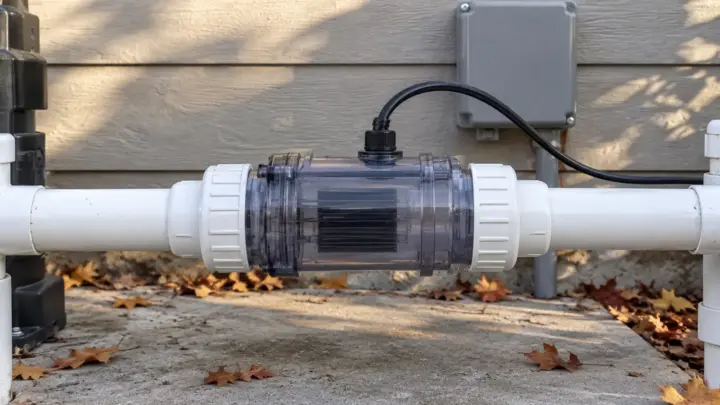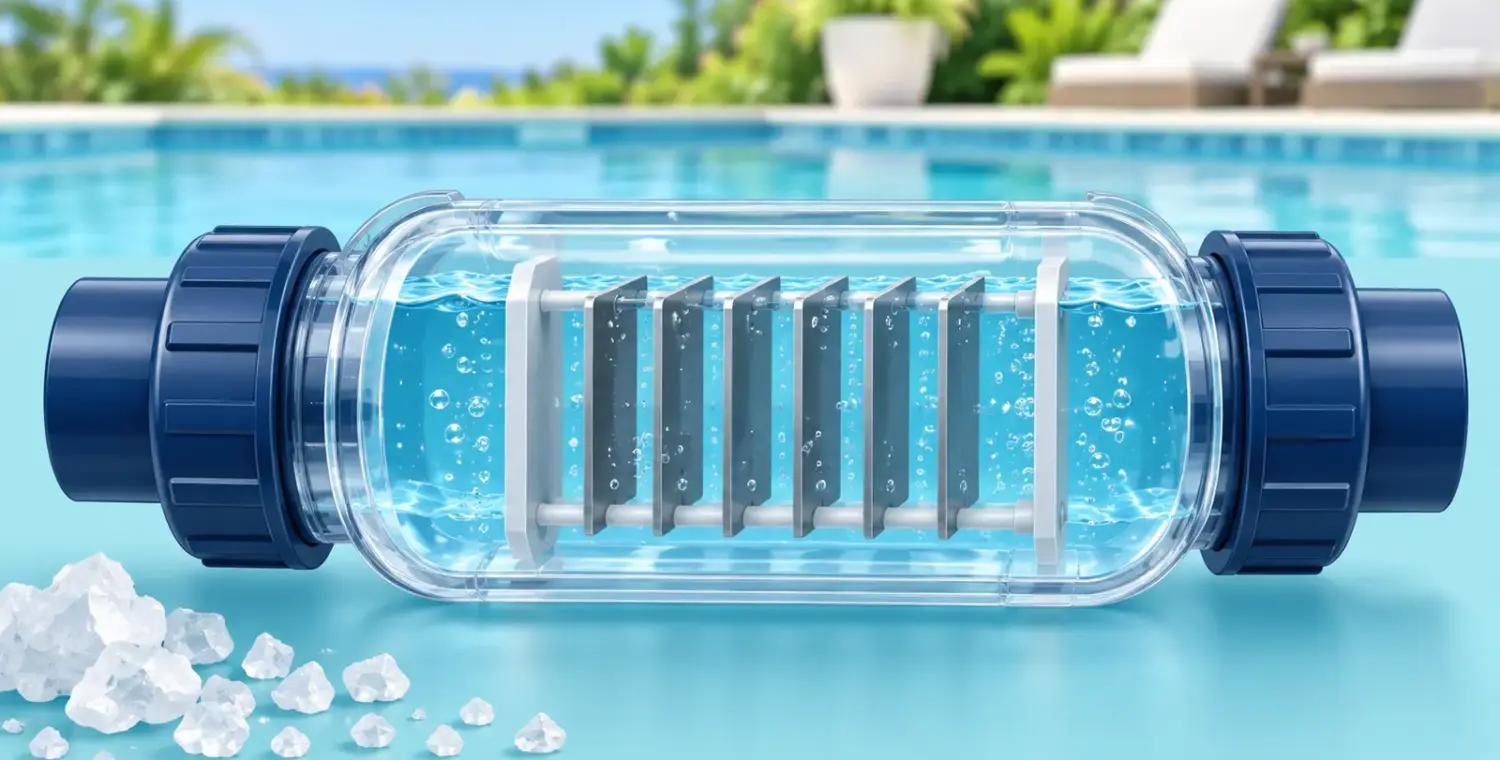
A saltwater pool is a chlorine pool. Its salt chlorine generator uses electricity and dissolved salt to produce chlorine sanitizer as water passes through the cell. That changes how chlorine is supplied; it does not remove the need to test the water, maintain balance, clean equipment or respond to contamination. If you are deciding between a generator and tablets, compare a salt chlorine generator with chlorine tablets.
For a new owner, the useful distinction is between what the generator produces and what remains in the pool. Output settings and status lights help explain equipment operation. A suitable water test tells you the sanitizer residual. You need both kinds of information to manage the pool.
How salt becomes chlorine sanitizer
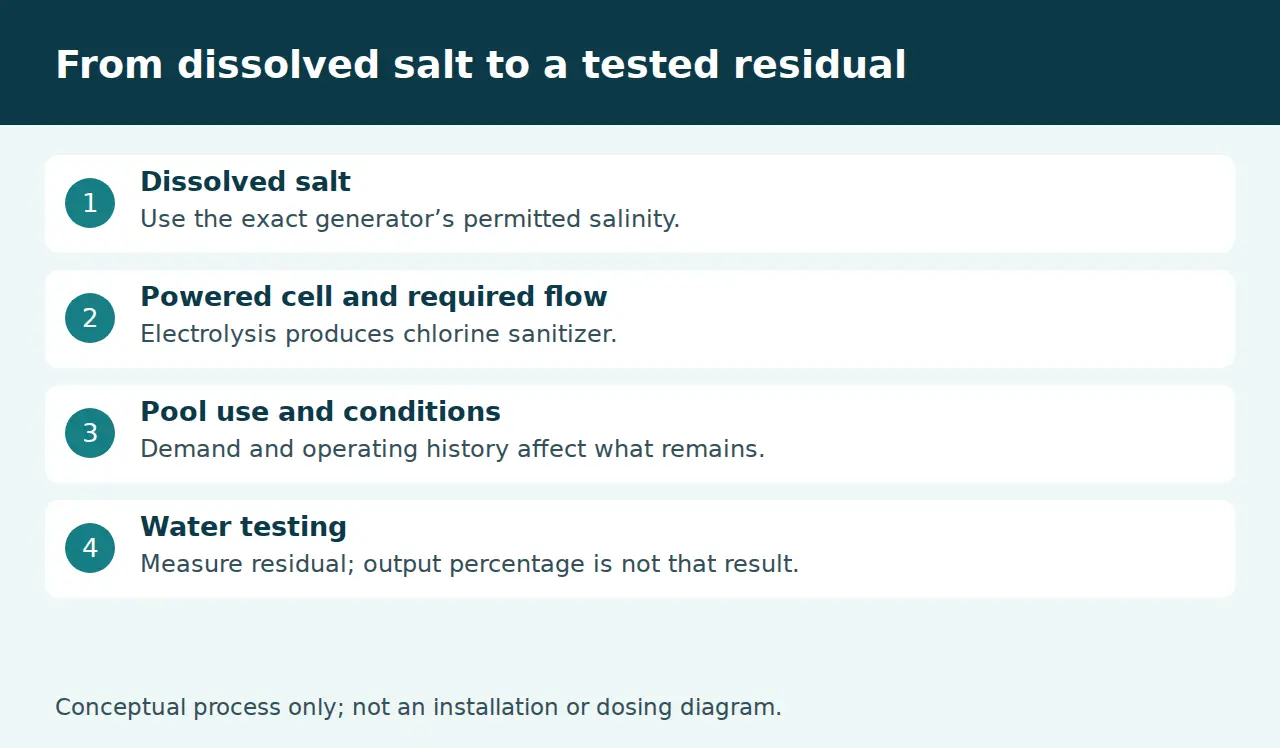
Dissolved salt supplies chloride for an electrically driven process called electrolysis. Inside the cell, that process creates chlorine that forms the active chlorine sanitizer in the water. Pentair’s manuals describe this conversion and the return of used chlorine to dissolved salt within the cycle.
The salt you add is therefore not a stand-alone substitute for disinfection. A pool with the expected salt concentration can still have too little free chlorine if production is interrupted or demand exceeds the supply. Health Canada explicitly describes saltwater sanitation as generating chlorine from salt.
You do not need to reproduce the chemical reactions to operate the pool safely. You do need to know that a generator’s power, permitted salinity, circulation and operating conditions support production, while use and contamination affect the residual you measure in the pool.
The main parts of the system
A typical system has a cell in the circulation plumbing, a power supply or control arrangement, and sensors or protections described in its manual. The pump moves water through the equipment. Some installations also use automation that controls the generator’s operating request.
The exact layout, electrical connections and permitted pool materials are installation matters. Do not use a simplified explanation as a plumbing drawing or wiring plan. Keep the model identification for the cell and controller, because parts that look similar may belong to different generations.
Ask the installer which display controls production, which observations are owner checks, and who should handle faults. A clear handover is more useful than assuming every button and warning has the same meaning across brands.
Output percentage is not the chlorine level
On the cited legacy IntelliChlor models, output controls how much of the available operating period the cell produces chlorine. That percentage is not a reading of the pool’s free chlorine. Other systems may organize their controls differently; consult your manual before interpreting them.
A higher displayed setting does not demonstrate that water conditions are suitable. There may be no production during a protective shutdown, insufficient required flow, or a non-producing part of an operating cycle. Separately, recent swimmers or debris may have changed chlorine demand.
Keep the output setting beside the actual test result and operating history. If an automation system owns the setting, record that too. Changing a local control without understanding the active controller can create an incomplete or misleading maintenance record.
Salt level: use the exact model’s requirements
Identify the generator’s permitted salt range and its salt-addition instructions. There is no single salinity value specified here for every cell. A warning should be interpreted through that model’s diagnostics, not answered by adding a bag of salt regardless of the existing measurement.
Record a reliable salt result and the displayed status before a correction. If readings disagree, follow the maker’s supported confirmation method or arrange qualified testing. Account for recent refill or water replacement in the history rather than treating yesterday’s result as the current concentration.
Any permitted addition depends on measured water volume, current concentration, the exact salt product and the manufacturer’s method. Keep chlorine-generator operation, circulation and retesting consistent with those instructions. This guide supplies no universal bag count or mixing calculation. For the arithmetic, the pool salt calculator estimates the salt needed from your volume, current reading and target; the target salinity comes from your generator manual.
Why pump runtime and flow matter
The generator needs its required operating conditions to produce chlorine. A powered controller alone does not establish that water is moving appropriately through the cell. Never bypass a flow switch or another protection to make production continue.
The cited Pentair manuals show that production depends on the available operating period and output, while conditions differ between pools. A schedule that worked previously may need reassessment after seasonal use or another equipment change. No fixed number of pump hours guarantees an adequate residual.
Use the pump runtime guide to plan around filtration, heating and chlorination requirements together. Ask the installer to verify appropriate settings, then check water results. Increasing time is not the remedy for an unsafe pump or unresolved flow fault.
What you still need to test
| Information | Why it belongs in the record | Keep it separate from |
|---|---|---|
| Free chlorine and relevant chlorine measurements | Assess sanitizer remaining in the pool | Output percentage and power status |
| pH and total alkalinity | Track operating conditions and buffering context | Assumptions based on salt alone |
| CYA where relevant | Understand stabilization and applicable sanitizer guidance | A copied target from another installation |
| Calcium hardness and other balance inputs | Assess the whole system’s balance and scale context | A single number treated as a safety certificate |
| Salt and equipment messages | Check generator operating requirements | A verified chlorine residual |
The pool water testing guide explains those measurements. Follow the test kit’s sampling, timing and reagent instructions, and check reagent storage and expiry. Unexpected results should be confirmed with a supported method before making repeated additions.
CDC’s US residential guidance recommends chlorine and pH checks at least twice daily, with more checks during heavy use. That is public-health advice, not a promise that two tests answer every situation or a worldwide statutory schedule. Equipment-maintenance headings do not replace water-safety checks.
High chlorine can make some DPD tests appear falsely low through bleaching. If a result is unexpectedly zero after treatment, explain that history to the tester and use the kit maker’s verification instructions. Do not turn an unexplained zero into a cycle of increasingly large additions.
Watch pH trends without assuming every change has one cause
Pentair’s European pH-control overview notes that electrolysis systems can tend to raise pH. That is a reason to measure a trend, not permission to add acid automatically. Record pH alongside the treatment and operating history, and confirm surprising results.
Our pool pH guide covers safe correction planning and test limitations. Use a product permitted for your generator and pool, not simply a product sold as “pH down.” The current Plus/LT manual and the older IntelliChlor manual have different dry-acid cautions, illustrating why exact equipment instructions matter.
For recurring changes, ask a qualified provider to review the whole care program. Do not lower alkalinity to a guessed value or copy another owner’s acid routine without measured results and appropriate instructions.
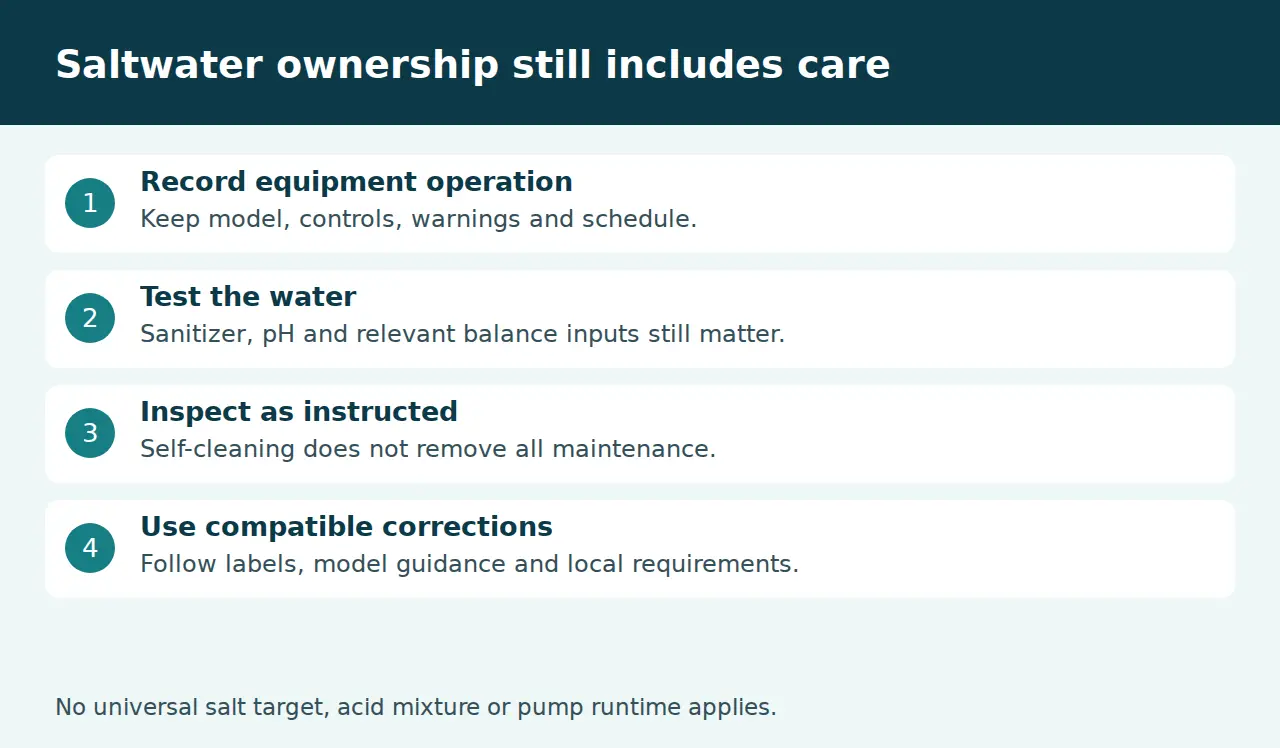
Scale and water balance involve more than salt
Calcium hardness, pH, alkalinity, temperature and dissolved solids interact in water-balance assessment. Taylor explains that balance is a relationship between these inputs. A cell with deposits needs both an equipment assessment and a look at the conditions that could allow recurrence.
The calcium hardness guide explains why the pool surface, equipment and overall water conditions matter. A balance calculation is useful within its intended method; it does not prove microbiological safety or remove the need for sanitizer testing.
Where CYA is used, it also matters to the care plan and some balance methods. Read the CYA guide before changing stabilizer. Different manuals and public-health sources may describe different ranges or contexts; have those reconciled for your installation instead of blending them into an invented universal target.
“Self-cleaning” still requires inspection
Automatic cleaning features can reduce deposits, but do not eliminate inspection and maintenance. The current Pentair manual distinguishes routine inspection, debris removal and acid cleaning when required. It also warns that excessive acid washing damages the blades.
Use the exact model’s inspection schedule and permitted access procedure. Cell removal involves power and circulation-system safety; request service if you cannot establish the required conditions. Do not scrape coated blades with tools, use an unapproved cleaner, or apply a generic acid mixture.
Chemical labels, protective equipment, ventilation and disposal requirements still apply. Never mix incompatible products or introduce acid and chlorine into a shared container. Original labelled storage remains important even when less routine chlorine is supplied manually.
Check compatibility and seasonal instructions
Before conversion, replacement or a new-surface startup, confirm that the pool construction, fittings and equipment permit the salt system. Pentair identifies corrosion and material deterioration concerns; compatibility is not established merely because a cell fits the pipe.
Follow surface-manufacturer and generator startup requirements together. For cold weather, check the exact model’s production limits and winterization instructions. A cold-weather production shutdown does not supply a winter water-care plan or guarantee freeze protection.
A useful owner record
- Cell, controller and automation model names and current manuals.
- Commissioned pump schedule and generator settings.
- Water-test method, results, dates and applicable operating requirements.
- Salt measurements, additions and any refill history.
- Warnings, inspection findings and professional service records.
Use that record to explain changes and seek advice before guessing at a replacement part. The generator supplies sanitizer; maintaining a suitable pool remains an ongoing task.
Common questions
Is saltwater chlorine-free?
No. Chlorine generated in the cell performs the sanitation role. Salt concentration alone does not demonstrate an adequate residual.
Can a generator replace every treatment?
No. It does not correct every balance problem or supply every contamination response. Follow the applicable product, equipment and public-health instructions for those situations.
Is clear water proof the system works?
No. Health Canada notes that clear water may still contain microorganisms. Verify sanitizer, water conditions and equipment operation rather than relying on appearance.
Research checked October 1, 2026. We only claim hands-on testing when we’ve actually tested the product ourselves. Featured image is an original illustration.
Sources and references
- CDC: Home Pool and Hot Tub Water Treatment and Testing
- Health Canada: Swimming pool and spa chemicals
- CDC: Pool Chemical Safety
- Taylor Technologies: Technical and Support FAQs
- Pentair: IntelliChlor IC15/20/40/60 User Guide, Rev R
- Pentair: IntelliChlor Plus and LT Installation and Maintenance Guide
- Pentair Europe: REG-pH Product Overview
- Taylor Technologies: Maintain Water Balance to Protect Your Pool and Spa