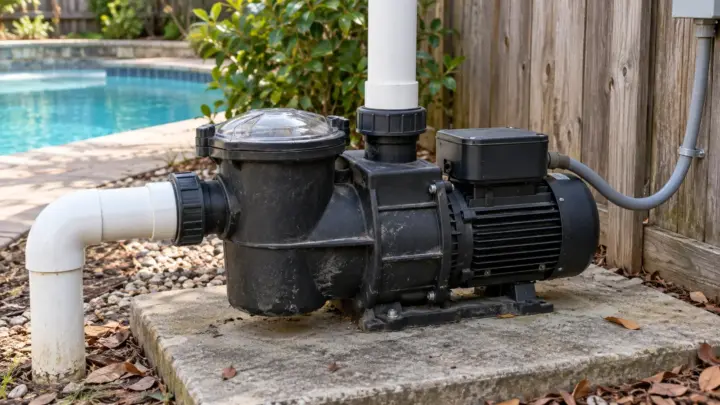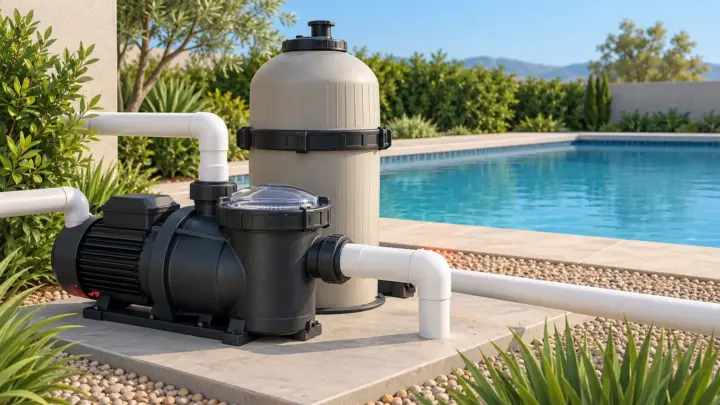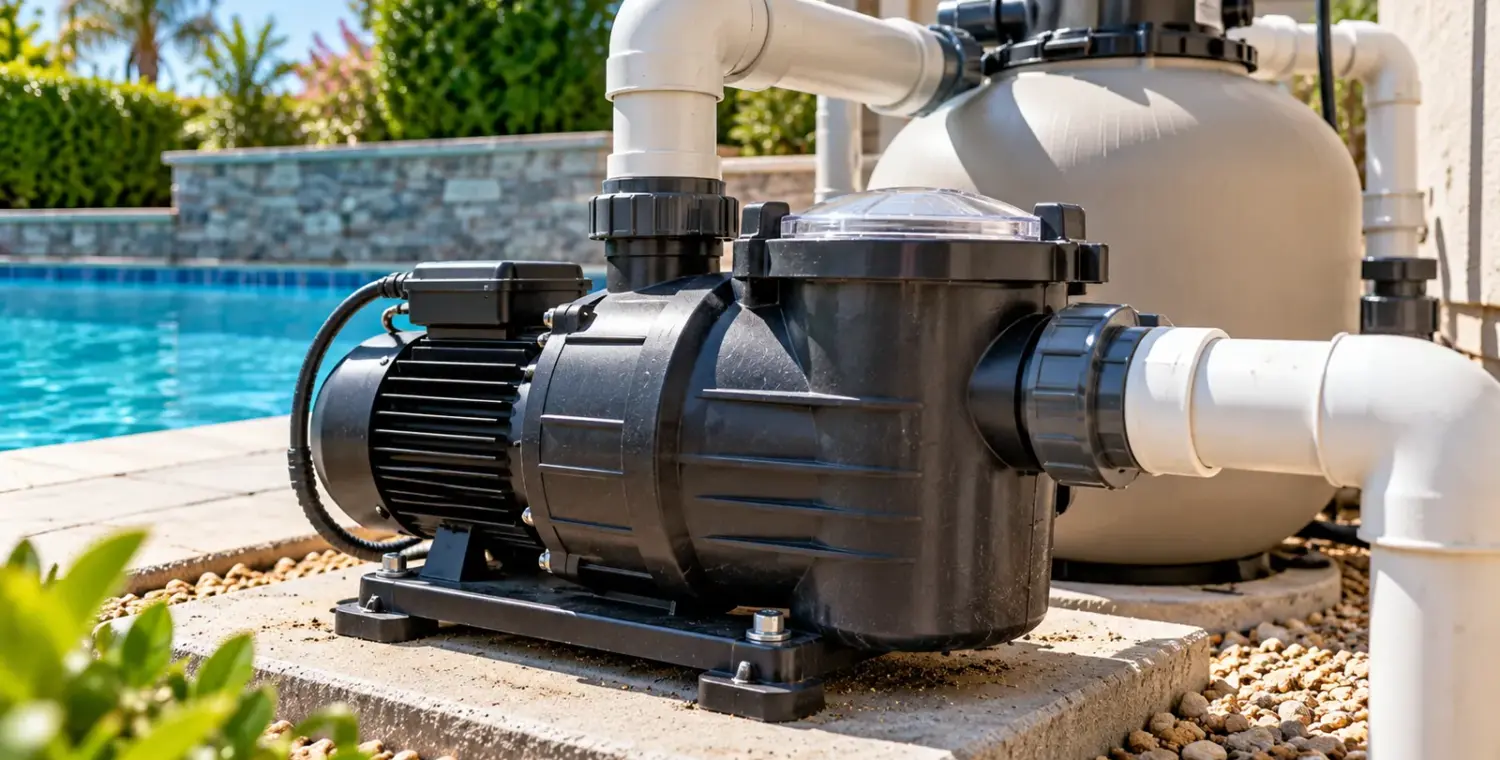
A pool pump that suddenly gets louder is telling you something has changed. Pump makers’ troubleshooting tables point to a short list of usual causes: air or restricted flow on the suction side (cavitation), poor mounting, debris inside the pump, and worn motor bearings. Some of these you can check safely yourself. Others need a pool professional or electrician.
The short answer
Turn the pump off and look first at the simple things: the water level at the skimmer, full skimmer and pump baskets, partly closed suction valves, a loose strainer lid, and whether the pump sits level and secure on its pad. A rattling, gravel-like sound usually points to the suction side. A screeching or grinding sound that continues at lower speeds points to the motor bearings, which is a repair job. Hayward’s technical guide puts it plainly: a loud pump is a symptom of a larger issue.
Key takeaways
- K2 Pumps lists incorrect pipe support, incorrect mounting, cavitation, bad motor bearings and debris in the pump housing as causes of a noisy pump. Hayward’s list is similar.
- Most owner checks are about the suction side: water level, baskets, valves and the strainer lid.
- Always switch off power at the breaker before servicing, and never run the pump dry.
- Bearing, motor and electrical problems are for a qualified professional.
Safety first
- Power: Pentair’s SuperFlo manual says to always disconnect power to the pump at the circuit breaker before servicing it. Failing to do so risks electric shock.
- Pressure: Hayward’s MaxFlo manual says that before servicing, all system and pump controls must be off and the filter’s manual air relief valve open.
- Hot strainer pot: Pentair warns not to open the strainer pot if the pump has failed to prime or has run without water in the pot. It may contain scalding hot water under vapor pressure.
- Dry running: Hayward says never to run the pump dry, because dry running may damage seals and cause leakage.
Cavitation and air in the line
Cavitation happens when the pump cannot get enough water on the suction side. It often sounds like gravel or marbles rattling through the pump. Hayward’s troubleshooting table lists cavitation caused by a restricted or undersized suction line, an air leak at any joint, low pool water level, or unrestricted return lines. Its technical guide adds that air bubbles can cause cavitation noise.
What you can check (pump off where needed):
- Pool water level at the skimmer. K2 Pumps suggests raising the water level to halfway up the skimmer intake.
- Skimmer basket and pump strainer basket for debris.
- Suction valves that are partly closed.
- The strainer lid and its O-ring for a proper seal, and visible air bubbles in a clear lid.
Manufacturer remedies differ by product: Hayward says to correct the suction condition or throttle the return lines, if practical. K2 Pumps suggests lowering a variable-speed pump’s RPM until the noise subsides, raising the water level, or checking with a professional installer. Use the method in your own pump’s manual. If the pump is also losing prime, see Pool Pump Losing Prime. If water is barely moving, see Pool Pump Not Circulating Water.
Undersized suction piping is an installation issue. Changing plumbing is a job for a pool professional.
Vibration and loose mounting
A humming or buzzing that you can feel through the pad or pipes may be vibration. Hayward’s technical guide notes that a pump that is not level on its pad will vibrate, and its installation guidance is to put the pump on a level concrete slab or other rigid base and secure it to reduce vibration noise. K2 Pumps also lists incorrect pipe support and incorrect mounting.
With the power off, look for a pump that rocks, missing or loose mounting hardware, or pipes that are not supported. Re-leveling or re-plumbing should follow the pump manual, or be done by an installer.
Debris in the pump
Hayward notes that loose stones or debris hitting the impeller or the motor cooling fan can cause noise. K2 Pumps says to check the pump housing and impeller for debris following the care section of the owner’s manual. Clearing the strainer basket is a normal owner task. Opening the pump housing or removing the motor to reach the impeller is a service job.
Worn motor bearings
A screech, squeal or grinding sound from the motor end is a common sign of bearing trouble. Hayward lists motor bearings that become noisy from normal wear, rust, overheating, or water getting in through a worn or damaged shaft seal, and says to contact a qualified repair professional. US Motors (Nidec), a motor manufacturer, says a motor that is louder than usual and vibrates excessively can usually be traced to defective bearings, loose or binding parts, or a bent shaft. It adds that bearing noise will be present even when the motor is not at full speed.
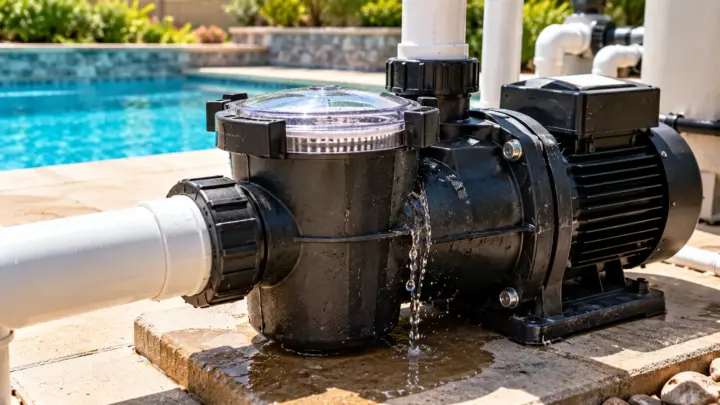
That last point is a useful clue on a variable-speed pump: if the noise stays when you turn the speed down, bearings are more likely than cavitation. If you also see water dripping under the motor, the shaft seal may be leaking.
Humming but not running
A pump motor that hums but does not start is a different problem. US Motors lists a locked bearing, incorrect connections, low voltage, excess load and motor circuit problems as possible causes. All of these involve electrical testing or motor work. Switch the pump off at the breaker and call a qualified technician or electrician.
What the noise may mean
| What you hear | Possible cause (per manufacturer tables) | Who should handle it |
|---|---|---|
| Rattling, gravel-like sound; bubbles in the lid | Cavitation or air on the suction side | Owner checks first; professional for plumbing |
| Buzzing you can feel in the pad or pipes | Vibration from mounting or unsupported pipes | Owner inspection; installer for re-mounting |
| Knocking or clattering | Debris hitting the impeller or fan | Professional if the pump must be opened |
| Screeching, squealing or grinding, even at low speed | Worn motor bearings | Qualified repair professional |
| Hum with no start | Locked bearing, wiring, voltage or load problems | Technician or electrician |
These are common patterns, not a diagnosis. Your pump’s manual and a technician have the final word.
When to call a professional
- The noise is from the motor, or continues after the suction-side checks.
- The motor hums but will not start, trips the breaker, smells hot or smokes.
- There is water under the motor.
- Any repair needs opening the pump housing, removing the motor or changing wiring or plumbing.
Hayward states that its pumps should be installed and serviced only by a qualified professional. If you are replacing a pump, our comparison of variable-speed and single-speed pumps may help.
FAQ
Is a noisy pool pump dangerous?
The noise itself is not, but its cause can damage the pump. Running dry can damage seals, and motor faults involve electricity. If you are unsure, switch it off at the breaker and get it checked.
Why is my pump louder when the water level is low?
Low water can let the skimmer draw air, and Hayward lists low pool water level among the causes of cavitation noise. If the level keeps dropping, see evaporation vs. leak.
Can I oil noisy bearings?
Do not assume so. Hayward says its pumps have self-lubricating motor bearings and shaft seals. Follow your pump’s manual and leave bearing work to a professional.
Sources
- Hayward: Hayward Variable Speed Pump Technical Training Guide (TriStar VS)
- Hayward (Australia): MaxFlo Variable Speed Pump Instruction Manual (30-LITINSB006)
- Nidec Motor Corporation / US Motors: Pool Pump Motors: Pool Troubleshooting Guide (e-book)
- Pentair: SuperFlo High Performance Pump Installation and User’s Guide
- K2 Pumps (GP Enterprises): Pool Pump Troubleshooting Guide
Research checked October 1, 2026. We only claim hands-on testing when we’ve actually tested the product ourselves. Manufacturer guidance applies to the named products; follow the manuals and labels for your own equipment.