There isn’t one pool cleaner that’s best for every job. Match the cleaner to the debris you actually see and where it tends to collect. For large recurring leaves, prioritize a suitable inlet and collection capacity. For settled fine dirt, check the actual filter media or collection path. For occasional isolated mess, a compatible manual vacuum may be enough. No single cleaner category wins for every combination of debris, pool shape and existing equipment.
Start by observing your pool before shopping. Are leaves still floating, packed on the floor, or caught in corners? Is the apparent dirt a settled layer, or is the water cloudy throughout? Those are different jobs. This guide compares cleaner types rather than inventing a best-products list.
Identify the debris before choosing equipment
Record the common material, where it accumulates and how quickly it returns. A pool near trees may have bulky leaves mixed with needles. A windy site may collect grit and dust. A floor with scattered grit presents a different collection problem from a deep pile of wet leaves.
Separate surface removal from bottom cleaning. Skimming floating debris before it sinks is a useful first step in the owner’s routine. A bottom cleaner is not automatically a surface skimmer. Inspect the collection baskets as directed; the skimmer-basket guide addresses that separate job.
If you cannot see the bottom clearly, or suspect algae or a sanitation problem, pause swimming and investigate water care before testing a new cleaner. A machine picking up debris does not demonstrate safe disinfectant conditions. CDC’s guidance keeps chlorine and pH testing central to home pool care.
Four cleaner types and their collection paths
| Type | How it operates | What to check for debris |
|---|---|---|
| Manual hose vacuum | You guide the head; approved suction arrangement does the collection | Head compatibility, basket/filter path, reach and operator effort |
| Suction-side automatic | Uses the pool’s suction flow and travels automatically | Approved inlet, hoses, flow and permitted leaf canister |
| Pressure-side automatic | Uses pressurized water; some models require a booster pump | Bag type, inlet, hose setup and installed supply |
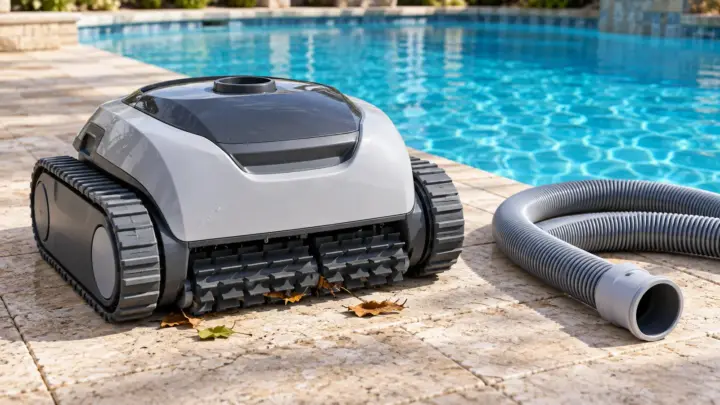
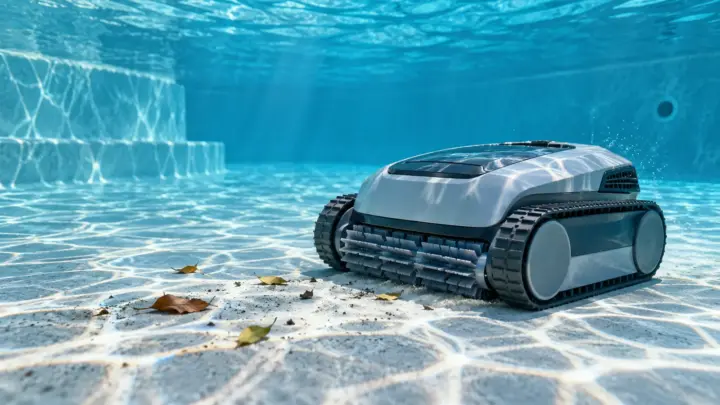
| Robotic | Uses its own drive and onboard collection system | Basket capacity, filter options and documented pool coverage |
Treat those categories as a starting point, then check the specific model before you buy. Read a candidate’s manual and compatible accessories list. Do not assume that adding a fine filter, removing an inlet piece or increasing flow is permitted on an unfamiliar cleaner.
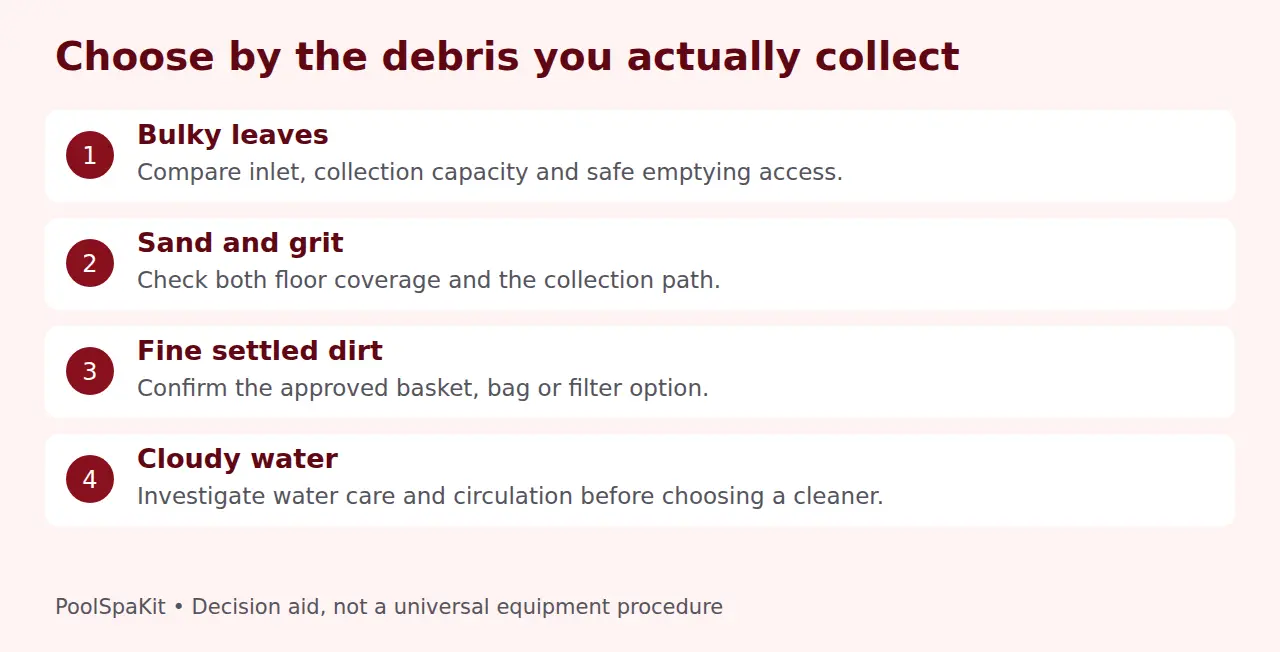
Leaves: start with capacity and blockage risk
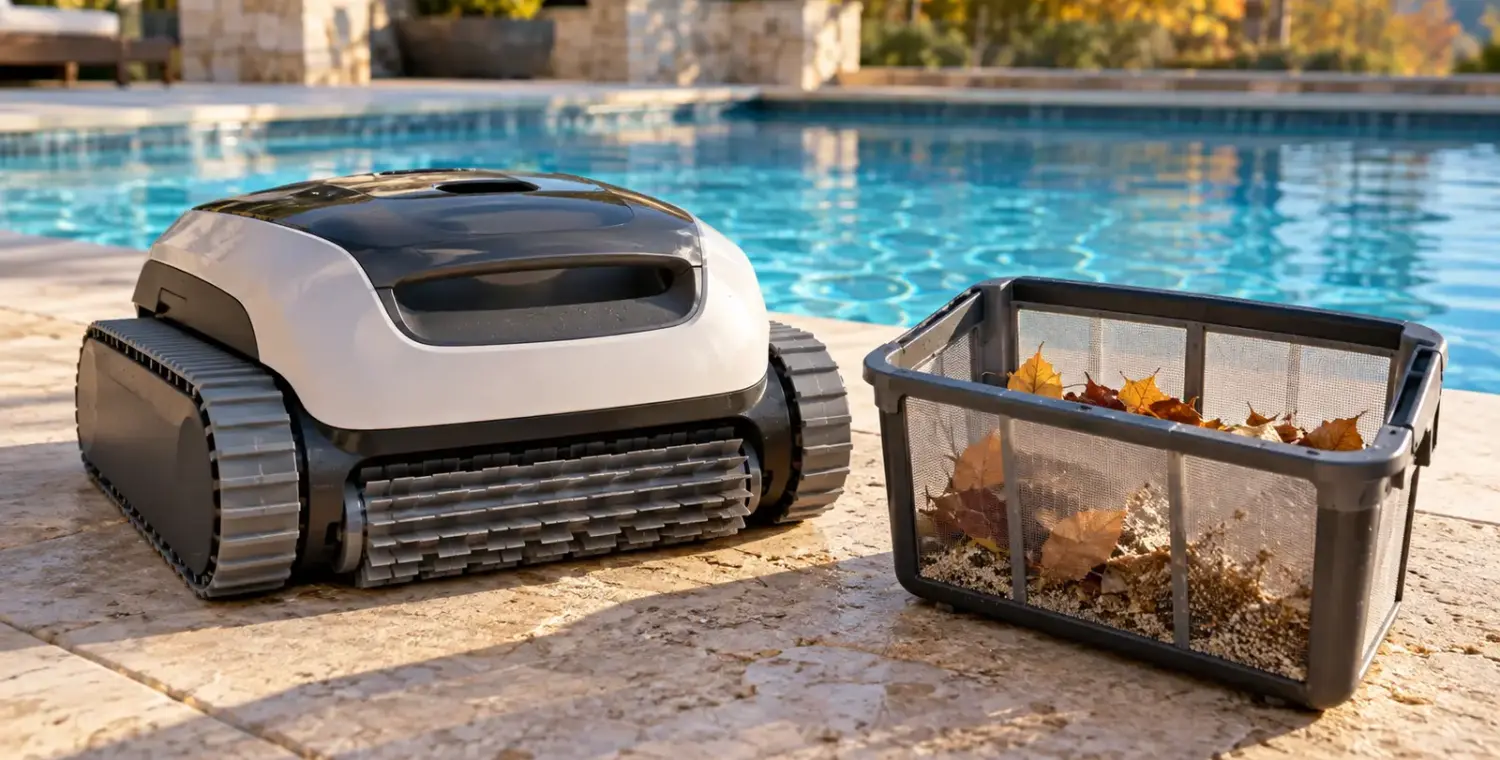
Large leaves make the collection opening and container useful comparison points. Ask what happens when the basket or bag is full, how easy it is to empty, and which restrictions the manual places on oversized debris. Before any machine runs through a heavy pile, use appropriate manual removal to reduce the load.
A pressure-side model with an onboard bag can be worth considering where its supply requirements already suit the installation. Polaris’s Vac-Sweep 280 is a documented example with a bag and a required booster pump. That does not mean all pressure cleaners need a booster, or that an existing return fitting can safely supply one. Confirm the full installation before purchase.
A robotic cleaner may also suit recurring leaves if its inlet and basket match the job. Check the removal routine: an easy-to-access basket is valuable only if you can safely retrieve and empty the cleaner when needed. Compare practical access, not a broad promise about debris of every size.
Suction cleaners should not be dismissed as a group. Zodiac’s MX8 manual, for example, describes different debris modes and an optional inline leaf canister. It also stresses keeping the pump basket clear. Those are model-specific choices, not permission to improvise modifications or connect any aftermarket container.
Sand and grit: collection and coverage both matter
For settled grit, the cleaner needs to reach the area and retain what it collects. Ask whether its basket or bag is intended for that material. A machine can move normally yet leave grit behind because the collection setup does not match the task.
For a suction cleaner or hose-connected manual vacuum, understand where the particles go. The main pool filter and any approved upstream collection accessories are part of the result. Do not treat the moving head as a complete independent filtration system.
For a robot, check the installed filter rather than assuming that a supplied large-debris basket handles fine material equally well. Pentair’s Prowler 920 documentation distinguishes large- and fine-debris filters. This discontinued model illustrates why filter options must be checked individually; it is not a current buying recommendation.
Manual vacuuming offers direct control over a small grit patch, provided visibility, access and a compatible head allow safe work from the deck. Move according to the head’s instructions instead of rushing. Pentair’s ProVac II manual specifically describes slow movement; other equipment may have different directions.
Fine debris is not the same as cloudy water
A visible layer on the floor is a cleaning target. Cloudiness throughout the water needs a wider diagnosis. Water balance, sanitizer, circulation and filtration can all matter. Choosing the finest advertised robot filter is not a substitute for determining the cause.
Avoid treating an exact micron figure as a universal ranking. Test methods, media condition, flow and the particles involved can differ, and this guide has not independently tested capture efficiency. Compare documented filter options and maintenance requirements without inventing numerical performance.
If particles appear to come back immediately, note whether you see material bypassing the cleaner, being stirred into suspension, or emerging from a return. Those observations support different investigations. Use our cloudy pool water guide rather than buying equipment to solve an unidentified chemistry or circulation problem.
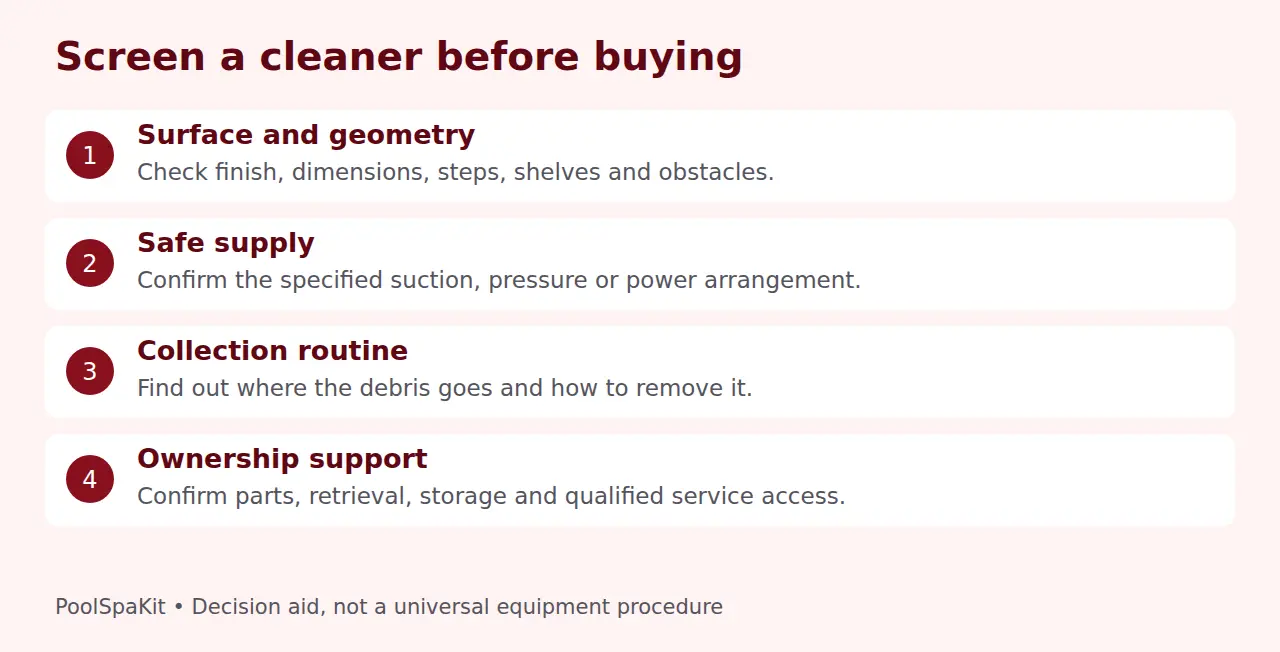
Pool shape and existing equipment can rule out a choice
Write down the surface, dimensions, depth changes, steps and shelves. Ask which parts the cleaner is documented to reach and which need brushing or manual attention. Automatic movement is not proof of complete coverage, especially around obstacles.
A suction cleaner depends on appropriate system flow. A pressure-side choice depends on its own specified supply. A robot depends on supported dimensions, power arrangements and operating conditions. The purchase is unsuitable if those requirements cannot be met safely, regardless of the debris comparison.
Do not increase pump speed indiscriminately or change valves to force a cleaner to work. Preserve the limits of connected equipment and protective devices. The pool pump flow and sizing guide explains why required flow must be considered alongside equipment limits.
For a cover or complicated ladder arrangement, ask how hoses and cables will be routed during operation. Remove or reposition only what the pool and cleaner manufacturers permit. Do not make an unsafe access route part of the regular cleanup routine.
Compare upkeep and total ownership work
Every cleaner produces a cleanup task: a basket to empty, a bag to rinse, a hose to inspect or a pool filter that receives collected material. Ask where the mess ends up and how often you will need to stop when the load is heavy.
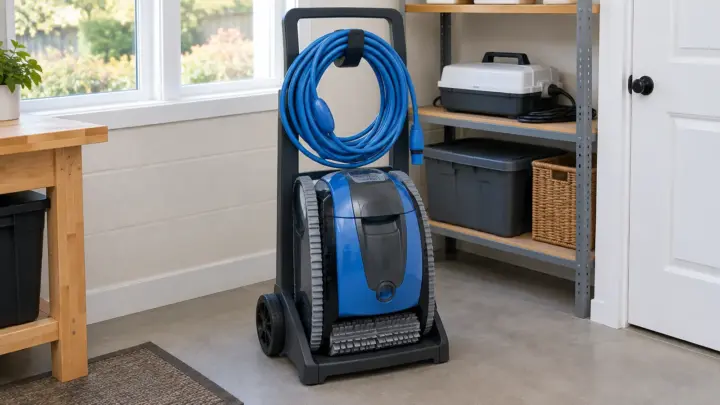
Include setup, retrieval and storage in your comparison. A robot reduces steering but still needs attention. A manual head may be easy to store but asks you to direct the entire pass. A suction or pressure cleaner can add hose-management and flow-check responsibilities.
Look for replacement filters, bags, brushes and permitted hoses before committing. Get model-specific service and warranty information without treating warranty length as a lifespan forecast. If ownership cost is important, compare actual quotes and your current routine rather than unsupported savings percentages.
A practical selection process
- Record the debris and the locations you need cleaned.
- Remove unsuitable categories based on surface, dimensions and safe supply requirements.
- Compare documented inlet, collection options and coverage for the remaining candidates.
- Check retrieval, cleanup, parts and service access.
- Ask for confirmation of any uncertain compatibility before buying.
For a mostly clean pool with occasional dirty corners, targeted manual work may be the simplest purchase. For recurring whole-floor debris, automation may reduce operator time. For heavy leaves, prioritize manageable collection capacity; for fine settled dirt, prioritize suitable filtration and coverage. These are decision priorities, not guarantees that one category will outperform another.
Safety and questions worth asking
Use only approved electrical and hydraulic arrangements. Hayward’s robotic instructions require GFCI protection, no extension cord, disconnection before inspection and removal before swimming. CPSC also identifies electrical hazards around pools. Leave wiring, unexplained trips and unsuitable outlets to a qualified electrician.
Keep your body away from suction openings and isolate equipment before permitted blockage checks. Never bypass protection or open a pressurized filter to improve cleaner flow. Ask a professional when plumbing compatibility or safe servicing is unclear.
Can one cleaner handle leaves and fine dirt?
Some models provide different collection options. Confirm which media and inlet configurations are permitted and what cleanup each requires. A changeable filter does not establish a tested result for every kind of debris.
Do I still need a brush and net?
Often they remain useful for floating debris, inaccessible surfaces and preparation before a heavy cleanup. Keep those tasks within the overall maintenance routine; selecting a cleaner does not eliminate testing or every manual task.
Research checked October 1, 2026. We only claim hands-on testing when we’ve actually tested the product ourselves.
Sources and references
- CDC: Home Pool and Hot Tub Water Treatment and Testing
- CPSC: Electrical safety around pools
- Pentair: ProVac II User’s Guide
- Pentair: Prowler 920 product documentation
- Hayward: Robotic Cleaner Safety Instructions, 8180000 Rev 01
- Polaris: Vac-Sweep 280 pressure-side cleaner documentation
- Zodiac: MX8 Owner’s Manual