Choose a pool cover by its purpose first. A solar blanket mainly helps manage evaporation and warmth. A winter cover is intended for seasonal closure. A safety cover is a documented, properly installed barrier system. An automatic cover describes how the cover moves, and may also serve other purposes when its design and installation support them.
These labels are not interchangeable. A cover that keeps leaves out is not necessarily a safety cover, and a floating bubble blanket is not a substitute for winter protection. Start with the problem you need to solve, then check the exact product’s requirements for your pool, climate and daily routine.
Three questions explain most cover differences
Ask what the cover is intended to do, what it is made of and how it is secured or operated. Purpose might be heat retention, seasonal debris control or restricting access. Fabric might be solid, mesh or bubble material. Operation might be manual handling, anchored installation or a powered track system.
A mesh safety cover can also be used during winter. A solid automatic safety-cover system can also reduce evaporation while closed. That overlap is useful, but it should be documented rather than inferred from a seller’s broad description. Look at the supplied instructions and safety labeling, not only a product photograph.
| Type | Main reason to consider it | Critical limitation |
|---|---|---|
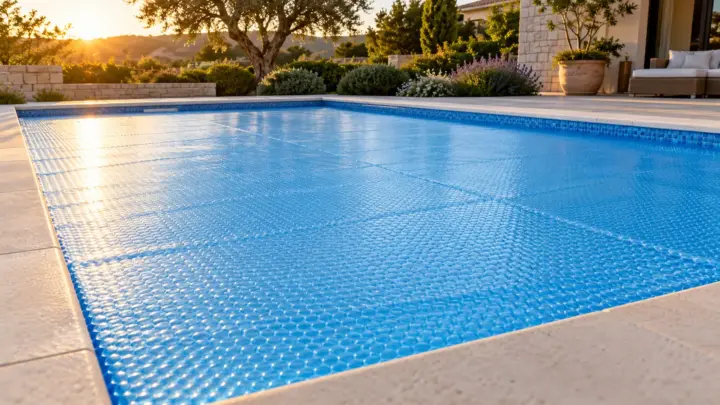
| Floating solar blanket | Manage evaporation and retain warmth during use season | Not a safety barrier; remove completely before swimming |
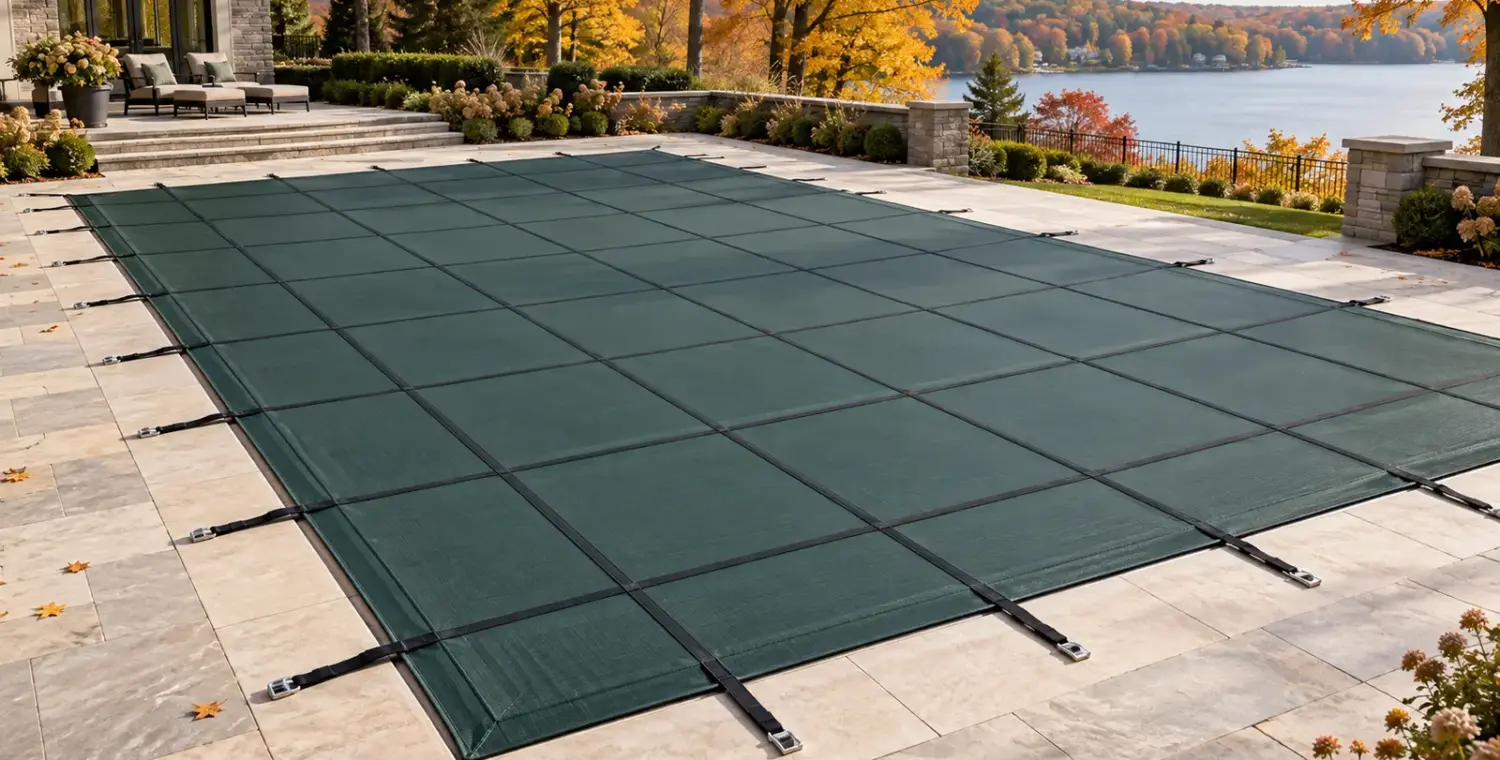
| Anchored safety cover | Documented access protection when properly installed and secured | Fit, condition, anchors and drainage matter |
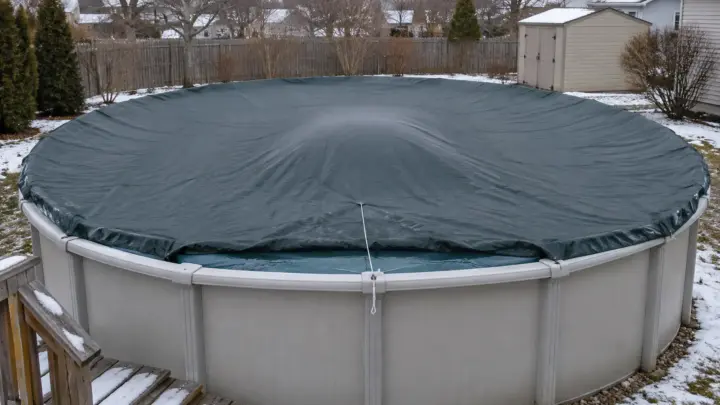
| Standard winter cover | Seasonal protection and debris management | Do not assume it is rated as a safety cover |
| Automatic cover | Powered covering/uncovering for frequent use | Installation, trained operation and maintenance remain necessary |
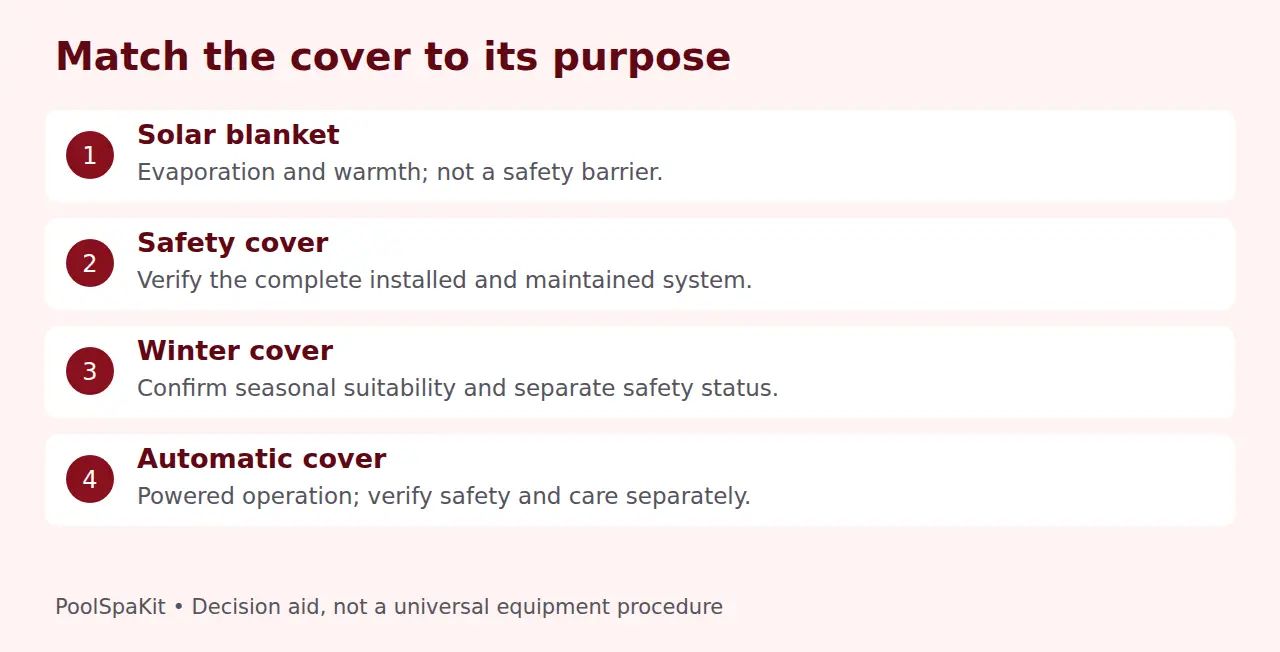
Solar covers: useful for warmth, not access protection
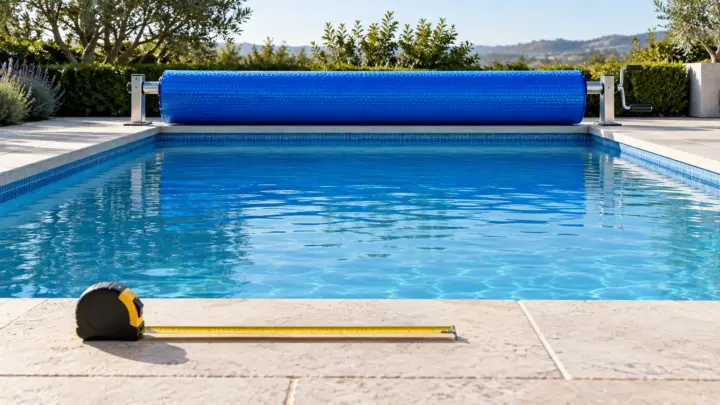
Solar or bubble covers float on the water. EPA identifies them as evaporation-control options and distinguishes them from safety covers. Their practical value depends partly on whether you can put them on and remove them consistently.
Before buying, think through the whole handling task. Where will the wet blanket go? Can you remove it without dragging it over sharp coping? Does the pool shape permit a compatible reel? A lightweight-looking sheet can still be awkward across a wide pool, especially when working alone.
The Blue Wave instructions reviewed here say the blanket is not a safety device, must be completely removed before swimming and is not a winter cover. They also specify protection from sun while stored off the pool. Use your blanket’s own directions for orientation, trimming and care.
Do not buy a solar cover on the promise of an exact temperature gain. Weather, exposure and use pattern change the outcome. Decide whether regular heat-retention use suits your routine, and keep access barriers in place regardless of whether a blanket is floating on the water.
Safety covers: the installed system matters
A safety-cover claim involves more than strong fabric. CPSC’s residential barrier guidance references ASTM F1346 for power safety covers and recommends maintaining covers and other barriers. Ask the manufacturer or installer for documentation applicable to the actual product and installation.
Check how the design handles the complete perimeter, steps, raised walls and other obstructions. A gap at an unusual feature is not solved by ordering a larger generic rectangle. LOOP-LOC specifically ties safety performance to accurate fitting and professional measurement and installation.
Keep children and pets off every cover. A documented emergency-support function is not permission to walk, play or clean from on top. Keep supervision, gates and other required barriers part of the safety plan. Ask your local building department about applicable rules rather than assuming that a cover removes a fencing requirement.
For an existing cover, find its identity and service history before relying on it. Torn fabric, damaged attachments or uncertain fit should be assessed by the manufacturer or qualified installer. A convenient repair patch is not automatic confirmation that the whole system meets its intended safety performance.
Winter covers: compare drainage and seasonal handling
A winter cover is selected for the closure period. Some are documented safety covers; others are ordinary seasonal covers. Confirm which you are ordering. The word winter describes the use season, not a verified access-protection rating.
Mesh lets water pass through according to its design, while a solid cover needs its specified way to manage collected water. Some solid safety covers include drainage panels; others rely on a supplied pump. LOOP-LOC describes both arrangements. The material name alone does not establish the maintenance task.
Consider who will inspect the pool after rain, snow or strong wind. If the house is vacant during winter, a plan for checks and qualified help matters more than a claim that a cover is maintenance-free. Ask about permitted debris removal and what conditions require service.
For above-ground pools, verify that the cover and attachment method suit that construction. Do not transfer an inground anchoring arrangement to an unsupported rim or deck. Our above-ground pool winterization guide covers the wider seasonal process; installing a cover does not finish equipment winterization.
Automatic covers: convenient operation adds responsibilities
A powered cover can make frequent use more practical, but the motor does not make the pool self-supervising. Confirm documented safety performance separately from the opening mechanism. Get an installer demonstration and the exact operating manual.
Cover-Pools’ T4 manual calls for trained operation, secure control-key storage, a clear view during operation and full removal before bathers enter. It warns about standing water and improper securing. These are owner responsibilities, not optional extras because the cover moves at the turn of a key.
Ask what upkeep is expected for fabric, tracks, drainage and the collection pump. Leave electrical components and uncertain mechanical adjustments to authorized or qualified service. Never bypass a stop or safety device to make a reluctant cover close.
Check the practical layout before comparing prices. Track location, housing access, deck use and pool geometry affect the installation. Get an actual quote that describes the complete system and service expectations; this guide does not invent a universal installed price or annual operating cost.
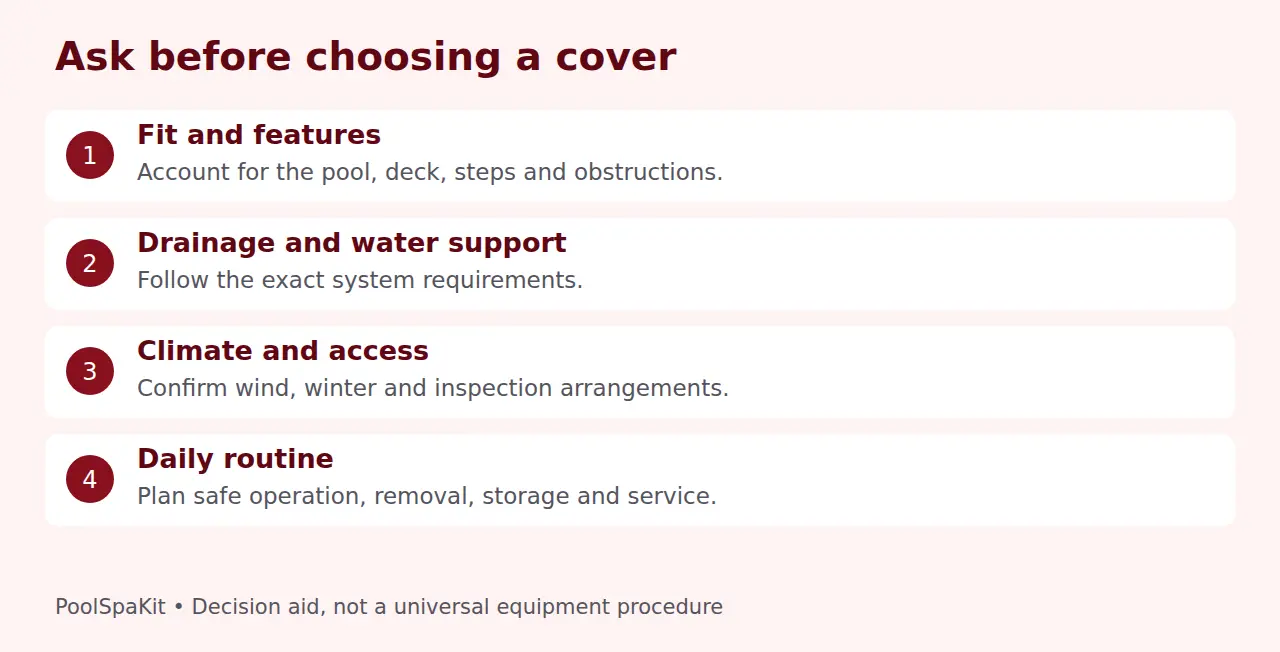
Climate changes the requirements, not the safety boundary
In a windy setting, ask about approved securing and operating limits. In a rainy location, ask how standing water is managed. In a snowy climate, confirm the cover’s snow and ice instructions and the required water support underneath. Do not convert an ordinary blanket into a winter system with improvised weights.
Water-level guidance can differ markedly. LOOP-LOC’s winter cover advice and the Cover-Pools T4 normal-level requirement address different designs. There is no safe universal instruction to drain every pool a fixed distance before covering it. Match the pool, cover and winterization plan together.
If those requirements appear to conflict, ask the cover manufacturer and pool professional to resolve them before lowering water. Avoid emptying a pool or removing supporting water to relieve a cover load without an approved plan.
Climate also affects use convenience. A cover you can safely manage after a routine swim is more likely to be used than one that requires an unrealistic storage or lifting arrangement. Treat ease of use as a household-specific decision rather than a promise about all manual or powered covers.
Compare ownership work before buying
- List the main goal: warmth, seasonal debris control, documented access protection or frequent operation.
- Record the pool’s shape, construction, surrounding deck and unusual features.
- Obtain the candidate’s safety documentation and model instructions.
- Confirm drainage, water-level, weather and chemical-exposure requirements.
- Plan removal, storage, inspection and service access.
- Compare complete quotes and warranty conditions.
Ask who will perform each task and what tools or approved accessories are needed. Include cover-pump care, safe storage and inspection. A warranty term is not a lifespan prediction, and a higher purchase price does not prove lower total ownership work.
Keep water care active while the pool is covered. Check readings through a safe access procedure and follow the product labels and cover instructions around chemical additions. Use the pool water testing guide rather than assuming reduced debris means acceptable chemistry.
Questions owners often ask
Can one cover serve summer and winter?
Sometimes, if the manufacturer supports both uses for your installation. Confirm winter water support, drainage and weather limits. A summer solar blanket should not be treated as a winter cover when its instructions exclude that use.
Is a mesh cover automatically a safety cover?
No. Mesh describes material and drainage. Verify the particular cover’s documented safety performance, fitting and attachment requirements. Likewise, solid fabric or automatic operation alone does not establish safety status.
Does a cover eliminate spring cleaning?
No guarantee follows from cover type alone. Debris handling, drainage and water care still influence opening conditions. Follow the spring opening checklist when the season changes.
Research checked October 1, 2026. We only claim hands-on testing when we’ve actually tested the product ourselves.