Pool water that burns your eyes or smells strongly of “chlorine” usually has too many chloramines, not too much chlorine. Chloramines form when chlorine reacts with sweat, dirt and pee, and that reaction also uses up the chlorine meant to kill germs.
The fix is to test combined chlorine. If it’s above 0.4 ppm, the limit most health departments use, raise free chlorine to 10 times that number to burn the chloramines off. pH outside 7.0–7.8 stings eyes too, so test it at the same time.
The smell is the giveaway. CDC says that if you smell “chlorine” where you swim, you are probably smelling chloramines. A strong smell is a reason to test, not proof that chlorine is high.
Check these in order
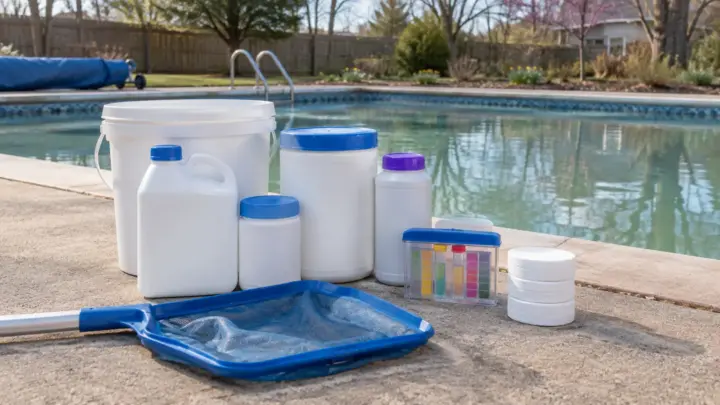
- Combined chlorine. Test free and total chlorine with a DPD kit. Combined chlorine = total chlorine − free chlorine. For example, total 2.8 − free 2.2 = 0.6 ppm combined. PHTA’s ideal is 0, with 0.2 ppm the maximum for pools. CDC says most health departments allow no more than 0.4 ppm.
- pH. Aim for 7.4–7.6 (PHTA ideal). CDC’s acceptable range is 7.0–7.8 and warns that pH outside it can cause skin and eye irritation. See how to correct pool pH.
- Free chlorine. CDC gives a typical range of 1–4 ppm. A reading well above that is a different problem; see pool chlorine too high.
How to clear chloramines
CDC’s method is to superchlorinate: raise free chlorine to 10 times the combined chlorine level. With 0.6 ppm combined, that means taking free chlorine to 6 ppm. Run the pump, retest combined chlorine the next day, and repeat if it is still above 0.4 ppm. Keep swimmers out until free chlorine has dropped back to the normal 1–4 ppm range. Our pool shock guide covers dosing.
Smell and stinging around the pool, not just in it
Chloramines in the water turn into gas, which CDC says is more common in indoor pools because they are often less well ventilated. Off-gassed chloramines are heavier than air and settle on top of the water’s surface, right where swimmers breathe, and they build up without proper ventilation. Anyone nearby, swimmer or not, can get nasal irritation, coughing or wheezing, and asthma attacks can be triggered in people with asthma.
Superchlorination increases off-gassing of chloramines, so make sure the area is well ventilated while you treat. In a pool room or enclosure, open doors or run the exhaust fan.
Stop them forming
- Shower for at least 1 minute before swimming. CDC notes a one-minute rinse removes most of the dirt on your body.
- Use the toilet before getting in, and take kids on regular bathroom breaks.
- Test combined chlorine weekly in a busy pool, and again after a party.
When it’s your eyes, not the water
Get out of water that stings. Take out contact lenses before you swim; the National Eye Institute says to keep contacts away from all water. Contact an ophthalmologist immediately if you have moderate to severe eye pain, blurred vision, increased sensitivity to light, intense redness, or symptoms that get worse instead of better. AAO says those signs may signal something more serious.
For the full testing routine, see the pool water testing guide.
Sources
- CDC: Preventing Eye Irritation from Pool Chemicals
- CDC: Chloramines and Pool Operation
- CDC: What You Can Do to Stay Healthy in Swimming Pools
- Pool & Hot Tub Alliance (PHTA), published by Taylor Technologies: Recommended Water Chemistry Parameters
- American Academy of Ophthalmology: Conjunctivitis: What Is Pink Eye?
- National Eye Institute (NIH): Contact Lenses
Research checked 2026-10-08.