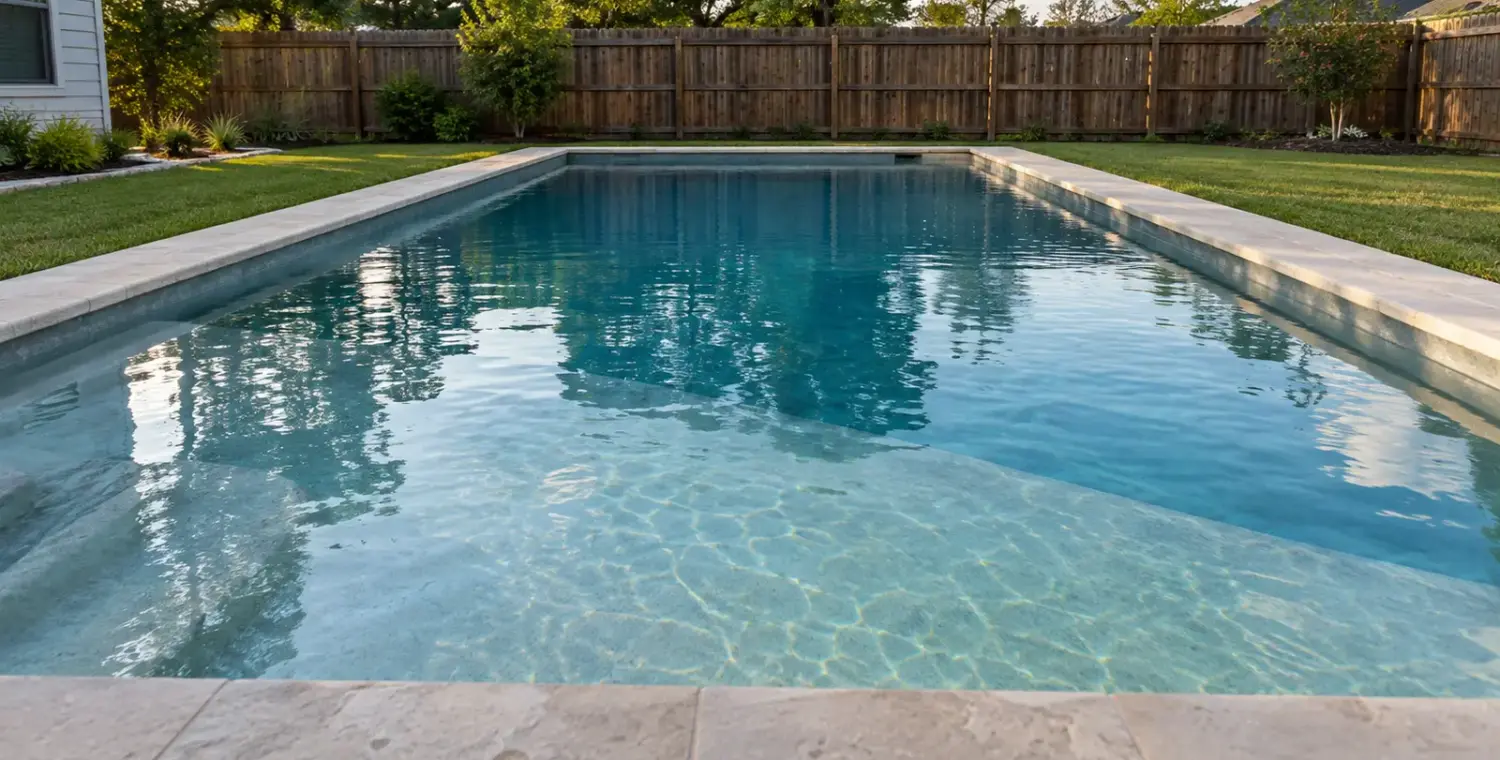
To calculate pool volume, multiply length × width × average depth in feet, then × 7.5. That gives US gallons for a rectangular pool. In metres, multiply length × width × average depth by 1,000 to get litres. Other shapes use a different last number: 5.9 for a round pool (diameter × diameter × average depth), 6.7 for an oval and 7.0 for a kidney shape.
| Shape | US gallons (measure in feet) | Litres (measure in metres) |
|---|---|---|
| Rectangle or square | length × width × average depth × 7.5 | length × width × average depth × 1,000 |
| Round | diameter × diameter × average depth × 5.9 | diameter × diameter × average depth × 785 |
| Oval | length × width × average depth × 6.7 | length × width × average depth × 893 |
| Kidney | length × width × average depth × 7.0 | convert the gallons: × 3.785 |
The factors are Pentair’s and Hayward’s published ones. For the kidney shape, Pentair gives only the gallons factor. Treat every result as an estimate of a simple shape.
Step 1: find the average depth
Add the shallow-end depth and the deep-end depth, then divide by two. Pentair’s example is a pool 3 ft deep at one end and 8 ft at the other: the depths total 11 ft, so the average is 5.5 ft. Measure the water depth, not the wall height.
A simple average suits a floor that slopes steadily. If the pool has a long flat shallow shelf, a sudden drop-off, steps or benches, Hayward’s advice is to break the pool into sections, work out each one, and add them up.
Worked examples
- Rectangle (Pentair’s example): 40 ft × 20 ft, average depth 5.5 ft. Area 800 sq ft × 5.5 = 4,400 cubic feet; 4,400 × 7.5 = 33,000 gallons.
- Round (Pentair’s example): 24 ft across, average depth 3.5 ft. 24 × 24 × 3.5 × 5.9 = 11,894 gallons.
- Metric: 10 m × 5 m, 1 m deep to 2 m deep. Average depth 1.5 m. 10 × 5 × 1.5 × 1,000 = 75,000 litres.
US gallons, imperial gallons and litres
The same water is a different number in each unit, and an imperial gallon is about 20% bigger than a US gallon. NIST’s conversion factors are 1 US gallon = 3.785 litres and 1 imperial gallon (the Canadian and U.K. gallon) = 4.546 litres. Pentair’s table gives 1 cubic metre as 264.2 US gallons or 220.0 imperial gallons.
Take the metric example: 75,000 litres is about 19,813 US gallons, or about 16,498 imperial gallons. Check which unit a chemical label, calculator or equipment manual uses before you dose from it.
How exact is the 7.5?
A cubic foot holds about 7.48 US gallons, so 7.5 slightly overstates the volume. For a 32 ft × 16 ft pool averaging 5 ft deep, the 7.5 rule gives 19,200 gallons and the exact figure is 19,150 gallons, a difference of about 0.3%. For a round pool of 24 ft and 3.5 ft average depth the exact calculation gives 11,846 gallons against Pentair’s 11,894.
What to use the number for
- Chemical doses, such as the calcium hardness and other balance corrections in the pool water chemistry guide.
- Pump flow and turnover time; see pool pump sizing.
- Heating time; see how long it takes to heat a pool.
To skip the arithmetic, the pool volume calculator does the same sum: the calculator is for simple shapes and uses average depth.
Sources
- Pentair: 2025–2026 Pool Product Catalog: Engineering Data (estimating gallons in a pool)
- Hayward: Chemistry Quick Start Guide (Step 1: Calculate Pool Volume)
- NIST: Guide for the Use of the International System of Units (SP 811), Appendix B: conversion factors
Research checked 2026-10-08.