To raise calcium hardness by 10 ppm, add 1.2 lb of calcium chloride (77%) per 10,000 gallons. That is Hayward’s figure, and the chemistry gives the same answer. Anhydrous calcium chloride (100% strength) is stronger, so you need about 0.93 lb for the same rise.
Pools aim for 200–400 ppm. That is the ideal range from the Pool & Hot Tub Alliance (PHTA), which lists 150 ppm as the minimum and 1,000 ppm as the maximum for pools. Hayward gives the same 200–400 ppm. Spas are lower: PHTA’s ideal for spas is 150–250 ppm.
How much calcium chloride for your pool
Pounds of 77% calcium chloride, from Hayward’s Table 5:
| Raise hardness by | 10,000 gal | 15,000 gal | 20,000 gal | 25,000 gal |
|---|---|---|---|---|
| 10 ppm | 1.2 | 1.8 | 2.4 | 3 |
| 20 ppm | 2.4 | 3.6 | 4.8 | 6 |
| 30 ppm | 3.6 | 5.4 | 7.2 | 9 |
| 50 ppm | 6.0 | 9 | 12.0 | 15 |
| 100 ppm | 12 | 18 | 24 | 30 |
For any pool: pounds = (gallons ÷ 10,000) × (ppm increase ÷ 10) × 1.2 for 77% calcium chloride, or × 0.93 for 100% anhydrous. Check the bag: Taylor says two forms are sold, hydrated (77% strength) and anhydrous (100% strength).
Worked example. A 20,000-gallon pool reads 150 ppm and you want 250 ppm, a rise of 100 ppm. That takes 24 lb of 77% calcium chloride, or 18.5 lb of 100% anhydrous. Need the volume? Work out your pool volume, or use the pool volume calculator; its estimates are for simple shapes, so use average depth.
How to add it safely
- Test first and confirm the volume. If a large rise is needed, add about half, let the water circulate, and retest before adding the rest.
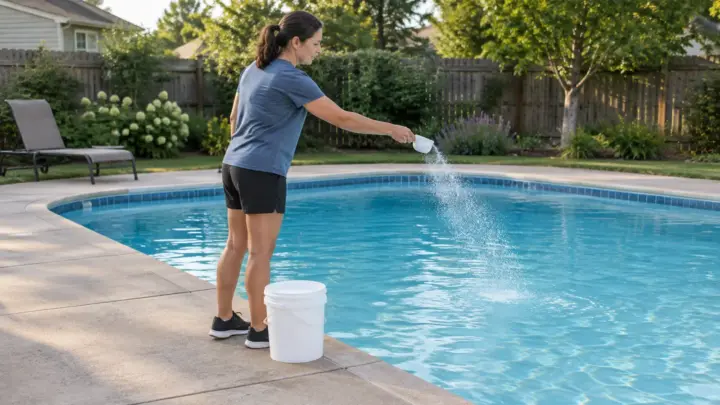
- Watch the heat. Taylor says each form will generate heat when contact with water is made, so you are generally instructed NOT to pre-dissolve the calcium chloride in a bucket, but to broadcast it over the water’s surface with the pump running. If your product label gives a different method, use the label.
- Keep it apart from alkalinity and pH products. Taylor says adding calcium chloride in the hours before or after treating with soda ash or baking soda will result in cloudy water. Do those adjustments on different days.
- One product at a time. CDC warns that pool chemicals can injure people when mixed together or when appropriate personal protective equipment is not used.
Two common mistakes
- Using it as pool salt. In a saltwater pool, calcium chloride is not a substitute for sodium chloride. Pentair’s IntelliChlor manual says DO NOT use calcium chloride, sodium bromide, or potassium chloride in the pool as salt, because they can scale the cell. See how much salt to add to a saltwater pool.
- Raising hardness that is already high. Calcium chloride only goes up. To lower hardness, Taylor says you can partially drain the pool or spa and refill it with lower-hardness water. Scale and white flakes are covered in white flakes in pool water.
PHTA notes that its ranges do not supersede product label directions or local or state codes and regulations. For what calcium hardness does and how to test it, read calcium hardness in pool water, and for the full routine, the pool water chemistry guide.
Sources
- Hayward: Chemistry Quick Start Guide (Table 5: calcium chloride 77% to increase calcium hardness)
- Pool & Hot Tub Alliance (PHTA), published by Taylor Technologies: Recommended Water Chemistry Parameters
- Taylor Technologies: Understanding and Managing Calcium Hardness in Pool & Spa Water
- Pentair: IntelliChlor Plus and IntelliChlor LT Installation and User’s Guide
- CDC: Pool Chemical Safety
Research checked 2026-10-12.