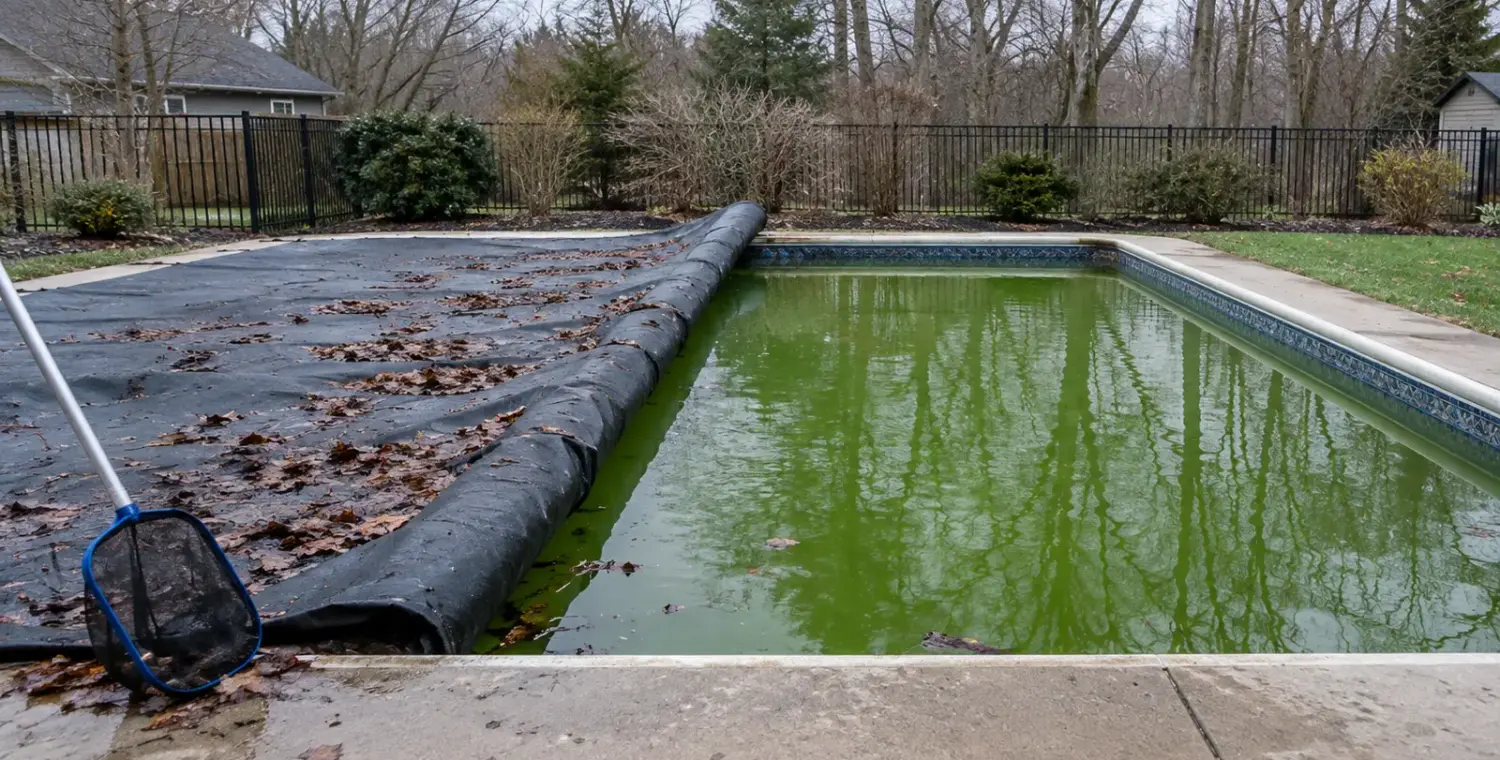
Don’t drain it. A pool that turns green under the winter cover can almost always be fixed in place. Work in this order: take the cover off, net out the debris, get the pump and filter running safely, brush, balance stabilizer, alkalinity and pH, then shock and keep the filter running until the water clears. Hayward’s spring-opening guide says outright that you don’t need to empty the pool. Pentair’s restart guide follows the same order.
Why the pool turned green over winter
Most of the time it comes down to timing. Hayward says green water at opening usually means the pool was reopened a little late: once spring sun warms a pool that is still winterized, algae start to spread. Pentair puts a number on it. It recommends restarting by the time the water reaches 12–15 °C (the mid-50s °F) at the latest, because that is when algae start growing if no treatment is running.
Intex adds that algae grow fastest in warm, stagnant water. They usually show up when filtration, water balance or chlorine has slipped. A closed pool has all three problems at once. Our reasoning: the winterizing chemicals ran out while the water was warm and nothing was circulating. That’s why the fix is circulation and sanitizer, and draining doesn’t solve it. Pentair also notes that in a covered, winterized pool the water may be green, but the winterizing product kept the number of micro-organisms down. You are starting from a manageable point.
What to do first, in order
- Remove the cover. Pentair lists this as step one. Then remove any winterizing floats, caps and plugs.
- Net out the big debris. Use a leaf net to lift leaves and sludge. Hayward advises against running your automatic pool cleaner at this stage because it can be damaged. Pentair says the same about robots: one will clog almost immediately.
- Get the water moving again. Pentair’s filter safety page says to make sure the return valves are open and all winterizing plugs are out of the returns. Reconnect the equipment and open the valves. Fill the pump’s strainer pot with water before you start the pump, and never let the pump run dry. Pentair warns this risks permanent damage to the shaft seal. Open the filter’s air relief valve while the system fills, and close it once water comes out. If your filter sits below the pool’s water level, Pentair says to close that valve again before water starts leaking out of it while the lines fill.
- Brush the walls and floor. Hayward says to brush by hand to loosen the remaining algae.
- Test and balance before you shock. Hayward’s order is stabilizer (CYA) first, then alkalinity, then pH. Hayward treats a stabilizer reading above 50 as high and calls around 20 correct. If yours is high, Hayward suggests replacing part of the water with fresh mains water. Our guide to cyanuric acid in pools explains why high CYA slows chlorine down. Pentair’s restart guide then says to set total alkalinity to 80–120 ppm and pH to 7.2. For the adjustments, see how to correct pool pH safely.
- Shock with chlorine. Hayward says chlorine shock is the fix whether you use chlorine or a salt chlorinator, and it works best added in the evening. Your shock product’s label sets the dose per gallon, so you need your pool’s volume before you add anything. The pool volume calculator gives you that figure. When you handle shock or any balancing chemical, follow all directions on the product label, wear gloves and goggles, and keep the containers secure and away from children and pets, as CDC advises.
- Clean the filter, then run it around the clock. Hayward says to clean the filter first, then run it continuously. Pentair says the water turns an off-white, cloudy colour as dead algae is filtered out. Keep filtering until it is clear, then clean the filter again (backwash a sand filter, rinse a cartridge). With a sand filter, Hayward suggests adding a flocculant through the skimmer to speed things up.
- Vacuum by hand while it filters. Pentair recommends a manual vacuum head on the suction line to pick up the settled residue.
- Turn on automation and the salt cell last. Pentair puts chlorine feeders and salt cells at the end of the restart. Intex notes that a heavy algae load uses up a salt system’s chlorine as soon as it is made, so expect to run the system for longer.
Opening the filter safely
Cleaning the filter means opening a tank that has been under pressure. Pentair warns that trapped air can build pressure strong enough to separate the lid from the base, a serious hazard that is especially injurious if you are standing close. For that reason Pentair says you should find a pool professional to handle this service. If you do it yourself, shut off the pump and open the manual air relief valve to release the pressure before servicing, as Pentair’s filter guidance instructs. When you finish, open the manual air relief valve again to let trapped air out before power goes back on. For more detail, see cleaning a cartridge filter without damaging it or when to backwash a sand filter.
The numbers to hit before anyone swims
- Free chlorine: CDC gives a typical range of 1–4 ppm for pools. If your pool uses cyanuric acid, a stabilizer, or stabilized chlorine such as dichlor or trichlor, CDC recommends at least 2 ppm, with pH still at 7.0–7.8. CDC’s published germ-kill times apply only to pools that don’t use cyanuric acid; disinfection takes longer when it is present.
- pH: CDC recommends 7.0–7.8. Pentair’s restart guide targets 7.2.
- Total alkalinity: 80–120 ppm, per Pentair’s restart guide.
Just after a shock, be careful with your test results. CDC notes that chlorine above 10 ppm can bleach a DPD test and show a false low or zero reading. Keep everyone out of the pool until the water is clear and both readings are back in range. Once it is clear, CDC recommends testing chlorine and pH at least twice a day, more often when lots of people are swimming. Our pool testing schedule covers the rest of the season.
If it is still green
Hayward lists other reasons the water can stay green: a filtration problem, scaled piping, high phosphates or a pool that wasn’t cleaned thoroughly. Check the filter first, and go back over the brushing and vacuuming. If you want to add algaecide as a follow-up, read when algaecide helps and when it doesn’t. If the water is still green after all of this, Hayward recommends having a pool specialist assess it. The same goes for a pump that won’t prime or a filter that leaks under pressure.
Next season, our spring opening checklist and list of pool opening chemicals help you open before the water warms up.
Sources
- Hayward: Green water pool – Treat green water after wintering
- Pentair: How to restart your swimming pool after winter
- Intex: General pool water maintenance
- Pentair: Clean & Clear Product Support
- CDC: Guidelines for Keeping Your Pool Safe and Healthy
- CDC: Home Pool and Hot Tub Water Treatment and Testing
Research checked 2026-10-25.