The right pool pump delivers the flow your equipment needs without exceeding the limits of the system. Pool volume matters, but it cannot tell you how much resistance the plumbing creates, what your filter can handle, or whether a heater will operate at your chosen speed.
Start with the operating requirements, then match a pump’s performance curve to the actual installation. A larger horsepower number is not a substitute for that process.
Scope: This guide helps residential pool owners prepare a sizing brief and understand an installer’s recommendation. It is not an engineered hydraulic design or installation manual. Use the exact equipment manuals and applicable local requirements in the US, Canada, UK or Australia.
The short answer: choose a flow range, not just horsepower
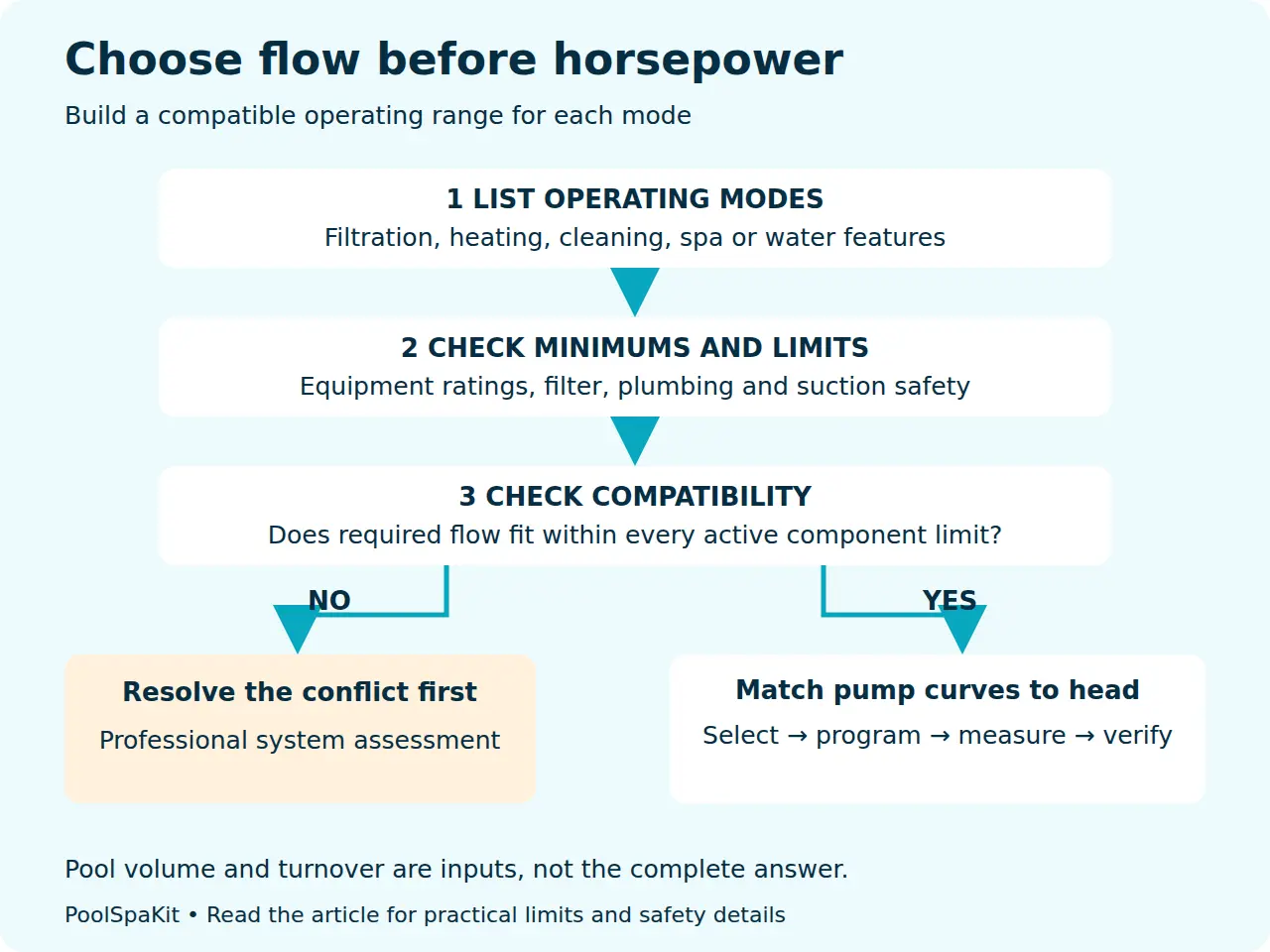
For each operating mode, identify the required flow, the maximum permitted flow through every active component, and the resistance the pump must overcome. A suitable pump must achieve the required operating points within its approved range.
Excess flow can exceed a filter or device rating and use energy for circulation the task does not need. A variable-speed pump with a larger motor can still operate appropriately at a lower setting; its nameplate alone does not prove that it is oversized.
- Required flow: circulation, filtration, skimming and any active heater, sanitizer or cleaner.
- Upper limits: filter ratings, equipment limits, plumbing design and suction-outlet safety.
- Hydraulic resistance: the pipes, fittings, valves and equipment in that mode.
- Verification: measured or appropriately verified flow and satisfactory equipment operation after installation.
Australian government guidance recommends the smallest effective pump and professional advice. ENERGY STAR explains why different pool operations can need different speeds. Neither makes a pump suitable merely because its motor is powerful.
Understand what GPM and turnover actually tell you
GPM means gallons per minute. In this article, gallons are US gallons; do not mix US and Imperial gallons when calculating volume. Manuals elsewhere may use litres per minute or cubic metres per hour. Convert the pool volume and flow into consistent units before comparing them.
A theoretical turnover is the time needed to circulate a volume equal to the pool’s capacity. For steady flow, the arithmetic is:
Flow in GPM = pool volume in US gallons ÷ (assumed turnover hours × 60).
Turnover is a volume calculation, not proof that every part of the pool has been evenly circulated or that the water is sanitary. It does not replace water testing, debris removal or checks for poorly circulated areas.
Example only: calculating a starting point
Assume a pool holds 18,000 US gallons and an owner wants to explore an eight-hour theoretical turnover. The calculation is 18,000 ÷ (8 × 60) = 37.5 GPM.
The volume and eight-hour assumption are invented for this example; eight hours is not presented as a universal residential requirement. The result does not yet select a pump. Actual system hydraulics, equipment ratings, sanitation needs and applicable requirements still matter. If the pool runs at different flows during the day, calculate each period’s circulated volume separately rather than assuming one constant GPM.
Why turnover guidance differs
The US Department of Energy’s Building America resource contains residential replacement guidance with different capacity and operating turnover references. Australia’s consumer guidance gives a broad daily circulation recommendation while directing owners to suppliers for adequate runtime. Southern Nevada Health District lists different maximum turnover times for regulated aquatic venues. For a homeowner-focused way to turn measured flow and equipment needs into a schedule, see how long to run a pool pump each day.
These sources address different situations. A public-pool rule from one jurisdiction should not become a worldwide backyard-pool instruction. Ask your installer which current standard, local requirement or manufacturer recommendation applies to your pool, and why.
List the equipment that needs water flow
Photograph the model plates and obtain the correct manuals before shopping. Make separate rows for ordinary filtration, heating, cleaning, spa operation and water features. Note which devices run together and which are on separate pumps or branches.
| Component | What to check | Why it affects sizing |
|---|---|---|
| Filter | Exact model’s recommended/design flow, maximum limits and cleaning requirements | A pump must not overdrive the filter in any active mode |
| Heater or heat pump | Permitted flow range and approved bypass arrangement | Heating may need more flow than ordinary filtration |
| Salt chlorine generator | Cell flow range, flow-switch requirements and production schedule | Minimum flow alone does not establish adequate daily chlorine production |
| Cleaner | Cleaner manual, flow gauge or adjustment procedure; any booster pump | Cleaner requirements cannot be assumed from pool volume |
| Spa spillover, jets or feature | Feature flow/head requirements, branch layout and valve position | The operating mode may have a different hydraulic demand |
| Skimmers and suction outlets | Ratings, condition and safe configuration | Available suction and entrapment protection constrain the installation |
Read ratings literally. A manufacturer may state a recommended flow rather than an absolute maximum. A maximum pressure rating is also different from a flow rating. Ask the manufacturer or installer to clarify unclear specifications.
For example, Pentair lists different flow ratings for different Clean & Clear Plus filter sizes and cautions that actual flow depends on plumbing and other components. That supports checking the exact model; it does not establish a target for every cartridge filter.
MasterTemp heater documentation gives model-specific minimum flows and a maximum flow with bypass provisions. Do not copy one heater model’s figures to another. A qualified installer should resolve any mismatch between a heater’s needs and the rest of the system. If an existing heater stops heating, our pool heater troubleshooting guide covers safe first checks.
Pentair’s IntelliChlor Plus/LT guidance also states a minimum activation flow and a maximum with bypass guidance. A salt cell’s “flow OK” indication is not a precise flow meter, and cell output and operating duration still need to maintain the required sanitizer residual.
For a suction cleaner, follow its own adjustment method. Pentair’s Rebel manual uses a supplied flow gauge to set an acceptable range. There is no reason to substitute an invented universal cleaner GPM.
Shared flow is not always added together
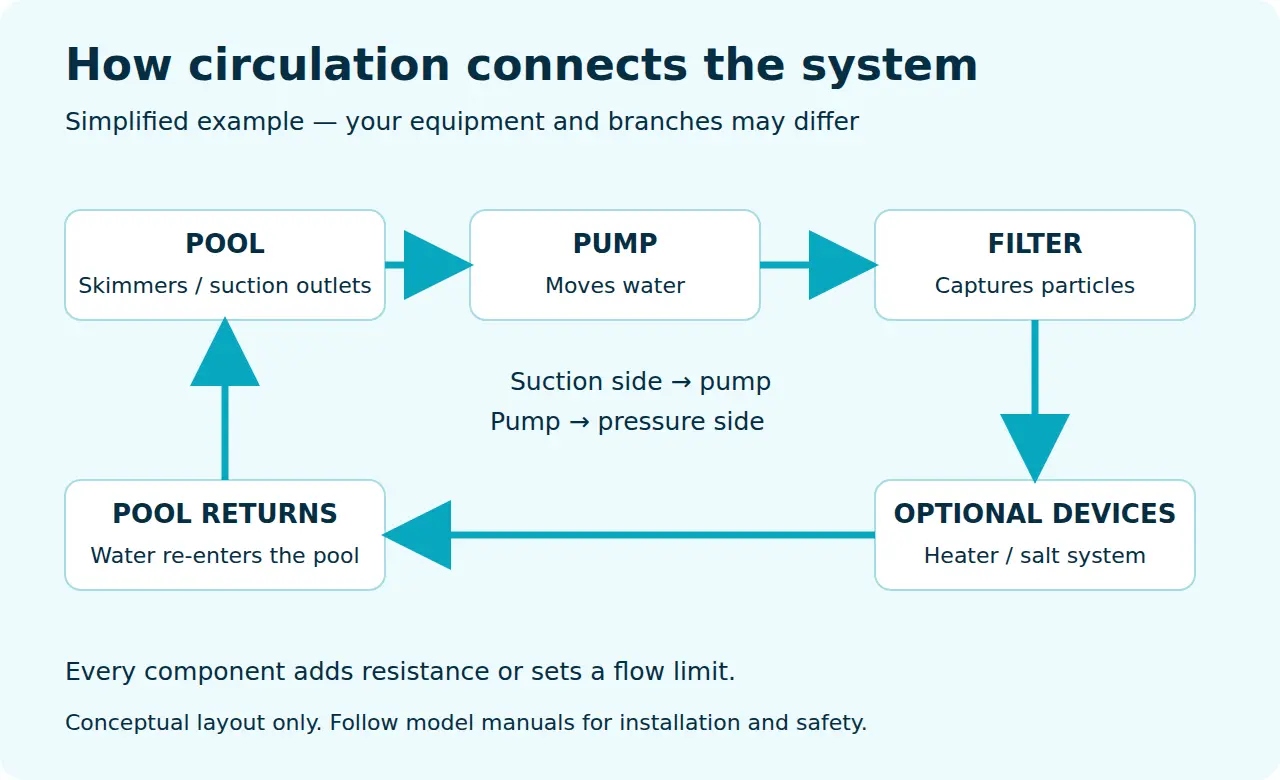
Where components are in series, the same water passes through each: you do not simply add their minimum flows. Their permitted ranges must overlap. Where water splits into branches, flow divides; the installer must account for each branch and the combined demand. A spillover or waterfall can change both the flow needed and the head, including elevation where applicable.
If the requirements conflict, a bigger pump is not the first answer. The arrangement may need an approved bypass, different equipment or a separate pump. Have that assessed before purchase.
Check plumbing diameter, length and fittings
A pump pushes against resistance throughout the circuit. Narrower internal pipe diameter, longer runs and fittings can increase friction losses at a given flow. Valves, elbows, tees, return fittings and equipment all belong in the hydraulic assessment.
Pentair’s pump installation guide recommends short, direct pipe runs and larger plumbing to reduce friction. Enlarging a short section at the equipment pad does not remove a restriction in buried pipe. A pump connection size is not proof that the whole system can carry the pump’s advertised maximum flow.
Ask the installer to identify:
- Suction and return pipe sizes, including narrower sections and flexible hoses.
- Approximate runs, fittings and valve arrangements, with uncertainty noted for buried plumbing.
- Separate skimmer, cleaner, spa and feature branches.
- Flow restrictions and the ratings of suction fittings and covers.
- The hydraulic effect of the proposed replacement equipment.
Do not use a single internet pipe-size-to-GPM table as the complete safety or sizing calculation. Pipe material, internal diameter, branch arrangement, equipment and applicable design rules matter.
Total dynamic head: the resistance at a particular flow
Total dynamic head (TDH) expresses the energy per unit weight the pump must supply, commonly shown as feet or metres of water. For a homeowner, think of it as the system’s hydraulic demand at the flow being considered.
TDH is not a fixed number determined by pool volume. The health district’s hydraulic worksheet requires losses for system components and notes that changing pipe diameter or equipment can change head and pump capability.
A professional can estimate the system’s resistance from its layout and manufacturer loss data, or evaluate operating conditions with suitable instruments. The filter pressure gauge alone does not describe the whole circuit: suction-side conditions also matter. Pentair specifically distinguishes its pump’s TDH monitoring from the filter-gauge reading.
Ask for the assumed head at the intended flow and valve configuration. Do not accept a generic “typical pool head” as a verified measurement of your installation.
How to use a pump performance curve
A pump curve connects flow with head for a particular model and speed. Jandy’s technical documentation, for example, shows flow on the horizontal axis, TDH on the vertical axis and separate curves for different speeds.
- Find the curve for the exact model and intended speed.
- Locate the required flow and estimated system head.
- Check whether that operating point falls within the manufacturer’s permitted operating range.
- Repeat for heating, cleaning, spa or feature modes where the flow or circuit changes.
- Confirm the installed result instead of relying solely on catalogue values.
The actual operating point is where pump capability meets system demand. An advertised maximum flow and maximum head are not a promise that the pump delivers both simultaneously. Likewise, two pumps with the same motor horsepower need not have the same curve.
Choose a model with suitable operating capability and practical allowance for changing filter resistance, without treating “extra capacity” as permission to exceed any component’s limits.
Single-speed and variable-speed sizing implications
A single-speed pump offers less flexibility when filtration and feature demands differ. Two-speed equipment gives another operating option, but both speeds still need checking against the system.
A variable-speed pump lets an installer set suitable operation for different tasks. Select it by the flows it can deliver at the relevant head, then program it for those requirements. Buying the highest maximum horsepower and leaving it at maximum speed defeats the purpose of matching output to demand.
Some pumps offer flow-based control; others are programmed by speed. An RPM setting is not a universal GPM setting because the plumbing and equipment influence the resulting flow. With speed-based control, verify flow using an appropriate method.
The affinity laws explain why reducing speed can substantially reduce power in suitable centrifugal-pump operation. They do not guarantee a particular household saving or remove minimum-flow requirements. Actual performance depends on the pump, system and schedule; no savings percentage is assumed here.
During commissioning, verify ordinary filtration, higher-demand modes and priming. Set manufacturer-supported limits correctly: Pentair’s IntelliFlo3 manual notes that some flow limits apply to flow programs and require an additional setting to cover speed programs. Check your model rather than assuming every mode is protected automatically.
Signs of oversizing or undersizing—and what else to check
Symptoms are clues, not proof of the wrong pump size. Rule out maintenance problems, air leaks, valve errors and damaged equipment before replacing a pump.
| Observation | Possible sizing issue | Check before deciding |
|---|---|---|
| Verified flow exceeds an active component’s rating | Excess capacity or excessive programmed speed | Correct limits, actual ratings and mode settings |
| Strong noise, turbulent returns or high energy use | More speed or flow than the task needs | Measured flow, air entry, mechanical faults and schedule |
| Weak circulation or heater/cleaner malfunction | Required flow is not being delivered | Water level, baskets, filter, valves, leaks and device condition |
| Pump reaches its approved maximum but cannot meet verified demand | Insufficient pump capability at that head | Restrictions, settings, curve and correct flow measurement |
| High filter pressure with poor flow | Not enough information to diagnose size | Dirty filter or downstream restriction before increasing power |
A pump that previously performed adequately and suddenly loses flow needs troubleshooting first. A larger replacement can leave the original fault unresolved.
Prepare a replacement-pump brief
Give prospective installers the information below and ask them to explain their recommendation:
- Pool volume estimate and its calculation method.
- Existing pump model, speed settings and observed operating problems.
- Filter, heater, salt system, cleaner and feature models.
- Available plumbing information and photographs of the pad.
- Required operating modes, including devices that run together.
- Relevant flow limits, suction safety checks and head assumptions.
- Electrical supply, automation compatibility and service access.
- Proposed commissioning measurements and written settings.
Installation, electrical work, bonding, suction-system changes and bypass design belong with suitably qualified professionals. Do not run a pump dry, bypass a flow switch or open pressurized equipment. Isolate power and follow the exact shutdown and pressure-relief procedure before approved maintenance. Keep a pool with missing or damaged suction covers out of use until corrected.
Common sizing mistakes to avoid
- Choosing horsepower from pool volume alone.
- Copying the old pump’s horsepower without comparing curves.
- Treating a theoretical turnover as a complete water-quality plan.
- Using filter maximum flow as the everyday target.
- Adding minimum flows for devices in series.
- Ignoring separate branches, valve modes or buried restrictions.
- Copying another owner’s RPM schedule.
- Increasing speed to compensate for a dirty filter or air leak.
- Buying equipment before checking electrical and automation compatibility.
Frequently asked questions
Can I size a pump from gallons alone?
Gallons provide a starting point for circulation-volume arithmetic. They do not supply the head, component limits or operating modes needed to choose a pump.
Should I buy a bigger pump for future equipment?
Document the proposed equipment and assess its flow and head requirements first. An unspecified future upgrade is not a useful basis for selecting maximum horsepower.
Will a variable-speed pump fix restrictive plumbing?
It offers adjustable operation, but cannot remove a physical restriction. Confirm achievable flow and safe settings; plumbing changes may still be necessary.
Editorial note: Research reviewed September 30, 2026. We only claim hands-on testing when we’ve actually tested the product ourselves.
Sources and references
Consult the exact model manuals for your installation. Historical turnover guidance and public-venue rules are included for context, not as universal residential requirements.
- US Department of Energy / PNNL Building America Solution Center: Variable-Speed Pool Pumps
- US EPA ENERGY STAR: Pool Pumps
- Australian Government: Pool pumps
- Southern Nevada Health District: Hydraulics
- Southern Nevada Health District: Calculation of Total Dynamic Head in Pool and Spa Recirculation Systems
- Pentair: Clean & Clear Plus Cartridge Filter
- Pentair: Clean & Clear Plus Cartridge Filter Installation and User’s Guide
- Pentair: MasterTemp Pool and Spa Heater Installation and User’s Guide
- Pentair: IntelliChlor Plus & LT Salt Chlorine Generators
- Pentair: Rebel Suction-Side Inground Pool Cleaner Installation and User’s Guide
- Jandy / Fluidra: 2023 Product Catalog Addendum: Dual-Voltage Variable-Speed Pumps
- Pentair: IntelliFlo3 VSF / IntelliPro3 VSF Installation and Maintenance Guide
- Pentair: Pump Affinity Laws and Energy Savings