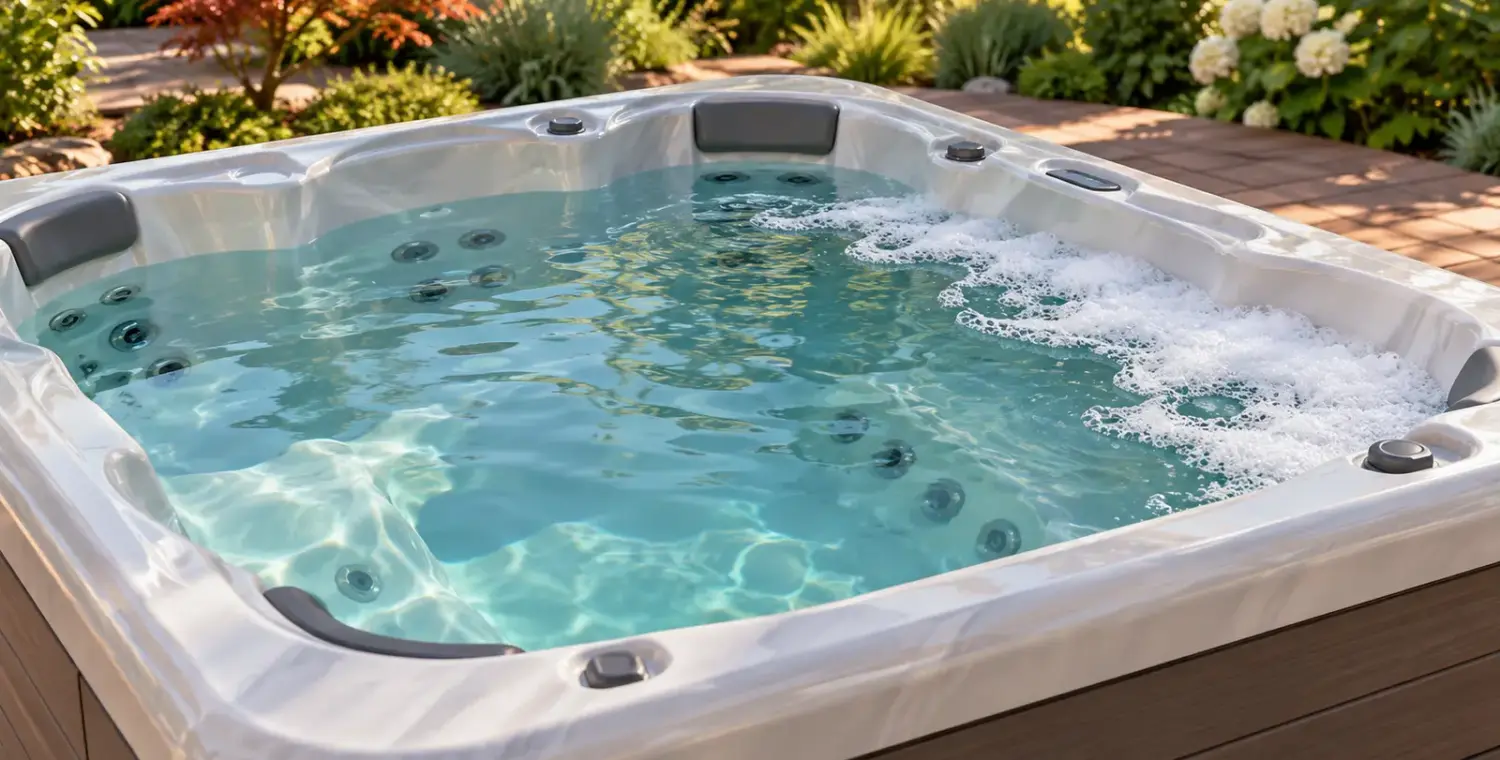
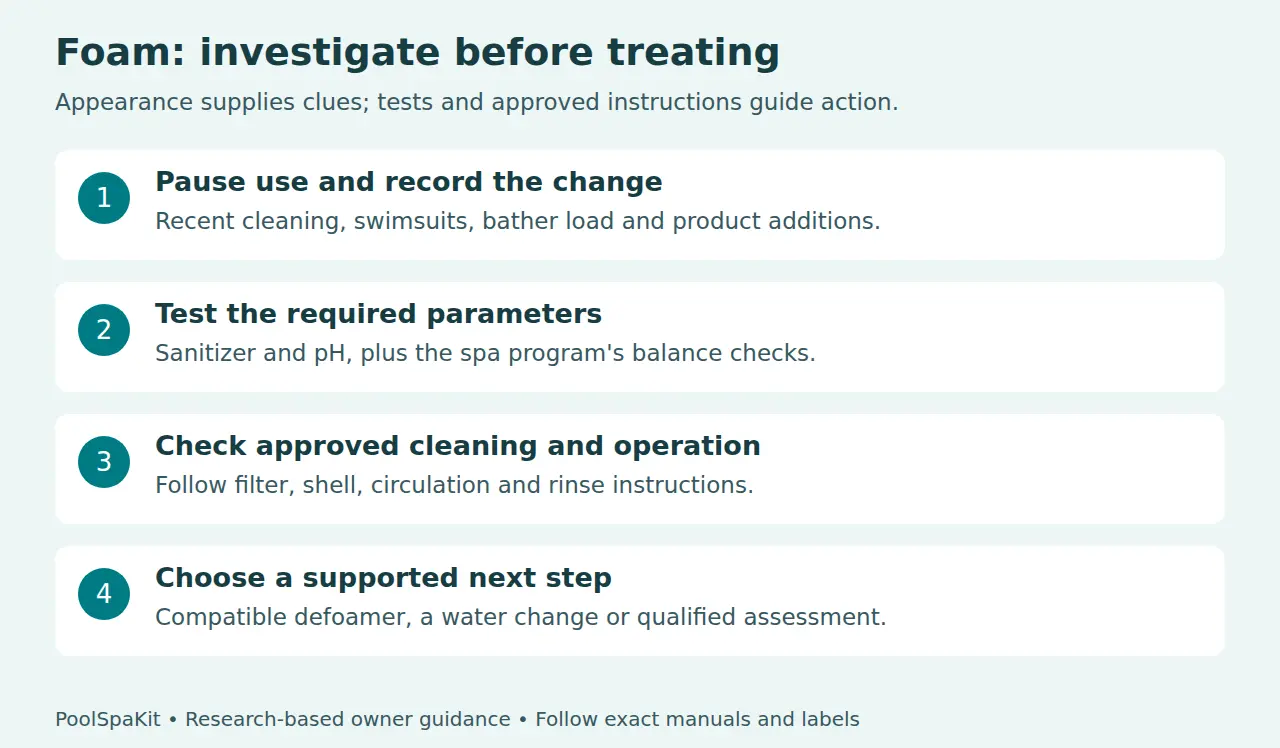
Persistent hot-tub foam often starts with soap, detergent residues, body oils or lotions entering the water. Water-care problems can contribute too. The useful order is to pause use, test the water, look for the input that changed, clean as the spa manual directs and decide whether a compatible defoamer or a water change is appropriate.
Defoamer can reduce the visible symptom. It does not establish that the water is disinfected or remove every contaminant that caused the foam. A tub that looks calm after treatment still needs the same water and equipment checks before anyone returns.
First precaution: Keep bathers out while investigating persistent foam, cloudy water, unusual odor or uncertain sanitizer readings. Never mix spa chemicals, add products while people are in the water or improvise a sanitizer change. Use the exact spa and product instructions.
Notice what changed before buying a treatment
Record when the foam appeared, whether it persists after the massage jets stop and whether the water is also cloudy or unusual in odor. These observations help describe the problem; they are not a test for a particular contaminant or a declaration that the water is safe. If odor is the main symptom, follow our guide to common causes of bad-smelling hot tub water.
Think back to recent events: heavy use, freshly washed swimsuits, a shell or cover cleaning, a new water-care product, a refill or an overdue maintenance task. Note the product names and the date. This short history is more useful to a dealer than simply asking for the strongest foam remover.
A practical log can have four fields: observation, test result, possible recent input and next action. For example, “foam began after cover cleaning” is a clue to investigate how the cleaner was used and rinsed. It does not justify treating the water for soap without checking the instructions and other conditions.
Common causes worth checking
| Possible contributor | What to investigate | Useful response |
|---|---|---|
| Soap or laundry residue | Swimsuits, shower products and recent cleaning | Reduce the input; ask whether existing buildup needs a water change |
| Lotions and body oils | Recent bather use and products entering the spa | Review pre-soak habits and the approved maintenance program |
| Water balance outside the model’s requirements | Measured results, including hardness where required | Correct only confirmed problems under the approved program |
| Maintenance or circulation concern | Filter care, water age, normal operation and alarms | Follow the exact maintenance procedure or arrange service |
Hot Spring’s 2025 Highlife manual identifies soap from users’ bodies and clothing, and notes that low calcium hardness can increase foaming. Jacuzzi and HTH also identify oils, lotions and detergents. Those sources support a list of possibilities; they do not let you determine the cause from the color or height of the bubbles.
Do not add calcium merely because a generic foam checklist mentions soft water. The Hot Spring manual gives different hardness requirements for different approved systems. A salt-system specification should not be copied to another spa, and a plaster pool’s requirements should not be copied to a hot tub.
Test before adjusting chemistry
Identify the sanitizer system actually in use and use a test that reports the relevant measurement. Test sanitizer and pH, then the other parameters required by the spa program, such as total alkalinity and calcium hardness. Write down the readings rather than relying on a verbal description such as “everything looks fine.”
CDC recommends testing chlorine and pH at least twice daily, and more often during heavy use. Follow the test maker’s sampling and reading directions. If a result is unexpected, repeat it correctly or arrange a reliable second test before making a large adjustment.
CDC also warns that chlorine above 10 ppm can bleach a DPD test and create a false low reading. A zero after repeated chlorine additions is a reason to verify the method, not a reason to keep adding product. Tell the dealer which test and treatments were used.
Compare measurements with the requirements for the exact spa, sanitizer and products. Public-health guidance and a model’s care program have different purposes. If you cannot reconcile the instructions, ask the manufacturer or qualified service provider before treating or bathing.
Clean the relevant parts without adding a new contaminant
Check the manual’s routine care for filters, the waterline, shell and cover. Use the approved cleaning method and products, including the required rinse. Household cleaning habits do not automatically transfer to a spa filled with treated water.
Follow shutdown instructions before removing a filter or opening an equipment compartment. If circulation has stopped or an alarm remains unresolved, obtain model-specific advice. Do not add chemicals that require circulation into a system you cannot confirm is operating normally.
Separate cleaning from diagnosis. Completing a filter service is useful maintenance, but it does not prove that detergent buildup, water balance or sanitizer has been corrected. After the permitted restart, reassess the same observations and test results before choosing another step.
If foam began immediately after a cleaning job, retain the cleaner’s label and explain the process to the dealer. Check whether the product was approved for that surface and whether the required rinse was completed. Do not attempt to neutralize an unknown cleaner by pouring a different product into the water.
What defoamer can and cannot do
Hot Spring distinguishes foam suppression from removal of soap. That is the key purchasing question: are you managing a limited surface symptom within an otherwise verified care program, or repeatedly concealing an unresolved buildup?
HTH markets its spa defoamer for foam associated with oils, lotions, detergents and other contaminants. Its directions require circulation and use according to the actual product label. Those instructions apply to that formulation; a product with a similar name may have different directions.
Confirm that a proposed defoamer is compatible with the spa and its sanitizer system. Follow the bottle’s quantity, addition method, protective equipment, storage and reentry instructions. This guide gives no universal spoonful or capful because product formulations and spa volumes vary.
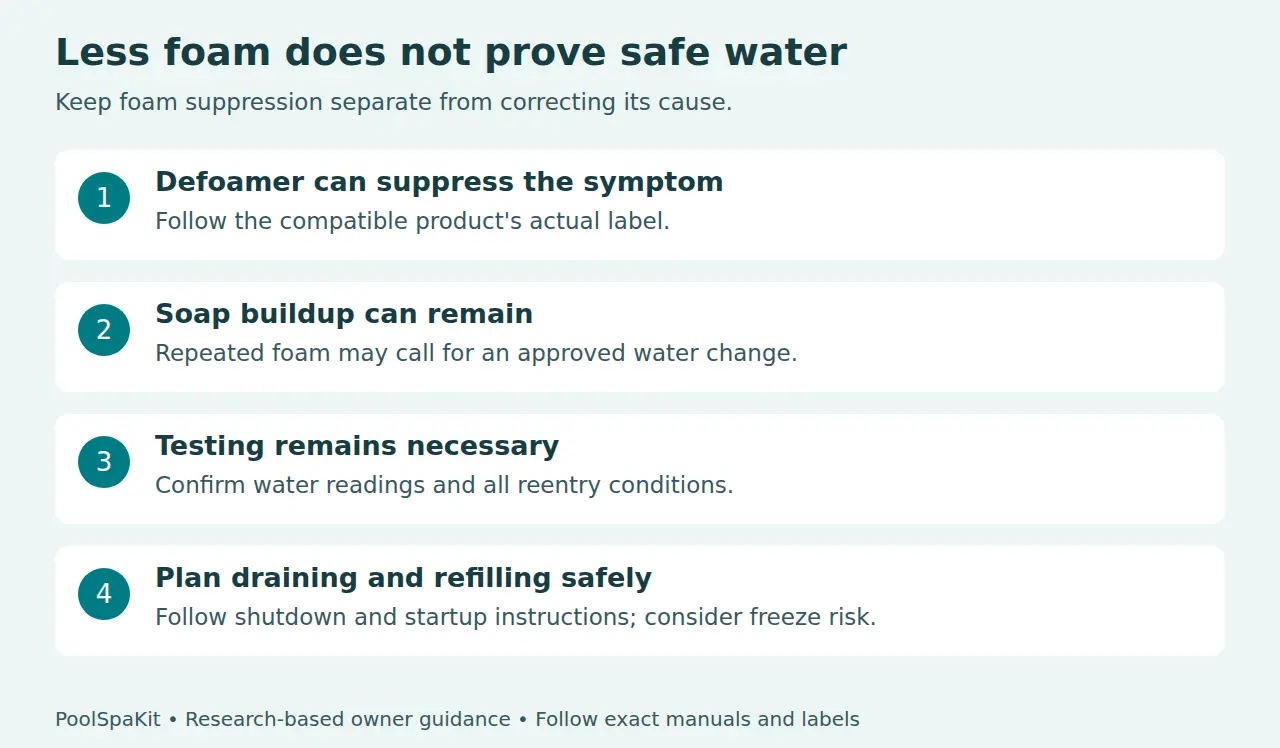
Use any permitted treatment as a recorded step, then reassess. Do not treat repeated additions as proof of improvement if foam returns or other symptoms persist. Reduced foam cannot replace disinfectant and pH tests, and it does not demonstrate that the underlying soap has left the water.
Keep the distinction when discussing products with a dealer. Ask what the product is intended to accomplish, how success should be checked and what should trigger a water change or service visit. A clear decision rule is more useful than buying several bottles to try together.
When a water change deserves consideration
Jacuzzi says severe foaming can require draining and refilling. Hot Spring’s manual also links excessive soap buildup with the need for a water change. Persistent symptoms despite appropriate testing and maintenance deserve that discussion, particularly when the water history is uncertain.
Follow the exact spa’s drain, cleaning, filling and startup instructions. A water change is a maintenance procedure, not permission to leave a partly drained spa unattended. Confirm power isolation, the allowed fill method and water conditions, and the approved destination for discharged water.
Plan the refill before starting. In cold weather, ask about freeze risk and whether the manual permits the proposed conditions. Our winter hot-tub care guide explains why working circulation and a practical freeze-protection plan matter. Do not leave a filled or partly drained spa powered off through freezing conditions without its full approved shutdown procedure.
Ask whether the maintenance plan requires cleaning beyond the shell or a specific approved plumbing treatment. Do not prescribe a purge product to every spa or combine one with the existing sanitizer on your own. The equipment maker and product instructions must establish the procedure.
After refilling, complete the manufacturer’s startup process, restore normal circulation and test again. Fresh water is a new starting point, not automatically treated bathing water. Confirm all care-program and label reentry conditions before using it.
Reduce recurring inputs and keep a useful routine
Review swimsuit rinsing, shower-product residues and any lotions entering the spa. Keep soaps and bubble-bath products out. Use spa-approved surface care, and prevent cleaning runoff from becoming a new input. Make these habits easy to follow for guests rather than relying on repeated chemical corrections.
Maintain the filter and water-change schedule for the actual spa and use pattern. Keep testing and recording adjustments. If heavy use changes the care requirements, follow the approved program rather than multiplying a generic shock dose.
Do not diagnose sanitation by smell, surface calm or a lack of foam. CDC’s hot-tub guidance calls for checking disinfectant and pH. Those checks remain necessary after the visible problem disappears.
When to stop and get help
Contact the dealer when sanitizer cannot be maintained, measurements are inconsistent, circulation is abnormal, an unfamiliar chemical entered the spa or foam returns after appropriate maintenance. Provide the model, sanitizer system, water age, recent products and recorded results.
Keep bathers out until water condition and equipment operation are verified. If you cannot identify the cause, a measured assessment and an approved maintenance plan are the next steps. There is no guaranteed clearing time or universal treatment sequence for every foamy spa.
Research checked September 30, 2026. We only claim hands-on testing when we’ve actually tested the product ourselves.