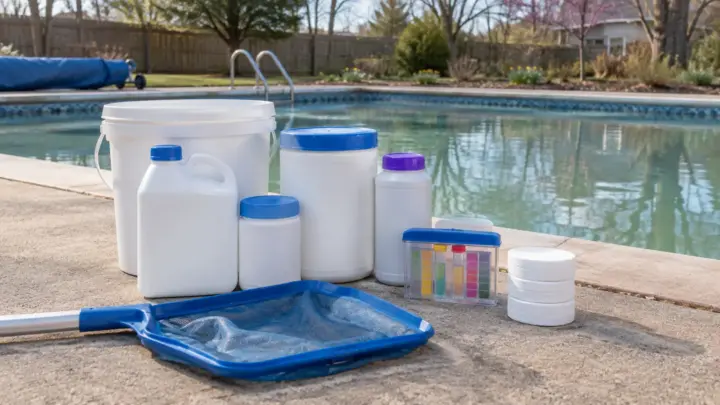

When pool chlorine is low, first confirm that the test is measuring the chlorine you need to assess. Then check whether sanitizer is being delivered and whether recent use, sunlight, debris or water replacement could have changed demand or concentration. Adding more product without those checks can conceal a feed fault or make an unreliable test more confusing.
Keep swimmers out when the required sanitizer or other swimming conditions cannot be verified. This guide concerns an ordinary residential chlorine pool, including a saltwater pool. A fecal incident, suspected illness outbreak, major chemical spill or newly filled pool needs its specific response procedure.
What “low chlorine” should mean in your record
Write the measurement name, value, unit and time. Free chlorine, total chlorine and combined chlorine are different entries. Taylor’s technical FAQs explain that OT testing measures total chlorine, while DPD methods can measure free and total chlorine. A total-only result does not establish the available free residual.
Compare a verified reading with your applicable product, equipment and local guidance. CDC gives pool chlorine minimums of at least 1 ppm, or at least 2 ppm when cyanuric acid or stabilized chlorine is used, alongside pH 7.0–7.8. These are public-health guidance, not an algae-treatment dose or a complete target for every stabilized pool.
Do not treat a minimum as the number to aim for under every condition. If your care program sets a different operating requirement, retain that requirement in the worksheet. If you cannot reconcile sources, ask a qualified provider to establish the appropriate plan for your pool.
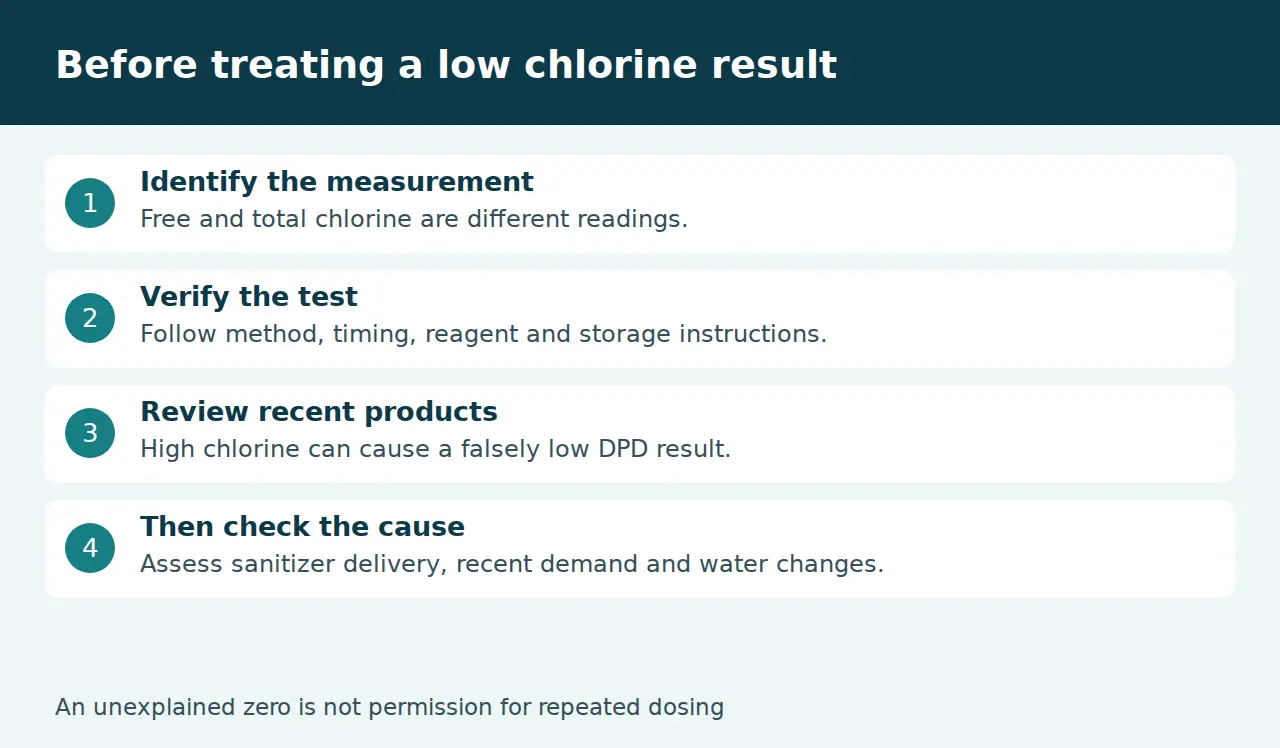
Check an unexpected low or zero reading first
- Identify the test method and which chlorine measurement it reports.
- Follow the exact sampling, reagent order, timing and reading instructions.
- Check reagent or strip best-by dates and storage history.
- List recent chlorine, oxidizer and other chemical additions.
- Repeat correctly or arrange a reliable second test if the result remains unexpected.
Taylor advises using reagents matched to its comparators and notes that residual total-chlorine reagent in a test cell can interfere with a later free-chlorine test. It also identifies monopersulfate interference with total and combined readings. That is a reason to explain treatment history to the tester, not to subtract a guessed correction.
A particularly important trap is a zero after substantial chlorine additions. CDC and Taylor warn that high chlorine, specifically above 10 ppm in the discussed DPD testing context, can bleach the color and produce a falsely low result. Stop adding on the strength of an unexplained zero and use the maker’s supported verification method.
Keep the original and repeat results rather than replacing the first number in your log. Our pool water-testing guide explains how chlorine, pH and other measurements fit together. This article uses those results to narrow the reason for a low residual.
Common causes: delivery, demand and dilution
| Possible cause | Useful evidence | First response |
|---|---|---|
| Missed or insufficient approved treatment | Product and maintenance record | Check what was actually used against the care program |
| Feed or generator interruption | Controller history, warnings and permitted owner checks | Verify operation using the exact manual |
| Heavier contamination load | Bather use, debris, algae signs and test trend | Remove debris appropriately and assess the required correction |
| Sunlight and stabilizer context | Exposure, measured CYA and product ingredients | Review the applicable stabilized-pool requirements |
| Heavy rain or water replacement | Weather, overflow/refill history and new tests | Retest and correct confirmed changes |
| Testing error or interference | Method, reagents and recent treatments | Verify the reading before dosing |
Several branches can apply together. A party can increase demand while a missed treatment reduces delivery. Rain can bring contaminants as well as change concentration. Use the table to choose evidence to collect rather than declaring one cause from a single low result.
Review recent use and contamination
Look back at the period since the last verified suitable test. Record swimmer numbers, leaves or other debris, unusual weather, water additions and treatments. Health Canada explains that sanitizer requirements depend on use and contaminants, and that algae can consume sanitizer while leaving less available for other microorganisms.
Visible algae, slippery surfaces or cloudiness call for a broader assessment. Do not label every loss “algae” when there is no supporting evidence, and do not treat clear appearance as proof of sanitation. Health Canada explicitly notes that even clear water can contain microorganisms.
If visibility is poor, keep swimming suspended and use the cloudy-pool troubleshooting guide to review chemistry and filtration together. Restoring a chlorine number does not by itself resolve an obscured bottom or damaged filtration.
Remove accessible debris using the appropriate routine equipment and surface-care method. Record what you removed and any abnormal observations. Do not enter uncertain water to carry out a maintenance task or use an unfamiliar chemical cleanup procedure.
Check how chlorine reaches the pool
For manual treatment, check the actual product label and record, including formulation, pool volume and what was added. Products with similar names can differ in available chlorine and use instructions. A count of capfuls or tablets without an exact product is an incomplete treatment record. Our guide to what pool shock labels mean explains why products sold as “shock” are not interchangeable. For the arithmetic of raising free chlorine from a verified reading, the pool chlorine calculator gives an estimate; it is not for algae or contamination treatment, and the product label controls.
For a dispenser or feeder, use only the owner checks the manual permits. Confirm the intended product, schedule and status without opening a pressurized or chemical-filled assembly casually. A knob position alone does not demonstrate that an appropriate quantity reached the water.
Do not put a different chemical into a feeder because the normal one is unavailable. Retain the equipment and product names for service advice. Electrical work and uncertain chemical-feed faults need qualified handling.
For a salt chlorine generator, remember that saltwater care still depends on chlorine production. Pentair’s IntelliChlor Plus and LT FAQs identify output setting, insufficient runtime, dirty or scaled blades and environmental load among possible low-chlorine contributors. Those are checks to apply through the exact model’s instructions, not a reason to replace a cell immediately.
Record flow, temperature and salinity warnings and whether the unit is actually chlorinating. The same FAQ describes temperature and flow protection and notes that a powered unit is not always producing. It also explains that connected automation can control output. Confirm which controller owns the setting before changing it.
Do not bypass an interlock, pour in salt for an unrelated warning or improvise acid cleaning. Have the provider assess unresolved errors. If circulation observations are unusual, our filter-pressure guide helps you record comparable readings for diagnosis.
Consider sunlight and cyanuric acid together
Sunlight can reduce chlorine, as CDC notes. For an outdoor pool, include a reliable cyanuric acid result and identify whether the chlorine products contain stabilizer. Record recent changes in products and water replacement alongside the test.
Do not add stabilizer solely because chlorine fell on a sunny day. Pentair includes both low and high CYA among potential contributors to low residual in its outdoor-generator troubleshooting list. The next action depends on a confirmed measurement and the applicable care requirements.
“Chlorine lock” is not a sufficient diagnosis for an unexplained zero. Keep testing limitations, delivery and demand in the investigation. There is no universal stabilizer number or chlorine-to-CYA dosing ratio prescribed here.
If a water replacement is proposed for excessive CYA or another concern, get a safe plan for the pool construction, groundwater, weather and local disposal rules. Do not drain a pool simply because an online checklist recommends dilution.
Correct the confirmed problem and retest
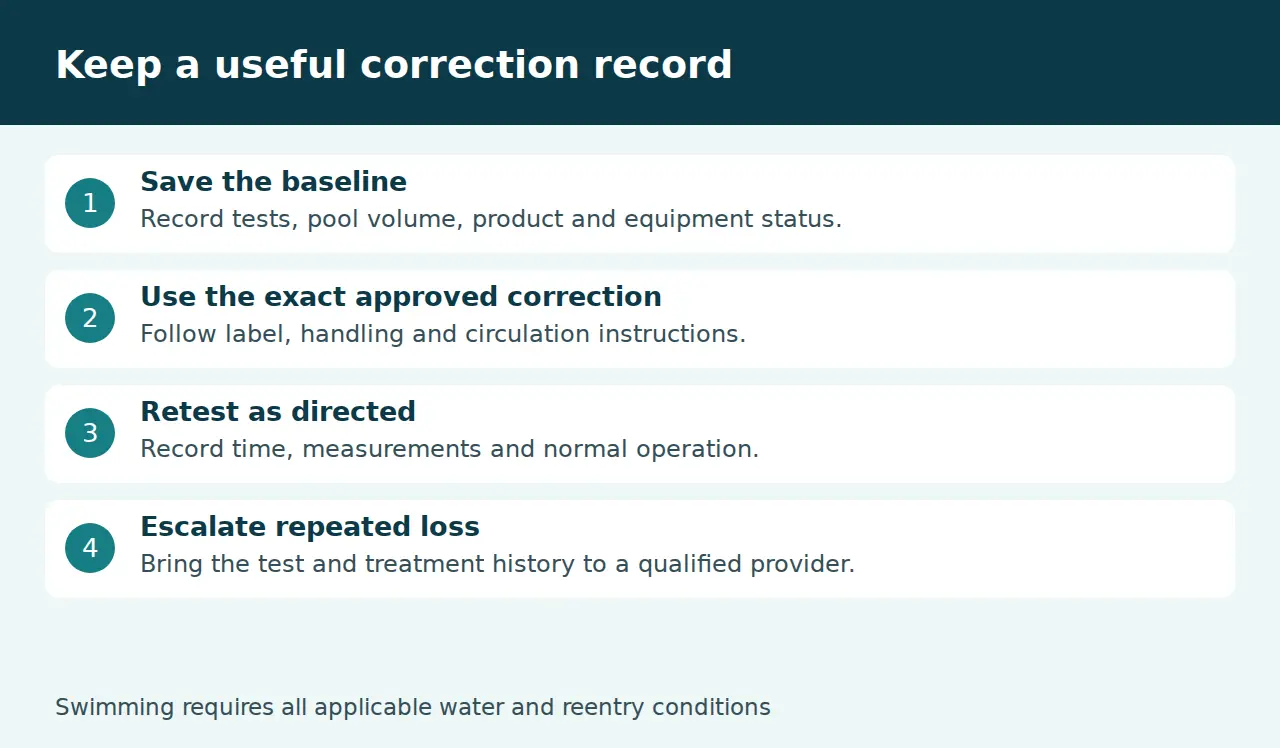
Use the exact label-directed correction after confirming the measurement and cause as far as practicable. Check measured pool volume, product identity, addition method, circulation requirements, protective equipment and reentry conditions. If those inputs are missing, obtain advice before calculating a dose.
CDC chemical-safety guidance warns against mixing products and emphasizes original containers and separation of incompatible materials. Do not combine chlorine with acid or another treatment in a bucket or feeder, and do not transfer chemicals into unlabelled containers.
After a permitted correction, record the amount, time and operating conditions. Retest at the interval required by the treatment instructions, then continue the care program’s checks. CDC recommends chlorine and pH testing at least twice daily, with more checks during heavy use.
If the residual falls again, compare equivalent measurements taken with the same method. Include actual operation and recent events. A repeated shortage needs an explanation rather than increasingly large additions with no treatment history.
When a professional assessment is the next step
Seek qualified help when repeat readings remain inconsistent, chlorine disappears repeatedly despite approved care, equipment cannot be confirmed operating normally or the proposed treatment is outside your instructions. Supply the test method, results, pool volume, CYA, product labels, additions and equipment warnings.
Ask the provider to distinguish a measurement problem, delivery fault and unusual demand before selling a sequence of additives. Additional chemical tests may be useful when supported by the assessment, but a low chlorine reading alone does not prove that a phosphate remover or replacement generator is needed.
Before reopening the pool, verify the applicable sanitizer and balance requirements, adequate visibility, normal operation and every treatment-label reentry condition. A clearer pool or stronger smell does not replace that evidence.
Research checked September 30, 2026. We only claim hands-on testing when we’ve actually tested the product ourselves. Featured image is an original illustration.