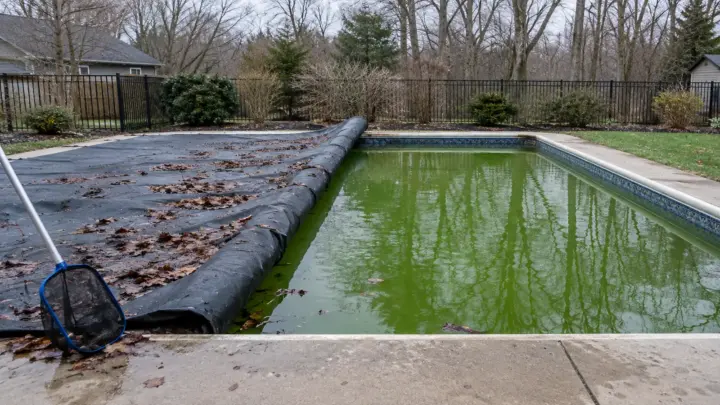
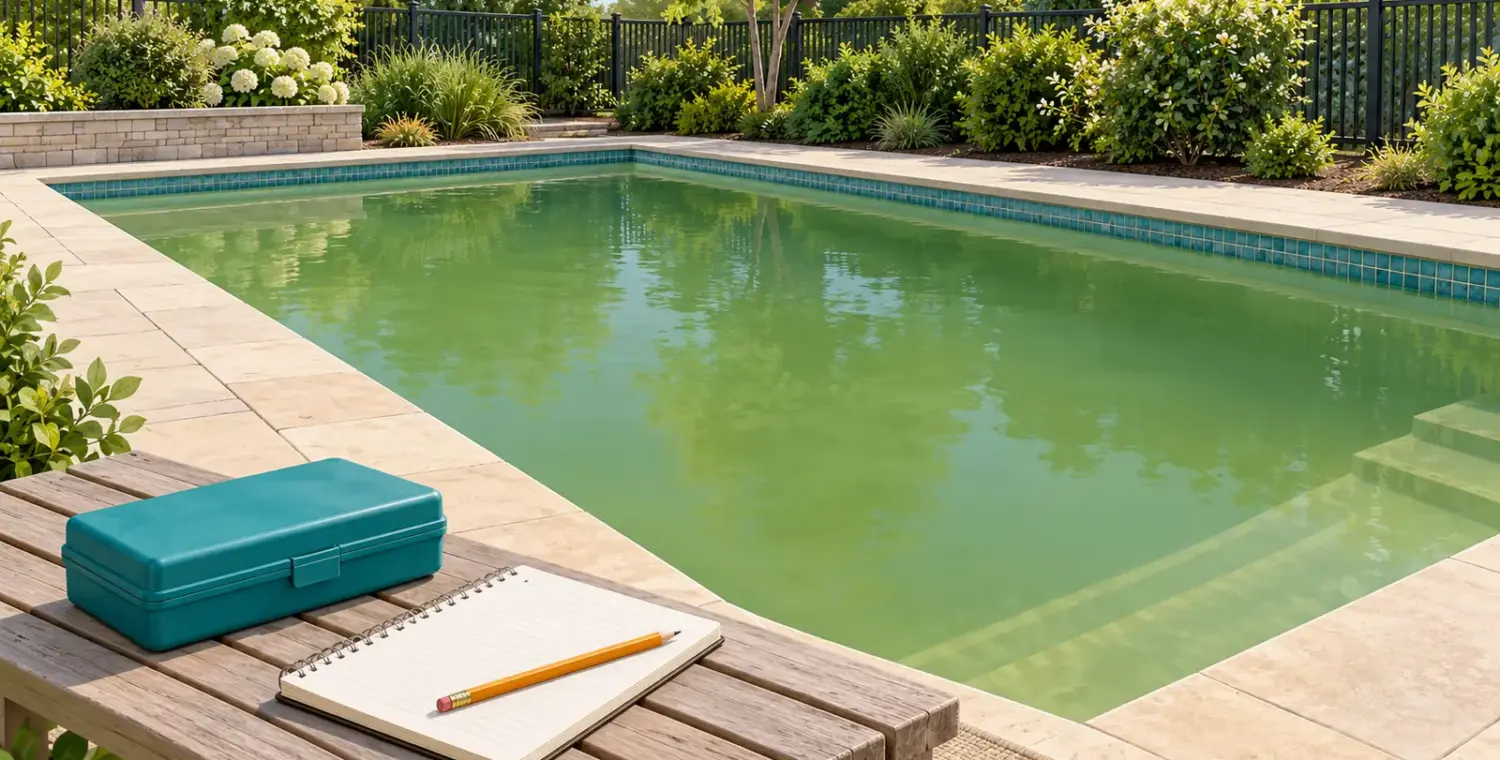
To fix green pool water, first keep swimmers out, test the water and work out whether the color is consistent with algae or needs a metal investigation. Then follow a treatment plan for the confirmed problem, remove debris and check that filtration is working. Adding more shock before those checks can waste treatment and complicate a metal problem.
This guide gives you a troubleshooting sequence for a residential pool. It does not prescribe a chemical dose or a fixed clearing deadline: those depend on the water volume, test results, exact product and equipment. If the pool is heavily neglected, the readings are unreliable or you cannot operate the equipment safely, use a qualified pool professional.
Step 1: Keep the pool out of use
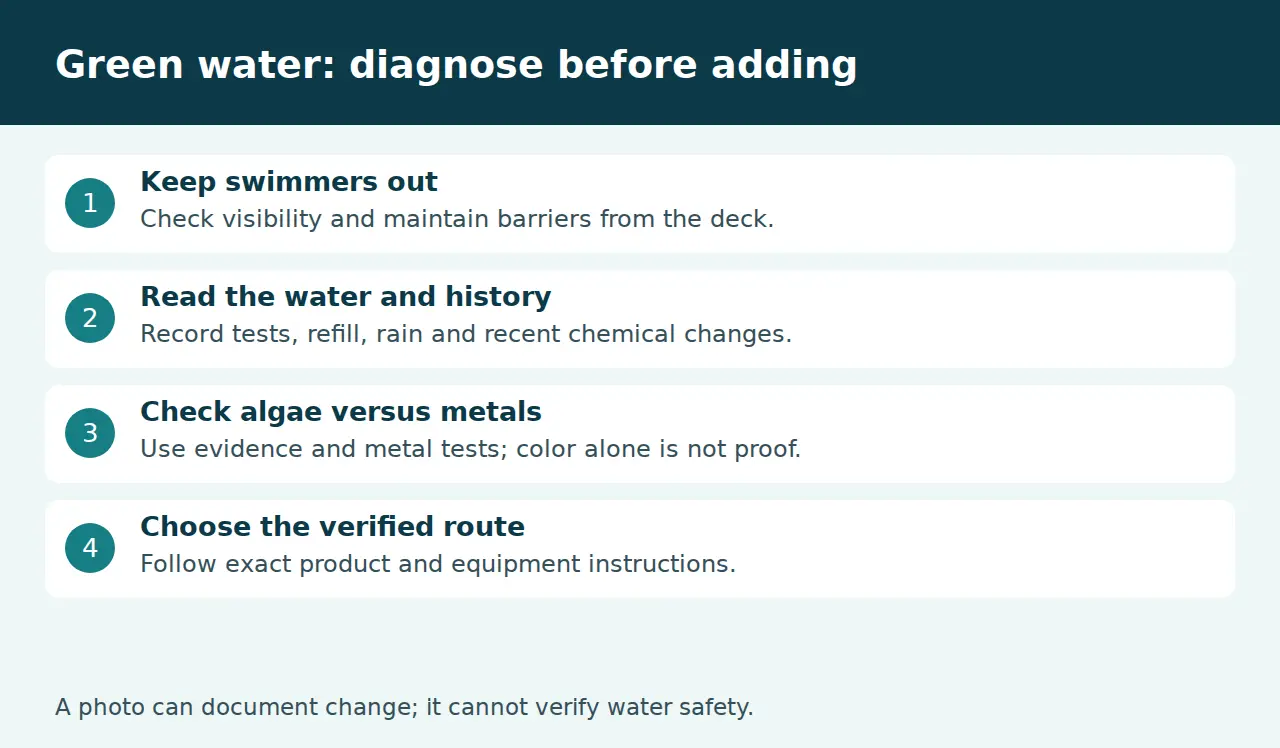
Do not swim in green water while the cause and water quality are unresolved. Poor visibility makes it harder to see someone underwater. CDC tells swimmers to check that the deep-end drain is visible; Red Cross training likewise treats obscured pool-bottom visibility and unusual water color as warning signs.
Check visibility from the deck, without entering the pool to inspect the bottom. Maintain the pool’s barriers and keep children and pets away while you work. A change from green to pale blue is encouraging, but it does not establish safe swimming conditions.
Take a photo and record when the color appeared. Note recent rain, a missed care period, a refill, equipment downtime or a chemical addition. That short history helps distinguish a problem that developed gradually from discoloration that appeared immediately after a change.
Use appearance as a clue, then verify
| What you notice | What to investigate | Next useful check |
|---|---|---|
| Cloudy green water, visible growth or slippery-looking deposits | Algae and inadequate sanitation, cleaning or circulation | Free chlorine, pH, CYA where used, surfaces and filtration |
| Tinted water after filling, shock or a pH change | Metals as a possible cause, alongside water chemistry | Fill-water history, products used and a metal test |
| Green deposits concentrated in corners or on steps | Surface growth and areas needing cleaning | Deck-side inspection and circulation/cleaning history |
| Color improves but haze remains | Remaining particles, ongoing growth or filtration trouble | Repeat water tests and check filter condition/flow |
| Uncertain cause or conflicting readings | A diagnosis that needs confirmation | Professional water analysis before another product |
None of these appearances proves the cause by itself. Health Canada explains that algae can cloud water, make surfaces slippery and consume sanitizer. BioGuard explains that metals introduced through source water, equipment or products can cause discoloration and staining, sometimes after oxidation or a pH change.
A tint after shock is therefore a reason to investigate metals, not a reason to keep adding chlorine until the color disappears. Tell the water-testing professional exactly what changed. A photo is useful context; it cannot replace a water analysis.
Step 2: Get useful water readings before treatment
Measure free chlorine and pH with a suitable, in-date test method. Record CYA if the pool uses stabilizer or stabilized chlorine; include alkalinity and calcium hardness when evaluating the full balance. If metals are a possibility, ask for a metal test rather than assuming the ordinary strip includes it.
Follow the kit’s instructions for where to sample, sample volume, reagent quantities and reading time. Avoid guessing a number beyond the test’s scale. Our pool water testing guide explains the roles of these measurements and how to keep a usable record.
A low result can need confirmation: CDC warns that chlorine above 10 ppm can bleach a DPD test and create a false low or zero reading. If a surprisingly low result follows a substantial chemical addition, do not automatically add another dose. Use the kit’s approved high-range method or obtain an independent test.
For routine pool guidance, CDC recommends pH 7.0–7.8 and at least 1 ppm free chlorine without CYA, or at least 2 ppm when CYA or stabilized chlorine is used. These are baseline minimums, not green-pool treatment targets or proof that algae is gone. Treatment and reentry limits must come from the applicable product instructions and local requirements.
Write down the actual volume used to calculate a treatment and check its units. Keep gallons and litres distinct. If the volume is only a rough guess, resolve it before working out a dose. Save the product name and active ingredient with the test results so the next decision uses the same information.
Step 3: Remove debris and clean accessible surfaces
Skim leaves and floating debris. Clean skimmer baskets and any other serviceable baskets following the equipment’s shutdown and opening instructions. Brush reachable walls, steps and corners from the deck with a brush approved for the pool finish. Do not use an aggressive brush simply because a general algae guide mentions one.
Use the cleaning equipment allowed for your pool and the current conditions. Vacuuming can remove material, but the discharge route matters. If the system permits vacuuming to waste, understand the valve procedure, water-level limits and local wastewater rules before using it. Do not improvise a waste connection or let the pump run dry.
Clorox Pool&Spa and HTH both include brushing, vacuuming and filter care in their green-water guidance. The practical point is that chemical treatment and physical removal have different jobs. Keep a note of areas you could not safely reach so they can be included in a professional cleanup.
Step 4: Treat the diagnosed problem with the exact label
If the evidence supports algae
Choose a product labeled for the pool, sanitizer system and problem being treated. Read its algae-treatment directions, required water balance, application method, circulation instructions and swimming restrictions. Follow the specified sequence; ask a professional if the test results or pool condition fall outside the directions.
“Shock” is a treatment term, not one interchangeable chemical. Do not copy a bag count from a different product or pool volume. Do not adopt a double-dose rule, a generic chlorine target or a fixed treatment multiplier from a general article.
If metals are suspected or confirmed
Have the metal result and source history reviewed before choosing a stain or metal-control product. BioGuard notes that oxidizing or changing pH can make dissolved metals precipitate onto surfaces. The plan must account for sanitation as well as discoloration; do not intentionally abandon the sanitizer routine just to make a tint look better.
Ask what the proposed treatment does, how it fits your current products, whether removal is required and what follow-up testing is needed. Keep the pool out of use while the instructions or cause remain unclear.
For either route
Never mix concentrated products, use unlabeled containers or put a new chemical into a feeder that is not approved for it. Follow the label’s protective-equipment and handling requirements. Predissolve a product only when its own directions require it, using the specified method. Keep chemicals in their original containers and away from children and pets.
Add only the products the plan calls for, in the stated order with the stated intervals. Record each addition and retest at the instructed time. This makes a stalled cleanup easier to diagnose than adding several products and trying to remember what happened.
Step 5: Verify filtration and remove remaining material
Check that the pump is operating normally, water is returning to the pool and the filter is not overdue for service. Follow the treatment label and equipment manual for circulation. A manufacturer article’s suggested extended run does not create one runtime that suits every pool or guarantees clarity.
Watch pressure and flow as material is captured. Compare pressure with the clean baseline at the same pump speed and valve arrangement. The Pentair Clean and Clear Plus guide explicitly notes the effect of pump RPM on its baseline; your own filter’s cleaning trigger and procedure still govern.
Sand, cartridge and DE systems need different maintenance. Do not backwash a cartridge filter or assume DE can be cleaned and restarted without the prescribed media care. The filter-pressure troubleshooting guide helps investigate unusual pressure without treating every reading as the same fault.
Before opening any pressurized filter, follow its full shutdown, restart-prevention and pressure-release procedure. Never loosen a clamp or lid under pressure. If the gauge, air relief or tank condition is questionable, stop and arrange service.
Some material can remain after algae treatment, so continued physical removal may be necessary. If water becomes hazy rather than green, use the cloudy-water diagnostic guide to reassess particles, balance and filtration instead of declaring the cleanup complete.
Step 6: Retest before reopening the pool
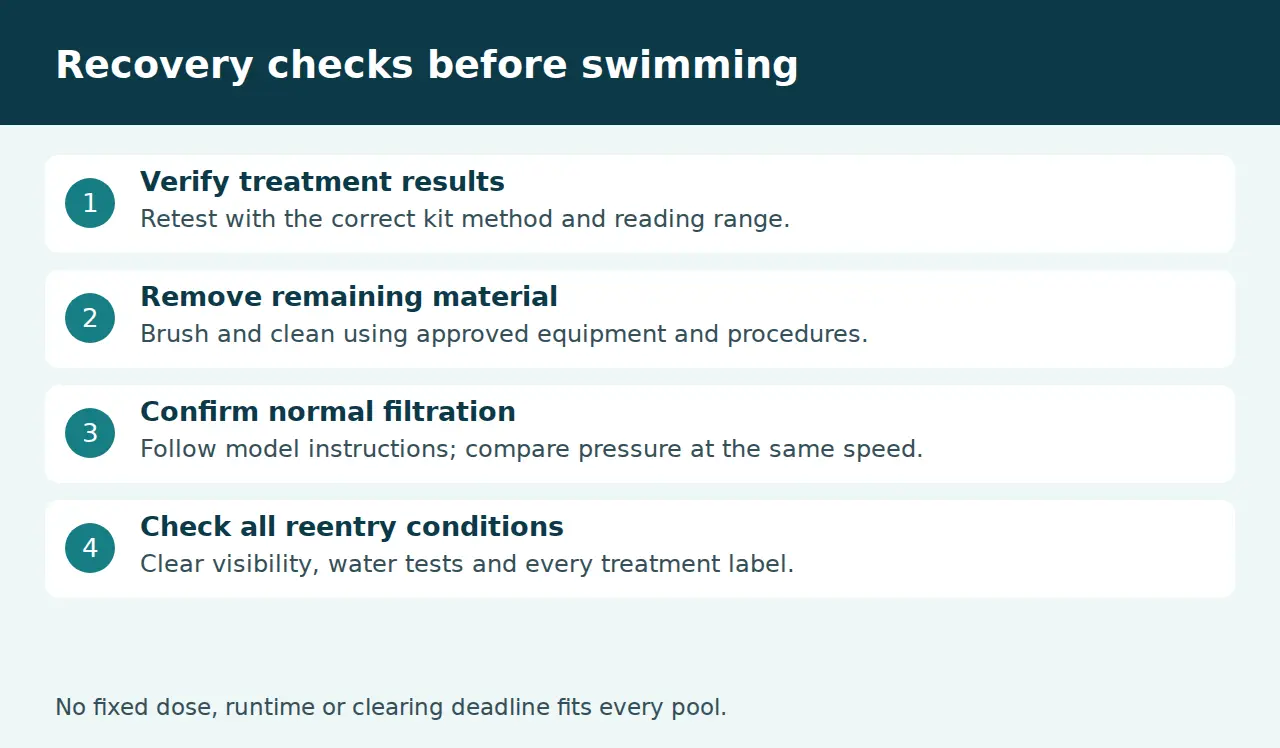
Confirm clear visibility to the bottom, appropriate sanitizer and pH readings, normal equipment operation and compliance with every treatment product’s reentry conditions. Follow applicable local requirements. A timer finishing or a photograph looking blue cannot replace those checks.
If the test is outside its range, unclear or inconsistent, keep the pool out of use and get confirmation. Make sure the person responsible for the pool knows which treatment was applied and what still needs checking. Do not schedule swimming around a promised overnight recovery.
If the pool stays green or quickly turns green again
Review the diagnosis, readings and maintenance record before escalating treatment. Was free chlorine actually measured, or was the result total chlorine? Was CYA included where relevant? Did color change immediately after an addition? Is the filter capturing material, and were neglected corners cleaned?
If sanitizer repeatedly falls short, the low-chlorine troubleshooting guide covers demand, delivery and test checks. Saltwater pools also need a measured chlorine residual; a generator’s presence does not show that the pool currently has enough sanitizer.
Bring a professional the volume, surface type, equipment models, exact product labels, additions, results and photos. Seek help promptly for heavy neglect, unsafe pressure equipment, persistent staining, unexplained readings or a problem returning after a correctly followed plan.
Avoid shortcuts that add another problem
Do not buy several algaecides solely because the pool is green, or add clarifier or flocculant without checking the label and filtration requirements. These products are not interchangeable. Our guide to whether a pool needs algaecide explains when it helps and when it does not. A plan that requires a waste route your equipment lacks needs a different approved approach.
Do not drain the pool as a quick color fix. Water replacement requires a separate assessment of the pool structure, liner, ground conditions, equipment and local discharge rules. Ask a qualified professional before taking that route.
Once the pool is usable again, keep records of routine water tests, cleaning and filter care. Review the lapse that preceded the problem and assign those tasks clearly. Consistent checks give you a chance to respond to a falling residual or equipment fault before another green-water cleanup is needed.
Research checked September 30, 2026. We only claim hands-on testing when we’ve actually tested the product ourselves. Featured image is an original illustration.
Sources and references
- CDC: Home pool and hot tub water treatment and testing
- Health Canada: Swimming pool and spa chemicals
- CDC: Preventing swimming-related illnesses
- CDC: Pool chemical safety
- BioGuard: Metal staining
- HTH: Green water
- Clorox Pool&Spa: How to clean a green pool
- Pentair: Clean and Clear Plus filter installation and user guide
- American Red Cross: Safety training for swim coaches supplement