
Change hot tub water on the schedule required for your spa and water-care system, and sooner when verified water conditions or contamination history call for it. Persistent residue, recurring foam, water that remains difficult to maintain, or a significant lapse in sanitation can justify a review before the next calendar reminder.
There is no reliable universal number of months for every residential hot tub. Start with the manual, then use records of use, testing and maintenance to decide whether an earlier change is needed. If illness or serious contamination is suspected, get appropriate advice before draining: a routine water change may be the wrong first step.
Start with the schedule for your actual spa
Find the water-replacement section in the spa manual and any separate instructions for its sanitizer or salt system. Confirm the model and system you own rather than following an interval advertised for another product.
CDC’s hot tub Legionella-prevention guidance advises replacement as often as required by the health department or recommended by the manufacturer. That is a useful starting principle, not a worldwide residential calendar. Shared or rental facilities may have requirements beyond those for a private home.
Turn the applicable instruction into a reminder and record the last full replacement date. Note any conditions attached to the recommendation, such as maintenance, water-care products or usage. An interval described for a particular program should not be extended when that program has not actually been followed.
If you have inherited a spa without its maintenance history, ask the supplier how to establish a safe starting condition. Do not treat an unknown fill date as a recent fill simply because the water looks clean.
Signs that deserve an earlier water-change review
| Observation | What to check | How replacement fits |
|---|---|---|
| Persistent foam or a residue feel | Soap inputs, cleaning products, water age and chemistry | Accumulated residue may justify a manual-directed change |
| Odor that returns after approved maintenance | Water, cover, sanitizer readings and equipment operation | Investigate the cause before assuming a drain will solve it |
| Repeatedly poor sanitizer results | Test limitations, supply, circulation and contamination history | A water-care reset may be needed, but confirm the measurement first |
| Cloudiness that does not resolve | Sanitizer, balance, filtration and recent additions | Replacement is one possible response, not a substitute for diagnosis |
| Unknown history or prolonged neglect | Maintenance records and qualified assessment | Plan appropriate cleaning and restart rather than only topping up |
| Suspected illness or serious contamination | Public-health or qualified professional instructions | Sampling and remediation may need to precede draining |
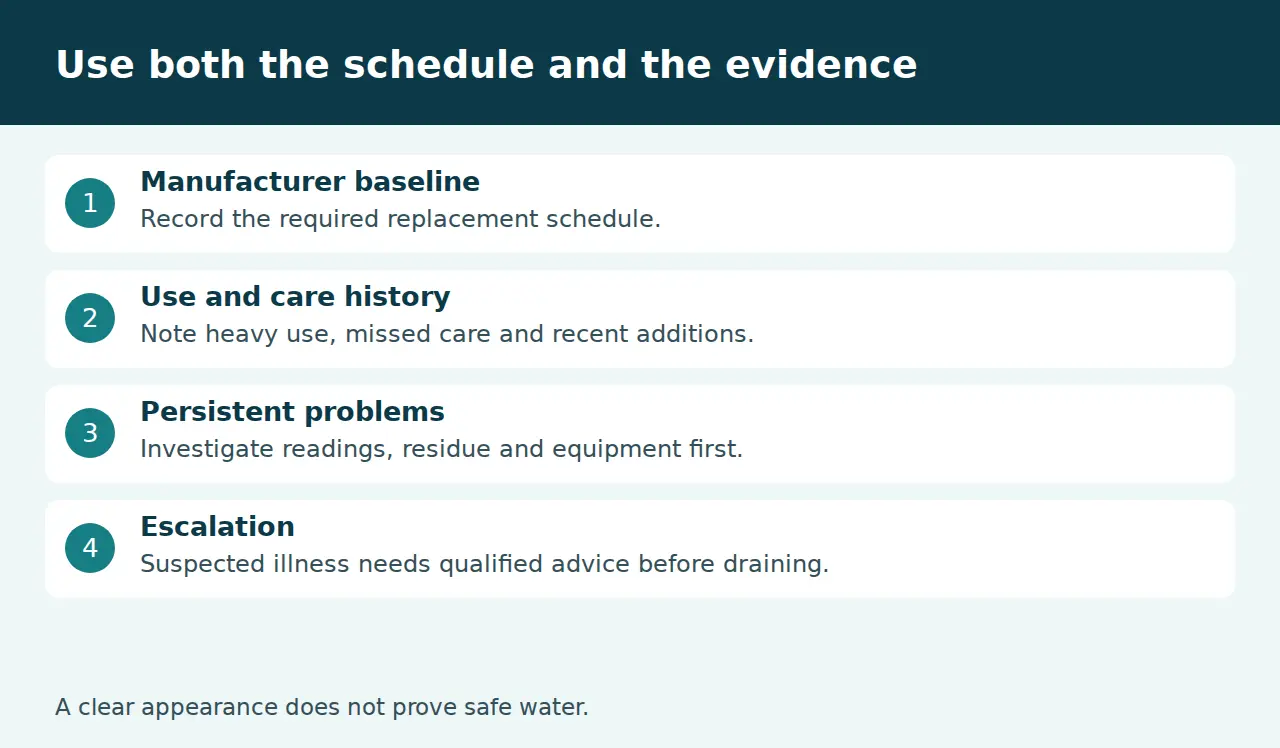
No single symptom supplies a laboratory diagnosis. Clear water can still contain germs, while a visible problem can have several causes. Keep bathers out when water suitability is uncertain and measure the relevant parameters.
Foam and residue
Hot Spring’s maintenance guidance identifies soap and detergent buildup as reasons for water replacement. Its owner manual also distinguishes suppressing foam from dealing with accumulated residue. A calmer surface after a defoamer does not mean the old water has become new water.
Look for a continuing input as well as water age: detergent on swimwear, lotions, or an unsuitable cleaner. Correcting the input helps avoid carrying the same problem into the next fill. Our hot tub foam guide explains that symptom in more detail.
Odor and cloudy water
Check sanitizer, pH and the normal filtration operation rather than choosing a stronger treatment by smell. Inspect the cover separately, following its instructions; water replacement will not repair a damaged cover. Use the hot tub odor guide for those checks.
If approved maintenance has not restored suitable conditions, ask the manufacturer or service provider whether draining, cleaning and refilling is appropriate. Report the actual results and work already completed. “I added several products” is less useful than a dated record of the product, amount used and follow-up measurement.
Use and maintenance history matter more than the date alone
A heavily used small spa and an infrequently used tub do not receive the same contamination inputs. Taylor’s spa chemistry discussion explains the importance of water volume, warm water and bather load. Those factors are reasons to reassess the schedule, not to invent an exact replacement formula for an individual tub.
Record changes in use, especially a period with more bathers than usual. Also record interrupted circulation, missed sanitizer care, significant top-ups and recent cleaners or treatments. This gives a supplier enough context to assess why an earlier reset may be needed.
Fresh water is not a remedy for every operating fault. If a filter, circulation problem or unapproved treatment caused the difficulty, correct that issue as part of the plan. Otherwise the new fill may develop the same problem.
Do not silently switch sanitizer programs during a water change. Product compatibility and startup requirements still apply. The bromine versus chlorine guide helps frame the questions to ask before considering a change.
What about total dissolved solids?
Total dissolved solids, or TDS, is a broad measurement of dissolved material. It is not a direct test of pathogen safety and does not identify each substance contributing to the result. A reading needs context: the fill water, treatment history and system type matter.
Hot Spring’s manual explains that evaporation and replacement water can contribute to mineral accumulation. Evaporation followed by a top-up is different from a complete replacement. Adding water to restore the operating level does not reset the fill date or remove every accumulated contaminant.
Ask your supplier how TDS is used in the approved care program, especially if the spa deliberately contains salt. Record the initial result if the program calls for it. Do not apply a cutoff from a different system, or use a low reading to overrule sanitation and equipment concerns.
When routine replacement advice is not enough
CDC identifies water age, sediment and biofilm, temperature and disinfectant residual as factors relevant to Legionella growth. Its operator toolkit describes coordinated response when illness is suspected, including sampling under public-health instructions before draining.
If people become ill after using the spa, or a professional identifies serious contamination, stop use and contact the appropriate health authority or qualified provider. Do not attempt an internet hyperchlorination recipe or erase potentially useful evidence by immediately emptying the tub.
CDC advises seeking medical care promptly for symptoms such as cough, shortness of breath, fever or muscle aches after hot tub use in the preceding two weeks, and telling the clinician about that exposure. This is an escalation precaution, not a diagnosis based on water appearance.
Plan the water change before opening the drain
Choose an approved disposal route
Check your local wastewater and environmental requirements. EPA stormwater guidance explains why material entering storm drains can reach waterways without treatment. Do not assume that a street drain, lawn, septic system or sewer connection is an approved destination for your spa water.
Tell the relevant authority about the sanitizer and other treatments present, including salt where applicable. Follow any permitted discharge conditions and location requirements. Permission for one property or municipality is not permission everywhere.
Check weather and restart access
In cold weather, arrange a procedure that can be completed safely for the model and installation. The Hot Spring manual has specific refill-temperature and cold-weather restrictions; these demonstrate why generic drain instructions are inadequate.
Draining the shell can leave water in equipment and lines. Complete winterization is a different task from an ordinary water change. See our winter hot tub care guide and obtain dealer help when freezing or an extended shutdown is involved.
A practical drain, clean and refill plan
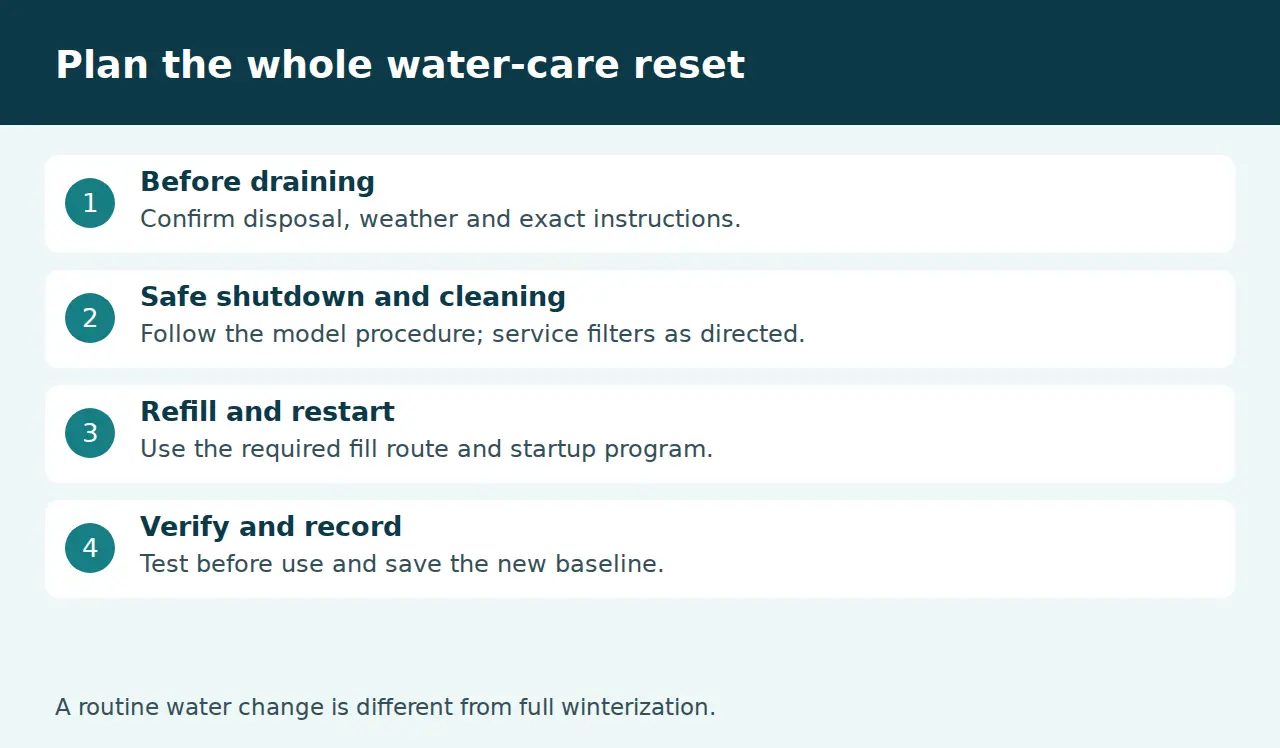
- Document the starting condition. Save readings, symptoms, fill date and recent maintenance. Resolve any need for professional sampling first.
- Gather the exact instructions. Include the spa’s drain/refill procedure, approved surface and filter care, startup program and discharge requirements.
- Make the spa safe for draining. Follow the manufacturer’s power-isolation and access instructions. Do not run pumps or heaters without their required water supply or open electrical components.
- Drain and clean as directed. Use compatible products and prescribed methods. A shell rinse alone is not proof that the entire system is free of contamination.
- Service the required filters. Follow their cleaning and replacement instructions, then reinstall correctly. Do not treat a new fill as a reason to ignore a damaged cartridge.
- Refill and restart correctly. Use the specified fill route and startup sequence. Resolve flow problems and alarms through the model’s instructions or qualified service.
- Test before use. Verify sanitizer, pH and the required balance parameters and observe all product re-entry conditions.
Never mix concentrated chemicals or improvise a combined cleaner and sanitizer. Follow labels for protective equipment, circulation and waiting periods. Keep children and pets away from the work area and secure the cover when the spa is unattended.
Establish a useful baseline for the new water
Record the refill date, source water, relevant starting measurements and startup products. Keep the schedule for sanitizer and pH testing separate from the reminder for replacement. A freshly filled spa still needs routine water care.
Use a suitable test method and respect its limits. High chlorine can bleach some DPD tests and produce a misleading low result, so repeated zero readings after treatment require verification rather than endless additions. Our water testing guide explains method distinctions; use spa-specific operating requirements.
Common questions
Can I keep the water longer if it looks clear?
Appearance cannot justify ignoring the applicable replacement instructions. Review the required schedule and actual maintenance history; clear water is not a disinfection test.
Does topping up count as changing the water?
No. Record it as a top-up, then test as required. It is not the same maintenance event as the manufacturer’s complete drain, cleaning and refill procedure.
Should I drain every time there is foam?
Investigate the input, water readings and care history first. Persistent accumulated residue can justify replacement, but a single symptom does not provide the same answer for every spa.
Research checked October 1, 2026. We only claim hands-on testing when we’ve actually tested the product ourselves. Featured image is an original illustration.
Sources and references
- CDC: Home Pool and Hot Tub Water Treatment and Testing
- Health Canada: Swimming pool and spa chemicals
- Taylor Technologies: Technical and Support FAQs
- CDC: Pool Chemical Safety
- Hot Spring / Watkins Wellness: 2025 Highlife Collection Owner Manual
- Taylor Technologies: The Unique Water Chemistry of Spas and Hot Tubs
- Hot Spring: Maintenance and Tips
- CDC: Protecting Yourself from Legionella in Hot Tubs
- CDC: Controlling Legionella in Hot Tubs
- US EPA: Homeowner Guide to Healthy Habits for Clean Water