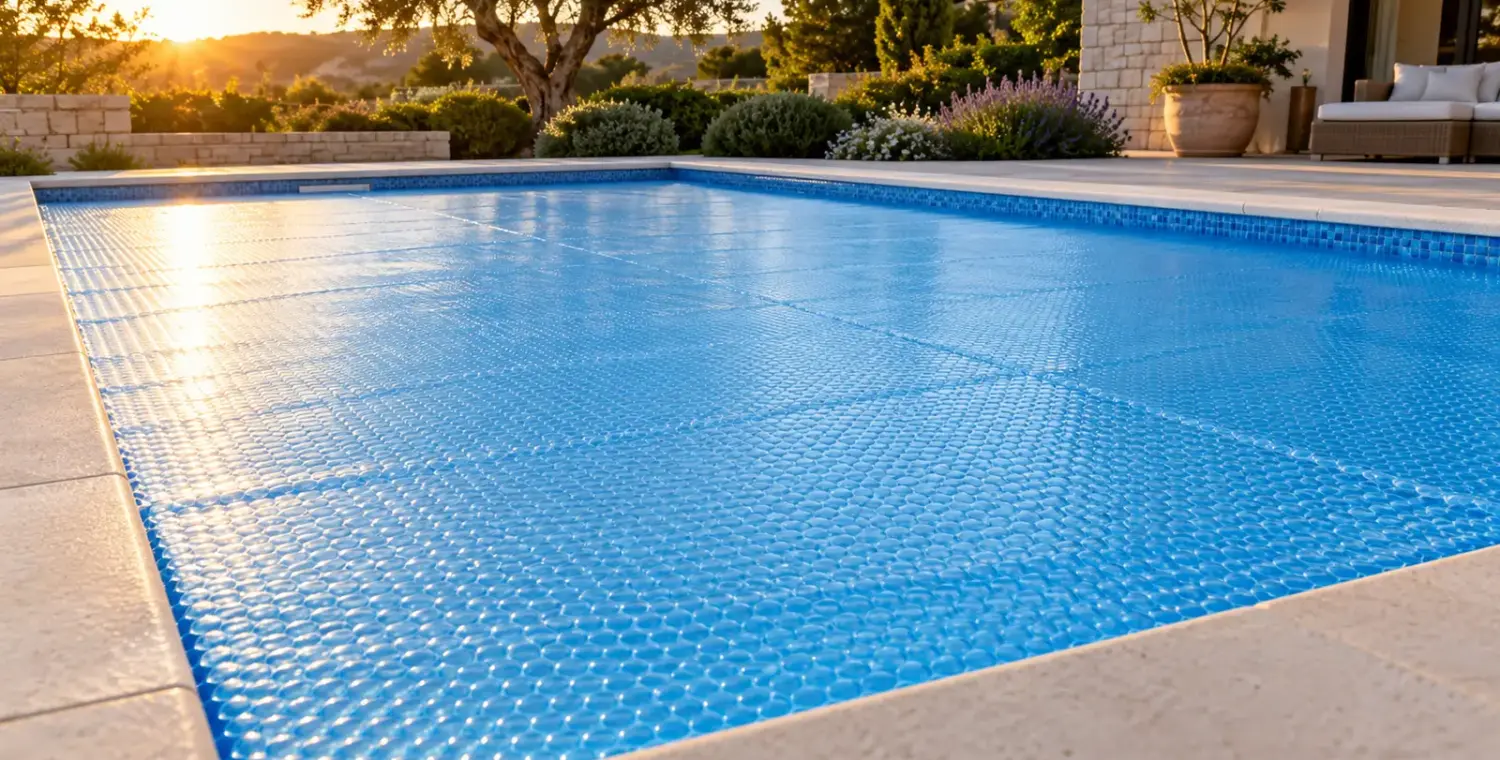
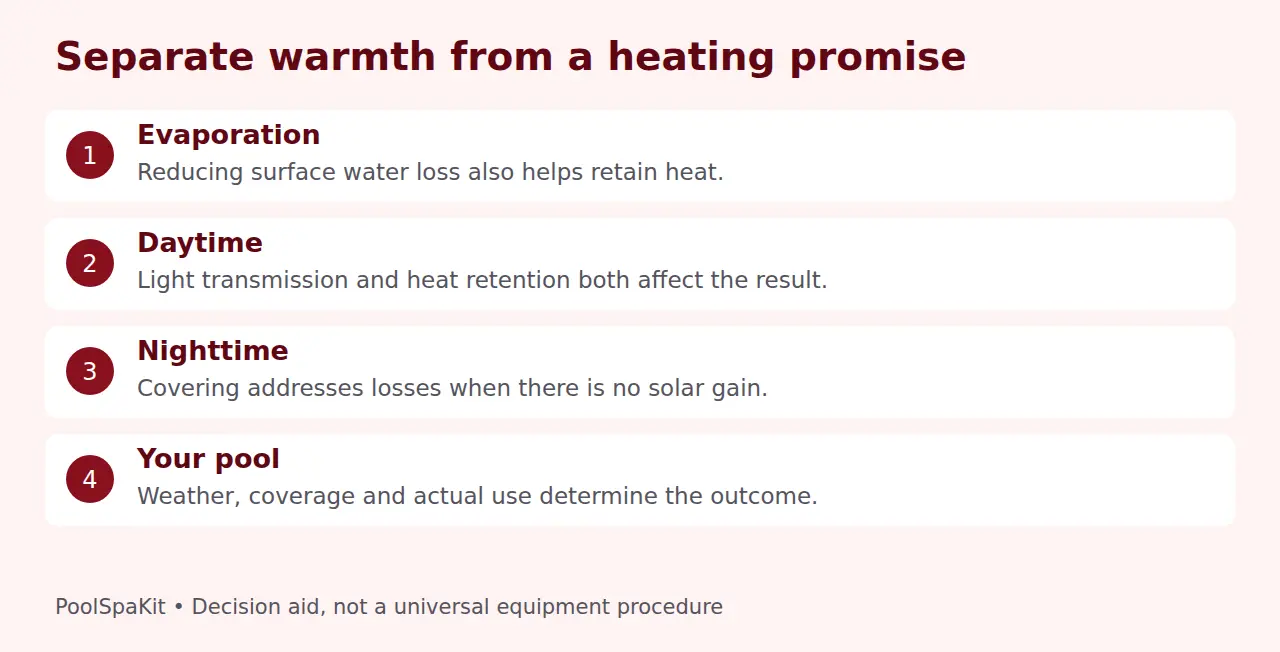
Yes, a suitable solar pool cover can help a pool stay warmer, especially by reducing evaporation and retaining heat already in the water. It is not a guaranteed way to raise every pool by a fixed number of degrees. The result depends on weather, sunlight, coverage and how consistently the blanket is used.
Think of it as a heat-management tool rather than a heater with a predictable output. Daytime warmth depends on heat entering and leaving the pool; overnight, a cover can help reduce losses when there is no solar gain. That distinction explains why owners in different locations report different results.
Why reducing evaporation helps retain warmth
Evaporation removes both water and heat from a pool. A physical cover reduces the exposed surface through which that loss occurs. EPA’s WaterSense guidance identifies covering as an evaporation-control measure, and DOE’s pool-energy guidance describes the related heat-retention benefit.
Retaining warmth is useful even when the blanket does not produce a dramatic rise during the day. A pool that loses less overnight may start the next morning closer to its evening temperature. That is a different outcome from heating cold water quickly before guests arrive.
A blanket does not eliminate every way heat can leave the pool. Nor does reduced top-up water prove a precise heating-cost saving. Keep those observations separate: water retention, temperature retention and purchased heating energy are related but different measurements.
Daytime heating is a balance of gains and losses
Sunlight can warm pool water, but a cover also changes the light reaching it. DOE explains that lower solar absorption may be offset by reduced heat loss. A 2020 primary research abstract likewise examines how a cover’s absorption and transmission properties affect solar heating efficiency.
That does not support a universal rule that every cover heats better on every sunny day, or that covers only help at night. The daytime result depends on the actual material and conditions. A marketing color name alone does not describe its light transmission or thermal performance.
When comparing products, ask what any heating claim measures. Is it temperature relative to an uncovered pool, change over several days, or retained heat overnight? What weather, starting temperature and coverage were used? If those conditions are unavailable, treat the figure as a limited product claim rather than your expected result.
Blue Wave’s product information includes an up-to temperature increase. This article does not repeat that as a homeowner forecast: it is not a controlled comparison for your pool. A result achieved under one set of conditions cannot establish a guaranteed change after a cloudy day or a short period of use.
Why overnight use is a practical place to start
At night, there is no incoming sunlight to trade against the cover’s light transmission. DOE’s physical explanation supports covering to reduce nighttime losses. Follow your blanket’s operating and safety instructions and remove it completely before anyone swims.
For your own routine, ask whether evening deployment and morning retrieval are realistic. If handling requires help, plan for that help. If you use the pool late, the available covered period may be shorter. These practical details matter when deciding whether a manual blanket suits the household.
Look at morning and evening temperatures rather than asking whether the blanket feels warm to a hand. Surface material temperature is not the same as the pool’s water temperature. Use a suitable thermometer through a safe sampling routine; do not lean across or enter a partially covered pool to take a reading.
A heater thermostat can also complicate observation. If a heater maintains its setpoint, the pool may show little temperature difference while heater operation changes. Do not turn that observation into a savings percentage without meaningful energy measurements and comparable conditions.
Weather, exposure and coverage set the limits
A pool with limited sun cannot gain the same solar input as one with long clear exposure. Wind, humidity and air temperature affect heat and evaporation behavior. DOE discusses these environmental differences; EPA also identifies wind control and surface coverage as relevant to evaporation management.
Walk through the site without changing safety barriers. Note when the house or trees shade the water, whether wind commonly crosses the pool and whether nearby landscaping deposits debris. That information helps set expectations and identify handling issues before a purchase.
Coverage matters. A blanket that leaves a large uncovered area does not perform the same job as a well-fitted cover across the intended surface. EPA’s published evaporation discussion explicitly qualifies solar-cover results by shape and coverage. Do not copy a percentage from a test and apply it to loosely spaced pieces.
Fit should follow the product instructions. Do not create unsafe attachment points, add improvised weights or assume a floating blanket should stretch across the deck like an anchored cover. Check the actual dimensions and shape before buying or trimming.
Heavy debris can make removal harder. Plan safe cleanup from the deck and follow the specified care process. A blanket with accumulated material is not a reason to climb onto it, and a torn or degraded cover should be assessed rather than patched into an imagined safety barrier.
Observe performance without pretending it is a laboratory test
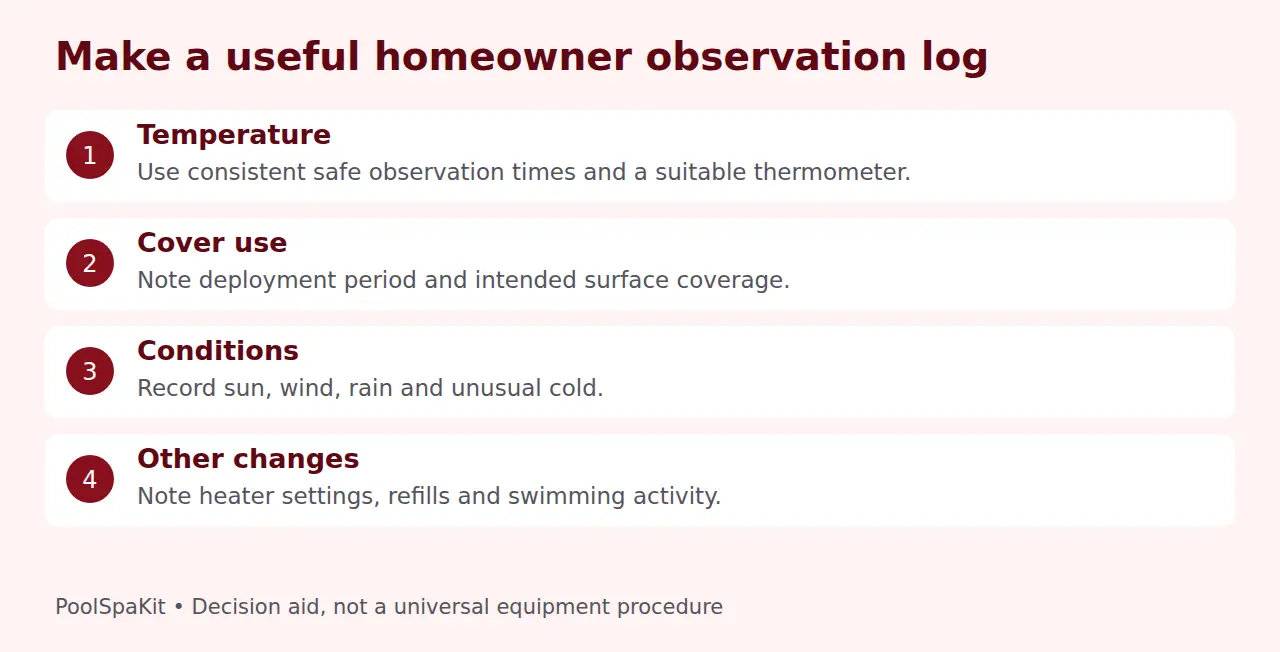
A simple log can show whether the blanket fits your routine and whether morning temperatures seem more useful. It cannot isolate the effect of the cover when weather, heater use and swimming activity are changing at the same time.
- Record the water temperature at consistent safe observation times.
- Note when the cover was on and whether coverage was complete.
- Record broad conditions such as sun, wind, rain and unusual cold.
- Note heater settings and any significant swimming or refill activity.
- Review several observations before making a purchasing or usage decision.
This is an editorial observation method, not a prescribed manufacturer interval or a claim of statistical accuracy. A warmer morning after a calm night may be encouraging, but it does not prove the cover caused the whole difference.
For cost decisions, use actual energy information where available and compare equivalent heating goals. Do not estimate a dollar saving from temperature alone. Equipment efficiency, local rates and operating conditions complicate the calculation. The article intentionally makes no payback or lifespan promise.
Choose a blanket you can use and care for
Read the removal and storage requirements before comparing thickness or warranty. Ask whether a compatible reel suits your pool shape, deck and storage space. Confirm that the setup allows complete removal without blocking the household’s safe access route.
The Blue Wave blanket instructions reviewed here specify shade or a protective opaque covering when the blanket is off the water, along with cleaning and dry storage. Follow the directions supplied with your product. A rolled-up blanket left in strong sun may have different exposure conditions from one floating on the pool.
Check temperature and chemical-exposure limits as product constraints, not water-care targets. If a cover’s chlorine limit conflicts with the sanitizer level your pool requires, remove or replace the incompatible cover; do not deliberately under-sanitize the water to preserve the blanket. CDC’s guidance keeps water testing and appropriate disinfectant care central.
Continue checking chlorine, pH and other relevant measurements. Our pool water testing guide explains what the readings mean. Cover use does not justify an automatic chemical dose reduction without testing and product guidance.
Know what a solar cover cannot do
It is not a safety cover or a substitute for fencing and supervision. The blanket’s instructions warn about drowning and entrapment and require complete removal before swimming. A partial opening is not an acceptable swimming arrangement.
It is also not automatically suitable for winter closure. The Blue Wave instructions specifically exclude winter-cover use. Consult the pool and cover manufacturers for seasonal protection and use the above-ground winterization guide for the broader process where relevant.
A solar blanket is different from a solar collector system, which heats water through separate equipment. If the blanket cannot meet the temperature goal, obtain model-specific advice about heating options. Leave gas, wiring and unsafe pressure-system work to qualified professionals.
If water level keeps dropping unexpectedly, investigate rather than assuming a larger blanket will solve it. Our evaporation-versus-leak guide addresses that separate diagnostic question.
Common questions
Will a thicker blanket always make the pool warmer?
Not established here. Thickness alone does not capture transmission, coverage, handling or the conditions behind a product claim. Compare documented properties and use requirements rather than promising a universal temperature ranking.
Should I leave it on during chemical treatment?
Follow the chemical label and cover’s instructions, including exposure and return-to-use limits. Keep the uncovered pool securely controlled while the blanket is out. Do not lower the required sanitizer level simply to meet a cover-material limit.
Can it warm a shaded pool?
It may help retain available heat, but shading limits solar input. Decide whether heat retention alone meets your goal; do not expect a cover to create sunshine or deliver a heater’s predictable output.
Research checked October 1, 2026. We only claim hands-on testing when we’ve actually tested the product ourselves.
Sources and references
- CPSC: Safety Barrier Guidelines for Residential Pools
- EPA: WaterSense at Work, Section 5.3: Commercial Pool and Spa Equipment
- Blue Wave: 12 Mil Solar Blanket: Installation and Use Instructions
- DOE / NREL: Conserving Energy and Heating Your Swimming Pools with Solar Energy, DOE/GO-102000-1077
- University of Glasgow / Solar Energy: Selective light transmission as a leading innovation for solar swimming pool covers
- Blue Wave: 12-mil Rectangular Solar Blanket product information
- CDC: Home Pool and Hot Tub Water Treatment and Testing