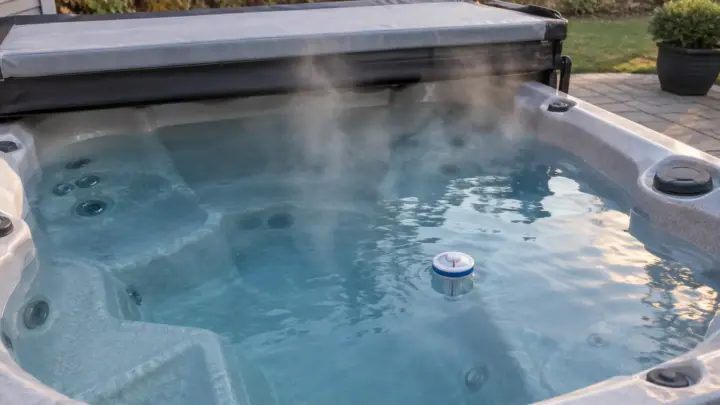
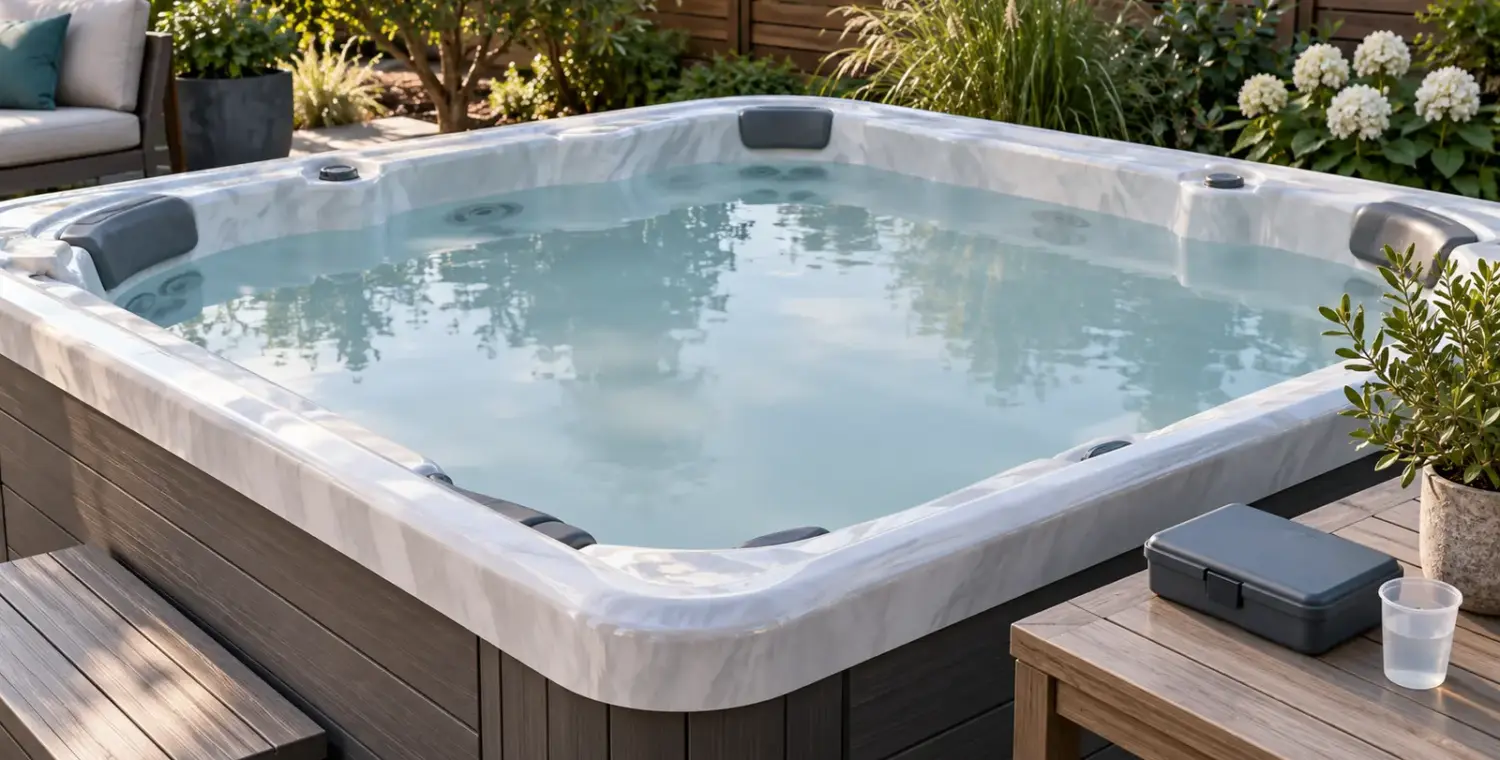
For cloudy hot tub water, pause soaking and check sanitizer, pH, alkalinity and normal filtration before choosing a treatment. Cloudiness can involve contamination, suspended particles, dirty filters, water balance or older water. The appearance alone does not identify which branch needs attention.
Use measurements and the spa’s approved care program to choose the fix, then retest. Water becoming clear is a useful observation, but it does not prove the spa is disinfected or ready for bathing.
Describe the problem before adding products
Record when the cloudiness started and what happened beforehand: a busy soaking session, refill, filter service, missed water care or chemical addition. Note whether the water is uniformly hazy, contains visible particles, has deposits, or also has foam or an unusual odor.
If it looks milky only while massage jets operate, record how its appearance changes after they stop. That is an observation to share, not a test that rules out contamination or confirms that bubbles are the only cause.
Keep the spa out of use while conditions are uncertain. Do not add clarifier, oxidizer and balance products together to see which works. Such a mixture obscures the original evidence and can conflict with labels or equipment instructions.
Test sanitizer and pH first
Use a kit appropriate for the actual sanitizer. A chlorine-treated spa needs a usable chlorine result; a bromine program needs the corresponding test and requirements. The bromine versus chlorine guide explains why these programs are not interchangeable.
CDC residential guidance recommends at least 3 ppm chlorine for hot tubs and pH 7.0–7.8. Treat those as US public-health references, not a dose or a complete operating specification. Labels, model instructions and applicable local requirements may add restrictions. If a verified chlorine result stays low, see what to check when hot tub chlorine is too low.
Record the current result before treatment. If it is outside the kit’s readable range, write that down rather than inventing a number. Use a fresh representative sample and the prescribed reagent order, timing and reading conditions.
Check suspicious results after treatment
High chlorine can bleach some DPD tests and cause a misleading low or zero result. Taylor also documents monopersulfate interference with certain total and combined chlorine measurements. These are reasons to verify the method when a result is unexpected, especially after recent treatment.
Do not keep adding chlorine to an unexplained zero or borrow a neutralizer recipe from another kit. Ask the test manufacturer for its exact procedure. The water testing guide covers method distinctions; use spa-specific operating requirements when interpreting the results.
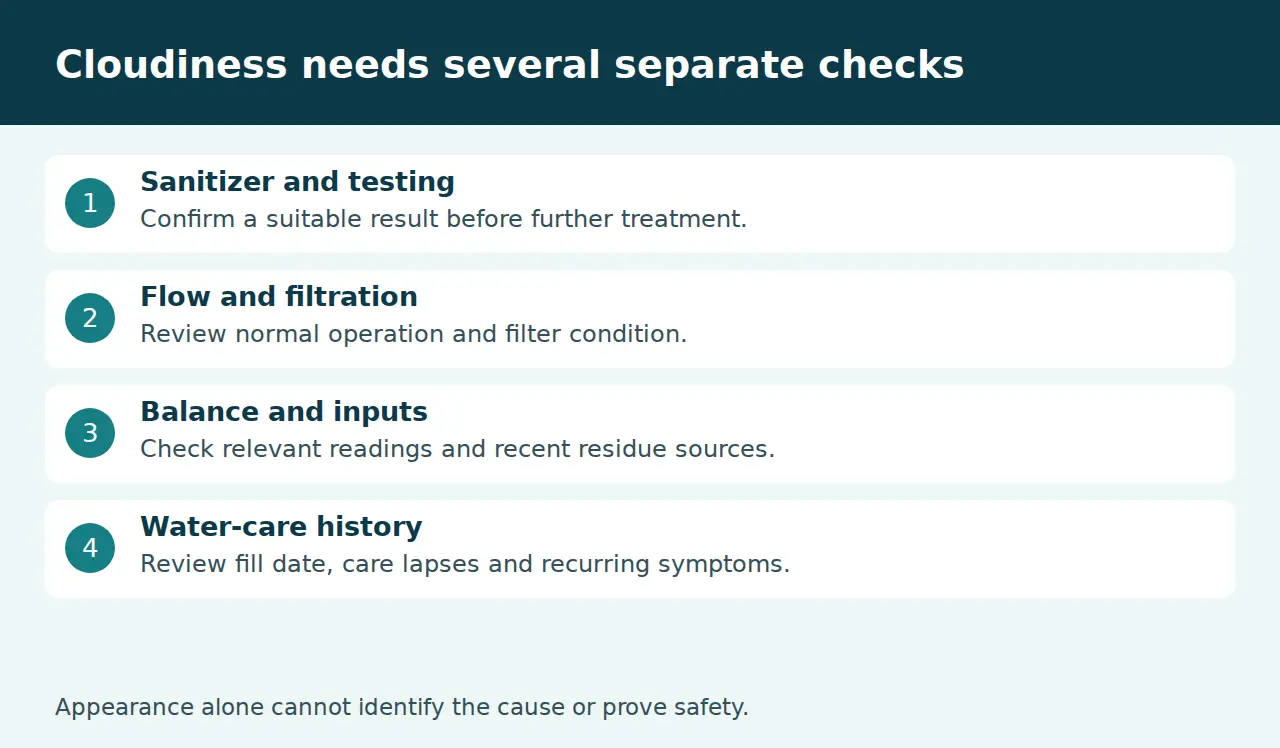
Use a diagnostic table rather than a treatment cocktail
| Branch to investigate | Evidence to collect | Supported next step |
|---|---|---|
| Sanitizer or contamination | Reliable residual, recent use and maintenance lapses | Approved corrective care and verified retesting; escalate serious concerns |
| Filtration or circulation | Filter condition, service history, normal flow and alarms | Model-directed cleaning or qualified equipment assessment |
| Water balance | pH, TA, calcium hardness and relevant source-water history | Correct the measured issue using the applicable instructions |
| Oils, soap or other inputs | Recent bathers, swimwear, lotions and cleaners | Stop the input and assess approved cleaning or replacement |
| Older or overused water | Fill date, care records and recurring symptoms | Review the manufacturer’s drain, clean and refill requirements |
| Recent product incompatibility | Exact products and current water-care system | Ask the supplier before further additions |
Hot Spring lists dirty filters, oils or organics, improper sanitation, suspended matter and older water in its cloudy-water troubleshooting guidance. Its possible remedies belong to the relevant cause and care program. They are not instructions to perform every treatment in the list.
Confirm the filter and circulation are doing their jobs
Check the filter’s maintenance history and inspect it through the access procedure permitted by your manual. A dirty cartridge can contribute to poor water clarity and impaired flow. Follow the spa’s shutdown instructions before removal.
Rinse or deep-clean only as directed for the actual filter, using an approved cleaner when required. Inspect for damage and follow replacement criteria. Do not install a similar-looking cartridge without confirming compatibility or operate without a required filter.
Check normal circulation separately from massage jets. The spa may have a dedicated circulation pump or a scheduled filtration program. Hearing a motor or seeing one set of jets work does not establish that all required circulation is present.
Record warnings and changes in operation. Persistent flow alarms or abnormal heating deserve model-specific support. Do not bypass a sensor, open electrical components or repeatedly reset a fault to keep the spa running.
A filter service is a maintenance action, not evidence that sanitizer or contamination problems have been resolved. After the prescribed restart, reassess both operation and water results.
Check balance without treating pH and alkalinity as synonyms
pH describes acidity or alkalinity; total alkalinity describes buffering capacity. A normal reading for one does not guarantee a normal reading for the other. Test both when balance or repeated pH drift is part of the investigation. Our guide to hot tub pH and alkalinity covers both readings.
Calcium hardness and temperature also matter to scale-forming conditions. Cloudiness accompanied by deposits needs a broader review than “lower pH until it looks better.” Use the ranges and sequence required for the spa and water-care system.
The Hot Spring manual discusses how balance parameters interact and affect equipment. It is an exact-model example, not a source of one universal TA or calcium target for every spa. A water-balance calculation does not establish microbiological safety.
Make only the corrections supported by the readings and applicable instructions. Observe the required circulation and retest affected parameters before another addition. Avoid alternating balancing chemicals without a clear record of what changed.
Review bather inputs and recent cleaning
Warm water, small volume and substantial use relative to that volume make hot tub care different from pool care. Taylor’s spa chemistry guidance explains this context. It does not mean a specific number of bathers will cloud every tub in a predictable time.
Look for oils, lotions, detergent residue on swimwear or a recently used cleaner. Reducing an ongoing input helps prevent recurrence; it does not remove the need for measured sanitizer care.
If persistent bubbles accompany the haze, use the hot tub foam guide. If an odor is also present, the odor troubleshooting guide helps distinguish water and cover observations. Neither smell nor visible foam identifies the chlorine result.
When water age and care history need attention
Review the last replacement date, frequency of use and any extended lapse in treatment or circulation. Manufacturer cloudy-water guidance includes older or overused water among possible causes, with drain, cleaning and refill as a possible response.
Ask whether that procedure is warranted when symptoms persist despite appropriate maintenance. Do not substitute topping up for the required replacement process or assume a new fill repairs an unresolved equipment fault.
Plan disposal and restart before draining, using local requirements and the exact manual. In freezing conditions, ordinary replacement and complete winterization are different tasks. The winter hot tub care guide explains the questions to resolve with the dealer.
Choose a supported treatment order
- Pause use and document the condition. Include recent inputs and treatment history.
- Obtain reliable water measurements. Check sanitizer and pH, then the other relevant balance parameters.
- Confirm normal equipment operation. Address unresolved flow or filter concerns through the permitted procedure.
- Choose the appropriate branch. Use the spa manual and product label for the measured problem rather than treating color or haze alone.
- Complete the prescribed follow-up. Allow the specified mixing and waiting periods, retest and observe whether the cloudiness is improving.
- Reassess recurrence. If the result is not satisfactory, obtain qualified advice on the remaining cause, cleaning or replacement.
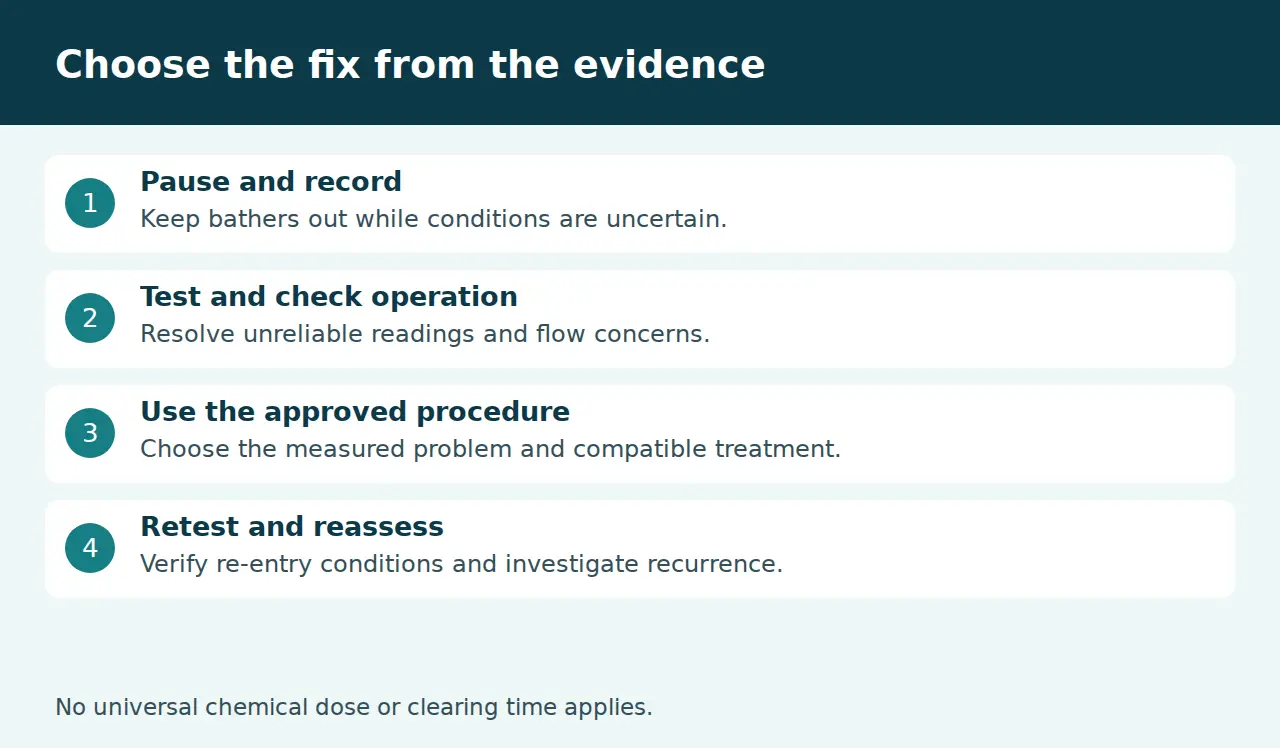
This is a planning sequence, not a universal chemical treatment order. Sanitizer and equipment problems may require coordinated correction. If instructions conflict or circulation is inadequate, ask the supplier before adding products that require normal flow.
Clarifiers and shock are not automatic fixes
Clarifier compatibility depends on the care program. For example, the Highlife manual restricts clarifier use in a particular silver-ion program. That does not establish that every clarifier is unsuitable, but it shows why a generic recommendation is unsafe.
Likewise, “shock” describes differing products and purposes. A non-chlorine oxidizer is not automatically a sanitizer substitute. Follow the approved program and exact label for handling, circulation and re-entry; this guide provides no universal dose or clearing deadline.
Verify before returning to the spa
Check that sanitizer and pH meet applicable requirements, required balance corrections are verified, circulation is normal and all treatment re-entry conditions are satisfied. Continue the prescribed testing routine, with extra checks for heavy use.
Clear water cannot prove disinfection. If sanitation remains uncertain or cloudiness recurs, keep the spa out of use and arrange further assessment rather than accepting appearance as the clearance rule.
When to get professional help
Seek qualified support for persistent cloudy water, unexplained readings, recurring equipment alarms or a significant maintenance lapse. Provide the model, test method, measurements, filter history, fill date and products used.
If illness or serious contamination is suspected, contact the appropriate health authority or qualified provider before routine draining or treatment. CDC’s Legionella toolkit describes sampling before remediation when directed by public health. Do not copy its operator hyperchlorination procedures into a home treatment recipe.
Research checked October 1, 2026. We only claim hands-on testing when we’ve actually tested the product ourselves. Featured image is an original illustration.
Sources and references
- CDC: Home Pool and Hot Tub Water Treatment and Testing
- Health Canada: Swimming pool and spa chemicals
- Taylor Technologies: Technical and Support FAQs
- CDC: Pool Chemical Safety
- Hot Spring / Watkins Wellness: 2025 Highlife Collection Owner Manual
- Taylor Technologies: The Unique Water Chemistry of Spas and Hot Tubs
- Taylor Technologies: Best Practices for Pool and Spa Water Testing
- CDC: Protecting Yourself from Legionella in Hot Tubs
- CDC: Controlling Legionella in Hot Tubs
- Hot Spring: Hot Tub Water Care and Troubleshooting