Regular testing is the core of hot tub water care. Hot water, small volume and several people sharing it mean sanitizer gets used up quickly. This guide covers what to test, which kind of test to use, how to get an accurate reading, and the target ranges published by health agencies and hot tub makers. Those ranges do not always match, so the differences are shown side by side.
The short answer
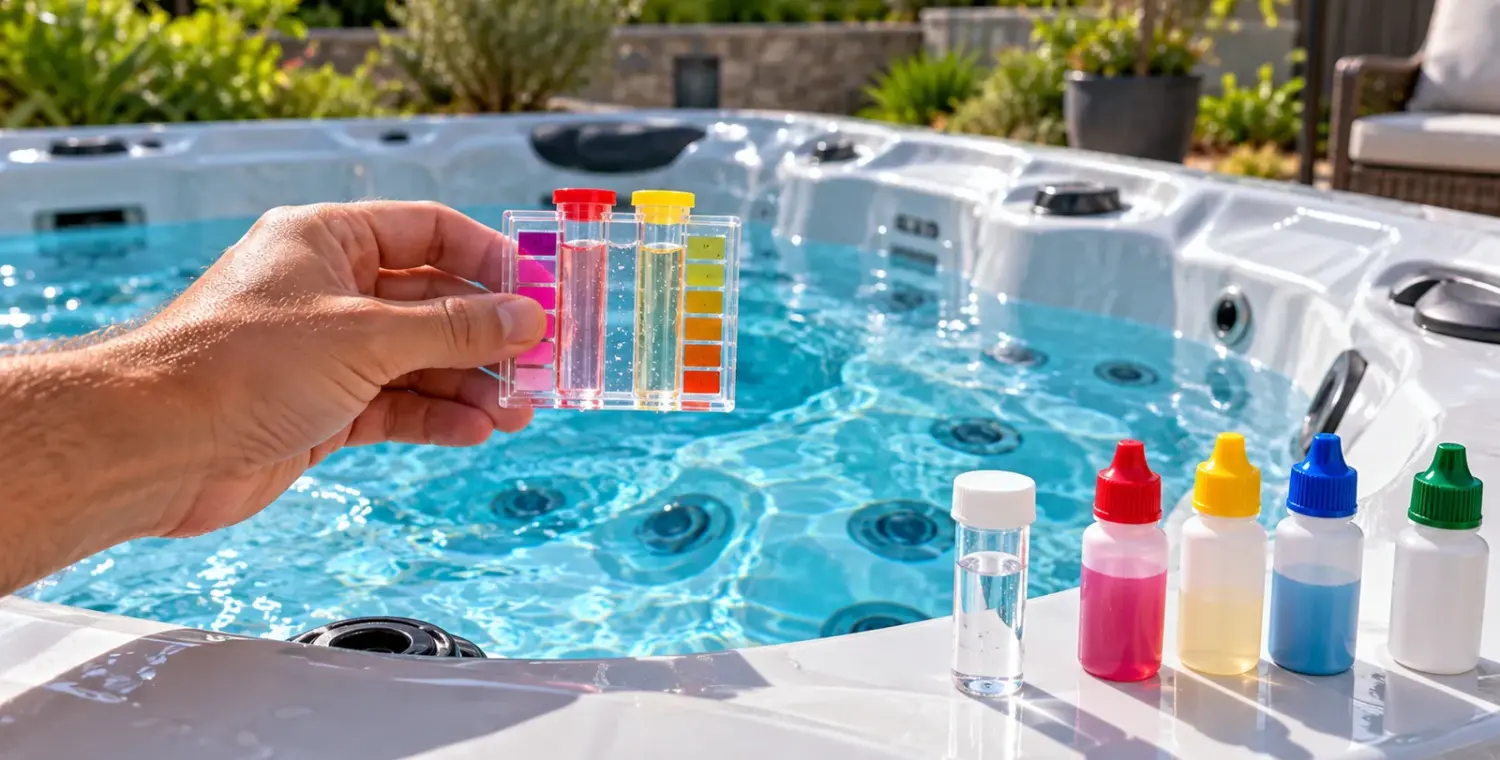
Test sanitizer (free chlorine or bromine) and pH most often. CDC recommends testing chlorine and pH at least twice per day, and more often with more users. Check total alkalinity and calcium hardness regularly too. Use a DPD liquid test kit for the most accurate results, follow the kit’s directions exactly, and compare results with the ranges in your hot tub manual.
Key takeaways
- Public health and manufacturer ranges differ. Use your spa manual and sanitizer label first.
- CDC says test strips are less accurate than a DPD test kit.
- Very high sanitizer can bleach a DPD test and read falsely low.
- Test before adding chemicals, and read results immediately unless the kit says otherwise.
What to test
- Sanitizer: free chlorine or bromine, whichever you use.
- pH: affects comfort, equipment and how well chlorine works.
- Total alkalinity: helps keep pH stable.
- Calcium hardness: too low or too high can affect equipment and surfaces.
- Optional: combined chlorine, and total dissolved solids if your guidance lists it.
Target ranges compared
| Test | CDC | Health Canada | Seattle & King County | Hudson Bay Spas (citing APSP) | Master Spas |
|---|---|---|---|---|---|
| Free chlorine | At least 3 ppm | 3-5 ppm | 3 ppm minimum; 3-6 ppm | 3.0 to 4.0 ppm | 2 – 4 ppm |
| Bromine | 4–8 ppm | 3-5 ppm | Not listed | 2.0 to 4.0 ppm | 3 – 5 ppm |
| pH | 7.0–7.8 | Not listed | 7.4 (approx.); 7.2 – 7.6 | 7.2 to 7.6 | 7.2 – 7.6 |
| Total alkalinity | Not listed | Not listed | 80-125 ppm (plaster & tile, wood); 125-150 ppm (vinyl, painted & fiberglass) | 80 to 120 ppm | 80 – 150 ppm |
| Calcium hardness | Not listed | Not listed | 150-200 ppm | 150 to 250 ppm | 180 – 250 ppm (table); 150 – 250 ppm (text) |
Evidence conflicts:
- Chlorine: CDC sets a 3 ppm minimum, but Master Spas lists 2 – 4 ppm, so its lower figure is below CDC’s minimum. Health Canada and King County go higher (5 and 6 ppm).
- Bromine: CDC lists 4–8 ppm for hot tubs, Health Canada and Master Spas list 3-5 ppm, and Hudson Bay Spas lists 2.0 to 4.0 ppm. These ranges differ, so follow the sanitizer label and your spa manufacturer’s guidance for your setup.
- Alkalinity and hardness: ranges vary by source and, in King County’s guide, by tub surface. Master Spas’ own guide gives two different calcium ranges.
Use your hot tub manual and your sanitizer product label as the primary reference. Where your manual is silent, the public health figures are a conservative reference for sanitizer.
Test kits vs strips
- DPD kits: CDC notes that test strips are less accurate than a DPD test kit. King County recommends a DPD kit with at least four functions: free chlorine, combined chlorine, pH and total alkalinity.
- OTO kits: King County notes that many orthotolidine (OTO) kits do not give accurate readings at hot tub temperature.
- Hardness: King County notes supplemental kits that measure water hardness are available, and suggests asking a retailer if one is recommended in your area.
- Reagent care: Taylor Technologies, a test kit maker, says reagents and strips have an expiration date, and should be stored out of direct sunlight, away from treatment chemicals and at a consistent temperature between 36°F–85°F (2°C–29°C).
Whatever you use, CDC says to always follow the manufacturer’s directions.
How to take a good sample
- Test before adding chemicals. King County says to test before adding tub chemicals to avoid false readings.
- Read promptly. Taylor says DPD readings should be taken immediately after testing unless the instructions say otherwise, because the color can change as the sample sits.
- Watch for bleach-out. CDC and Taylor both note that sanitizer above 10 ppm can bleach a DPD test and give a false low reading. Taylor suggests diluting the sample and retesting.
- Cloudy sample: Taylor says cloudiness in a test sample is typically caused by hardness over 500 ppm.
How often to test
CDC recommends testing chlorine and pH at least twice per day, and more often when a number of people are using the hot tub. King County notes that bather load and, for outdoor tubs, weather affect chemical balance. Alkalinity and hardness change more slowly, so many manuals suggest checking them less often. Follow your manual’s schedule for those.
Sanitizer: chlorine
Measure free chlorine, the chlorine available to kill germs. If you can also measure combined chlorine, a rising combined level suggests the water needs attention. If free chlorine is low, see hot tub chlorine too low.
Bromine
Many hot tubs use bromine instead of chlorine. King County notes that too much bromine can cause skin rashes, so measuring bromine matters too. Some DPD kits read bromine on a chlorine scale. Taylor says that to convert a bromine reading to chlorine, you divide the result by 2.25. Use a kit with a bromine scale or follow your kit’s conversion instructions. For choosing between the two, see bromine vs. chlorine for hot tubs.
pH
King County notes that both low and high pH cause skin and eye irritation, and that chlorine is much more effective in the 7.2-7.6 range. For adjusting pH, see hot tub pH and alkalinity.
Total alkalinity
Alkalinity buffers pH. Ranges in the table above differ between sources; follow your manual. Adjustments are covered in our pH and alkalinity guide.
Calcium hardness
Hudson Bay Spas notes that incorrect pH or calcium levels can lead to corrosion and scale on spa components. King County says that in soft water areas, hardness should be kept high enough to prevent copper pipe corrosion. If water turns cloudy, see hot tub cloudy water.
FAQ
Can I use my pool test kit for the hot tub?
Often yes, if it measures the right things and works at hot tub temperature. Check its instructions. Ranges for hot tubs differ from pools. Our pool water testing guide covers pools.
Why do different sources give different numbers?
They are written for different purposes and products. Health agencies focus on germ control, while manufacturers also consider their equipment and surfaces. Use your manual and product labels first.
Sources
- CDC: Home Pool and Hot Tub Water Treatment and Testing
- Health Canada: Swimming pool and spa chemicals
- Public Health – Seattle & King County: Staying Happy and Healthy in Your Spa & Hot Tub (6th ed.)
- Master Spas: Hot Tub Water Care & Basic Maintenance Guide
- Taylor Technologies: Technical and Support FAQs
- Hudson Bay Spas: Spa Owner’s Manual
Research checked October 1, 2026. We only claim hands-on testing when we’ve actually tested the product ourselves. Manufacturer guidance applies to the named products; follow the manuals and labels for your own equipment.